What Are Space Heaters? Types, Uses, and How They Work (Plus Safety Tips Before You Plug One In)
It is a frosty morning, the bedroom is a refrigerator and the furnace is warming up a house you are not occupying. That is when the majority of the population begins to wonder what space heaters are and whether they are worth the purchase.
Space heaters are an intelligent, inexpensive means of heating the area where you are actually. When not used properly, they also cause the most common home heating fires. This manual discusses their nature, functionality, the primary types, their prices, and safe usage.
Key takeaways
- A space heater does not heat an entire house, but only one room or zone.
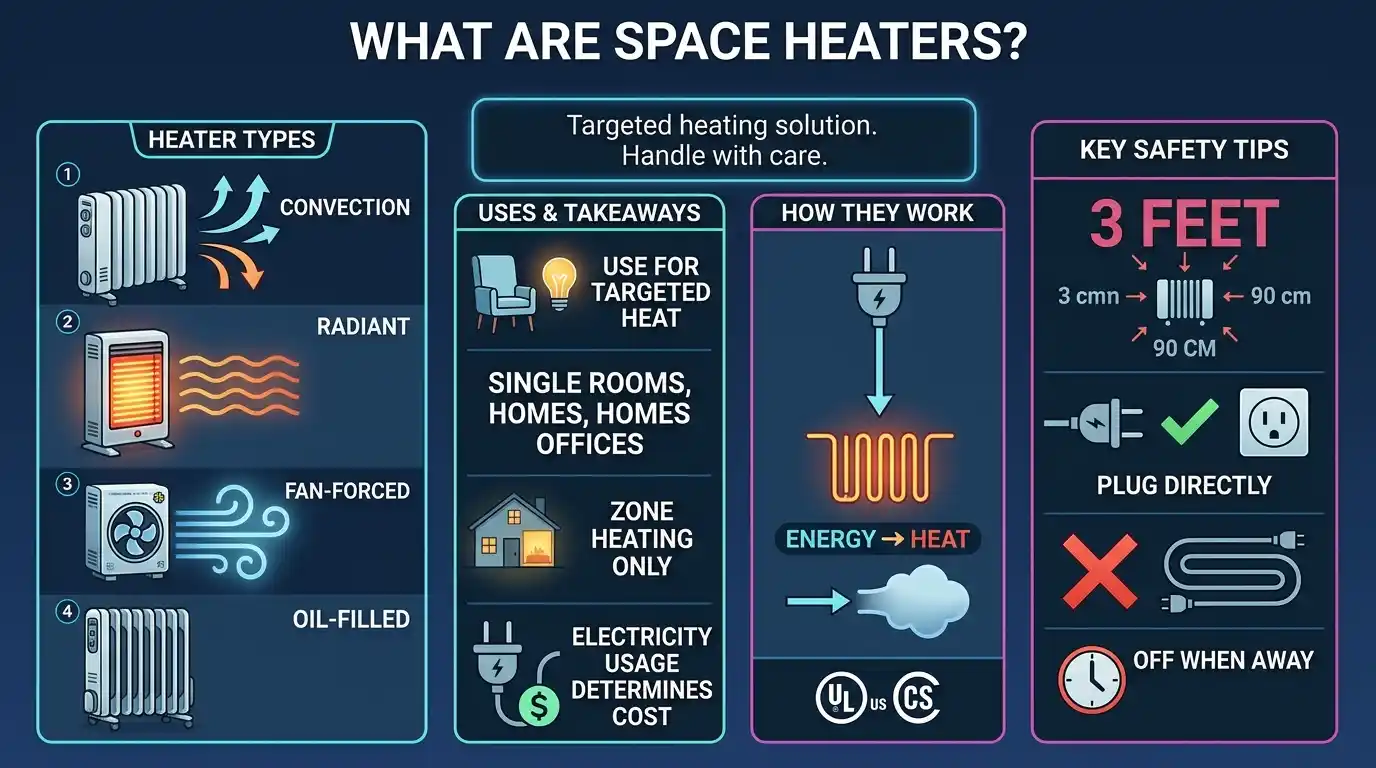
- The key ones are convection, radiant (infrared), fan-forced, and oil-filled, as well as fuel-burning ones.
- The majority of plug-in heaters have a maximum power of 1,500 watts due to household circuit breakers.
- Electric heaters convert almost all the power they consume into heat and therefore the actual cost is determined by the duration they are used.
- Always maintain a minimum of 3 feet clearance around any heater and never use an extension cord.
What Is a Space Heater?
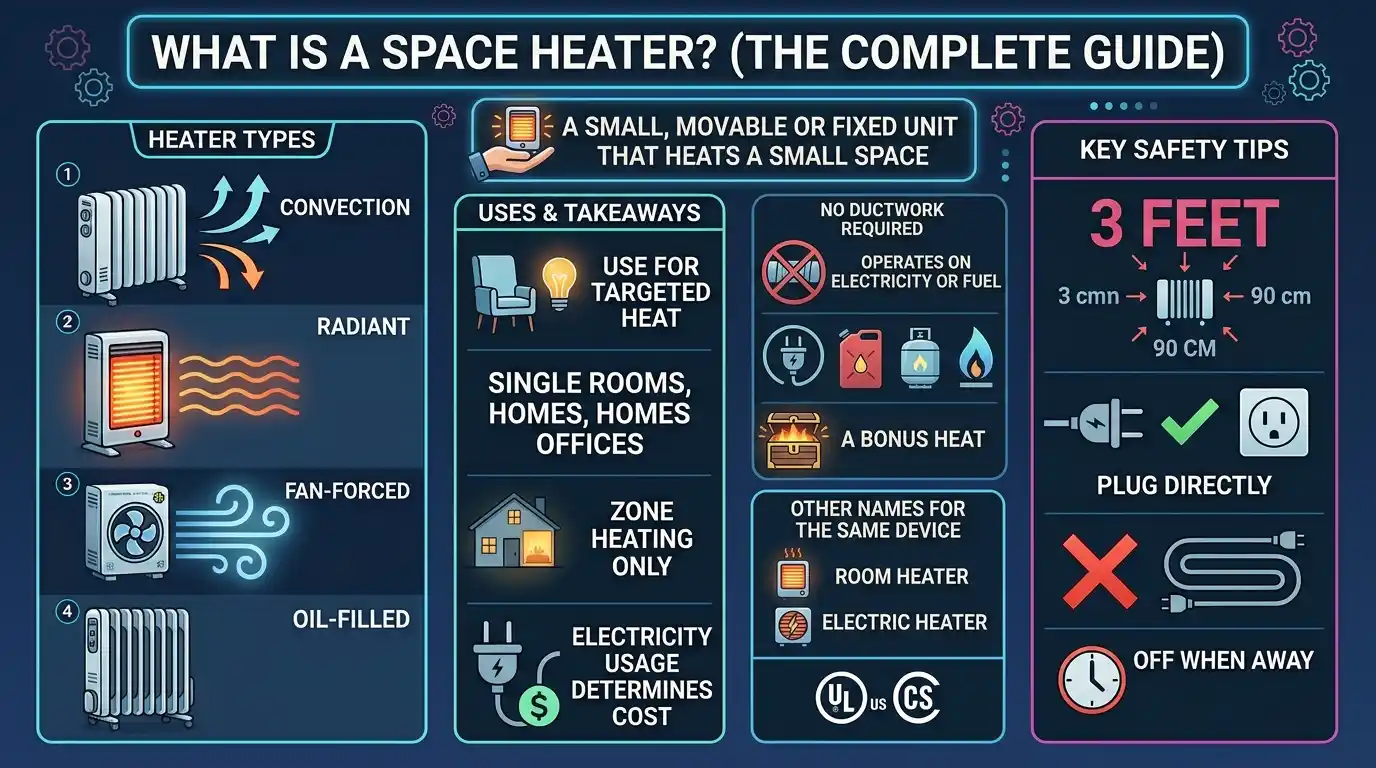
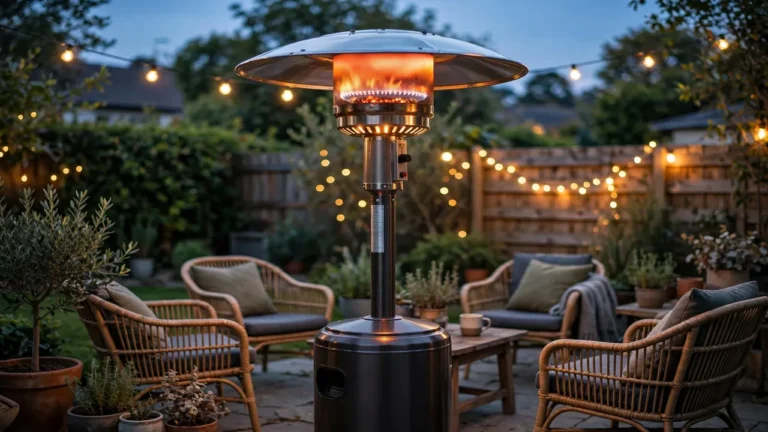
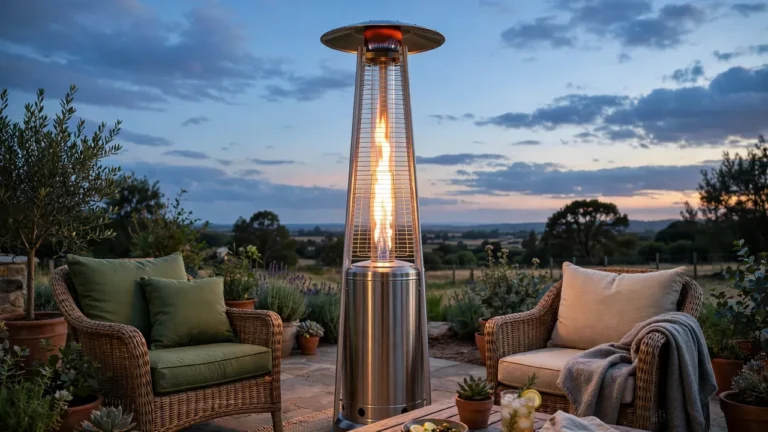
A space heater is a small, movable or fixed heating unit, which heats a small space, like a single room, a desk, or a workshop. It does not have ductwork, as a furnace does. It operates on electricity or fuel like kerosene, propane or natural gas.
Consider it as a bonus heat. It seals a hole left by your primary heating system, or allows you to warm one room as you turn down the thermostat in other rooms.
Other terms that you will come across are room heater, portable heater and electric heater. They are all directed to the same thought.
How Do Space Heaters Work?
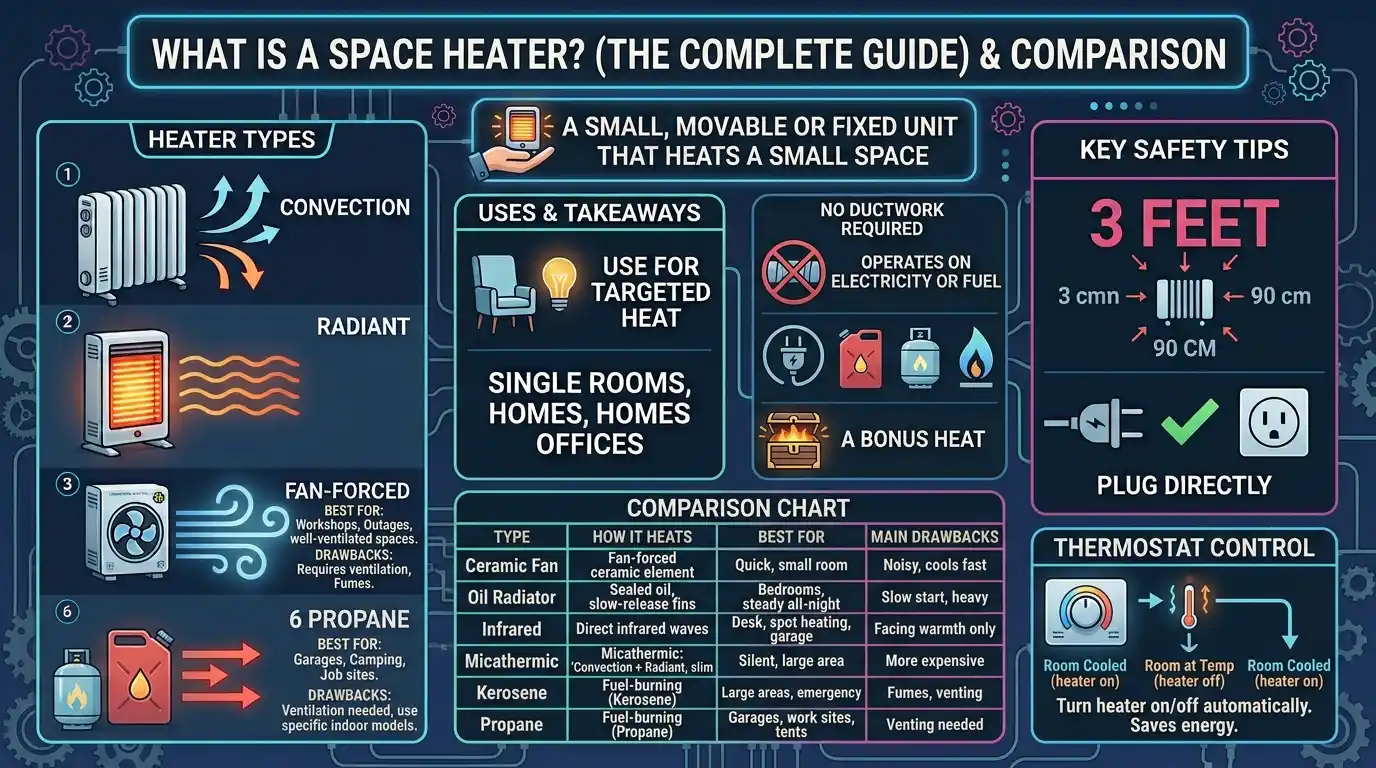
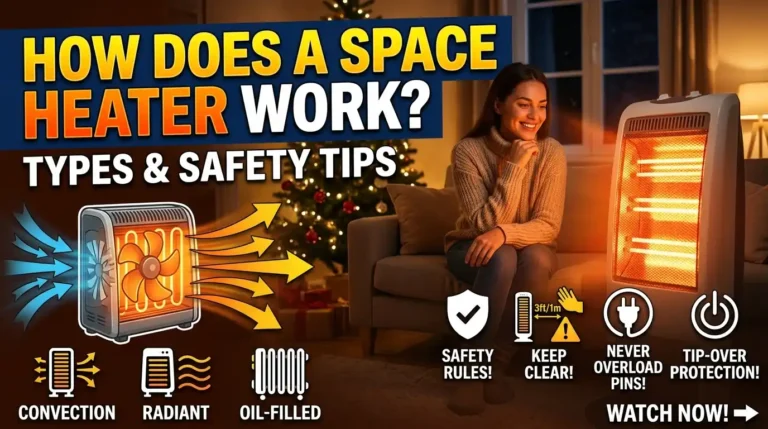
Each space heater produces heat, and transfers it into the room. Electric models drive current through a resistive element that heats up. Kerosene or propane are burned in fuel models. The heat is then passed on to you in two primary forms; through heating the air or heating objects and people directly.
For a deeper walkthrough, see our guide on how a space heater works.
Convection heating
Convection heaters heat the air surrounding the unit. The warm air ascends, the cooler air descends to replace it, and a cycle of circulation is formed. This evens out the room’s temperature but takes time.
Radiant (infrared) heating
Radiant heaters emit infrared rays that directly heat people and objects, similar to being in the sun. You get warm almost immediately, although the air may be cool. That makes them suitable to spend a short time in one place.
Fan-forced heating
A fan forces the air over a hot component and forces it into the room. It is rapid, but the heat is lost quickly when the device is turned off. The noisiest is typically fan heaters. To budget for one, see how much electricity a fan heater uses.
Thermostat control
A thermostat is found in most modern units. The heater is turned off when the room reaches your desired temperature and then turned on again as it cools. This is the reason why the actual running cost tends to be less than the full wattage indicates.
Types of Space Heaters
There are six common types you’ll see in stores. Here’s how they compare.
| Type | How it heats | Best for | Main drawbacks |
|---|---|---|---|
| Ceramic fan heater | Fan blows air over a ceramic element | Quick warmth in small rooms | Noisy, cools fast |
| Oil-filled radiator | Heated sealed oil warms metal fins | Bedrooms, steady all-night heat | Slow to warm up, heavy |
| Infrared (radiant) | Infrared waves warm people directly | Desks, garages, spot heating | Heats only what it faces |
| Micathermic panel | Mix of convection and radiant | Quiet, wall-hugging heat | Costs more than basic models |
| Kerosene heater | Burns kerosene | Outages, workshops, ventilated spaces | Fumes, strict ventilation needs |
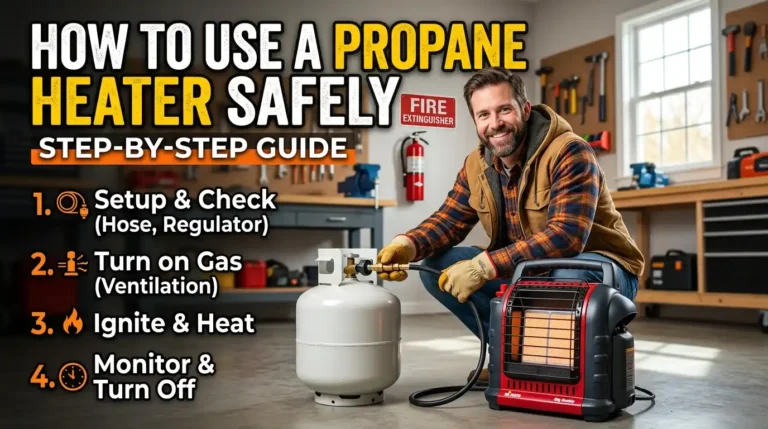
| Propane heater | Burns propane | Garages, job sites, camping | Needs ventilation and care |
Ceramic and fan heaters
These are the most common. They are rapid, inexpensive, and lightweight. If you want the full picture of how they differ from other styles, read are all space heaters the same.
Oil-filled radiators
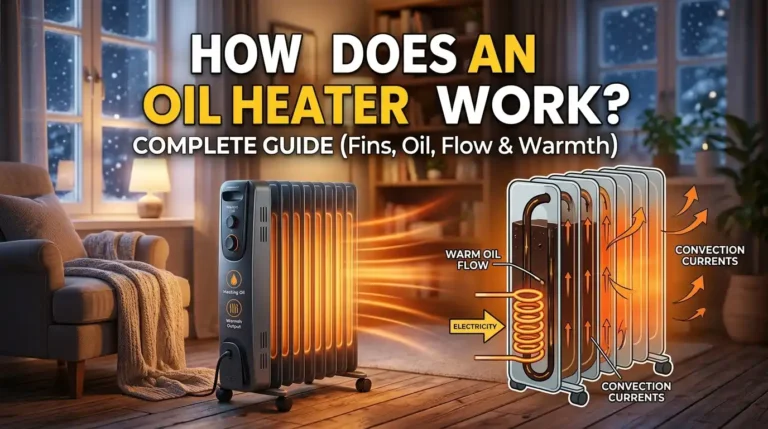
A sealed reservoir of diathermic oil is used in an oil-filled heater. The oil is never burned or used up. It merely stores heat and emits it gradually, therefore, the unit continues to emit heat once it has turned off. See what an oil-filled space heater is for the full breakdown.
Infrared heaters
These are your warm and not the room. They come in handy when you just require heat in a single location, like under a desk or in a corner of the garage.
Kerosene heaters
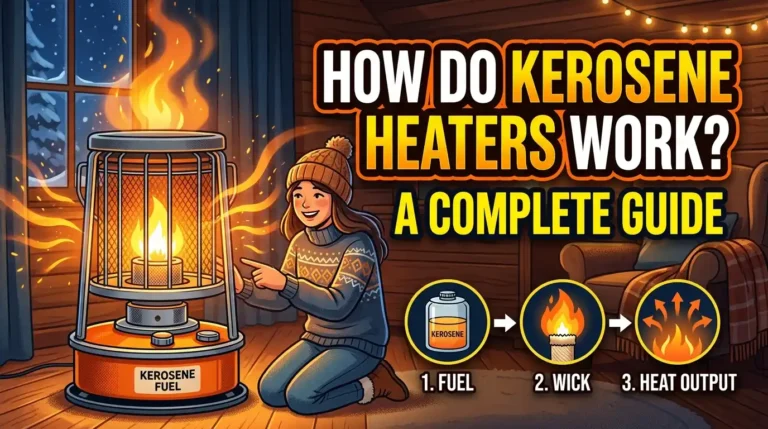
The kerosene heaters combust fuel, and generate combustion gasses, thus requiring fresh air to enter. Indoor use is limited in many cities and states, so verify local regulations before using. Learn the details in how kerosene heaters work and whether they’re safe indoors.
Propane heaters
Garages, tents, and job sites are popular with portable propane units. Use models that are marked to be used indoors, and obey the ventilation regulations of the manufacturer. Our guide on using a propane heater safely walks through setup.
What Are Space Heaters Used For?
Space heaters provide heating in the areas you need it, when you need it. Typical applications are warming a bedroom or home office, removing the chill in a bathroom, warming a garage or workshop, and making one room comfortable in the event of a power outage or furnace malfunction.
They are also used when your house is imbalanced in heat. An end-room duct may never get warm. A tiny heater would correct that, without lifting the entire thermostat.
How to Size a Space Heater
Another general guideline is approximately 10 watts per square foot in a room with average 8-foot ceilings and reasonable insulation. It’s an estimate, not a guarantee.
| Room size | Approximate watts needed |
|---|---|
| 100 sq ft | 1,000 W |
| 150 sq ft | 1,500 W |
| 300 sq ft | 3,000 W (needs more than one plug-in unit) |
A 1 watt heater has approximately 3.412 BTU per hour, which means that a 1,500 watt heater has about 5,100 BTU per hour. A cold climate, or a drafty room, will require more.
Why 1,500 watts? A typical 15 amp, 120 volt domestic circuit can safely carry approximately 1,800 watts and continuous loads must not exceed 80 percent of that. This is why almost all plug-in heaters in the U.S. have a cutoff point of 1,500 watts.
What Do Space Heaters Cost to Run?
The kilowatts of your electricity rate per hour times the cost of an electric space heater equals its cost. Example: 1.5 kW at 0.16/kWh will cost approximately 0.24/hour when operated continuously. Cycling of thermostats can reduce that.
| Usage | Approximate cost (1,500 W at $0.16/kWh) |
|---|---|
| 1 hour | $0.24 |
| 8 hours | $1.92 |
| 8 hours a day for 30 days | $57.60 (maximum, assuming constant running) |
Your rate will be different, and replace the number in your bill. Electric heaters convert almost all of the electricity they consume to heat, and as such, no electric style is essentially more efficient than another. It is the difference in the degree to which the heat is delivered to you and the length of the unit operation. For tips on lowering your bill, see which space heaters use the least electricity.
The space heaters are only economical when you heat a single room that is in use and you switch the main thermostat to the low setting. Operating them at the same time that the furnace is heating an empty house is not generally less expensive.
Are Space Heaters safe?
They can be, if you use them correctly. According to the National Fire Protection Association (NFPA) space heaters contribute to a significant portion of home heating fires and the majority of heating-related fire fatalities.
Get the current figures of NFPA. The majority of these fires are caused by heaters that are too close to flammable objects.
Safety checklist
- Purchase a heater that is approved by an accredited laboratory like UL.
- Find a tip-over switch and overheat protection.
- Minimum clearance of 3 feet around the curtains, bedding, furniture and paper.
- Plug directly into a wall outlet. Don’t use extension cords or power strips.
- It should be kept on a hard surface, not on a carpet or a bed.
- Do not leave it running when you are asleep, unless the model is made to do so, and you have operational smoke detectors.
- Turn it off when you leave the room.
- In the case of fuel-burning units, a carbon monoxide detector should be installed and properly ventilated.
How to Choose the Right Space Heater
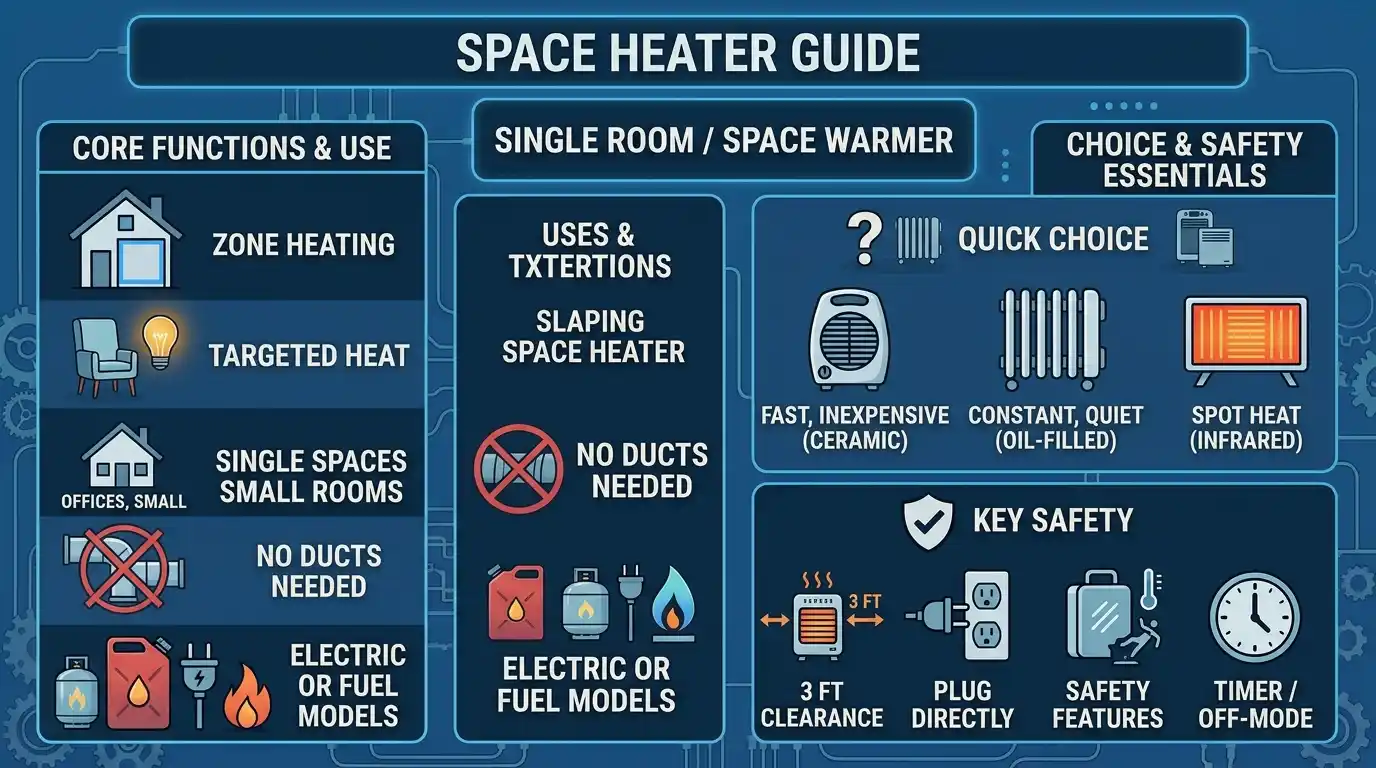
Begin with the location where you will be using it then select the type that fits the job.
- Measure the room. Follow the 10 watts per square foot guide.
- Pick the use. Constant warm temperatures during the night are appropriate with an oil-filled radiator. Instant spot heat infrareds. Quick, inexpensive heat befits ceramic.
- Check noise. Light sleepers can be bothered by fans.
- Find safety features. Tip-off shutoff, overheat protection and cool-touch case.
- Desire thermostat and timer. These reduce running time.
- Confirm the power. Plug-in models require a standard outlet. Types of fuels require storage and ventilation.
Not sure where to land? Our guide on the best type of space heater goes through this step by step.
Quick decision guide
- Bedroom or office, day-long heat: oil-filled radiator.
- Small room, quick heat: ceramic fan heater.
- A single individual sitting on a desk or in a garage: infrared heater.
- Outage or no power: a properly vented fuel heater, with a CO detector
- Large workshop: a fixed or fuel-fired unit of the size of the space.
Common Mistakes to Avoid
- Using an extension cord or a power strip.
- Putting heater on furniture or bedding.
- Having selected a model which was too small in the room.
- Leaving it on in a vacant room.
- Missing a carbon monoxide detector that has fuel heaters.
- Heater: a heater with a faulty cord or plug.
FAQs
What is a space heater simply put?
A space heater is a portable device that heats one room or small area using electricity or fuel instead of a whole-house system.
What is the use of a space heater?
The most common applications include heating bedrooms, offices, bathrooms, garages, and workshops, or heating when a furnace malfunctions or during a power outage.
How do space heaters work?
Electric ones conduct current through a resistive material that warms up and dissipates the heat either by air or radiation. Fuel models use kerosene or propane to heat.
What are the main types of space heaters?
Convection, radiant (infrared), fan-forced ceramic, oil-filled radiator, micathermic panel, and fuel-burning heaters like kerosene and propane.
Do space heaters cost a lot to operate?
A unit of 1,500 watts will cost approximately 0.24 an hour at 0.16 per kWh when operating continuously. Your price will be determined by your local rate and run time.
What is the size of the space heater that I require?
Calculate approximately 10 watts per square foot in a typical, insulated room. Climb higher when it is drafty or cold.
Is it safe to leave a space heater on overnight?
Should not be used unless the model is designed to do so and includes tip-off and overheat protection. The safety agencies recommend that heaters should be turned off before going to sleep.
Is it possible to use an extension cord to plug a space heater?
No. Heaters are high-current devices, and the majority of their cords can overheat. Use a wall outlet.
What is the proximity of a space heater to a wall or furniture?
Maintain a clear distance of at least 3 feet.
Which space heater is the most energy efficient?
All types of electricity are almost identical in converting power to heat, thus there is no more efficient type. The most suitable option is the one that fits the room, has a thermostat, and consumes less.
Do oil-filled heaters use less electricity?
No, at the same wattage. They turn off more often since they store heat, thus, it can decrease the real run time.
Does it allow me to use a kerosene or propane heater inside the house?
Models that are rated to be used indoors, with adequate ventilation and carbon monoxide detector. Before using a kerosene heater, check local regulations.
Are space heaters electric intensive?
One of the larger loads on a household circuit is a typical 1,500 watt model, similar to a hair dryer, but it is only expensive to run many hours.
Final Thoughts
A space heater is a basic device: it heats the place where you need it. The choice of the appropriate one depends on the room, the use, and safety features.
Measure your space, select a type that fits your intended use and use the 3 foot rule at all times. When properly used, a space heater makes you comfortable and can cut your bill. Misused, it is a fire hazard. Begin with the best type of space heater guide, look at your running cost and warm only the room you are in.