How Does an Electric Fireplace Work? Inside the Flame, Heat & Controls
You are staring at dancing flames behind glass, feeling real warmth on your face — yet nothing is burning. No logs, no gas line, no chimney. So how does an electric fireplace work? The short answer: it is three separate machines sharing one pretty box — a light show that fakes the fire, an electric heater that makes the warmth, and a small brain that runs both.
By the end of this guide you will know what each part does, how the flames trick your eyes, how the heat reaches your room, and why the whole thing plugs into a normal wall outlet. No engineering background needed. One note before we start: this is a look-but-don’t-touch tour — never open the housing while the unit is plugged in. Safety note: plug the fireplace directly into a grounded wall outlet (never an extension cord or power strip), keep the vents clear, and give the heater vents at least 3 feet of space from curtains and furniture.
- Outer shell & firebox — the cabinet that holds everything and gives the furniture look.
- LED flame lights — a strip of long-life LEDs; the “paint” for the flames.
- Rotating reflector rod — a small motor spins this mirrored rod so the light flickers like fire.
- Simulated log / ember bed — molded logs or crystals the light plays across for depth.
- Heating element — a metal coil (fan-forced models) or quartz tubes (infrared models) that turn electricity into heat.
- Blower fan — pulls room air over the coil and pushes warm air out the vents.
- Thermostat sensor — reads the room temperature for the control board.
- Control board — the brain; runs the lights, heater, fan, remote, and timer.
- Thermal cutoff — a safety switch that kills the heater if the inside gets too hot.
- Vents — cool air in at the bottom, warm air out at the top or front.

The Flame: Dancing Light, Not Fire
Most electric fireplaces fake fire with a strip of LED lights and a spinning rod covered in mirror-like surfaces. The LEDs shine onto the rod, and as the motor turns it, the reflected light dances across a screen behind the log set. Your eyes read the flicker as flames.
Color and brightness buttons change the mood — orange, blue, or mixed. Premium models use glowing water mist or projected flame video instead, which look even more real. For the full breakdown of each flame technology, see our guide on whether electric fireplaces have a real flame.
The Heat: Two Ways Your Room Gets Warm
The heater is a completely separate system from the flames, and it runs on its own switch. Most units warm a room one of two ways.
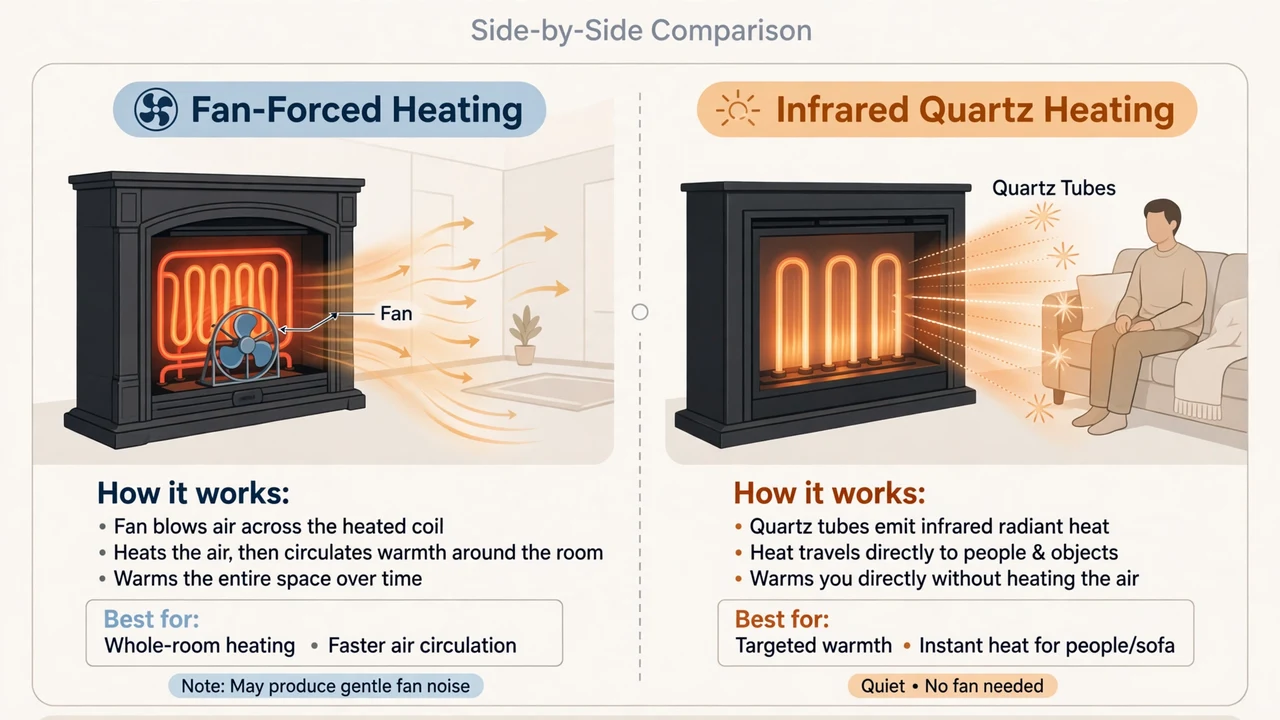
Fan-forced: a metal coil heats up like the element in a toaster. A small fan pulls cool room air over the hot coil and pushes the warmed air out through vents — the same idea as a space heater. This warms the room air itself, so the whole space heats up over time.
Infrared quartz: quartz tubes give off invisible infrared rays instead of heating air. The rays warm people, sofas, and floors directly — the way sunshine warms your skin on a cold day. There is no fan, so these models run quiet and barely change the room’s humidity.
Most plug-in models top out around 1,500 watts on a standard 120-volt outlet — about 5,100 BTU of heat per hour. Almost every watt becomes warmth, since nothing escapes up a chimney. Hardwired 240-volt models can reach up to about 9,000 BTU for bigger rooms. For exact output and room sizes, see our guide on how much heat electric fireplaces give off.
The Brain: How the Thermostat Runs the Show
A small sensor near the unit reads the room temperature around the clock. When you set a target — say 72°F — the control board compares the two numbers and decides what to do.
Room cooler than the target? A relay clicks and the heater switches on. That soft click many owners hear is the relay engaging, not a fault.
Room at target? The board cuts the heater and waits. This on-off cycle holds the room steady without you touching a thing.
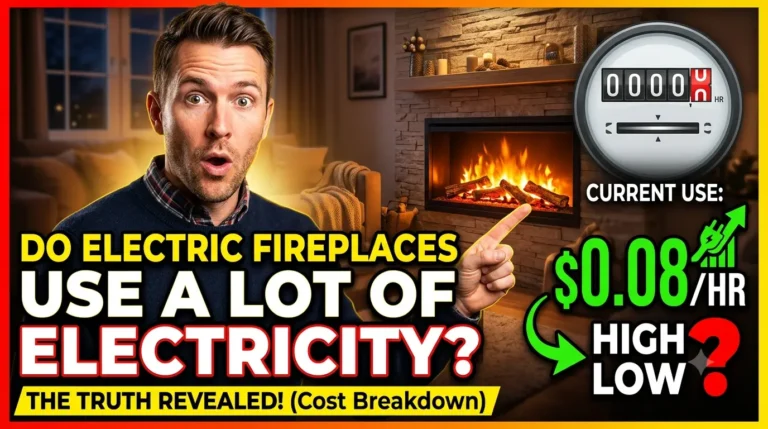
LOW and HIGH settings change how hard the heater works, and many units add timers, remotes, and app control. In flame-only mode the brain runs the light show alone — the LEDs sip so little power that the flames cost a fraction of a cent per hour to run.
Why There Is No Chimney, Smoke, or Vent
A real fire needs fuel, oxygen, and a way to dump smoke — that is what chimneys are for. An electric fireplace burns nothing, so it makes no smoke, no ash, and no carbon monoxide.
With no exhaust to vent, the unit only needs a standard wall outlet. That is why you can place one in a bedroom, an apartment, or against an inside wall with no construction. Our venting guide explains why electric fireplaces don’t need venting in more detail.
The Hidden Safety Crew
Three quiet parts watch over every heating cycle. A thermal cutoff switch kills power to the heater if the inside gets too hot — for example, if a blanket falls over the vents. Freestanding models add a tip-over switch that cuts power if the unit is knocked over. And the glass front stays cool to the touch, because the “flames” are only light.
The Full Picture: How Does an Electric Fireplace Work, Start to Finish
Here is everything above, in the order it actually happens when you press power. Watch how the three systems hand off to each other:
- You plug in and flip the main switch — the control board wakes up and waits for commands.
- You press the flame button — the LEDs light up and the reflector motor starts spinning, so dancing flames appear behind the glass.
- The thermostat reads the room and compares it with your target temperature.
- Room cooler than the target? The relay clicks and the heater switches on.
- The coil glows (or the quartz tubes warm up) and the fan pushes warm air out the vents — or infrared rays warm you directly.
- The room hits your target, the thermostat cuts the heater, and the cycle repeats. The flames can keep dancing the whole time.
| Myth: “The flames make the heat.” | Fact: The flames are light only and stay cool. Heat comes from a separate electric element you can run — or not — on its own. |
| Myth: “It pumps out carbon monoxide like a gas fireplace.” | Fact: Nothing burns inside, so no carbon monoxide is produced at all. That is also why no vent or chimney is needed. |
| Myth: “It will dry out the air in my room.” | Fact: Infrared models barely touch humidity since they don’t heat the air. Fan-forced models can reduce it slightly, but neither burns oxygen the way fuel heaters do. |
| Myth: “The glass gets as hot as a real fire.” | Fact: The flame display stays cool to the touch. Only the heater vents get hot while the heater runs — keep hands and fabrics away from those. |
Questions Beginners Always Ask
Does an electric fireplace need a chimney or vent?
No. Nothing burns inside, so there is no smoke or exhaust to vent. It plugs into a standard wall outlet and can go in almost any room.
Does the flame effect use much electricity?
Very little. The LED flame lights sip power — running the flames alone typically costs a fraction of a cent per hour. Almost all the electricity goes to the heater when it is on.
Can I run the flames without the heat?
Yes. On most models the flame effect and the heater are independent systems. Flame-only mode gives you the cozy look on a warm evening without warming the room a single degree.
Why does my electric fireplace click on and off by itself?
That is the thermostat doing its job. It switches the heater on when the room drops below your target and off when the room reaches it, holding a steady temperature.
Will an electric fireplace heat my whole house?
No. A standard plug-in model makes about 5,100 BTU — enough for one room as supplemental heat. It is designed for zone heating, not replacing your furnace.
Does an electric fireplace work during a power outage?
No. Everything inside — the flames, the heater, the controls — runs on electricity. When the power goes out, the whole unit stops until power returns.
Inside the box: LED strip, reflector rod + motor, log bed, heating element, fan, thermostat sensor, control board, thermal cutoff, vents
The cycle: plug in → flames on → thermostat checks room → heater clicks on → warm air out → target reached, heater rests
Remember: no chimney or vent needed · flame-only mode costs almost nothing · plug straight into the wall outlet
Now you can answer “how does an electric fireplace work” with confidence: light for the show, electricity for the warmth, and a thermostat keeping both in step. No chimney, no fuel, no ash — plug in, press power, and enjoy.
Curious what all this costs to run each evening? Our energy efficiency guide breaks down the real numbers.