Are Electric Fireplaces safe? Risks & Safety Precautions for You & Your Family
Quick Answer:
Are the electric fireplace safe? the sample answer is Yes; electric fireplaces are considered one of the safest means to warm a room. They do not use fuel, thus no burning fire, no carbon monoxide and no chimney to keep clean. The majority of fire-safety issues related to the so-called fireplaces are related to wood-burning and gas units, or incorrectly used portable space heaters, rather than to certified electric fireplaces used as intended.
The primary actual hazards are the same as any plug-in appliance: a frayed cord, an overloaded receptacle, or cloth too near the heating vent.With this said, safe is not risk-free and some details, such as overnight use, placement, and certification labels do matter. This is what the whole picture looks like.
Key Takeaways
- Electric fireplaces do not produce any actual flame, smoke, ash or carbon monoxide – the fire is a light effect, and the heat is generated by an independent electric heating system.
- The approximately 1 in 9 U.S. home fire reports to fire departments annually that involve heating equipment are not limited to electric fireplace units, but involve space heaters, wood stoves and fuel-burning fireplaces, 99 percent of such fires and fire-related deaths.
- Legitimate electric fireplace products are UL, ETL, or CSA certified, i.e., they have undergone an independent test of fire and shock hazards.
- Even a low-risk heat-producing appliance that is left unattended or unattended overnight is still not recommended by most fire departments and manufacturers.
- The largest daily risk is not the fireplace but rather plugging it into an extension cord or power strip, which may overheat.
How Electric Fireplaces Work and Why It Matters for Your Safety?
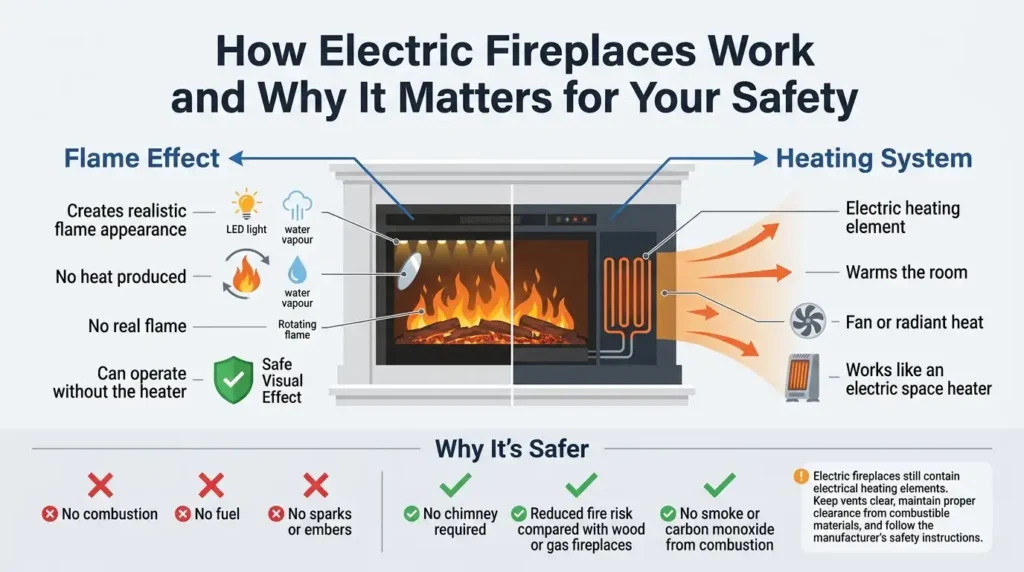
There are two distinct systems in an electric fireplace.
The flame effect: LED lights, rotating reflector, or a water-vapor mechanism produces the appearance of flickering flame. This section does not generate any heat and has no fire hazard whatsoever. It can generally be operated with the heater off.
The heater: an independent electric coil or infrared quartz heater, which works in the same manner as a space heater, warming the room either with a fan or radiant heat.
Since nothing is burning, there is no fuel, no burning, and nothing to light a fire or a spark. That fact alone is the reason why electric fireplaces are structurally safer than either wood-burning or gas fireplaces – the source of ignition that leads to the majority of fireplace related incidents is simply not there.
Do Electric Fireplaces pose a Fire Hazard?
It is the question to which most articles hint without actual information. This is actually what agencies on fire-safety are reporting. Here is a structured breakdown of the fire safety statistics from your text:
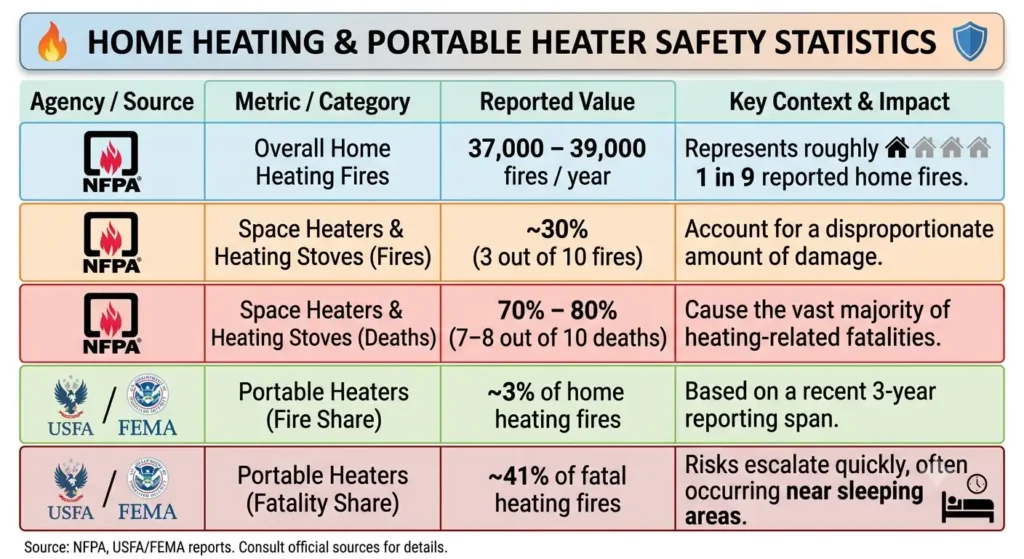
Home Heating & Portable Heater Safety Statistics
| Agency / Source | Metric / Category | Reported Value | Key Context & Impact |
| NFPA | Overall Home Heating Fires | 37,000 – 39,000 fires / year | Represents roughly 1 in 9 reported home fires |
| NFPA | Space Heaters & Heating Stoves (Fires) | ~30% (3 out of 10 fires) | Account for a disproportionate amount of damage |
| NFPA | Space Heaters & Heating Stoves (Deaths) | 70% – 80% (7–8 out of 10 deaths) | Cause the vast majority of heating-related fatalities |
| USFA / FEMA | Portable Heaters (Fire Share) | ~3% of home heating fires | Based on a recent 3-year reporting span |
| USFA / FEMA | Portable Heaters (Fatality Share) | ~41% of fatal heating fires | Risks escalate quickly, often occurring near sleeping areas |
Significant difference:
These figures are nearly all concerning portable space heaters and equipment that burns fuel (wood stoves, fireplaces, furnaces) – which combines combustion, exposed heating coils, and instability.
Electric fireplaces are not listed as a separate item in national fire databases but differ in three aspects that are safety-relevant: they are generally larger and more stable (wall-mounted, built into furniture, or installed), most are hardwired or dedicated circuits, and they must comply with the same product-safety certification that most space heaters must pass.
These reasons, precisely why manufacturers and retailers market electric fireplaces as the less hazardous end of the plug-in-heater range are the same reasons that lead to the engineering, though independent fire-incident statistics exclusively of electric fireplaces are not separately published.
Home Heating Fire Risk at a Glance
Here is a clean, easy-to-read comparison table based on your data, formatted to highlight the key safety distinctions across heating sources:
Electric fireplaces eliminate the two biggest heating hazards—open flames and carbon monoxide. Meanwhile, portable space heaters carry the highest fatality risk among heating equipment, making built-in electric options a significantly safer alternative.
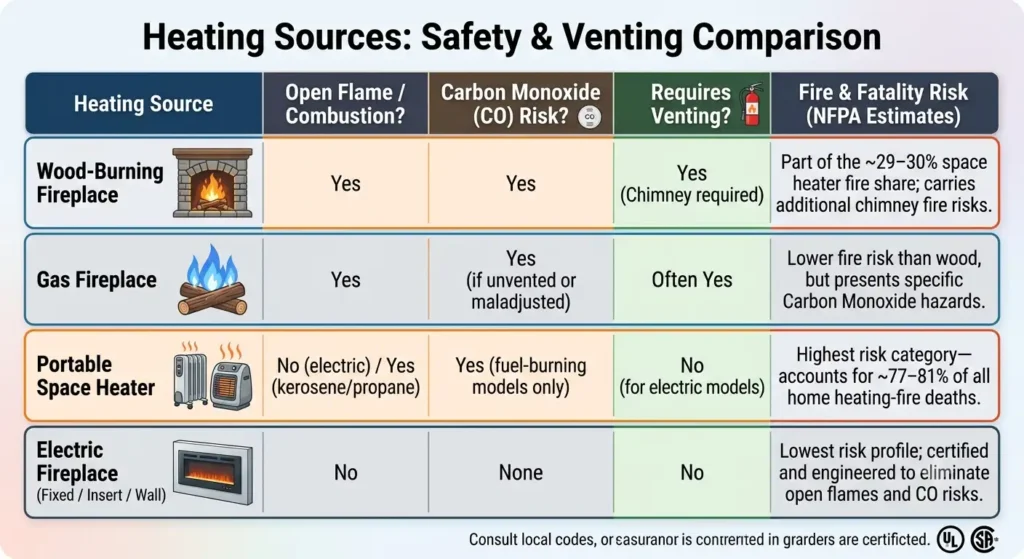
Heating Sources: Safety & Venting Comparison
| Heating Source | Open Flame / Combustion? | Carbon Monoxide (CO) Risk? | Requires Venting? | Fire & Fatality Risk (NFPA Estimates) |
| Wood-Burning Fireplace | Yes | Yes | Yes (Chimney required) | Part of the ~29–30% space heater fire share; carries additional chimney fire risks. |
| Gas Fireplace | Yes | Yes (if unvented or maladjusted) | Often Yes | Lower fire risk than wood, but presents specific Carbon Monoxide hazards. |
| Portable Space Heater | No (electric) / Yes (kerosene/propane) | Yes (fuel-burning models only) | No (for electric models) | Highest risk category—accounts for ~77–81% of all home heating-fire deaths. |
| Electric Fireplace (Fixed / Insert / Wall) | No | None | No | Lowest risk profile; certified and engineered to eliminate open flames and CO risks. |
Comparison of Electric, Gas & Wood Burning Fireplaces in Terms of Safety.
Here is a structured comparison table detailing the safety profiles of electric, gas, and wood-burning fireplaces:
Electric fireplaces eliminate every major structural and chemical hazard— open flames, creosote buildup, and carbon monoxide leaks—making them by far the safest option for households, children, pets, and rental properties.
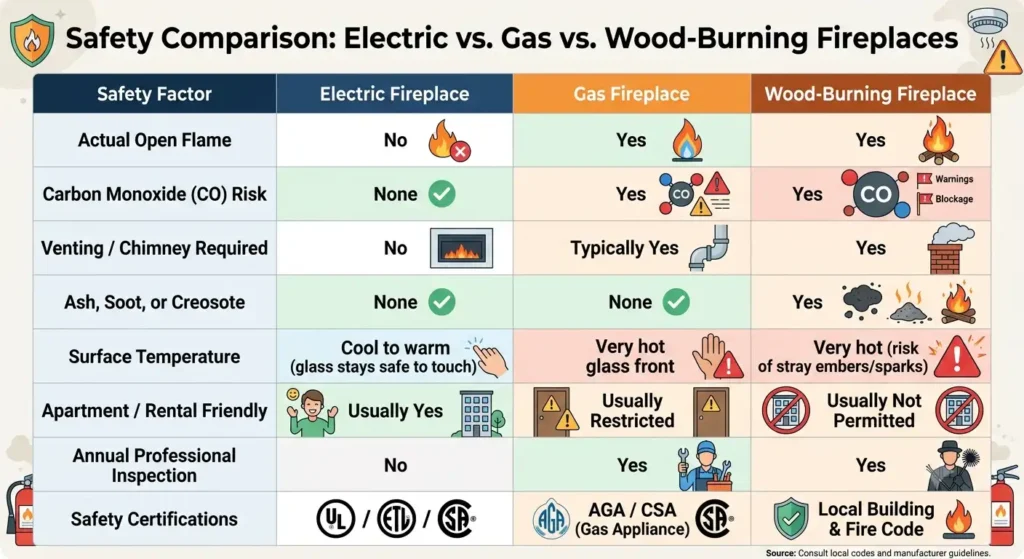
Safety Comparison: Electric vs. Gas vs. Wood-Burning Fireplaces
| Safety Factor | Electric Fireplace | Gas Fireplace | Wood-Burning Fireplace |
| Actual Open Flame | No (flame effect only) | Yes | Yes |
| Carbon Monoxide (CO) Risk | None | Yes, unless well-ventilated and maintained | Yes, especially if chimney is blocked or damaged |
| Venting / Chimney Required | No | Typically Yes | Yes |
| Ash, Soot, or Creosote | None | None | Yes (creosote is a primary cause of chimney fires) |
| Surface Temperature | Cool to warm (glass stays safe to touch) | Very hot glass front | Very hot (risk of stray embers/sparks) |
| Apartment / Rental Friendly | Usually Yes | Usually Restricted | Usually Not Permitted |
| Annual Professional Inspection | No | Yes | Yes |
| Safety Certifications | UL / ETL / CSA | AGA / CSA (Gas Appliance) | Local Building & Fire Code |
The Safety Features Built into Modern Electric Fireplaces
- Established manufacturers work in multi-layers protection. These are the features that you should look at when you are shopping:
- Overheat protection / thermal cutoff – automatically switches off the heater when the inside temperatures get too high.
- Cool-touch housing or glass – most of them are designed in such a way that the outside remains hot to the touch even during heating.
- Timers and auto shut-off – allows you to limit runtime, rather than use memory.
- Tip-over switches (portable/freestanding) – disables power when the unit is knocked over.
- Flame-only mode – allows you to operate the visual effect with the heater off, which can be used during warmer seasons or in the presence of curious kids.
- Remote or app control — allows you to turn off the unit without having to walk to the unit.
Can You Leave an Electric Fireplace on Overnight or Unattended?
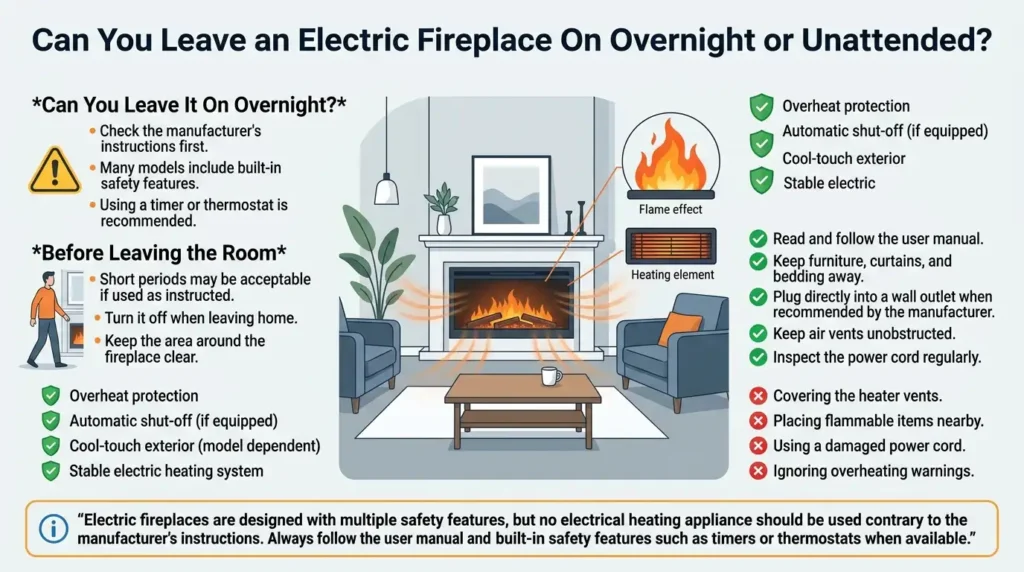
Other models are sold as safe to be used continuously due to their overheat safety and stable construction. Nonetheless, the majority of manufacturers and fire-safety agencies do not encourage the use of any heating appliance, including an electric fireplace, when you are asleep or not at home. The overheat protection minimizes risk- it does not negate the usefulness of human control. To achieve some ambiance in the night, the safest method is to use flame-only (heater on) mode.
Child & Pet Safety with Electric Fireplace
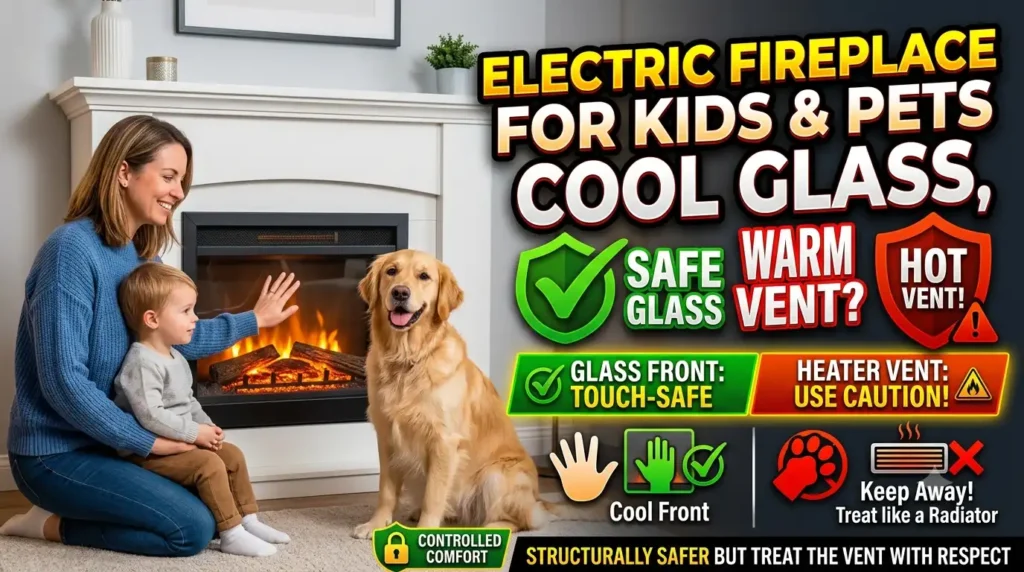
Generally, electric fireplaces are said to be among the superior choices of a fireplace in a home where children or pets live, largely because there is no exposed flame, spark or ember to be touched by a curious hand or paw. However, the heating vent and right in front of it can become hot to an uncomfortable level and as such, it would be worthwhile to treat the vent zone like you would a space heater or radiator, not a toy-safe area.
Placement and Electrical Safety Checklist
- Plug directly into the wall socket- never an extension power strip or power outlet, which can become hot with continuous use.
- Stay at least a few inches away walls and at least three feet away curtains, furniture, bedding, and other flammable materials.
- Make sure it is on a flat and firm surface, or wall-mounted/built-in units are installed according to the manufacturer instructions.
- Do not cover the heat vent with rugs, furniture, decor.
- Periodically check the cord and plug to ascertain fraying, discoloration or heat damage.
- When not in use, unplug it (or turn off at the breaker when hardwired) when it is not going to be used over an extended period.
- Unless it is rated to be used in a high-humidity or standing water environment, keep it off.
- Find a UL, ETL or CSA mark when purchasing – these marks show independent safety testing, rather than a claim of a manufacturer.
What Do UL, ETL, and CSA Certifications Actually Mean?
Instead of being merely a manufacturer-tested product as many companies claim, these marks indicate that a product has been tested by an independent accredited testing laboratory against accepted electrical-safety standards, such as fire-resistance, shock hazards, and overheat behavior. The certified unit is not guaranteed to be safe in all situations but has met a considerable, independent hurdle on its way to your living room. When a fireplace that you are looking at does not have any of these marks, this should be a red flag.
Myth vs. Fact
Most myths around electric fireplaces stem from confusing them with real flame appliances or cheap portable space heaters. Built-in electric fireplaces eliminate traditional fuel hazards (smoke, CO, open flame) while offering safer, fixed electrical setups.
Here is a clear, polished Myth vs. Fact table based on your data:
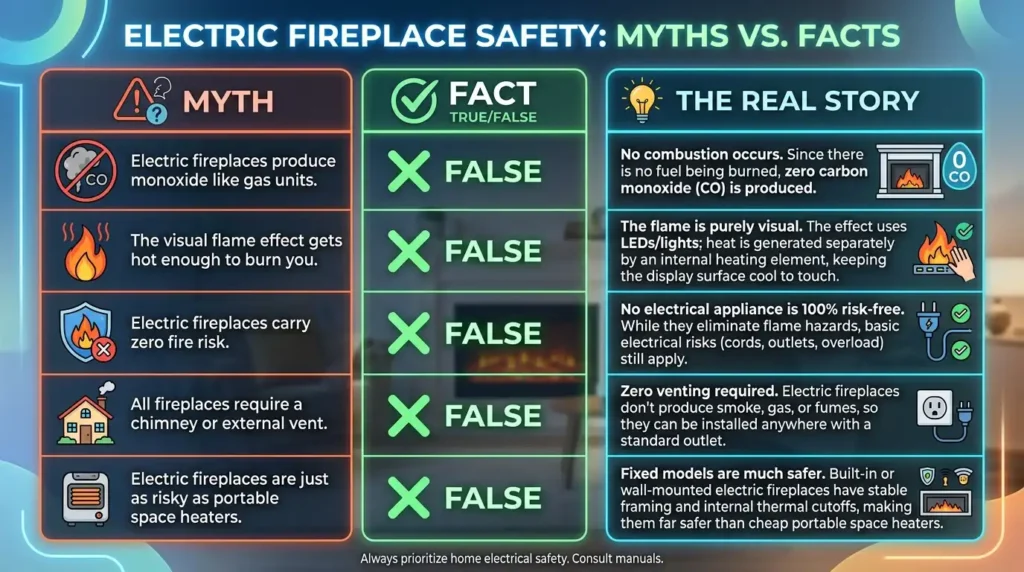
Electric Fireplace Safety: Myths vs. Facts
| Myth | Fact | The Real Story |
| “Electric fireplaces produce carbon monoxide like gas units.” | FALSE | No combustion occurs. Since there is no fuel being burned, zero carbon monoxide (CO) is produced. |
| “The visual flame effect gets hot enough to burn you.” | FALSE | The flame is purely visual. The effect uses LEDs/lights; heat is generated separately by an internal heating element, keeping the display surface cool to touch. |
| “Electric fireplaces carry zero fire risk.” | FALSE | No electrical appliance is 100% risk-free. While they eliminate flame hazards, basic electrical risks (cords, outlets, overload) still apply. |
| “All fireplaces require a chimney or external vent.” | FALSE | Zero venting required. Electric fireplaces don’t produce smoke, gas, or fumes, so they can be installed anywhere with a standard outlet. |
| “Electric fireplaces are just as risky as portable space heaters.” | FALSE | Fixed models are much safer. Built-in or wall-mounted electric fireplaces have stable framing and internal thermal cutoffs, making them far safer than cheap portable space heaters. |
You May also Like to Read
Frequently Asked Questions
Can electric fireplaces be left overnight unattended?
t is not recommended by most manufacturers, although inbuilt overheat protection reduces the risk. Overnight, with flame only mode, the question is evaded.
Do electric fireplaces lead to a house fire?
It can happen, but it is not common, and is nearly always related to a faulty cord, or an extension cord, or flammable material that is too near the vent – not to the appliance itself.
Are gas fireplaces safer or electric fireplaces safer?
Yes, mostly, as it does not involve any combustion, and therefore, there is no carbon monoxide hazard, no venting or chimney to preserve and maintain.
Are electric fireplaces which are mounted on the wall safe?
Yes, provided that it is mounted according to the instructions of the manufacturer on a wall of the building that is stable and free of any flammable substances.
Do electric fireplaces emit carbon monoxide?
No. Without combustion, there’s no CO produced.
Can electric fireplaces be used in small apartments or rentals?
Yes – since they do not require venting or a chimney, they are one of the few types of fireplace many rental leases and building codes permit.
Can electric fireplaces be used in bedrooms?
Yes, usually, with the same precautions as any heater: make sure there is no bedding around, no extension cords, and be sure to turn the heater off before bed.
Are electric fireplaces required to have a chimney or venting outside?
No.
Are pets safe around electric fireplace?
Yes, more than the open-flame ones, but the heating vent can get hot and is worth clearing.
Is it okay to leave an electric fireplace running?
The majority are made to be used during the day and then the overheat protection is turned on, although it is still a good practice to check on it every now and then and never leave it running when no one is at home.
My Final Thoughts
Are Electric Fireplaces safe? The sample answer is YES.
Electric fireplaces sit at the safe end of the home-heating spectrum no flame, no fuel, no carbon monoxide, and (on certified models) multiple layers of built-in protection. The fire-risk statistics that circulate online almost always trace back to portable space heaters and fuel-burning fireplaces, not electric ones.
Used the way any plug-in appliance should be used plugged directly into the wall, kept clear of flammable material, and not run unattended overnight an electric fireplace is one of the lower-risk ways to add heat and ambiance to a room.