Electric Fireplace Breaker Requirements? The Calculated Chart (120 V and 240 V).
Electric Fireplace Breaker Requirements? The Calculated Chart (120 V and 240 V)
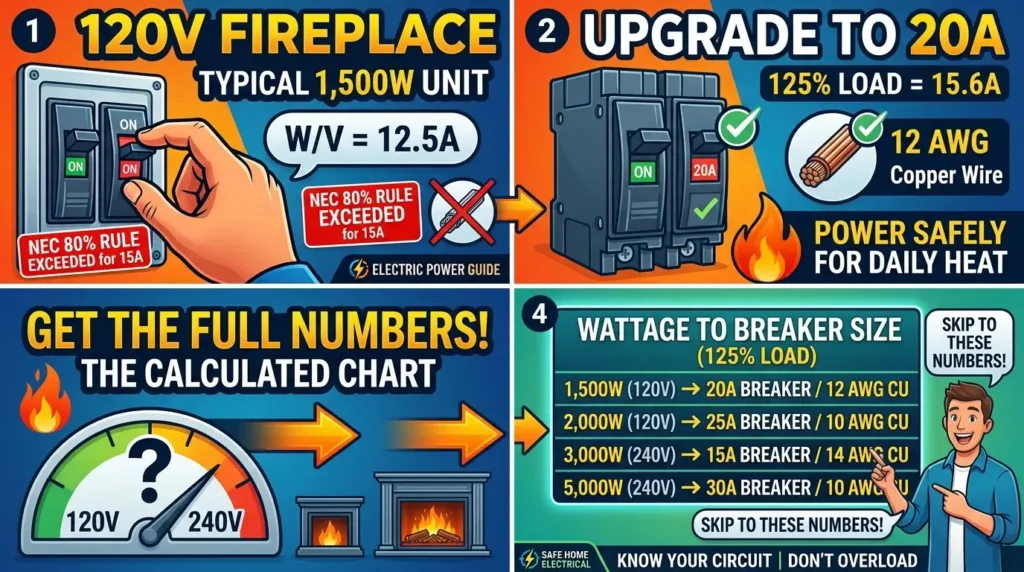
Electric Fireplace Breaker Requirements? Short answer: On a 120 V circuit, a typical 1,500-watt electric fireplace will consume 12.5 amps. Since this is a continuous load, the National Electrical Code size that circuit at 125% of that draw – 15.6 amps. That makes it exceed the maximum current that a 15-amp breaker can be legally loaded with and the reason most electricians suggest a special 20-amp breaker with 12 AWG copper wiring to any electric fireplace you are going to operate as a real heat source.
To get the numbers all at once, skip to the [calculated chart] (watts to breaker size). When you wish to know the reasons why those numbers are what they are, read on–the reasons being the things which prevent your having a breaker which opens every winter night, or still worse a wire which gets hot in your wall.
Key Takeaways
- 1,500W electric fireplace loads 12.5 amps at 120 V – that is the figure that any given breaker decision begins with.
- The NEC rule of 125 percent continuous load causes that 12.5A to be a minimum of 15.6A, making a 15-amp circuit technically undersized.
The typical, code-compliant installation of a full-time 1,500W fireplace is – 20A breaker + 12A WG copper wire. - Hardwired and built-in fireplaces must have a dedicated circuit, even though plug-in units are not legally required to have one, the math greatly prefers it.
- 240 V built-in (2,500W -6,000W) units should be calculated separately – do not use the 120 V figures.
Breaker size and wire gauge are one-to-one. The most frequent, and the most hazardous, error that homeowners make is to mismatch them.
What Size Breaker Does an Electric Fireplace Need?
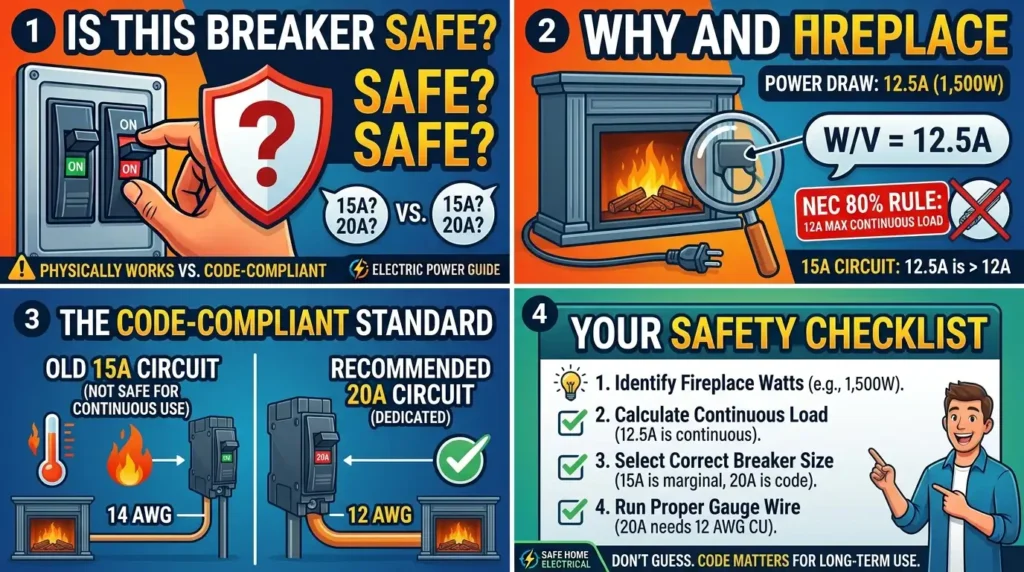
Majority electric fireplaces require 15 amp or 20 amp breaker, depending on the power and whether the circuit is shared with anything. The most popular size fireplace sold in North America is a 1,500-watt fireplace, which pulls 12.5 amps – just a bit beyond the legal continuous load limit of a 15-amp circuit when you do the NEC continuous-load calculations. That is why a dedicated 20-amp breaker is the more code-compliant and safer standard to use on full-time.
The misinformation that homeowners get is that a 15-amp breaker can physically operate a 1,500W fireplace without tripping at least temporarily. There is a difference between code compliance and it seems to work. The fact that the breaker did not trip today does not imply that the circuit is dimensioned to be used on continuous basis and over a season.
How to Calculate Your Fireplace’s Amp Draw
The actual current draw in the fireplace is required before you can size a breaker. The equation is easy:
Amps = Watts ÷ Volts
Look at the nameplate on the rear or lower side of your unit – it shows the wattage (the majority of fireplaces operate at 750W when on low and 1,500W when on high). Divide by the circuit voltage (120 V of a typical household circuit).
Example: A 1,500W fireplace on a 120V circuit:
1,500 ÷ 120 = 12.5 amps
Your drawing base. But the NEC does not allow you to leave it at that.
Why the 125% Rule Changes Everything
An electric fireplace that operates its heater is a continuous load under NEC Section 210.19(A)(1) and 210.20(A) – i.e. one that is supposed to operate at full current capacity three hours or more continuously. Continuous loads must be rated at 125 percent of the maximum current, of the wire (ampacity) and of the breaker (overcurrent protection). This is not a recommendation; that is what the code takes into consideration the heat built up in a continuous load on a piece of wire over hours, not a spike.
12.5A × 1.25 = 15.6A minimum circuit capacity
The maximum current of a 15-amp breaker is 15 amps. The amount of headroom your fireplace requires is 15.6A to comply with the literal interpretation of the code – even before you start putting anything on that circuit. It was precisely that 0.6A difference that makes a 20-amp dedicated circuit the recommended choice, rather than an overprotective suggestion of an electrician.
Quick point: It is the same principle as the general 80% rule that you will find elsewhere: the loading of a breaker should not exceed 80 percent of its rating on a continuous load. This 12.5A is 83 percent of the rating of a 15A breaker – already more than that.
The Calculated Chart: Watts to Breaker Size
This graph uses the amps-to-125%-rule calculation over the entire spectrum of wattages you’ll encounter in residential electric fireplaces, standard 120 V plug-in units as well as higher-power 240 V built-ins.
Plug-in fireplaces come in 120 V circuits, which are installed in the wall or mounted on the wall.
| Wattage Setting | Amp Draw (W/V) | Continuous Load (125%) | Minimum Breaker | Required Wire Gauge |
| 750W (low setting) | 6.25A | 7.8A | 15A | 14 AWG copper |
| 1,000W | 8.33A | 10.4A | 15A | 14 AWG copper |
| 1,200W | 10.00A | 12.5A | 15A | 14 AWG copper |
| 1,400W | 11.67A | 14.6A | 15A (marginal) | 14 AWG copper |
| 1,500W (standard max) | 12.50A | 15.6A | 20A (dedicated) | 12 AWG copper |
240V Circuits (Large Built-In & Multi-Sided Fireplaces)
| Wattage Setting | Amp Draw (W/V) | Continuous Load (125%) | Minimum Breaker | Required Wire Gauge |
| 2,000W | 8.3A | 10.4A | 15A | 14 AWG copper |
| 2,500W | 10.4A | 13.0A | 15A | 14 AWG copper |
| 2,700W | 11.25A | 14.1A | 15A (marginal) | 14 AWG copper |
| 3,000W | 12.5A | 15.6A | 20A (dedicated) | 12 AWG copper |
| 4,000W | 16.7A | 20.8A | 30A | 10 AWG copper |
| 5,000W | 20.8A | 26.0A | 30A | 10 AWG copper |
| 6,000W | 25.0A | 31.25A | 40A | 8 AWG copper |
How to interpret this chart: Determine your rated wattage on the nameplate of your fireplace (not the box, but the actual data plate), then compare it with the appropriate voltage table, and read across. The 125% continuous-load rule is already taken into consideration in the “Minimum Breaker” column and rounded to the next standard breaker size. Never round down.
Note on high-wattage units: 4,000W to 6,000W outputs are typical of large, dual-voltage or multi-sided built-in fireboxes, which are typically factory-wired to accept 240 V to add extra heat output to the unit. Note that manufacturer specs vary, and this table is a calculation of code minimums, not a replacement to the installation manual.
Does an Electric Fireplace Need a Dedicated Circuit?
This is the question divided into two very different answers when it comes to the type of fireplace that you have.
Plug-In Electric Fireplaces
Not stipulated by code, but highly suggested. Technically, any properly rated outlet can be used on a standard plug-in unit. The math above is the problem: even a 1,500W unit at 12.5A would be near the limit of a 15A circuit. Plug a lamp, or a phone charger, or a TV into the same circuit and you are in continuous-load territory. When you actually intend to operate the fireplace as a real source of heat (not a mere ambiance), then a dedicated 20A circuit will eliminate any risk whatsoever.
Hardwired & Built-In Electric Fireplaces
Always mandatory, no exceptions. Built-in and insert-style linear fireplaces which can be directly connected to the wiring of your home should be on a dedicated branch circuit fed out of the panel. It must be installed by a licensed electrician and it must have a permit in virtually all jurisdictions in the U.S. and Canada. Since these are mounted in a wall or cabinet, the circuit must be roughed in prior to the installing of drywall – doing so after building the wall would require breaking into the wall.
What “Dedicated” Actually Means
A dedicated circuit is a breaker which supplies one outlet or device, and no other. It does not mean the same as an outlet with nothing else in it at the moment. When turning on the breaker to your fireplace outlet also cuts the power to a lamp in another room, that circuit is shared – not dedicated – regardless of what is currently plugged in. This confusion is among the errors that homeowners commit when inspecting their wiring.
Electric Fireplace Wire Gauge Chart
The choice of breaker size and wire gauge is never done in isolation, but rather as a pair and that pairing is determined by the rule of small-conductor in the National Electrical Code (NEC 240.4(D)).
| Breaker Size | Minimum Copper Wire | Minimum Aluminum Wire | Typical Use Case |
| 15A | 14 AWG | 12 AWG | Small plug-in fireplace, common lighting circuit |
| 20A | 12 AWG | 10 AWG | Standard 1,500W dedicated fireplace circuit |
| 30A | 10 AWG | 8 AWG | Large 240V built-in fireplace (3,000W–5,000W) |
| 40A | 8 AWG | 6 AWG | High-output 240V multi-sided fireplace (5,000W–6,000W) |
The most important rule: the wire size determines the limit of the breaker, not vice versa. On larger wire you can always put a smaller breaker. You may not ever install a larger breaker on smaller wire. A 20A breaker on 14 AWG is a textbook fire hazard – the wire can carry 20A of current and begin heating up to dangerous levels long before that breaker will ever clear, since the breaker has no idea what size wire is on the other side of some breaker.
15A vs. 20A Circuit: Which One Does Your Fireplace Actually Need?
| Factor | 15A Circuit | 20A Circuit |
| Wire needed | 14 AWG copper | 12 AWG copper |
| Load at maximum continuous (80% rule) | 12A | 16A |
| Fires 750W–1,200W fireplace | Yes, comfortably | Yes, with room to spare |
| Handles 1,500W fireplace full-time | No — exceeds 80% rule at 12.5A | Yes — 12.5A is 62.5% of capacity |
| Safe when shared with other outlets | Only with low-wattage settings | Yes |
| Daily heating recommended | No | Yes |
It is a 20A dedicated circuit that will allow you to cease contemplation of your fireplace, should you intend to use it as a real heat source over the winter not merely as the flame effect.
Common Mistakes That Cause Tripped Breakers or Fire Risk
Using the fireplace on a common 15A circuit. There is hardly room in a fireplace of 12.5A. Plug in a space heater, a hair dryer or even a vacuum and you will blow the breaker – or not and the line will just become hot.
An empty circuit assumes a dedicated circuit. As discussed above, dedicated refers to the way the breaker is wired at the panel and not what currently has been plugged in.
Oversizing the breaker to prevent the tripping. When your fireplace is tripping on a 15A breaker, the solution is a 20A dedicated circuit with 12 AWG wire – not to change the 14 AWG breaker to a 20A breaker. That eliminates the very safeguard the breaker is meant to offer.
Disregarding the nameplate. Box packaging may include a rounded or marketing wattage. The number on the nameplate on the unit itself is what you need to use to calculate.
Omitting GFCI where it is needed. Fireplace outlets in unfinished basements, garages or close to a water source are normally subject to NEC GFCI protection, independent of the question of breaker size altogether.
Electric Fireplace Circuit Installation: Step by Step
- Locate nameplate wattage. Look on the back, bottom or inside the unit – not the retail box.
- Divide watts by voltage (120 V or 240 V).
- Multiply your amp draw by 1.25.
- Round to the standard breaker size. 15A, 20A, 30A or 40A – round to the nearest, but never to half-way.
- Select wire gauge to match breaker, according to chart above.
- Pull a permit – Before any new circuit is run off the panel – necessary in nearly all new circuit work.
- Contract an electrical contractor to install the circuit, connect it at the panel and arrange the inspection.
The steps 6 and 7 are not extras. Energy on work within a live panel – even with the main breaker off – remains energized at the main lugs, and work that is not permitted inside a panel is one of the most frequent areas that get called out when a home is subsequently inspected to be sold.
You May Also Read:
- Can You Have Two Fireplaces on One Chimney? 7 Essential Safety Tips
- What is Thermal Cutoff in Electric Fireplace? 5 Powerful Safety Tips
FAQs:
What size breaker do I require to have a 1,500-watt electric fireplace?
An electronic breaker with 12 AWG copper wire of 20 amps. The fireplace loads 12.5 A, and the 125% continuous-load requirement of the NEC increases the minimum required capacity to 15.6 A – higher than a 15A breaker is permitted by law to carry.
Will a standard outlet work with an electric fireplace?
Yes, with plug-in models that are 120 V, provided the outlet is on a circuit that has sufficient spare capacity. Not required to be a dedicated circuit by code, although it is not advisable to run it as a primary heat source on a common 15A circuit.
What is the size of the circuit used by an electric fireplace? 20 amps?
Not by the strict code requirement of plug-in units, but yes in practice of any 1,500W fireplace that is regularly used as a source of heat. Hardwired and built-in units must have a dedicated circuit and the typical size of that load is 20A.
What is the amperage of a 1,500W electric fireplace?
12.5 amps on a 120V circuit (1,500 ÷ 120 = 12.5). The same number of watts would cause 6.25 amps on a 240 V circuit.
What is the wire gauge that I need to have in an electric fireplace?
14 AWG copper in 15A circuit, or 12 AWG copper in more typical 20A dedicated circuit. 240 V built-in units larger than 240 V can take 10 AWG or 8 AWG, depending on wattage.
Why does my electric fireplace keep blowing out the breaker?
Virtually never due to a faulty fireplace, but rather due to the circuit being shared and overloaded. Anything else on that circuit can overload a 15A breaker, which already uses up about 83% of its rated capacity by a 1,500W fireplace.
Is a 15amp breaker sufficient to a fireplace that is powered by electricity?
Exclusively in smaller units with lower wattage (around 1,200W and below). A 15A breaker would technically be undersized based on the NEC continuous-load provisions when operating a 1.5 kW device continuously.
Are installed electric fireplaces required to have its own circuit?
Yes, always. Hardwired hard-wired and built-in units must have a special branch circuit installed by a licensed electrician, and a permit and inspection.
What can go wrong when I use incorrect size of a breaker?
Smaller than that and the breaker will start clearing over and over again, irritating but not hazardous. Too big to fit the wire gauge, and the wire overheats long before the breaker trips it at all a real fire hazard.
Is it possible to run an electric fireplace on a 240 V circuit?
Yes, several built-in and multi-sided designs are dual-voltage, and can be wired to 240 V, which is approximately twice their heat production with the same amp draw as 120 V.
What is the power consumption of an electric fireplace?
Approximately 1.5 kWh/h is consumed by a 1,500W unit operating on full heat. When using flame-only mode and the heater is off, draw is reduced to less than 1 amp because the only light taking power is the LED.
Am I required to permit adding a fireplace circuit?
Yes, in most jurisdictions, regardless of whether the fireplace is plug-in or hardwired, any new circuit operated off the panel needs a permit and inspection.
My Final Thought:
A typical 1500-watt electric fireplace requires a dedicated 20-amp circuit with 12 AWG copper wire to comply with NEC requirements of continuous load – although it may temporarily operate on a shared 15-amp circuit. Bigger 240 V built-in units require their own calculation according to nameplate wattage. When your math puts you over the 12-amp continuous-load limit of a 15A breaker, a dedicated circuit is not a precaution, but the answer per the code. To install anything that requires more than a simple plug-in installation, a licensed electrician and a permit are the difference between an installation that is safe and one that is expensive to fix in the future.