How Much Does an Electric Fireplace Cost? (2026 Price Guide)
Shopping for an electric fireplace usually starts with one question: how much does an electric fireplace cost? The honest answer is that prices run from about $200 for a small freestanding stove to $3,000 or more for a built-in unit with professional installation.
Most people land somewhere in the middle. A good wall-mounted or mantel unit with realistic flames costs $300 to $1,000, and you can often set it up yourself the same day it arrives. This guide breaks down the full price picture: what each type costs, what installers charge, what it costs to run one month after month, and the tricks that push the price up — or keep it down.
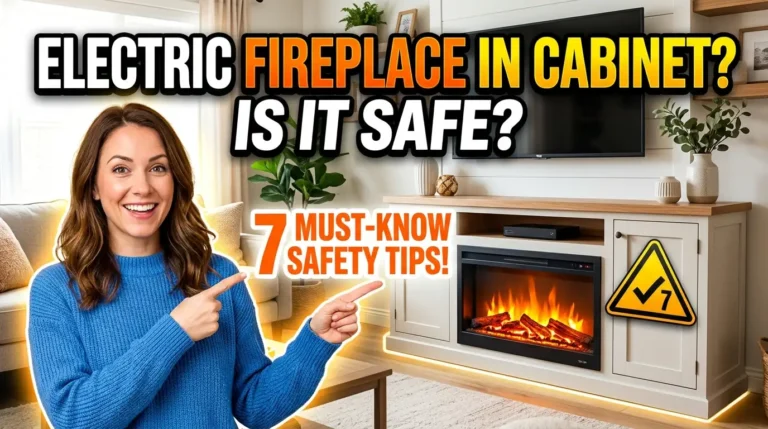
A quick safety note before we start: an electric fireplace is a heater. Plug it straight into a wall outlet, keep fabrics and furniture away from the heat vents, and never run the heater through an extension cord or power strip. Hardwired installs need a licensed electrician. This article is general information, not electrical advice — when in doubt, call a professional.
The Short Answer: What Most People Pay
Most homeowners pay $300 to $1,500 for an electric fireplace including basic setup. A small freestanding model can cost under $300 and needs no install at all, while a built-in recessed unit with professional installation can pass $3,000. Running costs are modest: a standard 1,500-watt unit costs roughly $0.21 to $0.33 per hour of heating, or about $26 to $40 a month at four hours a day.
Electric Fireplace Cost by Type
The style you choose moves the price more than any other factor. Here is what each type typically costs in 2026, based on current retail and contractor data.
| Type | Unit price | Installation | Best for |
|---|---|---|---|
| Freestanding stove or mantel | $200 – $1,500 | DIY, no install needed | Renters, first-timers, tight budgets |
| Electric fireplace insert | $200 – $2,000 | Pro recommended | Converting an old wood or gas firebox |
| Wall-mounted | $300 – $2,500 | DIY possible; pro for recessed or hardwired | Modern look, saving floor space |
| Built-in / recessed | $1,500 – $3,000+ | Professional installation | Custom media walls, remodels |
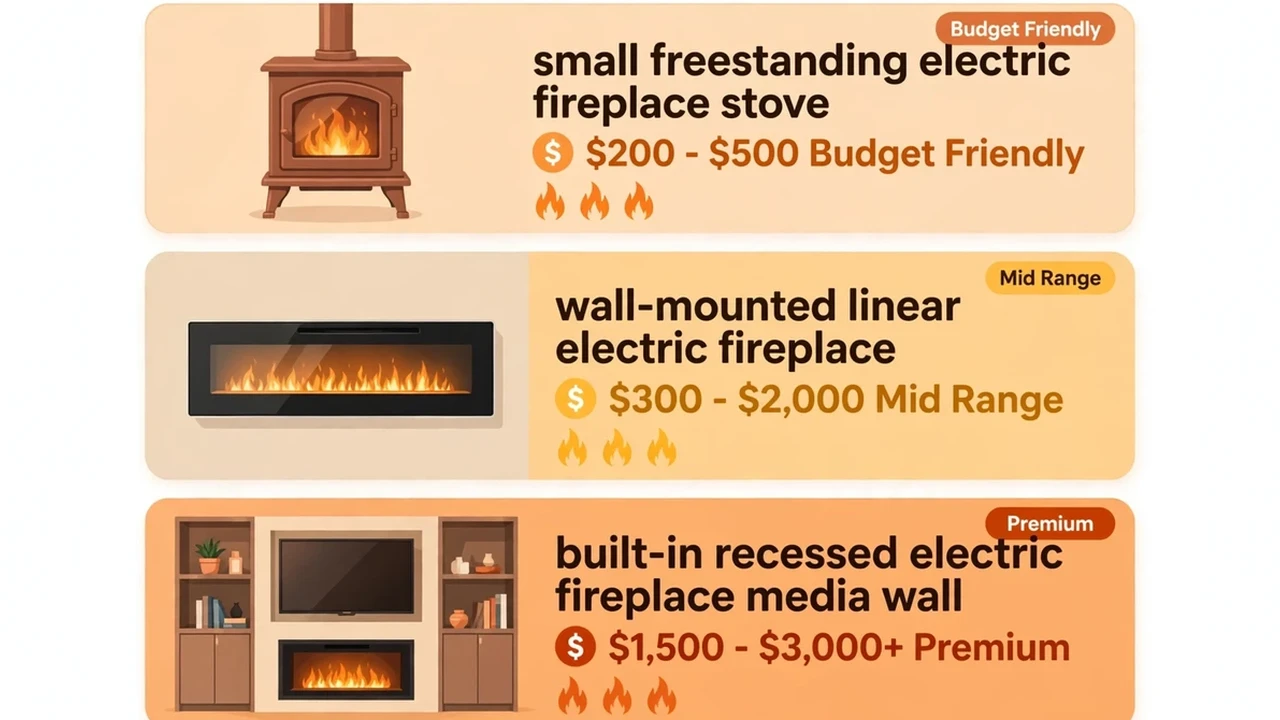
Freestanding models are the cheapest way in. Budget stoves start near $200 to $300, while mantel packages with nicer finishes climb toward $1,000. You unbox them, plug them in, and you are done.
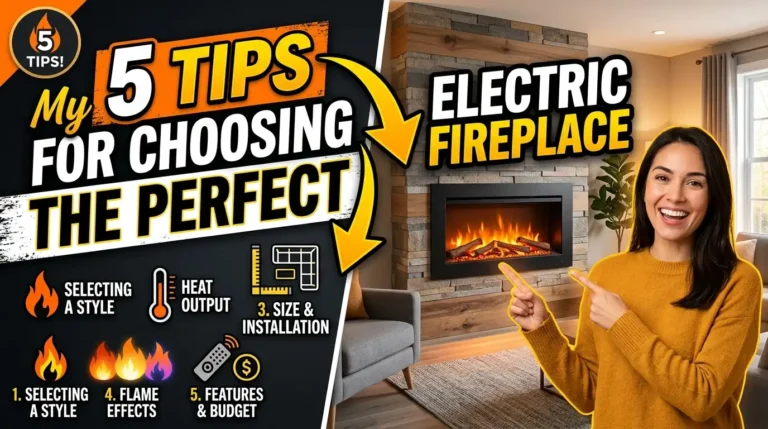
Wall-mounted units are the sweet spot for many homes. Basic models start around $300; wider premium linear fireplaces with realistic flames and smart controls can reach $2,000 or more. Inserts, which slide into an existing firebox, follow a similar range of $200 to $2,000 depending on size and flame quality.
Built-ins are the premium option. The unit alone runs $800 to $2,500, and professional installation pushes all-in costs to $1,500 to $3,000+. A full custom media wall with framing, drywall, and finishes can climb higher still.
What Drives the Price Up or Down
Two fireplaces can look similar and differ by $500. Here is what you are actually paying for.
- Flame realism. This is the biggest price lever. Basic models use a simple red glow over plastic logs; premium models use layered LED flames, ember beds, and crackling sounds. The fancier the flame, the higher the price.
- Size. A fireplace rated for a 200-square-foot room starts near $200, while one built to warm 600 square feet can top $1,500. Bigger rooms need more BTUs, and that costs more.
- Heat settings. A single-setting unit costs less than one with two or more heat levels, a thermostat, and a timer. Most standard units top out around 1,500 watts (about 5,100 BTU) because that is the limit of a normal 120-volt outlet.
- Finish and materials. Real wood mantels, stone surrounds, and metal trim add cost. Budget units use MDF and laminate, which look fine but cost far less.
- Smart features. App control, voice control, multi-color flames, and remote thermostats all add to the price tag.
Installation Costs: DIY vs. Hiring a Pro
Installation can cost nothing — or more than the fireplace itself. Freestanding models need no installation at all, which is part of why their total cost stays low.
Surface-mounted wall units are often DIY-friendly if you can handle a drill and a stud finder. Recessed, built-in, and insert models usually need a professional, especially when they are hardwired instead of plugged in. Any unit that requires a new dedicated 20-amp circuit means calling an electrician; as one example, that electrical work has been quoted at $300 to $600, though rates vary widely by area. Get local quotes before you buy.
⚠ Heads Up: Electrical Safety First
Plug heater-type fireplaces directly into a wall outlet on their own circuit. Never run one through an extension cord, power strip, or overloaded outlet — that is a leading cause of overheating. Keep at least 3 feet of clearance from curtains, furniture, and other combustibles, and follow your local electrical codes. Hardwired installs are a job for a licensed electrician, not a weekend project.
Reading up on electric fireplace code requirements before you start can save you from an expensive redo.
Running Costs: What It Costs to Use One
The purchase price is only half the story. Here is what it costs to actually run an electric fireplace, based on current electricity rates.
Most electric fireplaces draw 750 to 1,500 watts on heat, with flame-only mode using almost nothing (roughly 10 to 50 watts — about the same as a light bulb). At typical US rates of $0.14 to $0.22 per kWh, the hourly cost looks like this:
| Heat setting | Cost per hour | Cost per month (4 hrs/day) |
|---|---|---|
| Flame only (no heat) | Less than $0.01 | Under $1 |
| Low heat (~750 watts) | $0.11 – $0.17 | $13 – $20 |
| High heat (~1,500 watts) | $0.21 – $0.33 | $26 – $40 |
You can work out your own number with a simple formula: (watts ÷ 1,000) × your rate per kWh = cost per hour. So a 1,500-watt fireplace at $0.20 per kWh costs $0.30 an hour on full heat. Our guide on how much energy an electric fireplace uses walks through this in more detail.
💡 Pro Tip: The Thermostat Is Your Wallet’s Friend
The figures above assume the heater runs at full power the whole time. In real life, the built-in thermostat cycles the heating element off once the room hits your set temperature, so your actual bill often lands below these estimates. Use the thermostat instead of the manual high setting to keep costs down.
Because electric fireplaces convert nearly all their electricity into heat, there is no wasted fuel the way there is with vented fireplaces. That efficiency is part of why many people ask whether an electric fireplace saves money over other heating options — the answer depends on your rates and how you use it.
Ongoing Costs: Maintenance and Replacements
Here is the good news: electric fireplaces have almost no upkeep costs. There is no chimney to sweep, no fuel to buy, and no ash to clean. The flame effect runs on LEDs that typically last for many years of normal use.
Your only real ongoing expense is electricity. Occasionally a blower motor or remote may need replacing, but many owners go years without spending a cent beyond their power bill. Curious how many years you can expect? Our guide to electric fireplace lifespan covers that.
5 Ways to Keep Your Total Cost Down
- Buy the right size, not the biggest one. A unit sized for your room costs less upfront and less to run. A 1,500-watt model is plenty for most bedrooms and living rooms.
- Choose plug-in over hardwired when you can. Plug-in models skip the electrician bill entirely. Go hardwired only if the model you love requires it.
- Use flame-only mode for ambiance. Enjoying the look without the heat costs pennies per hour — sometimes less than a dollar a month.
- Shop off-season. Fireplaces often go on sale in spring and summer, when demand drops. You can save 15–30% versus peak winter pricing.
- Check the warranty. A longer warranty on the heating element and electronics protects you from surprise repair costs down the road.
Frequently Asked Questions
What is the cheapest type of electric fireplace?
A small freestanding electric stove is usually the cheapest, starting around $200. These plug into a standard outlet, need no installation, and cost the least to buy and set up.
Do I need an electrician to install an electric fireplace?
Not always. Freestanding and most plug-in wall-mounted models are fine as DIY installs. You need a licensed electrician for hardwired units, recessed built-ins, or any install that adds a new dedicated circuit.
How much does it cost to run an electric fireplace per month?
A standard 1,500-watt unit used 4 hours a day typically costs $26 to $40 per month at average US electricity rates. Flame-only mode costs under $1 a month.
Can I plug an electric fireplace into a regular outlet?
Yes, most models are designed for a standard 120-volt outlet. Plug it directly into the wall — never into an extension cord or power strip — and ideally give it a dedicated circuit so it does not share power with other heavy appliances.
Is an electric fireplace cheaper than a gas fireplace?
Usually yes on the purchase price: electric units cost far less to buy and install than gas. Running costs depend on your local electricity and gas rates — electric fireplaces are cheapest when used for zone heating a single room. Our gas vs. electric fireplace comparison breaks down the trade-offs.
Quick Reference Card
📋 Electric Fireplace Cost Cheat Sheet
- Freestanding: $200 – $1,500 (no install needed)
- Insert: $200 – $2,000 (+ pro install for hardwired)
- Wall-mounted: $300 – $2,500 (DIY or pro)
- Built-in: $1,500 – $3,000+ (pro install)
- Electrician (dedicated circuit): varies by area — get quotes
- Running cost: $0.21 – $0.33/hr on high; under $1/mo flame-only
Safety basics: plug into a wall outlet (no extension cords), keep 3 ft of clearance, use a dedicated circuit, and hire an electrician for hardwired installs.
The Bottom Line
An electric fireplace can cost as little as $200 or climb past $3,000 — but most people get a great one for $300 to $1,000 with little or no install cost.
Match the type to your budget, size it to your room, and let the thermostat do the heavy lifting. Do that, and you will get the cozy flames without the scary bill.
Next up: read our guide on electric fireplace safety so your new fireplace stays as safe as it is warm.