How Much Energy Does an Electric Fireplace Use?
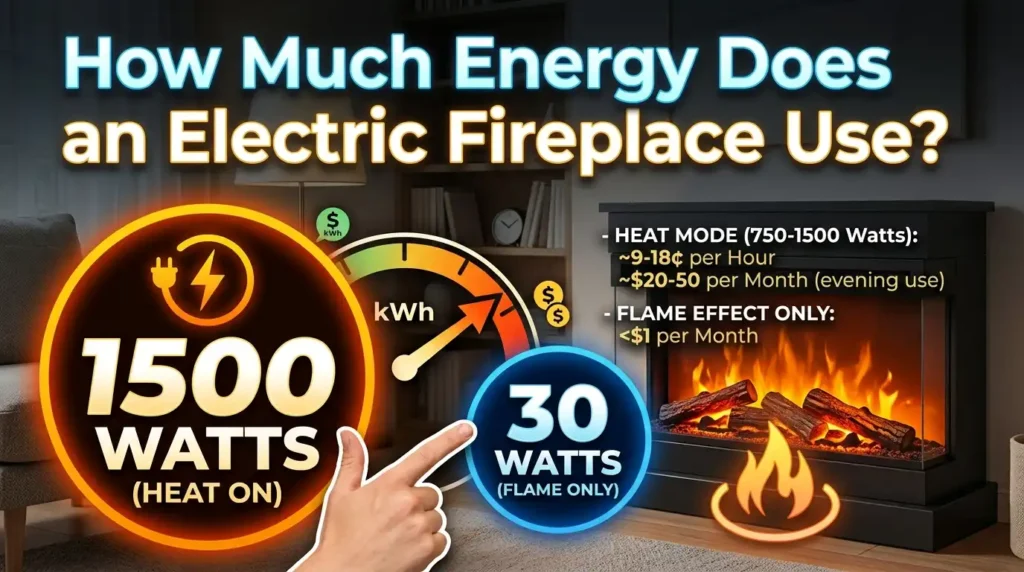
How Much Energy Does an Electric Fireplace Use? Short answer: The typical electric fireplace has a heat mode of between 750 and 1500 watts which equates to approximately 9-18 cents per hour and approximately 20-50 dollars per month of evening use. Using the flame effect, but not the heater, typically costs less than a dollar a month to operate.
When you are buying an electric fireplace, or when you have one and you wonder why your electric bill in the winter is increasing, you want specific numbers, not empty promises. It is a breakdown of precisely how many watts an electric fireplace will pull in, what that will cost per hour, day, month, and year and how it compares to gas and wood-burning alternatives. You will also find a simple formula so that you can enter in the wattage of your own fireplace and your own local rate of electricity to get your own estimate.
Quick Answer: Electric Fireplace Energy Use at a Glance
Key Takeaways: How Much Energy Does an Electric Fireplace Use?
- Standard output: 7501500 watts on heating mode (most models have a maximum of 1,500W).
- Flame-only mode: 20-100 watts, can be as low as 1 per month to operate.
- High heat average hourly cost: approximately, $0.12 to 0.25, with your electricity rate.
- Typical cost per month: about $20-50 with a limited amount of time use per day during the winter.
- Heat output: about 4,700–5,100 BTUs, enough for a room up to 400 square feet.
- Efficiency: virtually 100 percent of the electricity consumed is changed into heat without any chimney heat loss.
How Much Electricity Does an Electric Fireplace Use?
Electric fireplaces are rated in watts, which is also used to measure space heaters, hair dryers and microwaves. The initial step to knowing how much a fireplace will cost you to operate is to know the wattage.
Wattage Ranges Explained
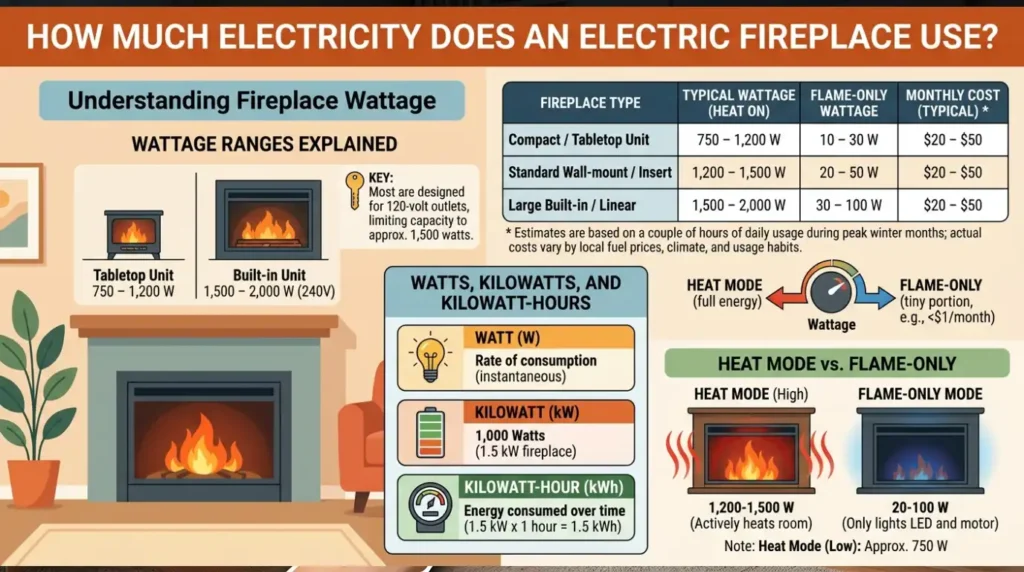
Most electric fireplaces sold in the US and Canada are designed with a common household 120-volt outlet, limiting their capacity to approximately 1,500 watts. A few smaller or tabletop models are less draw, and some larger built-in models are nearer 2,000 watts on 240-volt circuits.
| Fireplace Type | Typical Wattage (Heat On) | Flame-Only Wattage |
| Compact / tabletop unit | 750 – 1,200 W | 10 – 30 W |
| Standard wall-mount or insert | 1,200 – 1,500 W | 20 – 50 W |
| Large built-in / linear model | 1,500 – 2,000 W | 30 – 100 W |
Record the distance between flame display and heater. The effect of the dancing-flame is produced through LED lights and a rotating or refractive part, which consumes only a tiny portion of the power consumed by the heating coil. That is why you can leave the ambiance running in summer without having to see much difference on your bill.
Watts, Kilowatts, and Kilowatt-Hours
It does not measure your utility bill in watts; it measures it in kilowatt-hours (kWh) and knowing what the difference between the two is can make the remainder of this guide much easier to follow.
- Watt (W): The rate of energy consumption by any device at any point in time.
- Kilowatt (kW): Equal to 1,000 watts. A 24-kW power device is a 1,500-watt fireplace.
- Kilowatt-hour (kWh): This is the amount of energy consumed per time. When a fireplace with a power of 1.5 kW is on one hour, it consumes 1.5 kWh, the amount that your power company actually charges you.
Heat Mode vs. Flame-Only Mode
Almost all electric fireplaces allow you to decouple the heater and visual appearance of the flame. This difference is important to know since it can make a big difference in your energy consumption:
- Heat mode (high): Operates at full power of approximately 1,200-1,500 W to actively heat the room.
- Heat mode (low): There are numerous units with a low mode of about 750 W, about half the energy of high.
- Flame-only mode: The heating element is not on. You are just lighting LED lights and a small motor, typically 20-100 W.
How Much Does It Cost to Run an Electric Fireplace?
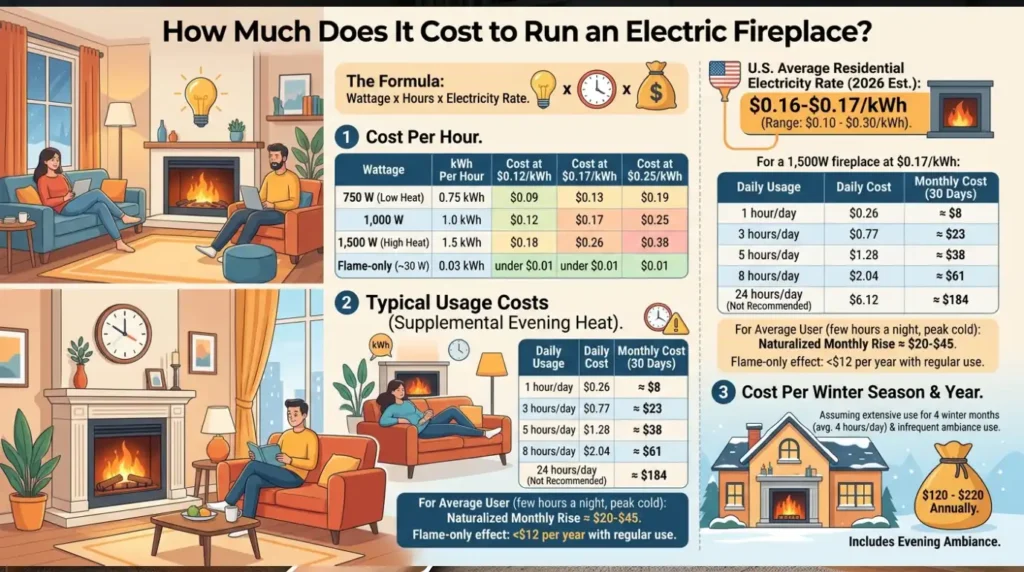
It all boils down to a formula: Wattage x hours spent x your electricity rate. By 2026, the average residential electricity rate in the U.S. is estimated to be around 0.16-0.17 per kWh (although it varies, with the lowest cost states at approximately 0.10 and the most expensive region at 0.30 per kWh).
Cost Per Hour
| Wattage | kWh Per Hour | Cost at $0.12/kWh | Cost at $0.17/kWh | Cost at $0.25/kWh |
| 750 W (low heat) | 0.75 kWh | $0.09 | $0.13 | $0.19 |
| 1,000 W | 1.0 kWh | $0.12 | $0.17 | $0.25 |
| 1,500 W (high heat) | 1.5 kWh | $0.18 | $0.26 | $0.38 |
| Flame-only (~30 W) | 0.03 kWh | under $0.01 | under $0.01 | $0.01 |
Cost Per Day and Per Month
The majority of the households do not operate fireplace 24/7. It’s typically used as supplemental, evening heat in one room. This is what it would look like at a 1,500 watt and a cost of 0.17/kWh:
| Daily Usage | Daily Cost | Monthly Cost (30 days) |
| 1 hour/day | $0.26 | ≈ $8 |
| 3 hours/day | $0.77 | ≈ $23 |
| 5 hours/day | $1.28 | ≈ $38 |
| 8 hours/day | $2.04 | ≈ $61 |
| 24 hours/day (not recommended) | $6.12 | ≈ $184 |
In the case of the average citizen who operates their fireplace a few hours a night during the lowest temperatures of the year, a naturalized monthly rise falls between 20 and 45. With a flame effect alone, no heat, an average person will only add less than $12 months with regular use.
Cost Per Winter Season and Per Year
Assuming that you burn your fireplace extensively for four winter months with an average of 4 hours a day and use it infrequently during the rest of the year to create ambiance, you will spend an average of $120 to $220 annually. Evening ambience (use of flame all year long) will also incur an additional charge of $1015 on top of that. These are approximations; your real value will be your individual wattage, settings and local rate and practices.
What Affects Electric Fireplace Energy Consumption?
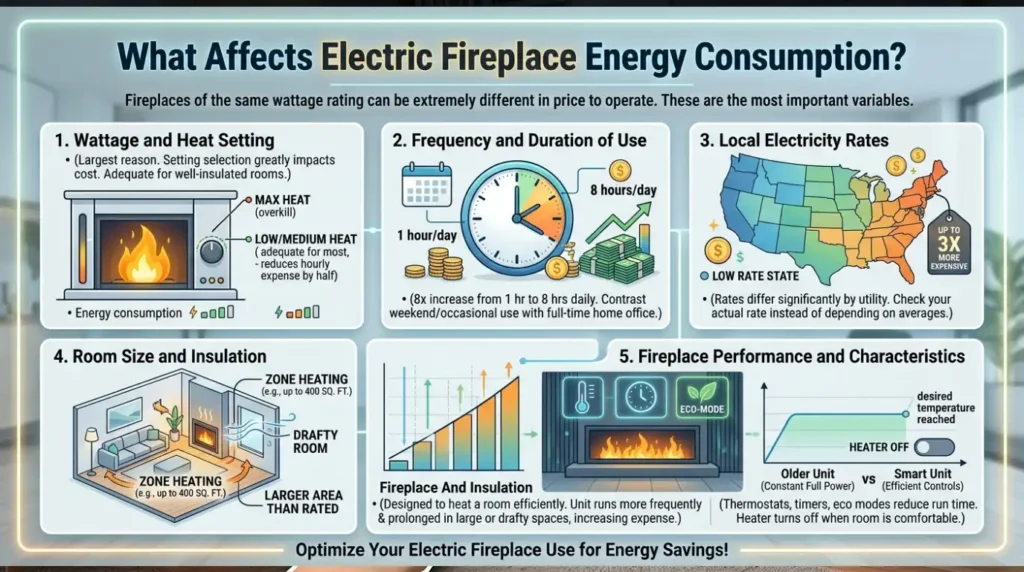
Fireplaces of the same wattage rating can be extremely different in price to operate. These are the most important variables.
Wattage and Heat Setting
This is the only largest reason. The difference between a low or medium heat setting and a maximum one can reduce your hourly expense by about half, and at least in most cases it is more than adequate to a well-insulated room.
Frequency and Duration of Use
An hour of fireplace operation per day compared to eight hours per day is approximately eight times the amount of energy consumed. Weekend use or occasional use will hardly show up on your bill and full time use in a home office can be accumulated in no time.
Local Electricity Rates
A high-rate state can be almost three times more expensive to run the same fireplace than a low-rate state. It would be good to look at what your utility rate is, instead of depending on the national averages to budget.
Room Size and Insulation
Electric fireplace is designed to heat a zone (usually a room up to approximately 400 square feet). The fireplace must operate more frequently and prolonged in a drafty room, or in a larger area than the unit is rated, to keep the room warm, and this increases the expense though the wattage remains the same.
Fireplace Performance and Characteristics
Thermostats, timers, eco or energy saving modes all cut the amount of time me-too runs by turning off the heater after the room reaches your desired temperature rather than running at full power all the time. Units with these controls will last longer in the same level of comfort as the older units.
Electric Fireplace vs. the other heating options.
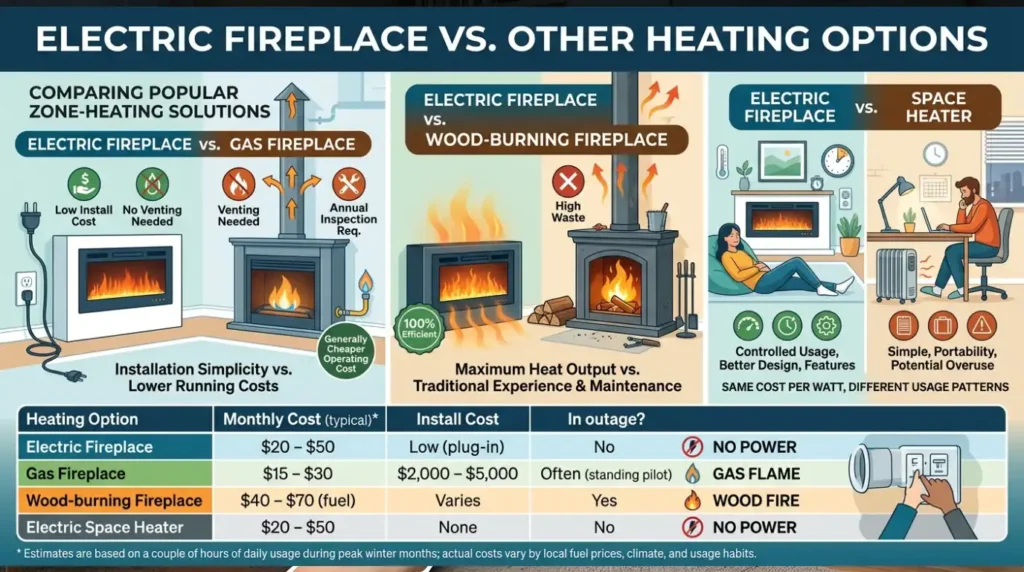
Electric fireplaces are not the only zone-heating solution, and the correct one is determined by your priorities: initial price, monthly running price, the intricacy of installation, or having a backup heat in the case of an outage.
Electric vs. Gas Fireplace
In many areas, gas fireplaces tend to be cheaper per hour of operation than electric fireplaces, as the natural gas tends to be cheaper per unit of heat than electricity. But gas units need a gas line and venting, and are more expensive to install, and must be inspected by a professional annually. All electric fireplaces require is a regular outlet and do not need venting (which keeps the cost of installation much lower), though the monthly operating cost is occasionally more expensive.
Electric vs. Wood-Burning Fireplace
The most inefficient of the three are the traditional wood burning fireplaces. A large portion of the heat produced goes right up the chimney and firewood, chimney cleaning, and maintenance are all extra expenses. Fireplaces that are electric require virtually all the energy put into them to be converted to useful heating in the room, with none going to waste (in the form of a flue).
Electric Fireplace vs Space Heater
A 1,500-watt electric fireplace and a 1,500-watt space heater were equally costly to operate, as both use electricity to produce heat equally efficiently. The actual distinction is usage pattern: fireplaces have more likely to have better thermostats, timers, and design that have more controlled and intentional use, whereas simple space heaters are more likely to be left on full blast.
| Heating Option | Monthly Cost (typical)* | Install Cost | In outage? |
| Electric fireplace | $20 – $50 | Low (plug-in) | No |
| Gas fireplace | $15 – $30 | $2,000 – $5,000 | Often (standing pilot) |
| Wood-burning fireplace | $40 – $70 (fuel) | Varies | Yes |
| Electric space heater | $20 – $50 | None | No |
Estimates are based on a couple of hours of daily usage during peak winter months; actual costs vary by local fuel prices, climate, and usage habits.
Is an Electric Fireplace Energy Efficient?
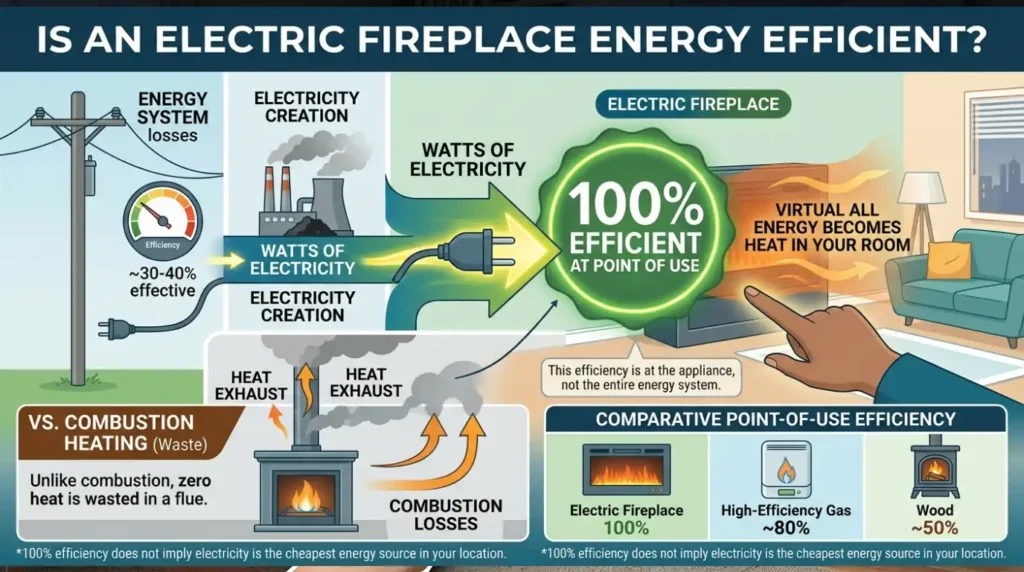
Yes, Electric fireplaces have been said to be about 100% efficient at the point of use, i.e. almost all of the watts of electricity that enter it make it into heat in your room. This is unlike the heating based on combustion where a portion of energy is always wasted as exhaust.
The ‘100% Efficiency’ Figure Explained
This value is a measure of efficiency at the appliance, not the entire energy system. Even electricity must be created and carried, and its creation and transmission have its own losses long before it reaches your outlet. Therefore, whereas a wood fire could dissipate much of its heat up the chimney, and a gas fireplace loses some of its heat during combustion, an electric fireplace loses virtually none of its heat between the outlet and the room. It is a real efficiency benefit, even though it does not necessarily imply that electricity is cheapest source of energy in your location.
How to Calculate Your Own Electric Fireplace Running Cost?
You do not have to use national averages. Having three figures, the wattage of your fireplace, the number of hours each day you use it, and the rate of your electricity bill, you can estimate the cost that is specific to your house.
- Step 1: Find your fireplace’s wattage. Test the spec label, manual, or product listing (most indicate 1,500W or 750/1,500W to set to dual).
- Step 2: Divide the watts by 1,000. Example: 1,500 W ÷ 1,000 = 1.5 kW.
- Step 3: Determine your rate in cents per kWh of electricity on a recent utility bill.
- Step 4: Multiply: kW x rate of yours = cost per hour. Example: 1.5 kW × $0.17 = $0.255 per hour.
- Step 5: Multiple your daily use of your hourly cost by the hours that you use it daily, then multiply by the number of days, to obtain a weekly, monthly, or seasonal estimate.
Worked Example
- Fireplace: 1,400 watts on high heat
- Rate: $0.18 per kWh
- Usage: 4 hours in the evening.
- Hourly cost: 1.4 kW × $0.18 = $0.252
- Daily cost: $0.252 × 4 hours = $1.01
- Monthly cost (30 days): $1.01 × 30 = about $30.24
Tips to Reduce Electric Fireplace Energy Usage
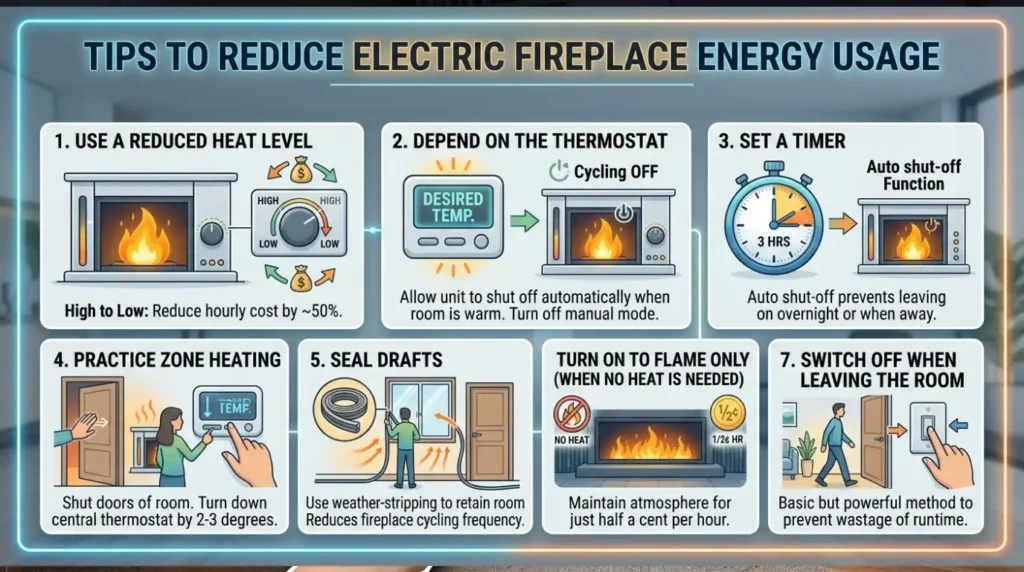
Even little things will help reduce what an electric fireplace will cost you without sacrificing the comfort or the atmosphere.
- Use a reduced heat level. The high to low hourly cost reduction can be about one-half.
- Depend on the thermostat. Allow the unit to switch off when the room reaches your desired temperature rather than operating it on manual.
- Set a timer. Auto shut off when reaching a pre-determined number of hours helps to avoid leaving it on overnight or when you are away.
- Practice zone heating. Shut the door of the room you are heating and turn down your central thermostat two or three degrees as the fireplace burns.
- Seal drafts. The doors and windows should be weather-stripped to allow the room to retain heat longer and reduce the frequency of fireplace cycling.
- Turn on to flame only when you do not need heat. You maintain the atmosphere at half a cent an hour.
- Switch off when leaving the room. Basic, yet it is the one and the only easy method to prevent wastage of runtime.
Common Mistakes That Increase Electric Fireplace Costs
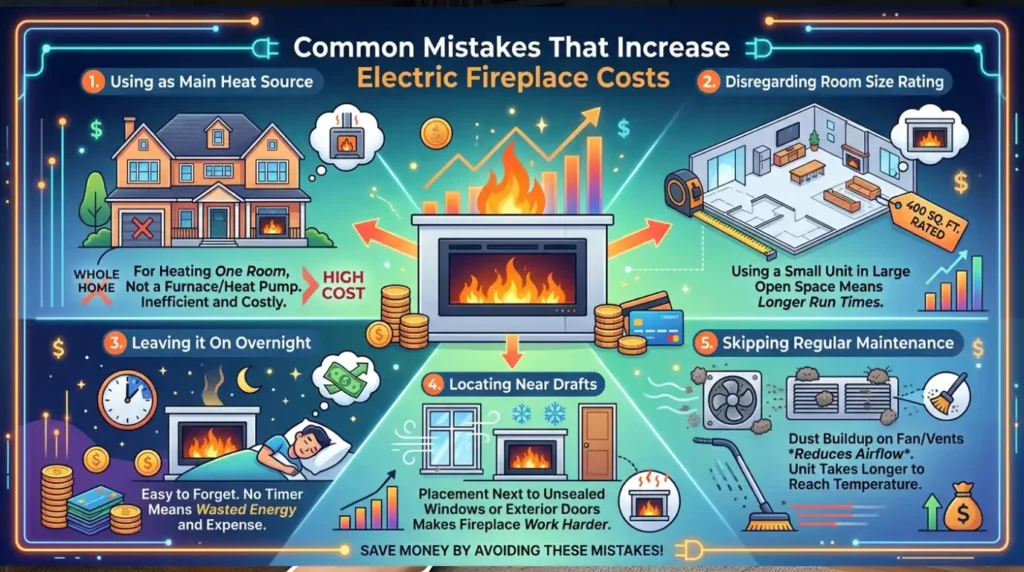
- It can be used as a main source of heat. Electric fireplaces are not to be used in place of a furnace or a heat pump in a whole home, but to heat one room.
- Disregarding the rating of the room size. Being in a 400-square-foot-rated unit in a significantly larger open-plan location implies longer run times of the same comfort.
- Leaving it overnight. It is easy to forget to turn the heater off after you have gone to sleep since there is no timer.
- Locating it close to a draft. A fireplace placed next to a window that is not sealed properly, or an exterior door makes the fireplace work harder.
- Skipping maintenance. The accumulation of dust on fan and vents may reduce airflow and cause the unit to take a longer time to achieve the same temperature.
You May Also Read:
- How High Should an Electric Fireplace Be from the Floor
- Electric Fireplace Flame Are on but Not Working
FAQS:
Are electric fireplaces very electricity consuming?
Not usually. With the heat feature on, most of them consume between 750 and 1500 watts, comparable to a hair dryer or toaster oven, and can cost an additional $20-50/month when used regularly during evening in winter. Very little power is consumed in flame-only mode.
What would it cost to operate an electric fireplace 24 hours a day?
With a rate of 0.17/kWh and a 1,500-watt power consumption, a 24-hour run costs approximately 6.12. Companies do not advise operating the heater 24 hours straight without a thermostat that switches the heater on and off.
Which is more economical to operate an electric fireplace or central heating?
An electric fireplace would typically be less expensive than operating a furnace or heat pump to heat empty rooms as well, to warm just a single occupied room. Central heating and heat pumps are more affordable when it comes to heating a whole home.
What are the typical electric fireplace watts?
A typical 1,500 watts on high heat and approximately 750 watts on low heat are most typical models, and the flame-only effect of a typical one may require as much as 20 to 100 watts.
Will an electric fireplace be okay to leave unattended all day?
The majority of contemporary units come with overheat protection, and can (technically) be left running longer, but any heater left on all day will add to the energy bills as well as the unit wear. The less risky and cheaper method is to use a timer or a thermostat.
Do the electric fireplaces increase your electric bill during summer?
Only under the condition that you use the heating. The amount of electricity used to run just flame effect to provide ambiance is so low, as little as 100 watts, that it can easily be less than a dollar a month with daily operation.
Is it cheaper to run electric fireplaces than gas fireplaces?
It relies on local power rates, yet the gas is slightly less by the hour of heat in most areas. Electric fireplaces compensate this by having less cost to install, as they do not require a gas line or venting.
Will the flame effect burn with the heater turned off?
Yes, but very little. Depending on the heating element power required, LED flame displays normally consumed 20-100 watts of power, versus 750-1500 watts the heating element consumed.
What is the size of breaker or circuit required in an electric fireplace?
The 1,500-watt electric fireplaces have a 120-volt household circuit with a standard 15- or 20-amp supply, so long as nothing else requiring power is sharing the circuit. The larger built-in models can have to use a separate 240-volt circuit; see what the manufacturer specifies.