What Is a Direct Vent Gas Fireplace? A Beginner’s Plain-English Guide
You have probably seen the phrase “direct vent” on gas fireplace listings and wondered what it changes. Here is the short version: a direct vent gas fireplace burns gas inside a sealed box, behind a fixed pane of glass, and it trades air with the outdoors — never with your living room.
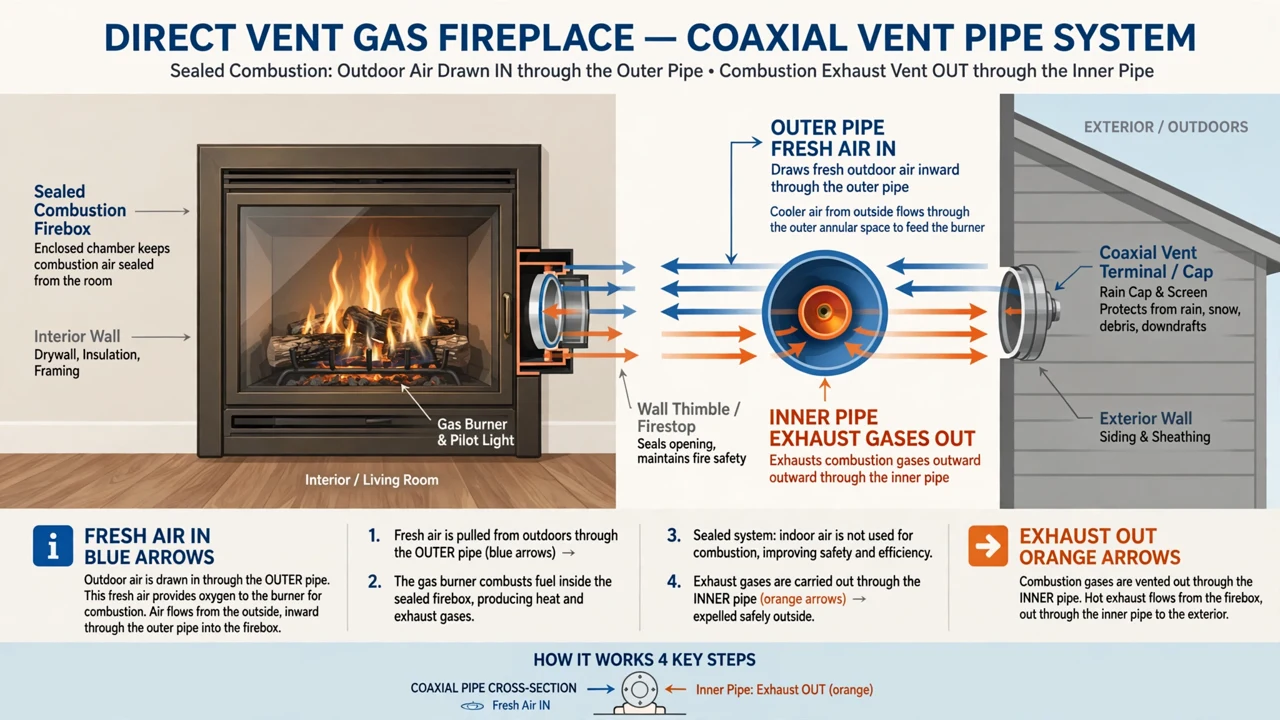
One pipe does two jobs at once. The outer channel of a coaxial vent pulls fresh combustion air in from outside, while the inner channel pushes exhaust gases back out. Your indoor air stays untouched, so you get real flames without the drafts and heat loss that come with older venting styles.
This guide covers how that sealed system works, how direct vent stacks up against B-vent and ventless models, where you can install one, what it costs, and how to keep the whole setup safe.
⚠️ Gas Safety First — Read Before Anything Else
Gas fireplaces carry carbon monoxide (CO) and gas-leak risks that can harm people and pets. Install CO alarms on every level of your home and near sleeping areas, test them monthly, and replace them per the manufacturer’s guidance. CO is colorless and odorless, so alarms are your early warning.
If you smell gas (a rotten-egg odor): do not touch light switches, flames, or appliances. Leave the home immediately — take people and pets with you. Call your gas utility’s emergency line or 911 from outside. Never hunt for the leak, open a gas line, or relight anything after a strong gas smell. That work is for the gas utility or a licensed gas fitter only.
Birds and small pets are extra sensitive to CO and combustion fumes, so keep their spaces away from any fuel-burning appliance and keep alarms working. All gas-line, installation, venting, and repair work belongs to a licensed professional.
The Short Answer: A Fireplace That Breathes Outdoor Air
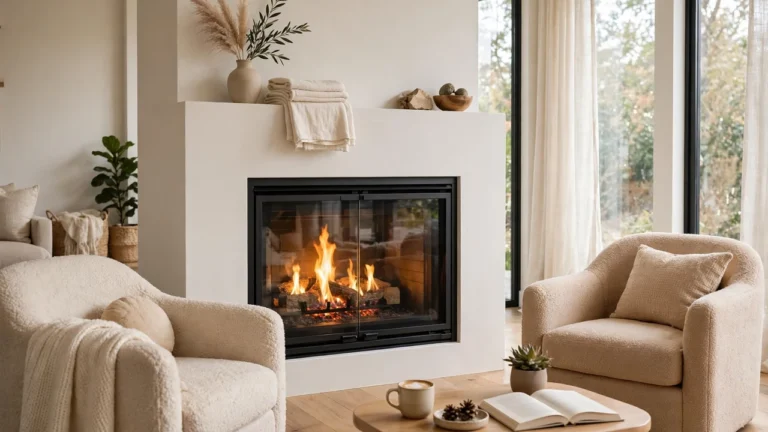
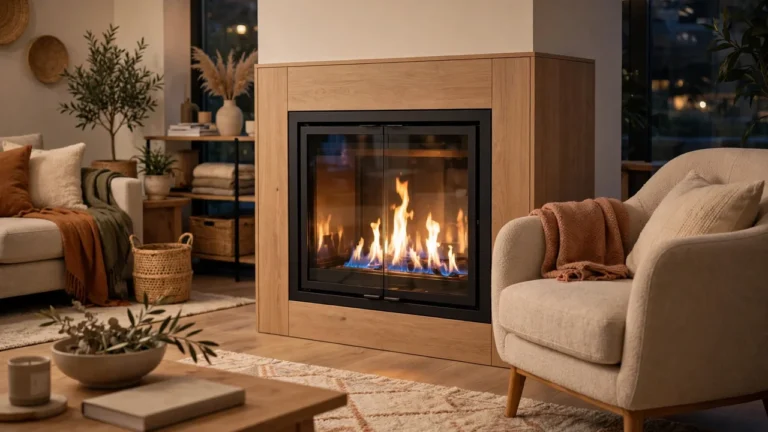
A direct vent gas fireplace is a factory-built fireplace that burns natural gas or propane inside a sealed combustion chamber. The chamber is closed off from your room by a fixed glass front, and a sealed coaxial vent pipe handles all the breathing: fresh air comes from outside, exhaust goes back outside.
That “sealed” part is the whole point. Older fireplace styles pull the air they burn from the room you are sitting in, then push exhaust up a chimney. A direct vent unit never borrows your heated room air, which is why it wastes less of it.
Most homeowners buy direct vent for one practical reason: it puts a real gas flame almost anywhere in the house — including rooms with no chimney at all — without pulling drafts through the doors and windows.
Anatomy of a Direct Vent Gas Fireplace
- Sealed firebox — the closed chamber where the gas burner and ceramic logs sit.
- Fixed glass front — keeps flames and exhaust sealed off from room air.
- Coaxial vent pipe — a pipe inside a pipe; the outer channel brings outdoor air in, the inner channel carries exhaust out.
- Termination cap — the covered outlet on your wall or roof where the vent ends.
- Burner and ignition — lights the gas; some models use a millivolt pilot, others use electronic ignition.
How the Coaxial Pipe Actually Works
Picture a pipe within a pipe. The larger outer pipe draws cool, fresh air in from outdoors and feeds it to the burner. The smaller inner pipe carries hot exhaust — including carbon monoxide — in the opposite direction, straight back outside.
There is a neat side effect: the hot exhaust in the inner pipe warms the cold incoming air in the outer pipe before it reaches the burner. The fireplace starts its burn with air that is already warmer, which helps it run with less waste.
The system is pressure-balanced, so it does not need a tall chimney to create draft the way a wood fireplace does. That is why the vent can be short and run sideways through an exterior wall instead of climbing all the way to the roof.
Direct Vent vs. B-Vent vs. Ventless: How They Differ
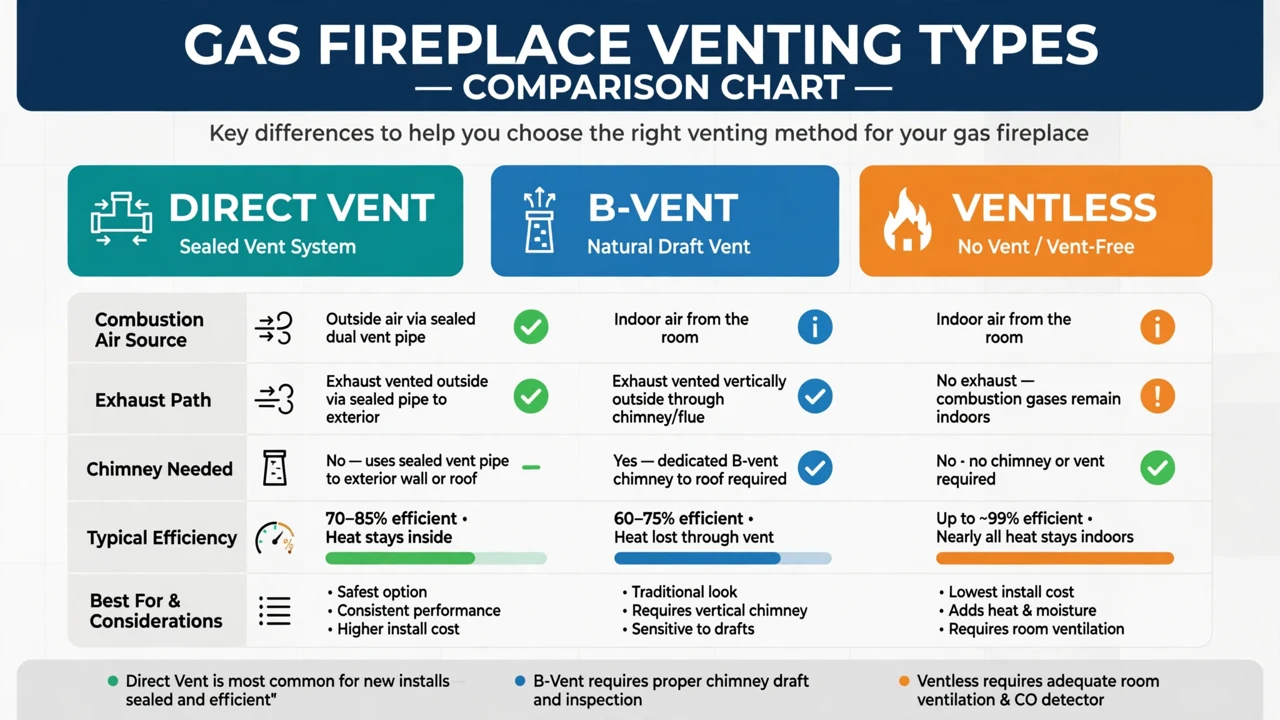
Three venting styles cover almost every gas fireplace. The difference comes down to where the combustion air comes from and where the exhaust goes. This choice shapes efficiency, cost, and safety, so it pays to know which is which before you shop.
| Direct Vent | B-Vent (Natural Vent) | Ventless | |
|---|---|---|---|
| Combustion air | From outdoors | From the room | From the room |
| Exhaust path | Outside, through the coaxial pipe | Outside, up a chimney or flue | Released into the room |
| Chimney needed? | No | Yes | No |
| Sealed firebox? | Yes | No | No |
| Heat use | Does not waste warmed room air | Sends some warmed room air up the chimney | Keeps all heat indoors — but releases combustion byproducts indoors too |
B-vent fireplaces are the older style. They burn room air and send exhaust up a vertical chimney, much like a traditional fireplace. Because they consume the air you already heated, they lose more warmth up the flue and can pull cold drafts in through gaps around doors and windows.
Ventless (vent-free) fireplaces need no pipe at all, which makes them cheap to install. Be clear-eyed about the trade-off: they release combustion byproducts — including carbon monoxide and water vapor — directly into your room. They are restricted or banned in some states and are not allowed in bedrooms in many areas. They rely on an oxygen-depletion sensor and demand a working CO alarm, and local codes always get the final word.
For a deeper side-by-side, see our vented vs. ventless gas fireplace breakdown.
Where You Can Install One
This is where direct vent shines. Because the vent can terminate horizontally through an exterior wall, you can add a fireplace to rooms that never had one — a bedroom, a basement, or an addition built long after the chimney question was settled.
Interior walls work too. The vent pipe runs up through the attic or a framed chase and exits through the roof with a proper termination cap. The route stays short and direct either way; that flexibility is why direct vent leads most new installations today.
There are rules, of course. The termination cap needs set clearances from windows, doors, and corners, and the fireplace needs clearances from combustible materials — your installer reads these off the manufacturer’s manual and local code. A room with a gas supply nearby keeps the project far simpler than one across the house from the gas line.
Honest Pros and Cons
No venting style is perfect. Here is how direct vent looks with both feet on the ground:
✓ What it does well
- No chimney or masonry needed
- Sealed combustion protects indoor air quality
- Keeps warmed room air inside instead of sending it up a flue
- Works in tightly built modern homes
- Millivolt models keep heating through a power outage
- Short, flexible venting routes open up more room layouts
✕ The trade-offs
- Higher upfront cost than ventless
- Professional installation required — no DIY gas or vent work
- The glass front gets very hot; a barrier screen is wise with kids and pets
- Termination placement must respect clearance rules
- Needs a gas line run if the room has none
What Installation Involves (and Who Should Do It)
Here is the honest part: the gas-line and venting work is not a weekend project. A licensed gas professional plans the vent route, runs or extends the gas supply, sets the termination clearances, pressure-tests the connections, and pulls the permits and inspections your area requires.
The process runs in a predictable order. The installer assesses the site and gas access, secures permits, connects the gas and vents, tests the flame pattern and checks for CO issues, then finishes the surround — stone, tile, mantel, and trim come last.
Your job as the homeowner is picking the unit, the placement, and the finish — then staying out of the gas work. If a bid skips permits or testing, that is your sign to call someone else. For a full walkthrough of what this project runs, see our guide on how much it costs to install a gas fireplace.
What One Costs
Costs swing with the unit you pick, how far the vent and gas lines run, and finish materials. Published 2026 figures give you a realistic band to start from: Angi reports direct-vent insert installations averaging $4,300–$11,200, while Cunningham Oil’s homeowner guide places a brand-new direct vent fireplace with no existing opening at roughly $5,500–$10,000+ installed.
Four things move the number most: the unit’s size and features, the venting route, the gas-line run, and the surround. Labor, venting materials, and finish work each add their share, and permits usually run a modest separate fee.
Treat any single figure with caution — regional labor rates differ widely. Get two or three written quotes from licensed installers, and compare what each one includes before you decide.
Living With It: Care and Safety
Day to day, a direct vent fireplace asks little of you. Keep the area in front of the glass clear, and wipe the glass with a cleaner made for fireplace glass when soot or haze builds up — never with household glass cleaners that can damage the coating.
Once a year, have a licensed professional service the unit: they check the burner, ignition, glass seal, and vent termination, and confirm the CO alarms are in place. Keep snow, leaves, and nests away from the termination cap outside, since a blocked vent is a genuine hazard.
Test your CO alarms monthly and replace them per the manufacturer’s guidance. And the rule never changes: gas smell means leave first, call from outside, and let the professionals handle the rest. Also worth knowing — if your home loses power often, ask specifically about millivolt models; our guide to whether a gas fireplace can run without electricity walks through the ignition types.
Frequently Asked Questions
Does a direct vent gas fireplace need a chimney?
No. The coaxial vent can terminate horizontally through an exterior wall or vertically through the roof, so no masonry chimney is required at all.
Can I install a direct vent fireplace on an interior wall?
Yes. The vent pipe runs up through the attic and out the roof. A licensed professional plans the route and confirms all clearances.
Are direct vent gas fireplaces safe?
They are widely regarded as the safest gas fireplace style, because sealed combustion keeps the flame and exhaust completely separate from your indoor air. You still need CO alarms on every level, tested monthly, plus annual professional service.
Will a direct vent fireplace work during a power outage?
Many do. Models with a millivolt ignition system light and run without household electricity, while electronic ignition models need power to start.
How much does a direct vent gas fireplace cost?
Angi’s 2026 data puts direct-vent insert installations around $4,300–$11,200, and a brand-new fireplace with no existing opening often lands between about $5,500 and $10,000+ installed. Your area and venting route decide where you land in that range.
Can I install one myself?
No. Gas-line and venting work belongs to a licensed gas professional, and most areas require permits and inspections before the unit can run.
📄 Quick Reference: Direct Vent Gas Fireplace
- Definition: sealed-combustion gas fireplace; coaxial vent draws outdoor air in and exhausts outside.
- Chimney: not required — vents through an exterior wall or the roof.
- vs. B-vent: no room-air loss up a chimney; vs. ventless: no combustion byproducts released indoors.
- Cost band: roughly $4,300–$11,200 for inserts (Angi, 2026); $5,500–$10,000+ for brand-new installs (Cunningham Oil).
- Safety: CO alarms on every level and near sleeping areas, test monthly; gas smell = leave and call from outside.
- Install: licensed gas professional only — permits, pressure tests, and inspections included.
Wrapping Up
A direct vent gas fireplace is, at heart, a sealed glass box that breathes outdoor air. The coaxial pipe handles both directions of that breathing, so your room keeps its warm air while the exhaust leaves through the wall or roof.
If that sounds like the right fit, your next step is a quote from a licensed installer — bring your room’s size and a photo of the wall you have in mind. And if you are still weighing gas against other options, our gas vs. electric fireplace comparison will help you decide which fuel suits your home.