Why Is My Gas Fireplace Beeping? 7 Causes & How to Fix Each One
Why is My Gas Fireplace Beeping? Quick fix: When the gas fireplace starts beeping, there is a battery in the system that is low somewhere, either in the distant, the receiver or a backup ignition module. That’s it. It is a reminder to service, not an emergency.
However, beeping sometimes indicates a larger problem, such as a jammed ignition cycle or a carbon monoxide alarm in the vicinity, and so it is worth taking five minutes to eliminate that possibility before you change anything.
The following is a list of each actual cause, in descending order of probability, and the specific solution to each, as well as how to distinguish between being annoyed by something and it actually being dangerous.
Key Takeaways
- 90% of the time, it’s batteries. It is not the fireplace itself that is not functioning, but a low power signal being sent by the remote, the receiver box, or a backup ignition module.
- Beep pattern matters. One slow chirp after every 30-60 seconds is nearly always a battery alert. An ignition or safety fault can be indicated by rapid, sustained or three-beep patterns.
- Always remember to never mix a fireplace beep and a CO alarm. When you smell of gas, spot soot, or feel dizzy or nauseated, around the fire place, it is an emergency of carbon monoxide, vacate the house and call your gas utility or 911, not a repair phone.
- The majority of these fixes can be completed in less than 10 minutes and only need a screwdriver and fresh AA or D-cell batteries.
- Beeping persists after replacing batteries in all the compartments, then the problem is probably the receiver security code, the sensor is faulty or the control board – call a certified hearth technician.
Beeping from Gas Fireplace Units
Gas fireplaces beep due to the majority of the current generation devices being operated by a combination of household current, standing pilot systems, and battery-operated electronics – remote receivers, back-up ignition modules, or wall thermostats. Any of those elements has a low-battery chirp as an in-built warning signal, similar to a smoke detector. The beep is not the fireplace malfunctioning – it is a minicomputer on board informing you that one of the parts requires new batteries or a restart.
Is a Beeping Gas Fireplace Dangerous?
Generally, no. By itself, a beeping gas fireplace is not a safety hazard. It is nearly never a gas leak alarm but an electronics caution, a gas fireplace does not have a gas leak alarm built into the unit. That task is the smoke and carbon monoxide detectors of your house, which are independent devices.
With any of the following, however, you should consider it an emergency:
- A sulfur-like or rotten-egg odor in the area of the fireplace or gas line.
- Accumulation of soot on the glass, logs or wall adjacent to the unit.
- A flickering, yellow, or lazy fire, rather than a steady blue fire.
- Headache, lightheadedness or nausea that feels better when you get out of the room.
- Your individual CO detector is chirping or alarming as well.
Should any of those be applicable, switch off the fireplace, and open the room, and call your gas utility provider or a professional as soon as possible. Otherwise, reason out the following causes.
Is Gas Fireplace Beeping Sound Indicate an Issue?
Usually not all gas fireplace unusual sounds indicate an issue with the fireplace. To identify the exact issue, you need to pay close attention.
- 1 chirp, single, when you press the remote: weak remote batteries.
- During no remote: weak receiver batteries. slow, steady chirp with no remote, every 30-60 seconds.
- Chirp when attempting ignition: poor backup ignition module batteries.
- Quick or hysterical beeping and adjusts itself: scrambled distant security code.
- Three beeps with or without a flashing red or amber light: an ignition or safety lockout.
- Each pattern is further detailed as its entire cause and fix in the table below.
The 7 Real Causes of a Beeping Gas Fireplace
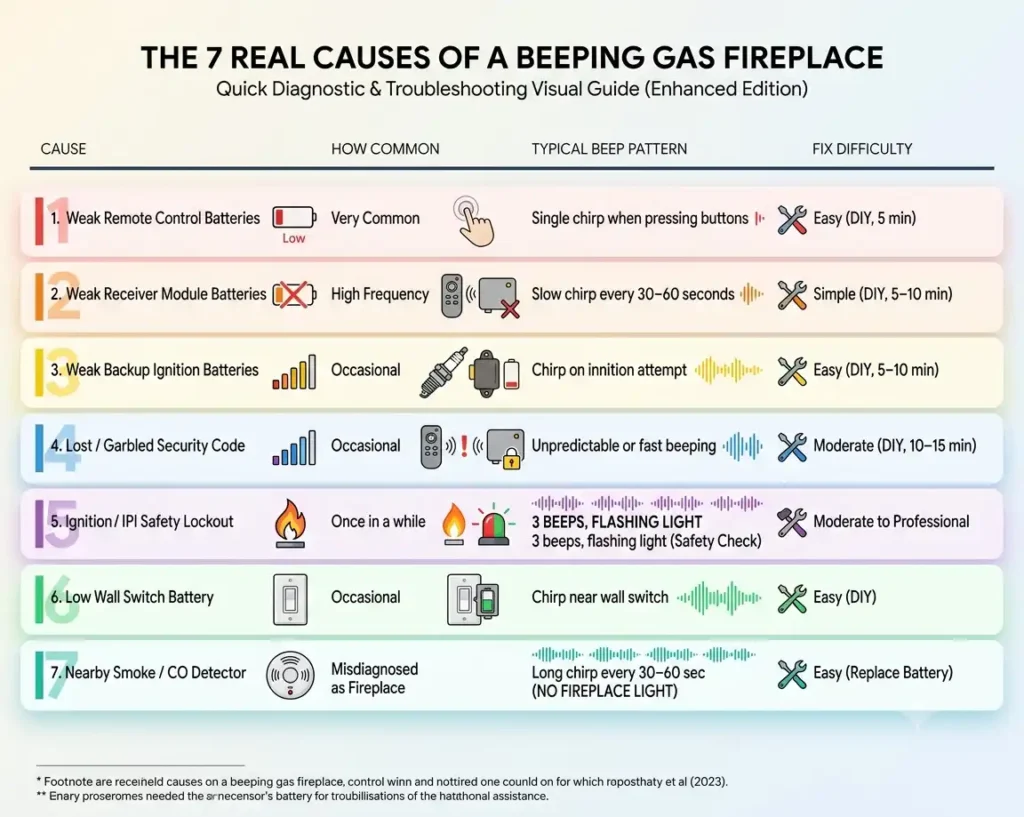
| Cause | How Common | Typical Beep Pattern | Fix Difficulty |
| Weak remote control batteries | Very common | Single chirp when pressing buttons | Easy (DIY, 5 min) |
| Weak receiver module batteries | High frequency | Slow chirp every 30–60 seconds | Simple (DIY, 5–10 min) |
| Weak backup ignition module batteries | Occasional | Chirp on ignition attempt | Easy (DIY, 5–10 min) |
| Lost or garbled remote security code | Occasional | Unpredictable or fast beeping | Moderate (DIY, 10–15 min) |
| Ignition / IPI safety lockout | Once in a while | 3 beeps, frequently accompanied by a flashing light | Moderate to Professional |
| Low wall switch / thermostat battery | Occasional | Chirp near the wall switch, not the firebox | Easy (DIY) |
| Nearby smoke / CO detector (misdiagnosed as fireplace) | Typical misdiagnosis | Long chirp every 30–60 seconds (no fireplace light) | Easy (DIY) – Replace detector battery |
1. Factories Weak Remote-Control Batteries.
This is the most common cause. When you press the button on a weak remote, the unit can give a small beep to warn you the signal is going dead before it cuts off.
How to Fix:
Find the battery cover on the back of the remote, replace the old ones with new ones of the type listed in your manual (AA or AAA, or sometimes a coin cell) and test.
2. Weak RM Batteries.
The back of the lower grill of most remote-operated gas fireplaces has a receiver box that listens to the signal of the remote, opening the gas valve. This receiver is powered by its own batteries – independent of the remote – and it generally requires new batteries more frequently than the remote. A dying receiver will beep, and frequently flash a little red light, and then cease to work altogether.
How to Fix:
Find the receiver box (consult your owner manual – it is typically clipped or screwed into position next to the valve, behind a louvered door). Replace the batteries simultaneously, and each of the batteries must be in the proper position – one battery inverted is an extremely frequent cause of replacement failure.
3. Weak or Damaged Ignition Module.
A significant portion of the intermittent pilot ignition (IPI) line of fireplaces have a battery powered backup ignition module to allow the unit to still ignite and light during a power outage. These modules are usually powered by 2 D-cell batteries. When they are depleted, the fireplace beeps to make you aware that it might not be able to light consistently in case of power interruption.
How to Fix:
Locate the module (typically in the area of the gas valve or control compartment) and change both of the D-cell batteries together.
4. Missing or Lost Remote Security Code.
Remote controlled fireplaces have a matched security code between the remote and receiver so that the garage door of your neighbor does not open your fireplace. This pairing can be scrambled by battery replacement, power bursts or stuck button leading to erratic beeping despite the replacement of batteries.
How to Fix:
See your manual to the LEARN or SYNC procedure. Usually, you position the slide switch of the receiver to REMOTE, you press the LEARN button on the receiver and then press MODE (or ON) on the remote within a few seconds. The re-synced code is normally confirmed by a change in the beep pattern.
5. Ignition or IPI Safety Lockout.
When the fireplace tries to light and will not start (due to dirty pilot, closed gas valve, low gas pressure, or a failed igniter) most control systems will lock out and beep in a certain sequence (usually three beeps, sometimes with a flashing red/amber light) instead of repeatedly trying and potentially causing a gas accumulation. This is an authentic safety measure that performs as it should, rather than a nuisance chirp.
How to Fix:
Switch the system off, wait a few minutes and attempt a complete manual reset according to your model. Should the lockout recur, do not continue to cycle it – this would indicate a thermocouple, thermopile, igniter or control board problem that would require a certified technician.
6. Wall Switch Battery Low or Thermostat Battery Low.
When a wireless wall switch (or thermostat) is used to operate your fireplace, rather than (or in addition to) a handheld remote control, the switch usually has its own battery that can emit a similar low-battery chirp, which is sometimes audible near the switch, not near the firebox.
How to Fix:
Test the battery compartment of the switch (typically behind the faceplate) and change when necessary.
7. It is Your Smoke or CO Detector.
This is a rather common confusion. A nearby chirping smoke or carbon monoxide detector may very well sound like a fireplace receiver beep, particularly through a wall. You might not see any blinking light on the fireplace itself, so first make sure you look at the detectors in the same room and hallway.
How to Fix:
Change the battery in the detector. Should it be a CO detector, and you have any doubts about whether it is the detector or the fireplace making the beep, consider it a potential CO incident and follow the aforementioned safety measures until you know it was a low-battery alarm.
Heat & Glow Fireplace Beeping: Brand-Specific Notes.
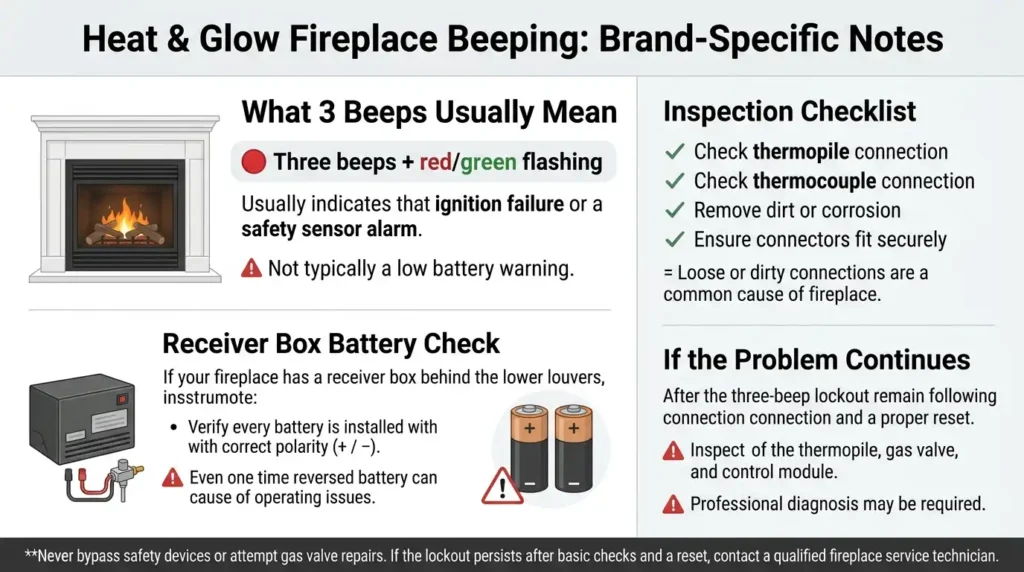
The most common questions on beep-code search results include Heat & Glo units, and the trend is typically unique: three beeps with a red-to-green flashing light is an indication of an ignition failure or a safety sensor alarm, not a low battery. Check that the thermopile and thermocouple are clean and well-fitting before resetting the unit as the most frequent trigger is a loose or dirty connection.
Assuming your Heat & Glo fireplace does have a receiver box behind the lower louvers, again, make sure all the batteries are facing the correct direction, (one battery on backwards is a common, easy-to-overlook error on this model). Three-beep lockouts that persist even following a clean reset probably require professional troubleshooting of the thermopile, gas valve, or control module.
Gas Fireplace Beeping vs. CO Alarm: How to Tell the Difference
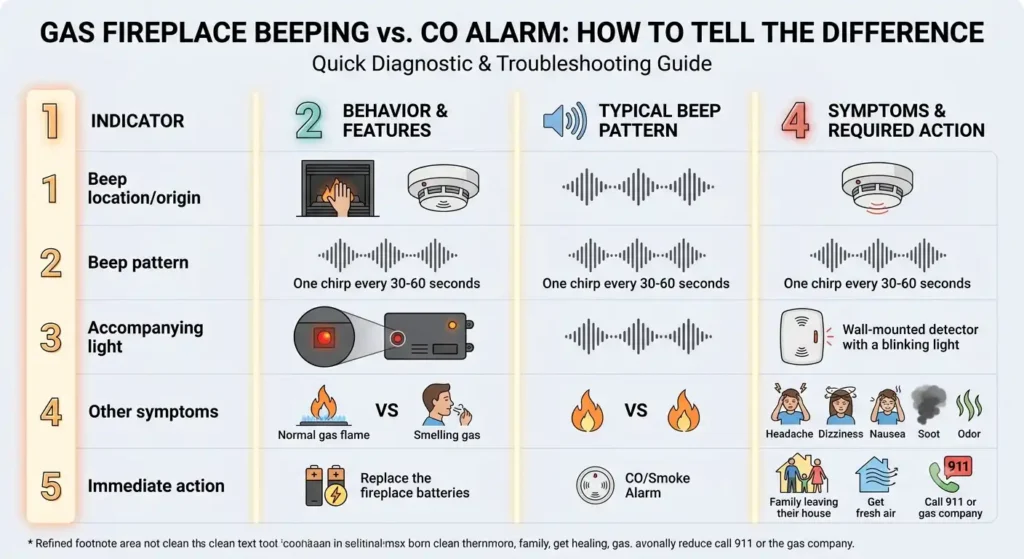
| Feature / Indicator | Likely Fireplace Battery Warning | Likely CO/Smoke Alarm |
|---|---|---|
| Beep location/origin | Behind fireplace grill or remote itself | Ceiling- or wall-mounted detector unit |
| Beep pattern | One chirp every 30–60 seconds | One chirp every 30–60 seconds (patterns may appear identical) |
| Accompanying light | Small red/amber light on the receiver box | Blinking light directly on the detector unit |
| Other symptoms | Flame appearance and smell remain normal | Headache, dizziness, nausea, soot, or gas odor |
| Immediate action required | Replace fireplace receiver / remote batteries | Leave the house immediately, get fresh air, and call 911 or your gas company |
Unless your first thought is of which device it is chirping, always assume it is a potential CO alarm at first. Fireplace battery alerts are a minor inconvenience, but a missed CO alarm is not.
How Do I Stop My Gas Fireplace from Beeping
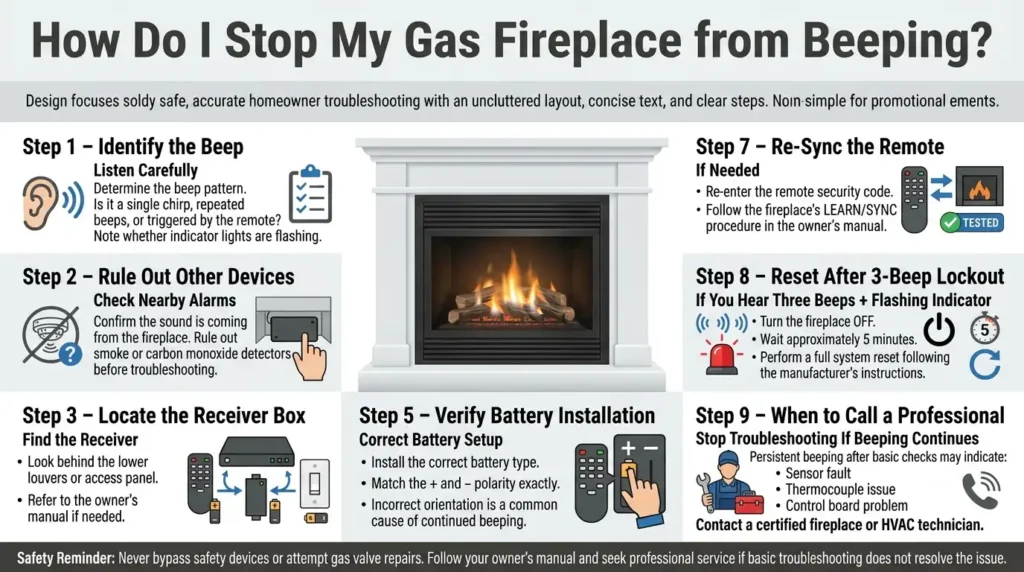
- Determine the precise beep code and schedule: Is it always the same, a single chirp on the timer, or is it related to a button press on the remote?
- Dis rule smoke/CO detectors in the room first. Walk towards the sound to ensure that it is caused by the fireplace or remote.
- Find the receiver box behind the lower louvers or the access panel – it may be behind the lower louvers or it may be behind the access panel depending on your owner’s manual.
- Change batteries in the following sequence: remote, receiver, backup ignition module, wall switch – it is more efficient to change all of them at the same time and not to repeat the journey in the future.
- Battery orientation and battery type are as specified in the manual; a reversed or incorrect type battery is one of the most common false fixes.
- Test the remote at normal distance and observe the beep to cease.
- In case the beeping persists, re-enter the security code of the remote, following your LEARN/SYNC instructions.
- When beeping 3 beeps with a flashing light, or the fireplace is not lighting, power/gas off, wait 5 minutes, and do a full system reset as per the manual.
- When it continues to beep, despite all of the above, cease troubleshooting and call a certified hearth or HVAC tech – this indicates a sensor, thermocouple, or control board problem.
Why Is My Gas Fireplace Beeping? Common Mistakes to Avoid
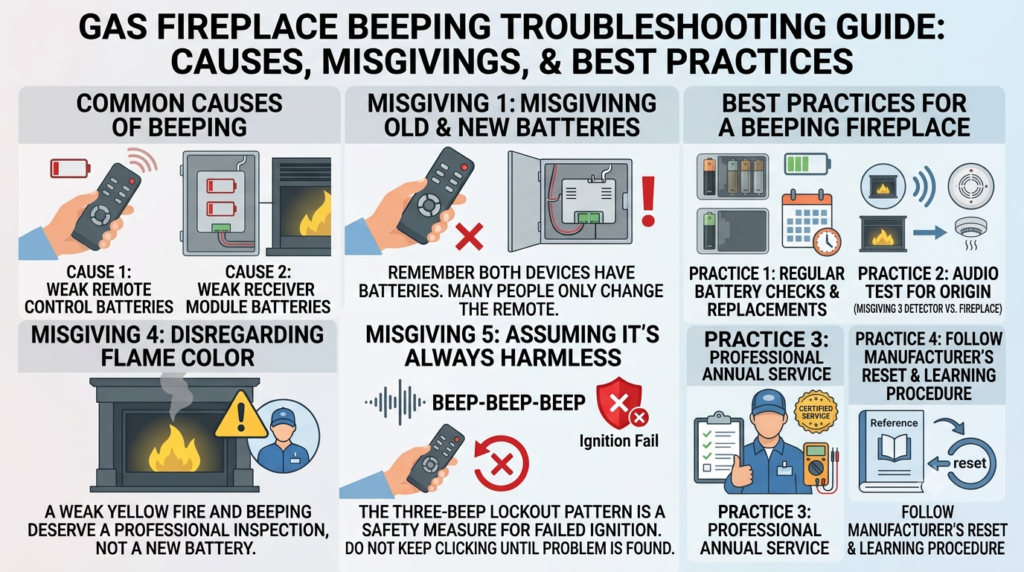
- Mingling old and new batteries. never replace one at a time but a whole set.
- There are batteries to forgetting the receiver, independent of the remote – many people just change the batteries in the remote, and the beeping still goes on.
- Disregarding a peculiar (colour of flame). A sluggish yellow fire and beeping deserves a professional inspect, rather than a replacement of a battery.
- It is always harmless and that is an assumption. The three-beep lockout pattern is a safety measure indicating that something did not ignite as it was supposed to – do not simply keep clicking it every time until you locate the problem.
- Improper type of battery or poor brand that can run out quicker and repeat beeping after a few weeks.
Myth vs. Fact
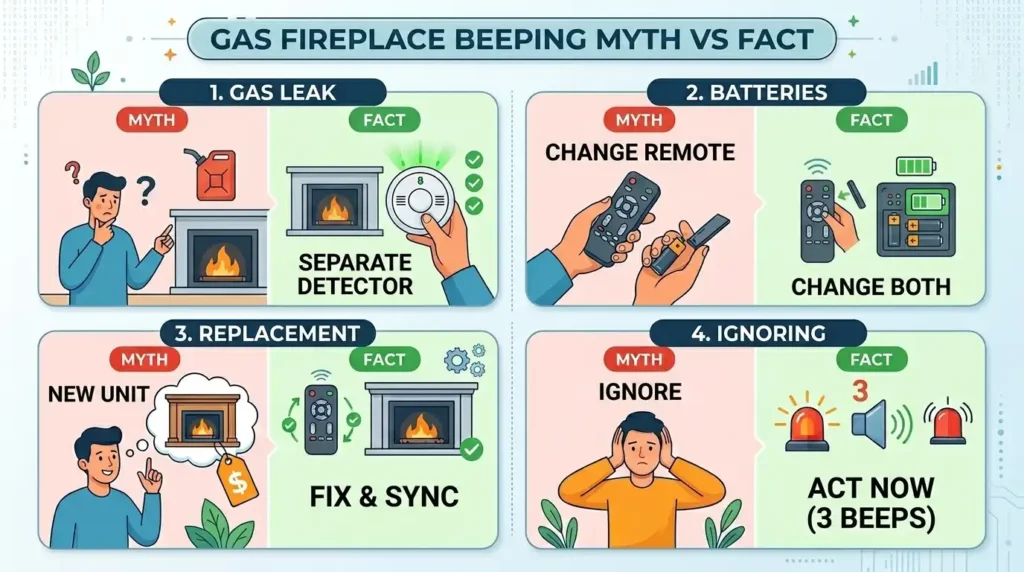
| Myth | Fact |
| There is never a leak of gases without beeping. | Gas fireplaces do not include a built-in gas leak alarm; detecting gas or carbon monoxide is the job of an independent detector. Almost any beep directly from the fireplace is related to a low battery or ignition alert. |
| If I change the remote batteries, the beeping will stop. | The receiver box inside the fireplace usually has its own set of batteries, which are independent of the remote. Both the remote and receiver batteries need to be checked and replaced. |
| If it’s beeping, I require a whole new fireplace. | Most beeping issues are fixed simply by changing batteries or re-syncing the remote control code rather than replacing the unit. |
| It is all right to ignore the beeping and see what happens. | An ignition lockout (often indicated by 3 beeps and a flashing light) can cause further system issues if unaddressed. Always address the beep quickly and verify it is not a carbon monoxide alarm. |
Gas Fireplace Beeping Won’t Turn On: What It Means
When your fireplace is beeping and will not light at all, there are two most likely causes: too weak batteries to open the gas valve, or an ignition lockout due to an unsuccessful light attempt. Begin by changing all battery compartments remote, receiver and backup ignition module as a valve, which cannot draw sufficient power, just will not open, despite a good pilot being present.
When new batteries do nothing, and you see a repeating three-beep pattern, then consider that it has a safety lockout: turn off all power and all the gas and wait a few minutes and then, according to your manual, do a complete restart. The lock out which continues following a clean reset indicates a thermocouple, igniter, or control board issue requiring a certified technician instead of another battery change.
How Often Should You Replace Fireplace Batteries?
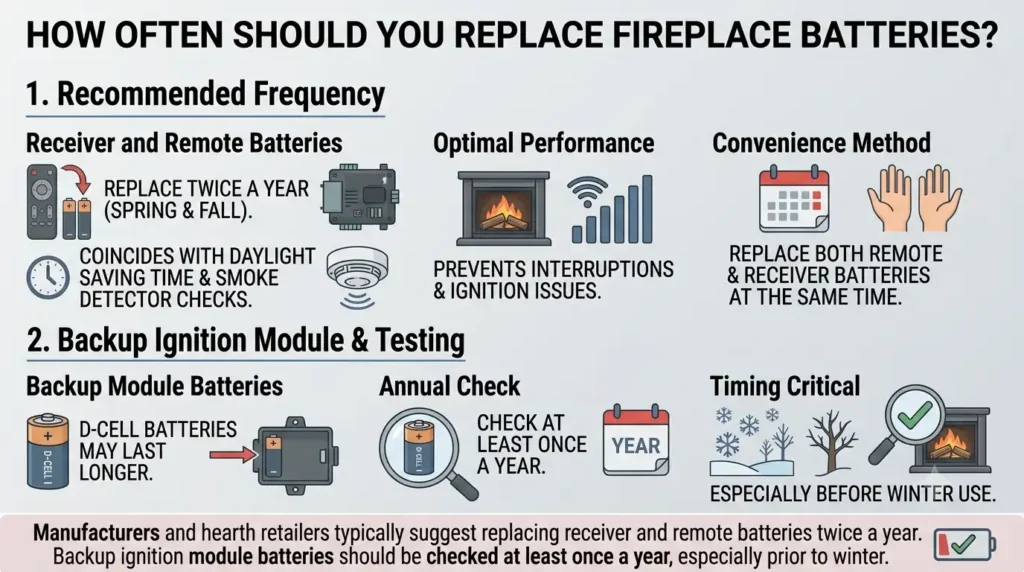
Manufacturers and hearth retailers typically suggest that receiver and remote batteries be replaced twice a year – one easy method to do it is to replace them at the same time you change your smoke detector batteries when you change daylight saving time in the spring and fall. Batteries in the backup ignition module (usually D-cells) may last longer, however, these should also be checked at least once a year, particularly prior to winter since the fireplace is used most during that time of year.
You May Also Read
- Why Gas Fireplace Wont Light? Causes & Fixes Explained
- Electric Fireplace Error Codes (E1to E5) Causes & Fixes
FAQs:
Why is my gas fireplace beeping but I do not have a remote?
Even when you never use a handheld remote, some units still have a receiver or backup ignition module, and can beep on its own low-battery schedule. Look behind the bottom access door to check a battery compartment, or check smoke/CO detectors around.
Why does my gas fireplace beep thrice?
A three-beep sequence, and more so one with a flashing light is usually a sign of an ignition failure or safety sensor malfunction and not a low battery. This is dependent on the model, and thus please refer to your owner’s manual to find the correct code and do not keep re-setting the alarm without fixing the problem.
Will I be allowed to remove the batteries so as to put the beeping to a stop?
You can, but in remote-controlled or IPI systems, it can be possible to simply remove the batteries, and the fireplace will not even start, as many of the valves rely on battery power to open. It’s better to replace them than remove them.
Why is my gas fireplace beeping but the pilot light is on?
In millivolt systems, the standing pilot may be left hot regardless of whether the receiver is on or off, and the remote batteries are on or off, as the pilot itself does not require battery power. The beeping then is nearly always the remote or receiver warning you individually.
Where is the receiver box on my gas fireplace?
It is usually a small plastic box behind the lower louvered grill or access panel, occasionally held with a zip-tie or clips close to the gas valve. The model of your owner should indicate its exact location.
What type of battery does a gas fireplace receiver have?
This is dependent on the manufacturer – usually AA batteries, but some backup ignition modules are powered by D-cell batteries. Look in the manual of your owner or label on the side of the compartment, as the incorrect type may lead to recurring failures.
My gas fireplace won’t turn on; why is it beeping?
This set of symptoms frequently indicates batteries too feeble to crack the gas valve, or an ignition lockup following a unsuccessful light request. The first thing to do is to replace batteries; after that, it still will not boot up, turn it into a lockout and go through the reset procedure above.
How do I stop my gas fireplace from beeping?
Work through the causes in order of likelihood: replace the remote batteries, then the receiver box batteries, then any backup ignition module batteries, making sure each one is inserted in the correct direction. If it keeps beeping, re-sync the remote’s security code. This resolves the vast majority of cases without a service call.