What Gas Heaters Can You Use Indoors? A Complete Guide to Safe Types, Rules, and Buying Tips
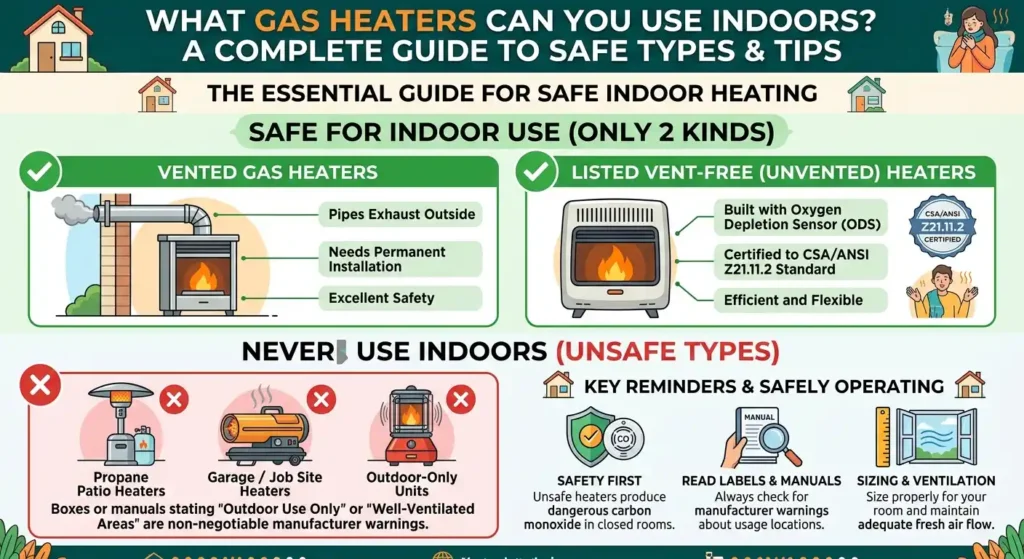
The Short Answer: Only two kinds of gas heaters belong indoors: vented heaters, which pipe exhaust outside through a flue, and listed vent-free (unvented) heaters, which are built with an oxygen depletion sensor and certified to CSA/ANSI Z21.11.2. Anything else such as the propane heaters that are sold to use in patios, garages and job sites are not safe to operate in a closed room. When the box or manual of a heater states that the heater should only be used outdoors or in well-ventilated areas, it is not a recommendation. It is the manufacturer who is telling you that the unit will generate unsafe amounts of carbon monoxide when boxed in.
That one difference, vented and listed-unvented and all the rest, is the most lacking information that the shopper is likely to miss when he or she searches this subject. The remainder of this guide will go through the reasons why it is important, how to test a particular heater, and how to size and operate one safely.
Why This Question Matters More Than You’d Think
Carbon monoxide (CO) heating equipment poisoning is not an isolated, accidental incident. It’s a well-documented seasonal pattern. The history of the U.S. Consumer Product Safety Commission with unvented heaters is long and painful: in 1978, the agency attempted to prohibit unvented gas space heaters altogether after they were implicated in at least 60 cases of carbon monoxide poisoning or asphyxiation since 1973. Regulators did not ban it, but instead mandated oxygen depletion sensor on all unvented units, which explains why that aspect is so important nowadays.
Despite the advanced safety technology, CPSC continues to issue warnings to consumers each winter. Gas space heaters that are improperly vented continue to be a significant source of CO poisoning: when a heater is improperly vented, or not vented at all, or the vent is blocked or corroded, the home can be filled with dangerous levels of carbon monoxide. And home heating equipment CO poisoning puts thousands of people in the ER annually and more than 200 to death according to CPSC own statistics.
Important lesson: It is not about being too cautious. It is about having awareness of the type of heater you are really holding before you plug it in or light it.
Vented vs. Unvented (Vent-Free): The Distinction That Decides Everything
Vented Gas Heaters
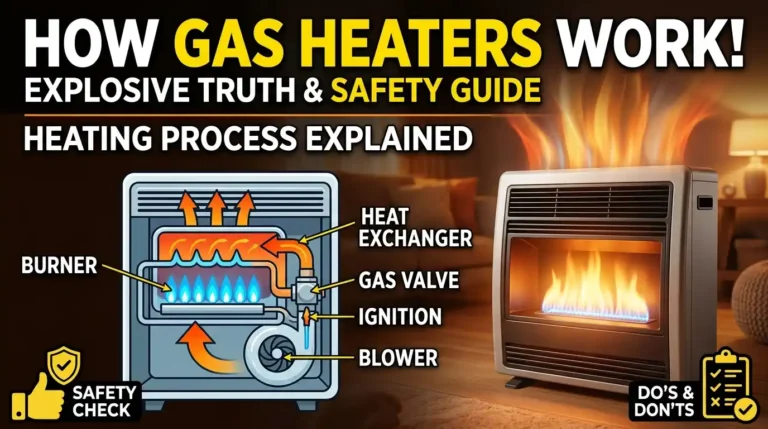
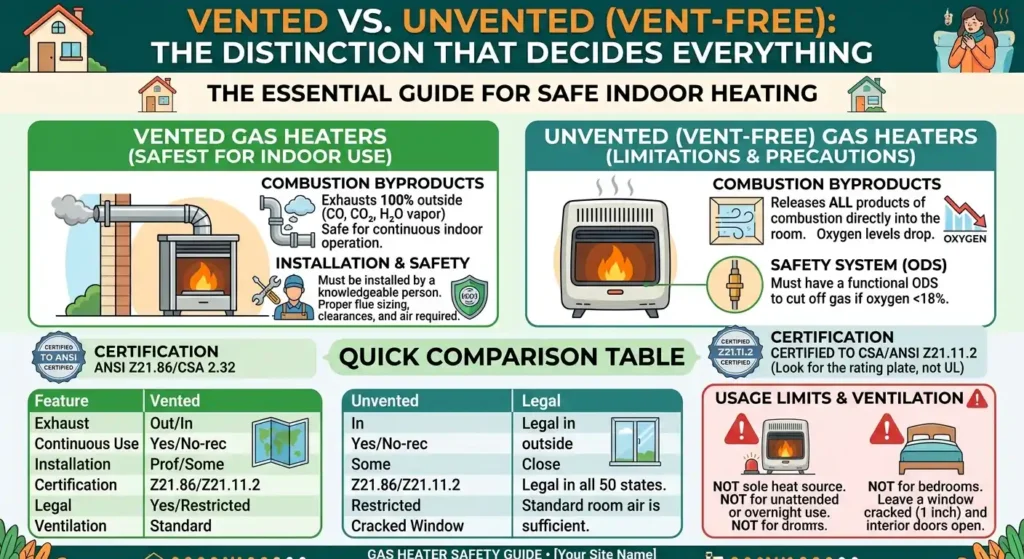
A vented heater burns natural gas or propane and exhausts 100% of combustion byproducts (carbon monoxide, carbon dioxide, water vapor, nitrogen oxides) outside of the home via a flue pipe or direct-vent system. Since no exhaust of that type remains in the room, vented heaters are the safest gas source to use in the continuous indoor operation, as a supplemental or primary heat source in certain jurisdictions.
Vented units should be certified to ANSI Z21.86/CSA 2.32 (vented room heaters) and must be installed by a person knowledgeable in appropriate flue sizing, clearances and combustion air requirements.
Unvented (Vent-Free) Gas Heaters
Unvented heater releases all the products of combustion directly into the room you are in. That is scary and this is why these heaters are under such scrutiny, however, the current unvented heaters that comply with the current safety standards are supposed to have an oxygen depletion sensor (ODS).
The ODS will cut off the gas supply to the heater when the oxygen concentration in the room becomes less than approximately 18 percent, as compared to the normal level of 20.9 in the atmosphere. That will provide a shutoff before CO can accumulate to a lethal level, provided that the sensor is functional and the heater is not too large to serve the room.
Unvented heaters should be certified to CSA/ANSI Z21.11.2. Check that certification number on the rating plate, not merely a UL listed sticker, as UL and CSA/ANSI are different in what they cover about the appliance.
Notable exception: A certified, ODS-equipped unvented heater is not intended to be your sole source of heat, left unattended, or in a bedroom in most jurisdictions. The advice of CPSC itself is to leave a window open at least one inch and leave interior doors open to the rest of the house to ensure that there is enough ventilation when one of these is in operation.
Quick Comparison Table
| Feature | Vented Gas Heater | Unvented (Vent-Free) Gas Heater | Outdoor Propane Heater |
| Exhaust goes outside? | Yes, via flue/vent | No, released into room | No, and not designed to be indoors at all |
| Safe for continuous/overnight use | Yes, with proper install and CO detector | Not recommended for overnight or unattended use | Never indoors |
| Requires professional installation | Usually yes | Sometimes (built-in wall units) or no (portable ODS units) | N/A |
| Certification to look for | ANSI Z21.86/CSA 2.32 | CSA/ANSI Z21.11.2 with ODS | Outdoor-rated only |
| Legal in all 50 states | Yes | No, banned in California; restricted elsewhere | N/A, not intended for indoor use anywhere |
| Ventilation needed while running | Standard room air is fine | Cracked window + open interior doors | N/A |
The 4 Types of Gas Heaters, Ranked by Indoor Suitability
1. Vented Wall or Console Heaters
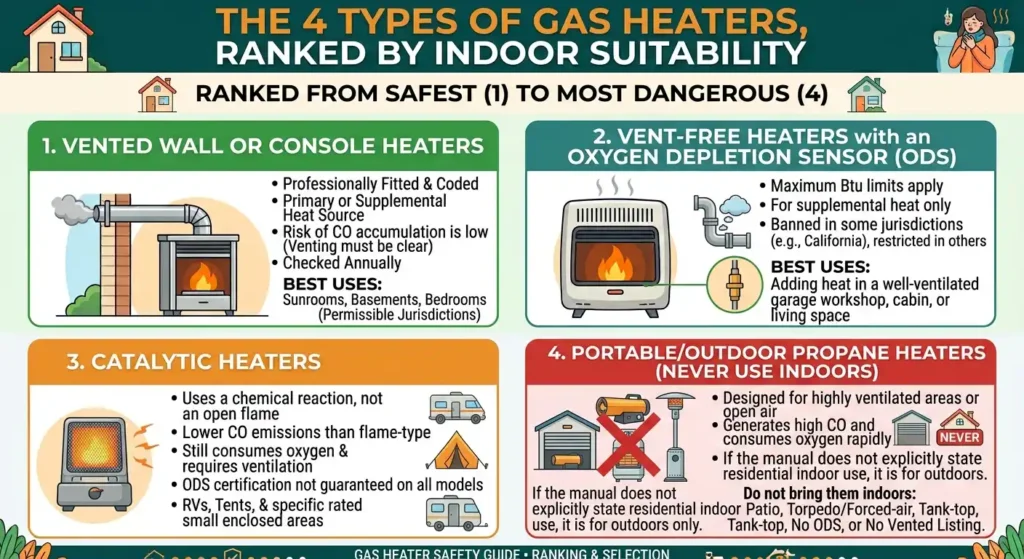
They are professionally fitted and connect to an outside wall or an existing flue. They are the nearest to a set it and forget it gas heat source in the bedroom, sunroom or basement. Since the gases of combustion leave the house, the risk of CO on a daily basis is low, as long as the vent is not covered with debris, nests of birds, or snow, and is checked once a year.
Best: Homeowners seeking a permanent, code-compliant gas heat source to a particular room.
2. Vent-Free Heaters with an Oxygen Depletion Sensor (ODS)
This encompasses small wall-mounted unvented heaters and part of portable indoor-rated propane and natural gas heaters. These are legal in the majority of states (California is the big exception) but have practical limitations: they have a maximum Btu input, many codes forbid them in bedrooms and bathrooms unless specifically listed to that purpose, and they were never intended to be a primary source of heat in a home.
The mechanical code guidance in California prohibits unvented gas heaters as primary heat, limited in bedrooms and bathrooms to small, listed ODS wall units with limited strict input limits, and banned in Group R residential occupancies in that state.
Best use: Adding heat in a garage workshop, cabin or well-ventilated living space, but never as the sole source of heat in a home.
3. Catalytic Heaters
Catalytic heaters do not burn propane in an open flame, but rather rely on a chemical reaction to generate heat, and thus, reduces CO emissions relative to a conventional flame-type unvented heater. A variety of catalytic models are sold as safer to use in enclosed areas such as tents or RVs.
They do not cease to use oxygen and do not cease to need ventilation, and not every one of them is the same ODS certification as vent-free wall heaters, so read the listing carefully before you think that anything called catalytic is necessarily indoors-safe.
Best in: RVs, tents, and small enclosed areas where the particular model is specifically rated to be used.
4. Portable/Outdoor Propane Heaters (Not to be used indoors)
This is the type that brings the greatest confusion, and the majority of accidents. Patio heaters, so-called torpedo style construction heaters and tank-top propane heaters are designed to be used in open-air or highly-ventilated areas such as a garage with the door open. CPSC is straightforward on this one: portable propane space heaters should not be used in a confined space or indoors unless it is specially intended to be used indoors.
A heater does not have to have toxic printed on the box to be a hazard inside the house. In case the manual does not specifically identify indoor residential use, then it is outdoor only.
Do not ever bring them indoors, even on a temporary basis: patio heaters, torpedo/forced-air construction heaters, tank-top propane heaters and any heater that lacks an ODS or vented-listing.
What Gas Heaters Can You Use Indoors? Heaters You Should Never Bring Indoors
- any heater that is marked to be used outdoors.
- Grills as a source of heat, either charcoal or propane.
- Kitchen stoves and ovens (gas or electric) to heat a room. CPSC specifically cautions against the use of gas or electric stoves to heat the home, as they are not intended to heat the home and may be a source of CO or fire.
- Generators or generator-powered heaters are operated in a garage, basement, or in open windows.
- Unvented heater in a room less than the recommended minimum square feet.
- Unvented heaters (without an apparent ODS certification) of older models (before 1980s) are not required to have the standard.
Is It Legal to Use an Unvented Gas Heater in Your State?
Rules are not as consistent as most shoppers would expect. California is the only state in the United States to have an outright ban on unvented gas heating appliances, following a number of other states (Alaska, Montana, Minnesota, New York, and Massachusetts) repealing similar bans over the years. The law of California, in particular, forbids the sale of any unvented heater intended to be used in a dwelling, with limited exceptions of electric heater and decorative gas logs in a vented fireplace.
Restrictions continue to manifest locally outside California. The City of New York forbids the installation of unvented gas-fired space heaters, gas logs, and gas fireplace inserts throughout the city, and Minnesota forbids ventless gas appliances in cities with a population of over 2,500.
What this implies to you: Although a vent-free heater can be sold nationally, your city or state might limit or prohibit it. Before buying, check with your local building department or fire marshal, especially if you live in California, New York City, or Minnesota.
How to Tell If a Gas Heater Is Approved for Indoor Use
Test yourself with this checklist prior to purchasing or plugging in any gas heater:
- Do not read the packaging photograph, read the label. Even when the fine print indicates that a heater can be used outdoors only, marketing pictures depict a heater in a living room.
- Find a certification number. ANSI Z21.86/CSA 2.32 should be listed on vented units. CSA/ANSI Z21.11.2 should be listed in unvented units.
- Test an oxygen depletion sensor (ODS). This must be clearly stated in the manual and not implied.
- Make sure the Btu rating is appropriate to your room size. A large unvented heater in a small room burns the oxygen away at a rate that the sensor can not be adjusted to detect safely.
- Review your local code. Search “[your state] unvented gas heater regulations” or call your local building department.
- Check that it is not a decorative or outdoor only product that has been incorrectly labeled as a gas heater in a general merchandise section (this is common in large box stores).
Sizing a Gas Heater to Your Room (Btu Chart)
Small heaters are not efficient. Unvented heaters that are oversized have the capacity to deplete room oxygen at a faster rate and recycle the ODS shutoff more frequently. General planning estimate (actual requirements depend on insulation, ceiling height, and climate):
| Room Size | Approximate Heat Output Needed |
| 150 sq ft | 4,500 to 5,500 Btu/hr |
| 300 sq ft | 9,000 to 11,000 Btu/hr |
| 450 sq ft | 13,500 to 16,500 Btu/hr |
| 600 sq ft | 18,000 to 22,000 Btu/hr |
Speedy fact: These are approximate planning ranges, not to be confused with the room-size rating printed on the unit itself by the manufacturer. The reason why manufacturers post the actual minimum room sizes of unvented heaters is that undersized rooms are not only a comfort problem, but also a safety problem.
Safety Rules for Running Any Gas Heater Indoors
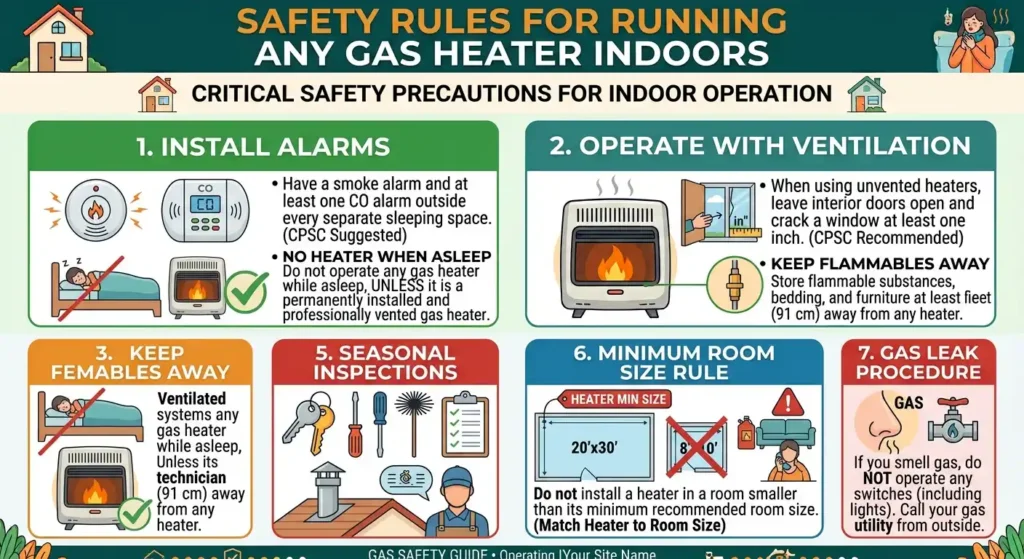
- Have a smoke alarm, as well as a carbon monoxide alarm; CPSC suggests at least one CO alarm outside of every separate sleeping space.
- When operating an unvented heater, leave at least an inch of a window open, and leave interior doors open, as recommended by CPSC.
- Do not operate any gas heater when asleep unless it is a permanently installed and professionally vented gas heater.
- Store flammable substances, bedding, and furniture at least three feet away from any heater.
- Ventilate and flues: Ventilated systems and flues should be professionally checked prior to every heating season.
- Do not install a heater with a minimum room size higher than the size of a room in a smaller room, once.
- If you smell gas, don’t operate any switch, including a light switch. Call outside to your gas utility.
Warning Signs of Carbon Monoxide Exposure
CO poisoning resembles the flu, and this is the reason why people are taken by surprise. Be aware of headache, dizziness, nausea, confusion, or unusual fatigue, particularly when more than one person (or pet) in the house feels it and the symptoms subside when you are out. In case this occurs, switch off the heater, get everyone outside and seek medical assistance. CO is colorless, odorless, so the only sure early warning is a working CO alarm; do not trust your own feelings.
This is not medical advice, but general safety information. In case you are suspected of being exposed to active carbon monoxide, consider it as an emergency and call your local emergency services.
Myth vs. Fact
Myth: “Ventless” means it doesn’t need any ventilation at all.
Fact: Vent-free simply means that the exhaust is not piped out of the building. It also needs ventilation to the outside in the room, which is why manufacturers have a minimum size of the room and, in many cases, a window that is open.
Myth: With a heater that has an oxygen sensor, it is okay to leave it running at night.
Fact: The majority of manufacturers and CPSC advice continue to caution against the use of any unvented heater when unattended or when sleeping, ODS or not.
Myth: A patio heater is just a larger version of an indoor gas heater.
Fact: Patio heaters are constructed to burn in the open air. One of the more frequent causes of accidental CO poisoning that CPSC specifically cautions against is to bring one into a garage with the door closed, or any enclosed room.
Myth: New heaters do not require a CO detector, as they are safer.
Fact: All gas burning appliances, new and old, can produce CO when they malfunction, are abused or installed in a space that is too small. A CO detector is not an option, but a backup.
Our Picks: Indoor-Safe Gas Heater Types Worth Considering
Instead of identifying particular models that switch stock and specs frequently, the following are the ways to shop each safe category:
- Permanent room heat source: A permanently installed vented wall or console heater that is certified to ANSI Z21.86/CSA 2.32. Have an HVAC contractor size and install it.
- To provide supplemental heat in a garage, workshop, or cabin: A vent-free heater that is marked to CSA/ANSI Z21.11.2 with an integrated ODS, sized to the minimum square footage of the room, and a plug-in CO detector.
- In a tent, RV, or a very small enclosed area: A catalytic heater specifically designed by the manufacturer to be used in an enclosed area, and a battery-operated CO alarm is used as a backup as RVs do not always have household CO detectors.
In either case, purchase a product with a retailer that displays the certification standard on the product page, and retain the manual because it records the precise room-size and ventilation needs of your model.
FAQs
Are you able to use a gas heater indoors?
Yes, but only vented gas heaters and unvented (vent-free) heaters that are specifically listed and certified to be used indoors, preferably with an oxygen depletion sensor. Job-site propane heaters (outdoors and portable) are not safe inside.
What is the difference between a vented and unvented gas heater?
A vented heater directs combustion exhaust to the outside by a flue. An unvented (vent-free) heater discharges exhaust into the room and uses an oxygen depletion sensor and open-air ventilation to ensure safety.
Is it safe to leave a gas heater on overnight?
No, in general, unless it is a permanently installed professionally vented system that is properly vented and has a functioning CO detector in the immediate vicinity. The majority of manufacturers and CPSC guidelines discourage the use of portable or unvented heaters when unattended or when sleeping.
Do indoor gas heaters need a carbon monoxide detector?
Yes. All houses with any type of gas-burning heater must have a CO alarm, preferably located outside of each sleeping space, whether the heater is vented or not.
Is it possible to use an outdoor gas heater inside with an open window?
No. Outdoor rated heaters (such as patio and torpedo propane heaters) are not designed with the same combustion controls as interior-listed units and an open window is not enough to provide the airflow necessary to safely burn in a confined space.
Are ventless (vent-free) gas heaters legal in all locations?
No. California prohibits sale of unvented heaters intended to be used in dwelling, and cities such as New York City outlaw their installation. They are locally restricted in some other states such as Minnesota. Look at your state and city codes prior to purchase.
What is the way to determine whether a gas heater has an oxygen depletion sensor?
Check the product manual and rating plate CSA/ANSI Z21.11.2 certified with an ODS on unvented heaters. Unless it is indicated in the listing, do not think it is included.
How big a room does a vent-free gas heater require?
It is dependent on the model and Btu rating; manufacturers have a minimum room size per unit. Average is about 30 to 40 Btu per square foot, but, of course, always use the printed minimum of a particular unit.
Will a gas heater not only cause CO poisoning, but also a fire?
Yes. Thousands of home fires happen annually because of space heaters, both gas and electric, and it is often due to their being placed too near combustible substances. Maintain a minimum of three feet of space between bedding, curtains and furniture.
Which is safer to use on an indoor heater propane or natural gas?
Both fuels are not necessarily safer indoors, but the difference in safety is due to the presence or absence of a vented and properly listed heater, and not the type of fuel it burns. Both emit carbon monoxide when the combustion process is not complete or the room is not well ventilated.
Is it possible to use a gas heater in a bathroom?
The majority of codes limit or ban unvented heaters in bathrooms because of the lack of ventilation and increased humidity. Before installing a heater there, be sure to check your local mechanical code and the listing of the heater.
What to do in case my CO alarm is on when a gas heater is on?
Switch the heater off, bring all people (and pets) out into the fresh air as soon as possible and dial emergency services or your gas company outside the house before going in again.
Are catalytic heaters carbon monoxide producers?
They generate lower CO than open-flame heaters due to the flameless catalytic reaction, but are not CO-free. Ventilation is necessary, and not all catalytic heaters are listed as vent-free wall units.
Why are there states that prohibit unvented gas heaters and not all states?
It mostly depends on the state adoption of building and mechanical codes, as well as past information on CO poisoning. California has implemented a statewide ban; the majority of other states use the CSA/ANSI Z21.11.2 standard and ODS requirement instead of an actual ban.
Final Thoughts
The most safe method of indoor gas heat is not complex, it is merely particular. The safest solution to continue the indoor heat is vented heaters installed properly. Vent-free heaters are also safe, but only within their recommended room size, with an ODS, and should not be used to replace the primary heating system in your home. All that is sold as patios, job-sites, or well-ventilated spaces is outside, period.
Whichever heater you purchase, make sure to verify the certification number, ensure that the Btu rating is appropriate to your room size, and install a CO alarm. That, the type of heater in the right area, combined with the simplest of monitoring, is the actual preventive of the accidents upon which this guide is constructed.