How Does a Gas Heater Work? Parts, Heating Process & Safety Guide
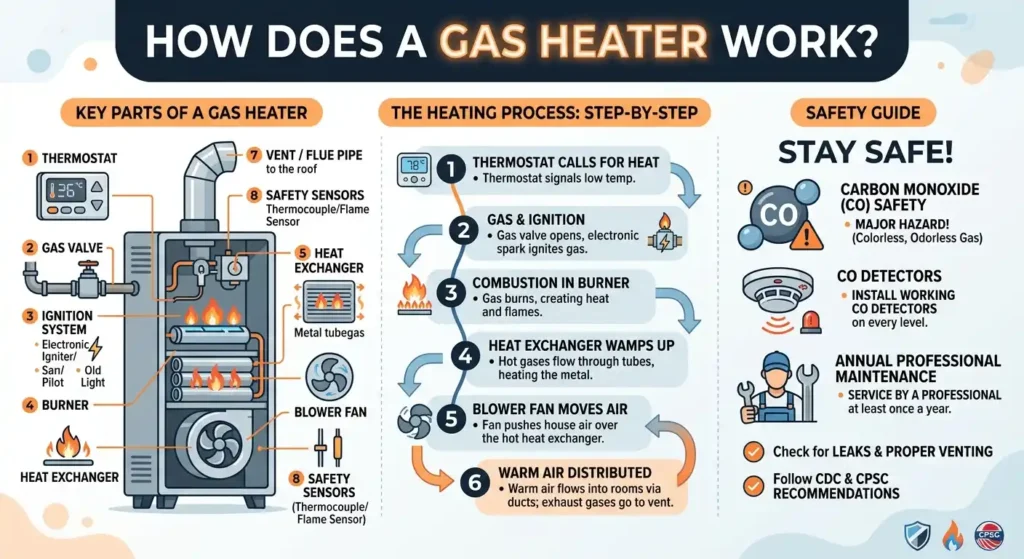
A lot happens in the few seconds before warm air reaches the room when your gas heater kicks on. Air is combined with gas, a pilot flame or a spark of gas sets it off, a heat exchanger grabs that heat, and a blower forces it into your home, all without a sound that some safety devices are in place, and everything is operating as it should.
This guide dissects each component of a gas heater, covers the entire heating process step-by-step, and discusses the safety measures that do matter, according to the accepted principles of fire and combustion and the recommendations of different organizations, such as the CDC and the U.S. Consumer Product Safety Commission (CPSC).
Key takeaways
- A gas heater burns natural gas or propane to produce heat, and transfers that heat to your living area with a heat exchanger and blower.
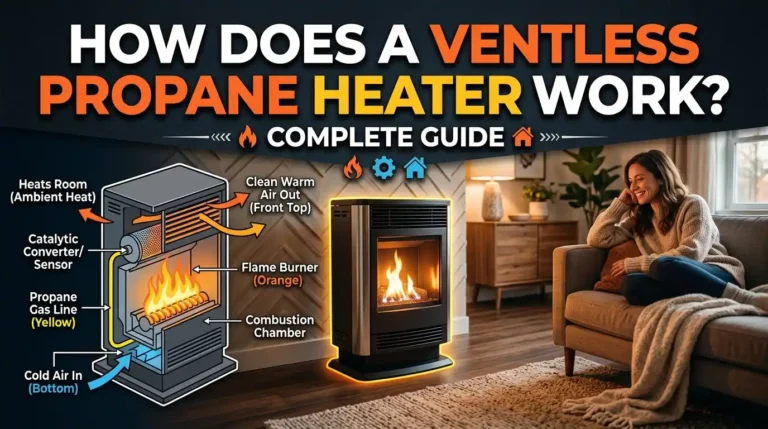
- The primary components include the burner, heat exchanger, ignition system, thermocouple or flame sensor, gas valve, thermostat, blower fan, and vent or flue.
- New gas heaters have electronic ignition; older models can still have a standing pilot light.
- Carbon monoxide is the largest safety hazard of any gas appliance, and working CO detectors and having them serviced by a professional at least once a year is not a luxury.
What Is a Gas Heater and How Does a Gas Heater Work?
A gas heater is a heating device, which burns natural gas or propane in a closed combustion chamber to generate heat, which is then transferred into the air in your house by a heat exchanger and a fan. The gases of combustion are safely discharged outdoors and the heated air is forced through ducts or directly into the room.
In brief: gas enters, it burns, the heat is transferred to air and the exhaust is released via a vent. All other components of the system are designed to ensure that process is efficient and safe.
The Main Parts of a Gas Heater, Explained
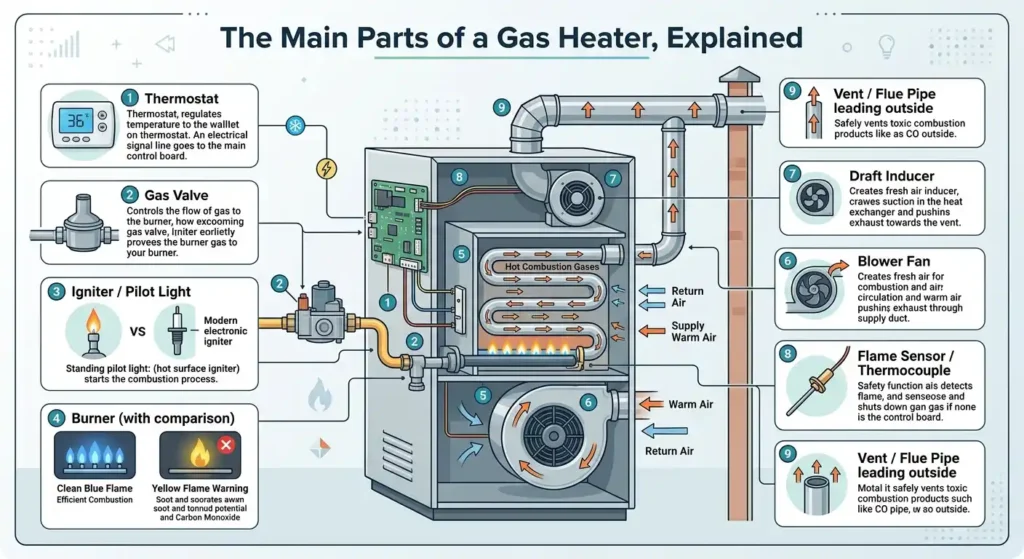
All gas furnaces, wall heaters, or gas-fired space heaters are based on the same basic components, with the specific arrangement differing by model.
| Part | What It Does |
|---|---|
| Burner | Where gas and air mix and ignite to create the flame |
| Heat Exchanger | Transfers heat from the flame to the air without letting combustion gases mix with your indoor air |
| Igniter or Pilot Light | Provides the spark or standing flame that lights the burner |
| Thermocouple or Flame Sensor | Confirms a flame is present and shuts off gas flow if it isn’t, a critical safety feature |
| Gas Valve | Controls how much gas reaches the burner, opening and closing based on signals from the thermostat and safety switches |
| Thermostat | Reads room temperature and tells the heater when to start and stop |
| Blower Fan | Pushes air across the heat exchanger and out into the home |
| Draft Inducer | A small fan that pulls combustion air in and pushes exhaust gases out through the flue |
| Vent or Flue | Carries carbon monoxide and other combustion byproducts safely outside |
Burner
The metal assembly in which the gas actually ignites is called the burner. Gas enters via small ports or holes and combines with air and burns in a controlled blue flame. A clean, well adjusted burner should give a steady blue flame; a yellow or flickering flame is often an indication of incomplete combustion, which may indicate increased carbon monoxide production.
Heat Exchanger
The heat exchanger consists of a series of metal tubes or chambers which are located between the flame and your indoor air. The blower forces room air over the outside of the exchanger as hot combustion gases go through one side, therefore heat is transferred through the metal without combustion byproducts being mixed with the air you breathe. One of the most severe gas heater issues is a cracked heat exchanger, as it may leak carbon monoxide into the airstream.
Igniter or Pilot Light
The older type of gas heaters utilizes a standing pilot light, a small flame that burns constantly and lights the burner each time the thermostat demands heat. The majority of heaters produced within the past few decades employ electronic ignition, either a hot surface igniter, or an intermittent spark igniter, which only becomes active when heat is required. This conserves fuel as opposed to a pilot that would run 24 hours.
Thermocouple or Flame Sensor
This is among the safety components that are most crucial in the whole system. A thermocouple is a miniature gadget comprising of two different metals which produces a small electric current when heated by the pilot flame. The gas valve is held open by that current. When the flame is extinguished, the thermocouple cools in a few seconds, the current is cut off and the valve automatically closes before the gas can accumulate in the home. More recent electronic-ignition systems employ a similar purpose flame sensor rod in their place.
Gas Valve
Fuel flow to the burner is controlled by the gas valve. It will not open until the thermostat demands heat and all safety interlocks are satisfied such as the flame sensor and draft inducer that the system is ready to safely ignite.
Thermostat
The thermostat measures the temperature in the room and tells the heater to turn on when the temperature goes below your set point and to turn off when the target temperature is achieved.
Blower Fan and Draft Inducer
The blower fan moves room air over the heat exchanger and moves the warmed air into your ducts or directly into the room. The draft inducer is a smaller fan that forces fresh combustion air into the burner and forces exhaust gases out of the vent, which assists the heater to ignite safely and burn efficiently.
Vent or Flue
The vent, also known as a flue or exhaust pipe, removes the byproducts of combustion, such as carbon monoxide, carbon dioxide and water vapor, safely out of the house. One of the causes of carbon monoxide accumulation in the house is a blocked, disconnected, or corroded vent.
How the Gas Heating Process Works, Step by Step
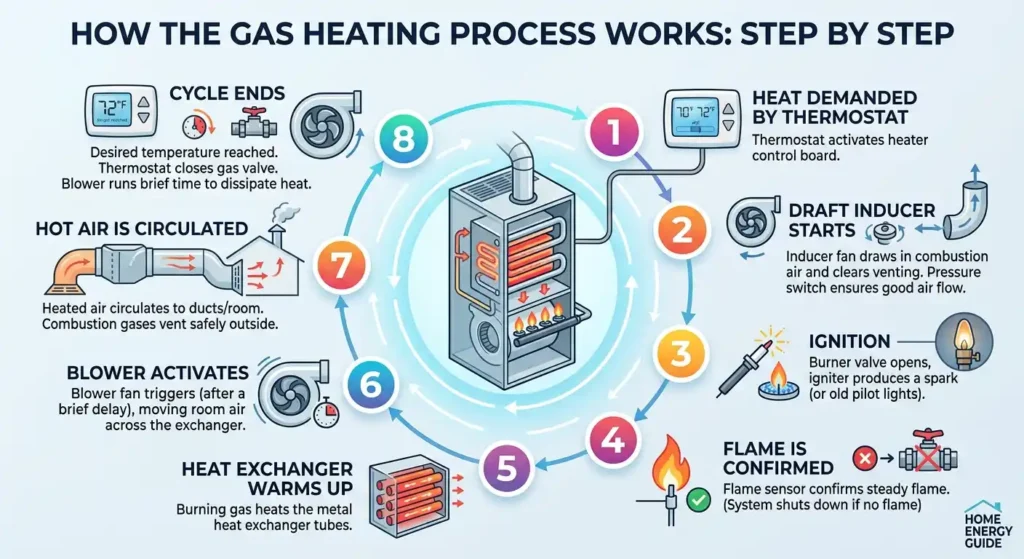
- Heat demanded by thermostat. The thermostat activates the heater control board when the temperature in the house is lower than what you set.
- Draft inducer starts. The inducer fan starts to draw in combustion air and clear the venting system and a pressure switch is used to ensure that there is good air flow before ignition is permitted.
- Ignition. The igniter produces a spark or warms up sufficiently to ignite the gas when the burner valve opens. In older units that have a standing pilot, the burner is directly lit by the existing pilot flame.
- Flame is confirmed. The thermocouple/flame sensor confirms that a steady flame is present. Otherwise, the system closes the gas valve in a few seconds as a precaution.
- Heat exchanger warms up. The metal heat exchanger is heated by the burning gas.
- Blower activates. The blower fan is then triggered after a brief delay to allow the heat exchanger to warm up, and moves room air across it.
- Hot air is circulated. The ductwork (or directly into the room in the case of wall and space heaters) is heated by heated air and the combustion gases are removed through the vent.
- Cycle ends. When the thermostat detects the desired temperature, it triggers the gas valve to be closed. The blower is usually left to run a little longer to dissipate any residual heat before it shuts off.
Types of Gas Heaters
All gas heaters do not operate in exactly the same manner. The following is a comparison of the key types.
| Type | How It Heats | Typical Use | Venting |
|---|---|---|---|
| Central gas furnace | Heats air through a heat exchanger, distributes via ductwork | Whole-home heating | Vented outside through a flue |
| Gas wall heater | Heats a single room directly, often with a small blower or by convection | Single rooms, additions, cabins | Vented or, in some older models, unvented |
| Gas space heater | Portable or fixed unit for supplemental heat | Small rooms, garages, workshops | Some are unvented (use with caution and ventilation) |
| Gas boiler | Heats water instead of air, which circulates through radiators or radiant flooring | Whole-home heating with radiators or hydronic systems | Vented outside |
Not every type on this list is safe to run indoors without restrictions. For a full breakdown of which gas heaters are approved for indoor use, the ventilation rules that apply, and what to look for when buying one, see our guide to gas heaters you can use indoors.
Gas Heater vs Electric Heater
| Factor | Gas Heater | Electric Heater |
|---|---|---|
| Heating speed | Generally heats faster, especially in cold climates | Can be slower for whole-home heating |
| Running cost | Often cheaper where natural gas prices are low | Can cost more per unit of heat, depending on local electricity rates |
| Installation | Requires a gas line and venting | Simpler installation, no venting needed for most units |
| Safety considerations | Requires carbon monoxide monitoring and venting | No combustion byproducts, but still a fire risk if used improperly |
| Lifespan | Typically 15 to 20 years with maintenance | Often 10 to 15 years |
| Best for | Cold climates, whole-home heating | Mild climates, supplemental or zoned heating |
Gas Heater Safety Guide
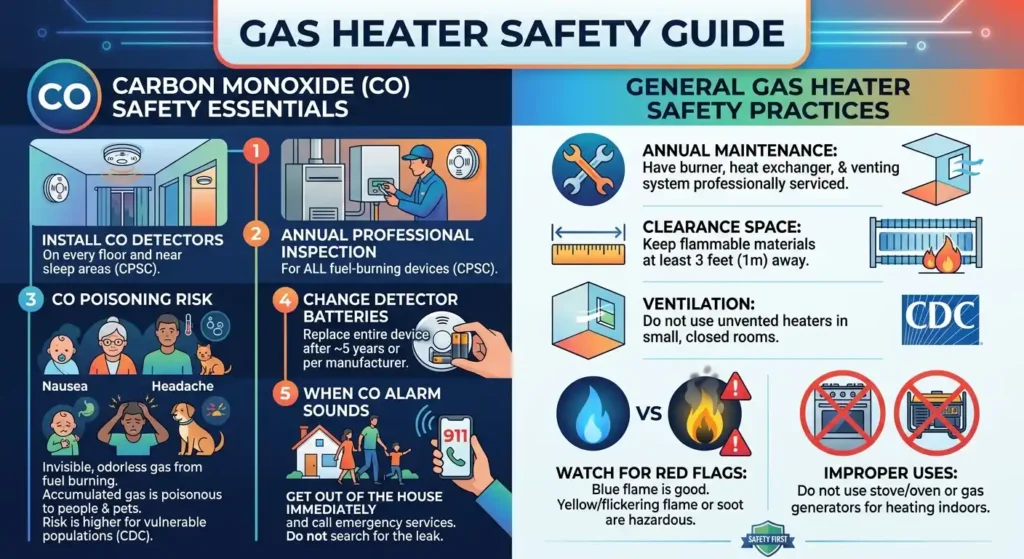
When properly installed and maintained, gas heaters are safe, but combustion appliances are dangerous when they are not effectively maintained. Carbon monoxide (CO) is the most serious issue, as it is an incomplete combustion product that is a colorless, odorless gas. Since CO is invisible and odorless, a leak in a heater may occur without any noticeable symptoms.
Carbon monoxide safety essentials:
- CPSC suggests that each household should have CO detectors on each floor and outside of each bedroom, and that all fuel-burning devices be professionally inspected annually.
- CO is formed whenever fuel is burned in stoves, furnaces, or other gas appliances, and may accumulate in the home and become poisonous to those who inhale it or pets.
- According to the CDC, infants, elderly individuals, and individuals with chronic heart disease, anemia, or breathing issues are at increased risk due to CO exposure, although any person may be at risk.
- Change batteries in the CO alarm regularly and change the entire device after about five years or as recommended by the manufacturer.
- When a CO alarm goes off, get out of the house and call the emergency services outside; do not attempt to find the source.
General gas heater safety practices:
- Have the burner, heat exchanger and venting system professionally maintained annually.
- Do not store flammable materials within three feet of the heater.
- Do not operate an unvented gas heater in a small, closed room without proper ventilation.
- Be alert to red flags: a yellow or flickering flame rather than blue, soot on the surrounding unit or lingering smell.
- Do not use a gas stove or gas oven to heat a room, do not operate generators or other equipment using gas in the house.
Common Gas Heater Problems and What They Mean
| Symptom | Likely Cause |
|---|---|
| Pilot light won’t stay lit | Weak or blocked pilot tube, faulty thermocouple |
| Yellow or flickering flame | Dirty burner, poor air mixture, possible venting issue |
| No heat but fan runs | Ignition failure, closed gas valve, or tripped safety switch |
| Heater cycles on and off frequently | Dirty air filter, restricted airflow, or thermostat issue |
| Unusual smell | Possible gas leak (rotten egg smell) or dust burning off at startup |
| Rising energy bills with no change in use | Aging heat exchanger, dirty burner, or worn-out parts reducing efficiency |
In case you can smell gas (rotten egg smell intentionally added to be detected) anywhere, evacuate the home, do not touch switches or flames, and call your gas utility or emergency services at a safe distance.
How to Maintain a Gas Heater
- Change or wash the air filter at least once every 1 to 3 months when heating.
- Do not block vents and registers with furniture or carpets.
- Have a professional inspection and tune-up at least once a year, preferably in advance of the onset of cold weather.
- Check CO and smoke detectors once a month.
- Make sure that the area surrounding the unit is clean and there is no dust accumulation as it can interfere with the airflow and combustion.
- Pay attention to strange noises, e.g. banging, rattling, squealing, and get them inspected.
Myth vs Fact
| Myth | Fact |
|---|---|
| “Gas heaters always produce dangerous levels of carbon monoxide.” | Properly installed, vented, and maintained gas heaters burn cleanly and vent CO safely outside. |
| “You’ll always smell a gas leak or CO buildup.” | Carbon monoxide has no smell at all; only a working CO alarm can reliably detect it. |
| “A pilot light means the heater is older and less safe.” | A standing pilot is simply an older ignition method. It isn’t unsafe on its own if the thermocouple and venting are working correctly. |
| “Gas heaters don’t need maintenance if they’re heating fine.” | Problems like a cracked heat exchanger or degraded venting can develop without any obvious change in heating performance. |
FAQs
What makes a gas heater turn on and off?
This is controlled by the thermostat. When the room temperature falls below your set point, it will trigger the opening of the gas valve to initiate the heating cycle; when the target temperature is met, it will trigger the closing of the valve.
Is it normal for a gas heater to smell when first turned on?
It is usual to have a slight dusty smell in a few minutes at the beginning of the heating season when dust is burned off the heat exchanger. A lingering smell, or a rotting egg smell, is not normal and should be examined immediately.
What is the average life of gas heaters?
A gas furnace is expected to last 15 to 20 years with annual maintenance, but depends on usage, quality of installation and manufacturer.
Is it possible to operate a gas heater without electricity?
The majority of recent gas heaters require electricity to operate the blower fan, control board and ignition system, and therefore will not work during a power outage despite the fuel source being gas. Certain older standing-pilot wall heaters are still able to warm up without electricity, as they do not use a blower, but rather natural convection.
What’s the difference between a vented and unvented gas heater?
Vented heater combustion exhaust is directed out via a flue or vent pipe. An unvented (ventless) heater emits the byproducts of combustion into the room, and this should be considered in relation to the size of the room, the ventilation and the run time to prevent the accumulation of CO.
Why does my gas heater have a yellow flame instead of blue?
Full, efficient combustion is indicated by a blue flame. A yellow or orange flame is normally an indication that the burner is not receiving sufficient air and this may enhance the production of the carbon monoxide and this is normally an indication that it is time to have a professional cleaning or check up.
Should gas heaters have a carbon monoxide detector?
Yes. Working CO alarms should be installed in any home with a gas heater, gas water heater, gas stove, or other fuel-burning appliance, according to the CPSC and CDC instructions.
What is the frequency of a gas heater maintenance?
The most common recommendation is once a year, which is usually recommended by most manufacturers and safety organizations, preferably at the beginning of the heating season.
What is a thermocouple, and why?
It is a little safety gadget which notices whether the pilot flame is on or not. In case of flame extinction, the thermocouple will switch off the gas supply after a few seconds, eliminating the unburned gas in the house.
Is it possible to have a house fire due to a gas heater?
This is not common in a properly maintained system but can occur when flammable materials are stored too near the unit, the heat exchanger is broken or when the system is not serviced on a regular basis.
Is a gas heater less expensive to operate than electric heater?
Natural gas is cheaper per unit of heat than electricity in most areas, but that depends on utility rates where you live, the efficiency rating of the heater that you use, and your climate.
What can I do when the pilot light of my gas heater goes off?
This usually indicates a poor or contaminated pilot tube, malfunctioning thermocouple, or a draft on the flame. It is a fix that should be left to a certified HVAC specialist, as it has to do with gas elements.
Can ventless gas heaters be safely used indoors?
When properly sized to fit the room, properly ventilated and never left unattended or overnight, they can be so. Most local codes limit or control their use and thus it is a good idea to check the rules in your area.
Final Thoughts
The work of a gas heater is reduced to three things: to burn gas in a clean way, to transfer that heat to your house, and to vent the exhaust out of the building safely. All the components within the unit, including the thermocouple and the draft inducer, are there to ensure that process is dependable and safe.
Being a homeowner, the most helpful thing you can do is not learn all the components, but be aware of the basics that will indeed help you avoid trouble: a functional carbon monoxide alarm, annual check-up by a professional, and observing such warning signs as a yellow flame or strange odor. When something doesn’t feel right, do not wait it out. A phone call to a certified HVAC specialist is much less expensive than a fix that was aggravated by neglect.