How Much Does It Cost to Run a Gas Fireplace? Work Out Your Hourly Cost
A gas fireplace can warm one room on a cold night, but many owners have no clear idea what each hour of heat costs them. This guide shows you how to work out your own cost with numbers from your own home. You need only three facts: your fireplace BTU rating, how many hours you run it, and the price you pay for gas.
Gas Safety: Read This First
Gas fireplaces can release carbon monoxide, a gas you cannot see or smell, so fit working carbon monoxide alarms on every level of your home and near sleeping areas. Test your alarms each month and replace them when the maker says to do so, and never disable a carbon monoxide alarm.
If you smell gas, which often smells like rotten eggs, do not touch light switches, flames, or appliances. Leave your home at once with all people and pets, then call your gas utility emergency line or 911 from outside.
Do not try to find or fix a gas leak, open a gas line, block a vent, or bypass a safety device. Gas line, install, and repair work beyond normal user controls in your manual and basic cleaning must go to a licensed gas professional.
Pets can be more sensitive to carbon monoxide and combustion fumes than people, and birds are at high risk. If a vent-free or ventless model is named in this guide, note that it releases combustion byproducts into the room, and local codes may restrict or ban its use.
Running cost is not the same as install cost. Running cost is what you pay each hour and each month to keep the fire lit, while install cost is the one-time price to buy and fit the fireplace. If you want install prices and what affects them, read our guide to the cost to install a gas fireplace.
The Simple Formula for Running Cost
For natural gas, the formula is easy once you know your numbers. Divide your fireplace BTU rating by 100,000, then multiply that result by the hours you run it and by your price per therm. The answer is your gas cost for that time, and you can use the same steps for one hour, one night, or one month.
Natural gas formula: (BTU rating ÷ 100,000) × hours run × price per therm = gas cost. For propane, ask your supplier how many BTU are in one gallon, then divide your BTU rating by that number to get gallons per hour, and multiply by hours run and your price per gallon.
Use the price from your own bill or your propane supplier, since rates change by area and by season. The examples in this guide use assumed rates only, so they show the math and do not quote your market price.
Step 1: Find Your Fireplace BTU Rating
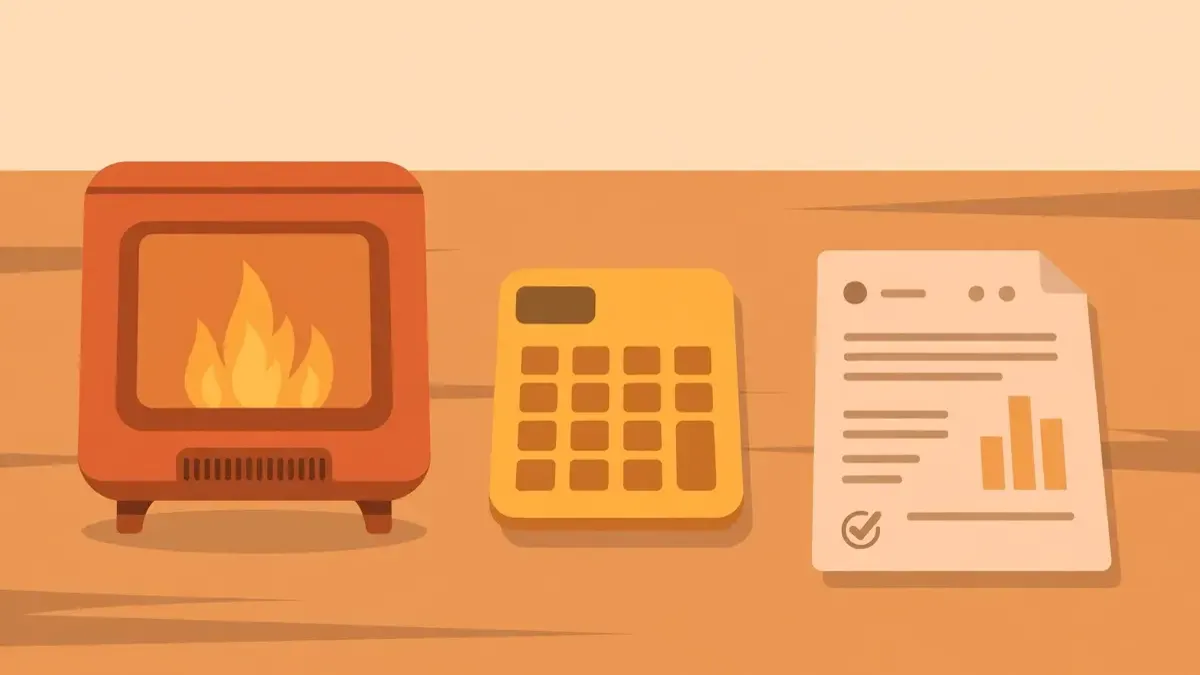
Your BTU rating tells you how much heat your fireplace can give out at full flame, and it is the first number in the formula. Look for a rating plate inside the fireplace, often near the controls or behind a lower panel, and check your manual for the same rating. If you cannot find the plate, search your model name and number on the maker website or call the maker for help.
Write down both the high and low BTU ratings if your manual lists two numbers, since many models can run at more than one heat level. The high number gives your cost at full flame, while the low number gives your cost at a lower flame. Keep this note near your bill so you can redo the math fast each winter.
Step 2: Find Your Gas Price
Your gas price is on your utility bill, but it can hide among fees and taxes, so read the bill with care. Look for a line that states a price per therm, and use that number as your rate for the formula. If no per-therm price is shown, divide your gas supply charge by the therms used, and note that taxes and fixed fees will add to your total bill.
Propane users should use the price per gallon from their supplier, not a price from a web post or a neighbor bill. Propane prices can change with each fill, so use your most recent fill price for the best estimate. Check your bill or supplier slip each time you want a fresh cost figure.
Step 3: Do the Math With Worked Examples
The table below shows three examples with assumed rates, and each example is labeled so you can see it is not a market quote. Change the BTU rating, hours, and price to match your own home, and the math will give your own cost. All three examples use natural gas, and the propane steps in the formula box work the same way with gallons.
| Example | BTU rating | Hours | Assumed price | Cost |
|---|---|---|---|---|
| Example A: one evening | 30,000 BTU | 3 hours | $1.20 per therm (assumed) | $1.08 |
| Example B: short evening | 20,000 BTU | 2 hours | $1.20 per therm (assumed) | $0.48 |
| Example C: high flame for one hour | 40,000 BTU | 1 hour | $1.50 per therm (assumed) | $0.60 |
Here is how Example A works, step by step, so you can check it with your own numbers. Divide 30,000 by 100,000 to get 0.3 therms per hour, then multiply 0.3 by 3 hours to get 0.9 therms. Multiply 0.9 therms by the assumed price of $1.20 per therm, and the result is $1.08 for the evening.
Low Flame vs High Flame
A low flame uses less gas than a high flame, so your cost can change a lot with one turn of the control. For this example, assume a fireplace rated at 40,000 BTU on high and 20,000 BTU on low, with an assumed price of $1.50 per therm. At those assumed numbers, low flame costs $0.30 per hour, while high flame costs $0.60 per hour.
Heat need also matters, since a small room may feel warm on low flame while a large open room may need high flame. Try low flame first on mild nights, and turn the flame up only when the room still feels cold after a short time. This habit can cut gas use without leaving you cold, and it keeps your cost easy to track.
What About the Pilot Light?
Some gas fireplaces have a standing pilot light, which is a small flame that stays lit all the time so the main burner can light fast. That small flame uses a small amount of gas each hour, so it adds a small cost each month even when you do not use the fireplace. Check your manual for the pilot BTU rating, then use the same formula for a full month of hours to find its cost.
Other models use electronic ignition, which lights the burner only when you ask for heat and has no standing pilot flame. If your model has a pilot switch, your manual may explain how to turn the pilot off in warm months, and you should follow that manual only. Do not adjust valves or parts beyond the normal user controls shown in your manual.
Do Not Forget the Fan or Blower
Many gas fireplaces have a fan or blower that pushes warm air into the room, and that fan uses home power. To find its cost, divide the fan watts by 1,000 to get kilowatts, then multiply by hours run and your price per kilowatt-hour from your power bill. The fan cost is often small next to gas cost, but it belongs in your total if you want a true hourly figure.
If you do not know your fan watts, check your manual or the label on the fan unit for the watt rating. Add the fan cost to the gas cost from the formula above, and you have your full running cost per hour. If your fireplace has no fan, skip this step and use the gas cost alone.
How to Lower Your Running Cost
You do not need a new fireplace to spend less on heat, since small habits can make a real change over a winter. Heat one room at a time, close doors to rooms you do not use, and run the fireplace only when people are in the room. These steps cut hours run, which is one of the three numbers in the formula.
- Run the fireplace on low flame when the room feels warm enough, and save high flame for very cold nights.
- Turn the fireplace off when you leave the room for a long time or when you go to bed, unless your manual says a timer or thermostat mode is safe for your model.
- Keep the glass and vents clean as your manual directs, since dirt and dust can hurt heat flow and make the unit work harder.
- Check door and window drafts in the room, since cold air leaks force you to run the fire longer for the same warmth.
- Use a room thermostat or timer if your model has one, so heat stops when the room reaches the temp you set.
Service also matters for cost and safety, so book a check by a licensed gas professional if the flame looks weak, yellow, or uneven, or if soot builds up. A weak flame can mean poor burn, and soot can point to a vent or burner fault that needs pro care. Do not take the unit apart or adjust gas parts on your own to chase a lower bill.
Gas Fireplace vs Central Heat: Which Costs Less?
A gas fireplace heats one room, while central heat warms a whole home, so a fair cost test must match the rooms you heat. If you spend the evening in one room and turn central heat down in the rest of the home, the fireplace can cost less for that evening. If you heat the whole home with the fireplace and central heat at full blast, you pay for both and save nothing.
To test this in your home, work out your fireplace cost per hour with the formula above, then compare it with your central heat cost for the same hours. Your bills and your home size decide the winner, so no web post can give you a true answer for your home. Use your own numbers, test for one week, and keep the setup that gives warmth at the lower total cost.
Choosing a Model With Running Cost in Mind
If you shop for a new fireplace, ask for the BTU rating range and the ignition type before you look at style or trim. A model with a wide BTU range gives you a low flame choice for mild nights and a high flame choice for cold nights. An electronic ignition model avoids standing pilot cost, while a standing pilot model may cost a small amount each month all year.
Vent type also affects heat and safety, so learn the trade-offs before you buy, and read our guide to vented vs ventless gas fireplaces. A direct vent gas fireplace pulls air from outside and vents fumes outside, which many owners prefer for indoor air. If you worry about indoor safety in general, read our guide on whether gas fireplaces are safe to use indoors, and check local codes with a licensed pro before you choose a vent-free model.
Power cuts raise one more cost and comfort point, since some models need power for fans, remotes, or ignition. Read our guide on whether a gas fireplace can run without electricity before a storm season, so you know what still works when power fails. A model that lights by hand or by battery may keep giving heat in a cut, while a power-only model may not.
Frequently Asked Questions
Does a gas fireplace use a lot of gas?
A gas fireplace uses gas in line with its BTU rating, so a high BTU model at full flame uses more gas than a low BTU model on low flame. Use the formula in this guide with your BTU rating and your price per therm to find your own hourly cost. Your hours run matter as much as the rating, since a short evening costs far less than all-day use.
Is it cheaper to run a gas fireplace than central heat?
It can be cheaper when you heat one room with the fireplace and turn central heat down in the rest of the home. It is not cheaper when you run both systems at full blast, since then you pay for both heat sources at once. Work out your fireplace cost per hour and compare it with your central heat cost for the same hours.
Does the pilot light cost much to run?
A standing pilot light uses a small amount of gas, so its monthly cost is small next to the cost of full flame use. Check your manual for the pilot BTU rating and use the formula in this guide for a full month of hours. Models with electronic ignition have no standing pilot cost, since they light only when you ask for heat.
Does a gas fireplace work without power?
Some gas fireplaces work without power, while others need power for ignition, fans, or remote controls. Check your manual to learn what your model needs, and do not assume it will light in a power cut. A model with manual or battery ignition may still give heat, while a power-only model may not light at all.
Is a ventless gas fireplace cheaper to run?
A ventless gas fireplace can seem cheaper since no heat escapes through a vent, but it releases combustion byproducts into the room. Local codes may restrict or ban ventless models, so check the rules for your area before you buy one. Weigh any fuel saving against indoor air and safety rules, and ask a licensed gas professional if you are unsure.