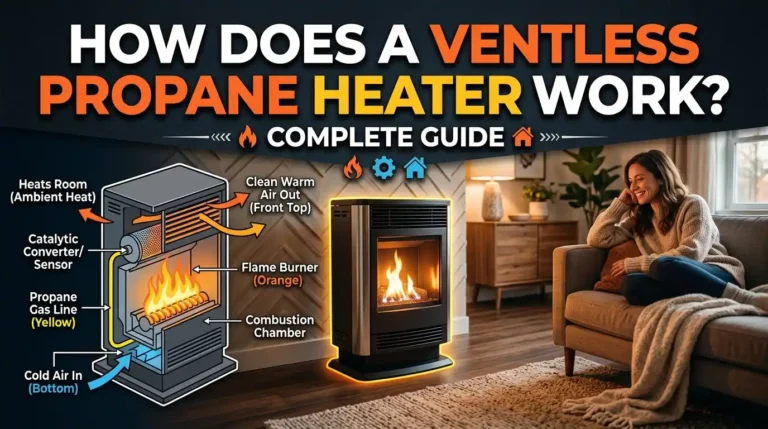
Why Gas Fireplace Shuts off by Itself? Reasons, Repair and When to Call a Professional.
When your gas fireplace turns off automatically, be it the moment you release the knob or several minutes into a fire or totally randomly, it is nearly always due to a safety sensor in the unit. That’s good news indeed: your fireplace has not been broken in a dangerous manner; it is defending you as it is made to defend you. The actual enquiry is what sensor is tripping and why.
Quick Answer: The root cause of most self-shutoffs is in one of four components: a weak or contaminated thermocouple, a faulty thermopile, a dirty or improperly aligned flame sensor on electronic-ignition units or (in ventless models) the oxygen depletion sensor (ODS) doing exactly what it is designed to do. A significant portion of the cases can be remedied by cleaning the pilot assembly; a faulty sensor or control board requires a replacement board.
The following is a breakdown of what is actually occurring in your fireplace, how you can tell what part is faulty depending on when it goes off and what the sure indications that you should cease troubleshooting and call a technician are.
How Your Fireplace’s Safety System Actually Works?
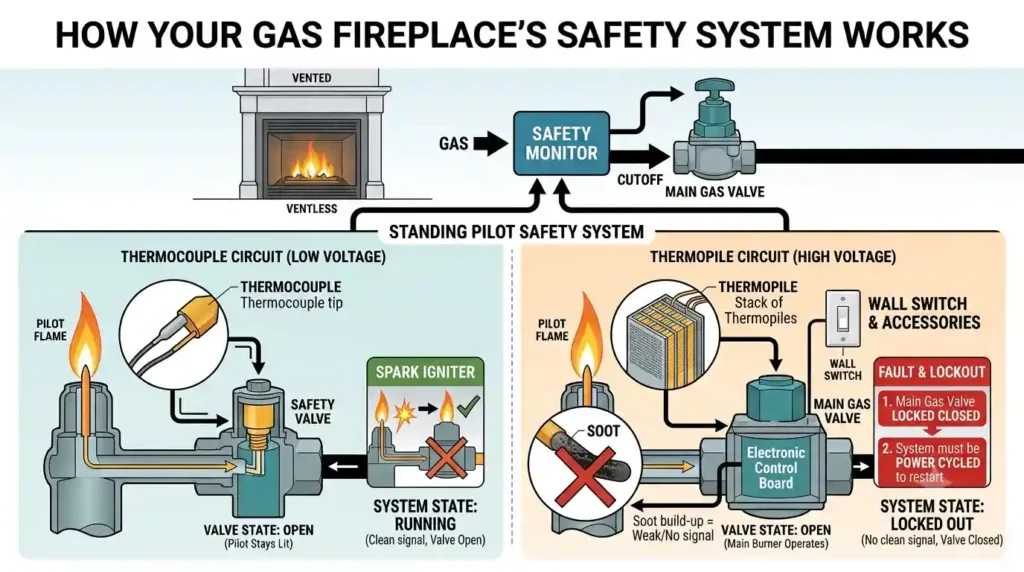
All gas fireplaces, vented and ventless, standing pilot, push-button, are constructed under the same rule, which is, that when the system cannot assure that it is a clean burn, the gas is cut off. That one rule is the reason behind nearly all the “shuts off by itself” complaints.
Standing pilot systems: thermocouple and thermopile
The older, more primitive fireplaces have a pilot flame that is small and constantly burning. Two similar halves are there in that flame, which do very different work:
- Thermocouple: A narrow strip of metal that produces a small amount of voltage (approximately 2030 millivolts) as it heats with the pilot flame. A small safety valve is kept open by that voltage. When the flame is not in contact with the thermocouple on a constant basis, the voltage disappears, the valve is closed and the gas ceases to flow, even to the main burner.
- Thermopile: A stack of thermocouples connected together to generate higher voltage (300-750 millivolts). It doesn’t simply open a safety valve, it drives the main gas valve, and accessories such as a wall switch, remote receiver, or a blower.
A faulty thermocouple normally results in the pilot being shut off or not wanting to remain on. The weak thermopile is more frequently a cause that the main burner should be switched off once started on, or not start at all, due to the insufficient voltage to hold the main valve open.
Electronic ignition (IPI) systems.
More recent fireplaces have Intermittent Pilot Ignition (IPI): the pilot is not lit until you turn the unit on, through a spark or hot-surface igniter, and a flame sensor rod detects combustion on a concept known as flame rectification. When the control board does not receive a clean confirmation signal (which is usually due to the sensor rod being covered with soot) it assumes there is no flame and closes the gas valve to prevent fire but in the process may lock out and must restart with a complete power cycle.
Oxygen depletion sensors (vent less fireplaces only)
Vent free gas fireplaces and log sets do not emit exhaust out of the home, thus it has a dedicated safety pilot, the oxygen depletion sensor (ODS). It is set to automatically turn the unit off in case room oxygen drops below a normal level of about 20.9 to about 18-18.5. Mechanically, this occurs due to the fact that the shape and lift of the pilot flame varies in a low-oxygen atmosphere and cools the thermocouple in the ODS pilot to the extent of shutting the gas valve. Since 1980, it has been a required characteristic on ANSI-certified vent-free heaters, with the purpose of ensuring that the carbon monoxide in the room does not accumulate.
Important lesson learned: An ODS shutoff on a ventless unit is not a fixation to work around. It implies that the room cannot exchange fresh air on that appliance, and it is the sensor that performs its function.
Common Causes, organized by When It Shuts Off
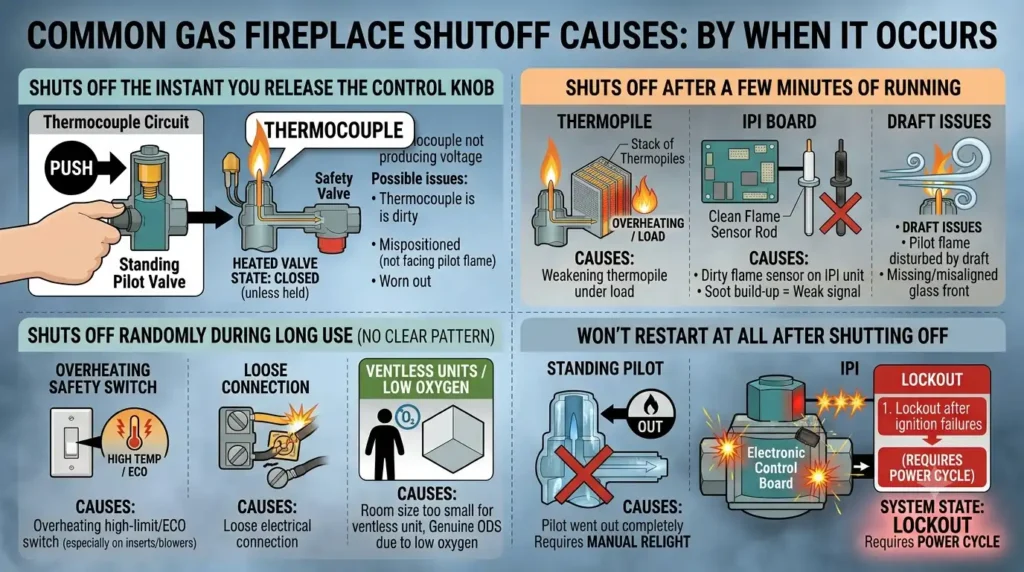
The only best diagnostic hint that you have is the time of the shutoff. Make it occur to a narrow before you begin to take things apart.
It shuts off the instant you release the control knob
This is the typical symptom of the thermocouple. In a standing pilot system, you must press the knob in 30-60 seconds after lighting to allow the thermocouple to warm and produce sufficient voltage to keep the safety valve open by itself. When it will not drop out the second time you release it, the thermocouple is not producing sufficient voltage – typically due to either dirtyliness, misposition (not directly facing the pilot flame), or wear.
It shuts off after a few minutes of running
The trend is toward a weakening under load thermopile, a dirty flame sensor on an IPI unit, or a draft that is causing the pilot flame to be disturbed to the extent that the sensor is losing contact periodically. It may also occur when the glass front is not placed in place, altering airflow in the burner.
It shuts off randomly during long use, with no clear pattern
A characteristic of an overheating safety switch (also known as a high-limit or ECO switch, particularly on inserts and on units with blowers), a loose electrical connection, or on ventless units, the genuine reduction in oxygen level in the room due to the small size of the space, is non-repetitive, non-random shutoff (or non-random shutoff).
It won’t restart at all after shutting off
This typically implies that the pilot went out and has not re-lit itself (expected behavior of standing pilot systems – one needs to relight it manually), or an IPI system has entered a lockout state following numerous consecutive failures on ignition (which generally clears by turning the unit off, waiting a minute, and then returning it on).
Cause Comparison Table
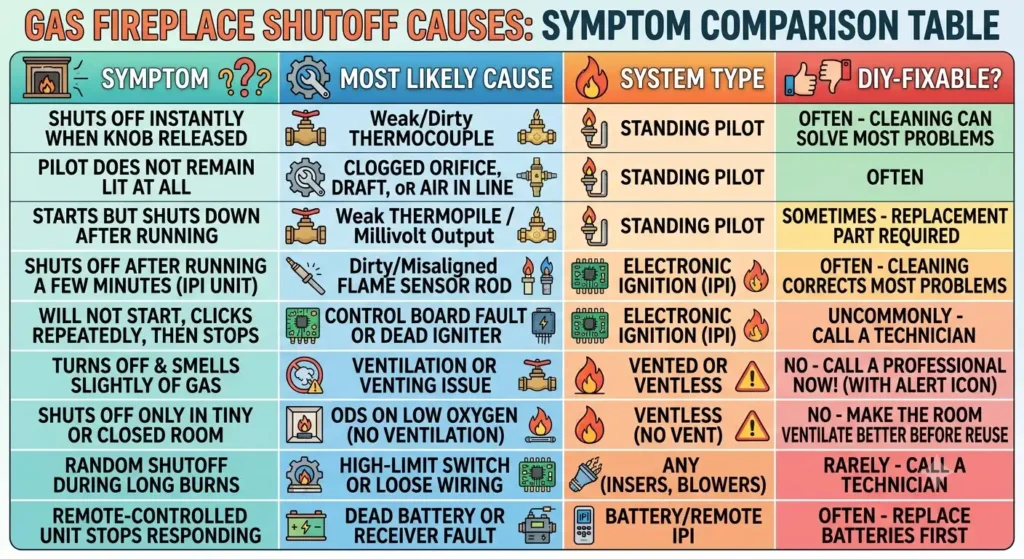
| Symptom | Most Likely Cause | System Type | DIY-Fixable? |
|---|---|---|---|
| Turns off the second one you loosen the knob | Weak/dirty thermocouple | Standing pilot | Often – cleaning can solve most problems |
| Pilot does not remain lit at all | Clogged pilot orifice, draft, or air in gas line, | Standing pilot, | Often, |
| Starts but will not continue to burn | Weak thermopile or millivolt output | Standing pilot | Sometimes – replacement part – |
| Shuts off a few minutes later, IPI unit | Dirty/misaligned flame sensor rod | Electronic ignition (IPI) | Often – cleaning corrects most of these problems |
| Will not start, clicks several times, then shuts down the power | Control board fault or dead igniter | Electronic ignition (IPI) | Uncommonly — call a technician |
| Turns off and smells slightly of gas | Ventilation or venting issue | Vented or ventless | No – call a professional now |
| Switching off in a tiny or closed room | ODS on low oxygen | no ventilation | not a solution but make the room ventilate better |
| Random shutoff during long burns | High-limit switch, loose wiring | Any, particularly inserts/blowers | Rarely – call a technician. |
| Remote-controlled stops responding | Dead battery or receiver fault | Battery/remote IPI | Often – replace batteries first |
Note: This table represents general design principles of typical residential gas fireplace models. The owner manual of your particular unit is the absolute authority in your particular unit as tolerances and part names are unique to each manufacturer.
Why Gas Fireplace Shuts off by Itself? How to Diagnose It Yourself:
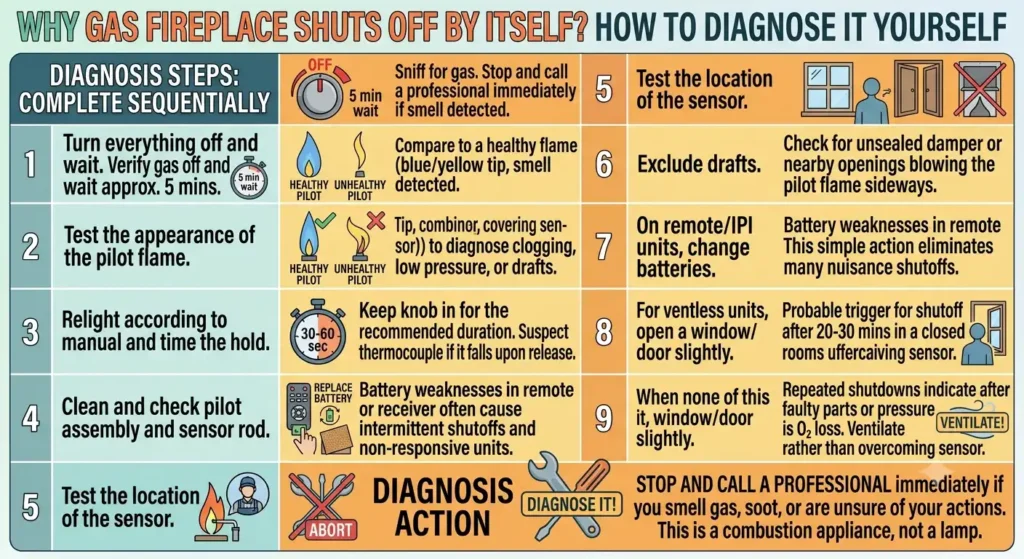
Complete these step by step. Stop and get a professional as soon as you smell gas, see soot or are not quite sure what you are doing, this is a combustion appliance, not a lamp.
- Turn everything off and wait. Turn the gas control to OFF and wait approximately 5 minutes and then sniff around the floor and around the unit to determine whether there is any smell of gas or not.
- Test the appearance of the pilot flame. The healthy pilot is mostly blue with a small yellow tip, approximately 1/2 inch high and must completely cover the thermocouple or sensor rod. A small, feebly burning, yellow, or rising flame indicates a clogged orifice, low gas pressure or a draft issue.
- Relight according to the manual and time the hold. Keep the knob in the entire time your manual recommends (usually 30-60 seconds) and then release. When it falls right away when released, suspect thermocouple.
- Clean and check pilot assembly and sensor rod. Soot can be removed with a soft brush or fine sandpaper with the gas off, cleaning the thermocouple, thermopile, or flame sensor rod. This one action eliminates a big portion of nuisance shutoffs.
- Test the location of the sensor. The flame should not be licking the sensor as it touches it. Even a clean bend or shifted rod will not give a reliable signal.
- Exclude drafts. Shut nearby windows, doors and check to an unsealed damper or vent that may be blowing the pilot flame sideways.
- On remote/IPI units change the batteries. Battery weaknesses in the remote or receiver is a simple, ignored reason behind intermittent shutoffs and non-responsive units.
- In ventless units, open a window or door slightly. In a closed room, when the shutoff occurs consistently after 20-30 minutes, then the probable trigger is the loss of oxygen – ventilate instead of attempting to overcome the sensor.
- When none of this fixes it, abort. Repeated shutdowns following simple cleaning indicates a faulty thermocouple, thermopile, control board or gas pressure – a certified technician job.
Ventless vs. Vented Fireplaces: Different Failure Points
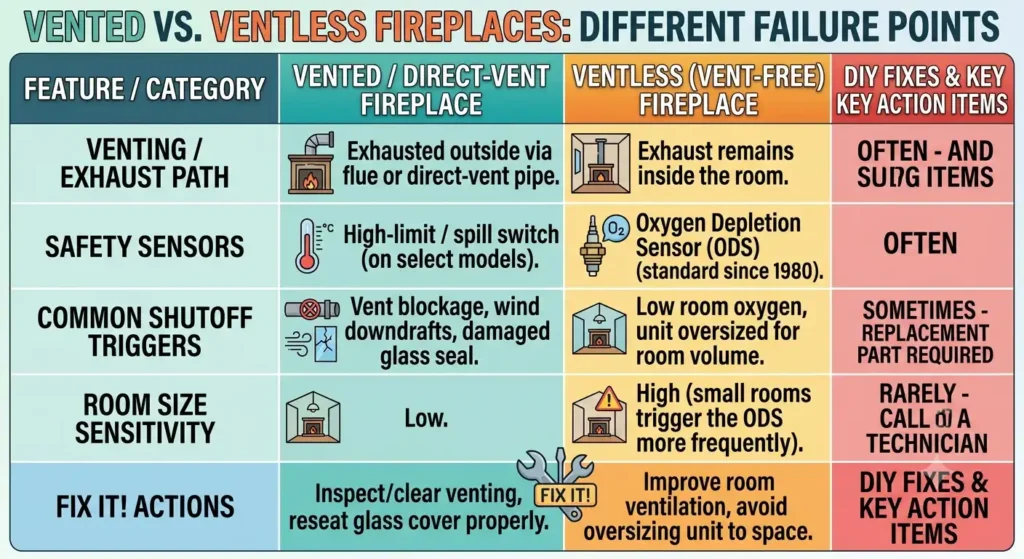
| Feature / Category | Vented / Direct-Vent Fireplace | Ventless (Vent-Free) Fireplace |
| Venting / Exhaust Path | Exhausted outside via a flue or direct-vent pipe | Exhaust remains inside the room |
| Safety Sensors | High-limit / spill switch (on select models) | Oxygen Depletion Sensor (ODS) (standard since 1980) |
| Common Shutoff Triggers | Vent blockage, wind downdrafts, damaged glass seal | Low room oxygen, unit oversized for room volume |
| Room Size Sensitivity | Low | High (small rooms trigger the ODS more frequently) |
| Key Fixes & Action Items | Inspect/clear venting, reseat glass cover properly | Improve room ventilation, avoid oversizing unit to space |
Is It Safe to Keep Using a Fireplace That Shuts Off?
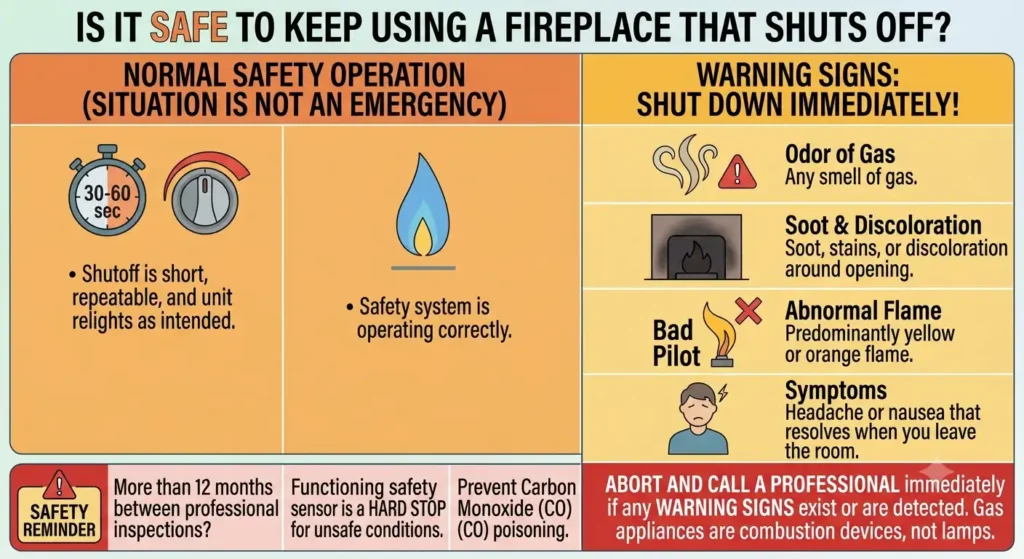
When the shutoff can be repeated, short in duration and the unit can relight as usual, then the safety system is operating as intended and that in itself is not an emergency. But consider these as hard stop signs and close the gas at the valve until an expert has checked it:
- Odor of gas, however slight, particularly immediately after being turned off.
- Soot, dark stain, or discolouration about the fireplace opening or above the fireplace.
- a pilot or burner flame which is predominantly yellow or orange, rather than blue.
- Headache, light-headedness or nausea, which feels better when you get out of the room.
- There is a period of over 12 months between professional inspection of the fireplace.
All this is because of carbon monoxide. It is colorless and non-odorant, and CPSC statistics indicate that non-automotive consumer products, a category that includes gas heating appliances and fireplaces, are responsible over an average year in the U.S. of over 200 accidental CO deaths, of which about one-third are directly related to gas-fueled appliances. A functioning safety sensor to close your fireplace is what keeps those figures down where they belong – you should treat every shutoff as knowledge, not merely as a nuisance.
When to Call a Professional
Contact a certified fireplace or HVAC professional instead of completing the self-work in case:
- Cleaning the pilot assembly and sensor didn’t resolve the shutoff
- You are suspicious of a broken-off heat exchanger, faulty gas valve, or broken wires.
- The unit is beyond the age of 15 years and the components are difficult to obtain.
- You are not quite at ease in an open gas line.
- There is any gas smell – this is not a DIY step, turn off the gas, contact your gas company or fire department first.
Preventing Future Shutdowns: Maintenance Checklist
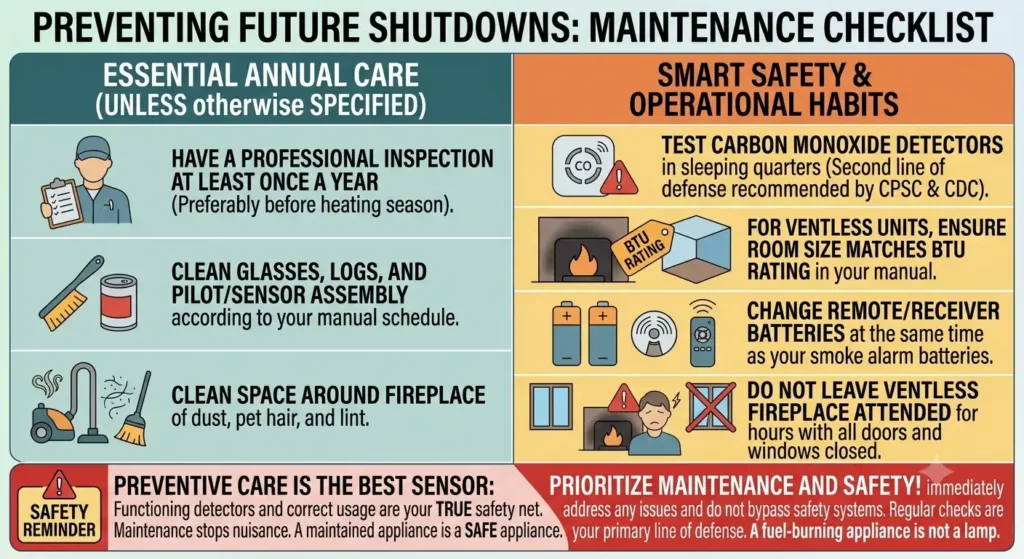
- Have a professional inspection done at least once a year, preferably prior to heating season.
- Clean glasses, logs and pilot/sensor assembly according to your manual schedule.
- Clean the space around the fireplace of dust, hair of pets, and lint.
- Have and test carbon monoxide detectors around sleeping quarters – CPSC and CDC recommend this as a second line of defense that should be installed in any home with fuel-burning appliances.
- In the case of ventless units, ensure that the room size is the same as the BTU rating in your manual.
- Change remote/receiver batteries with your smoke alarm batteries.
- Do not leave a ventless fireplace, with doors and windows completely closed, unattended over hours at a time.
Myth vs. Fact
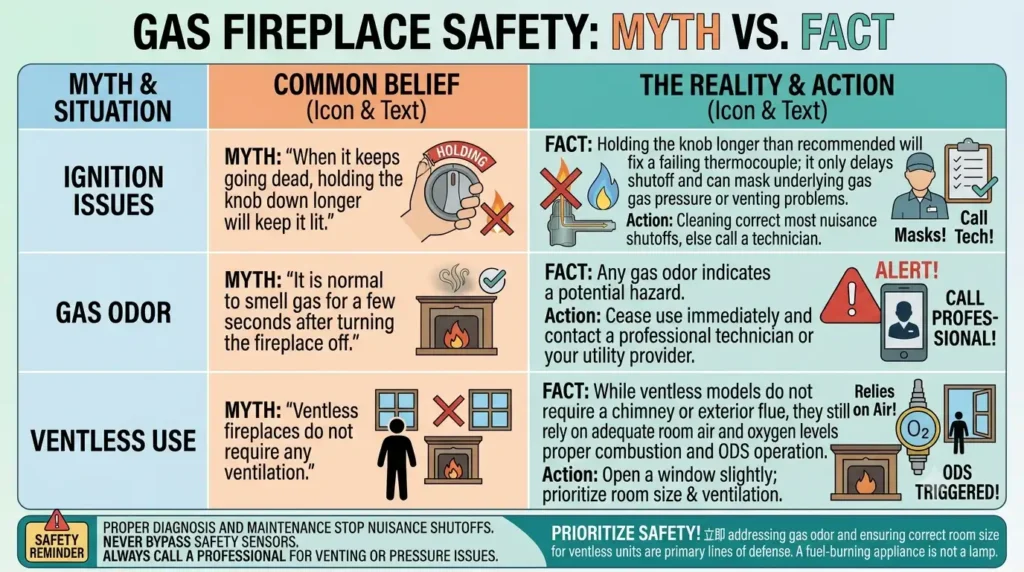
Gas Fireplace Safety: Myth vs. Fact
| Myth | Fact |
| “When it keeps going dead, holding the knob down longer will keep it lit.” | Holding the knob longer than recommended will not fix a failing thermocouple; it only delays shutoff and can mask underlying gas pressure or venting problems. |
| “It is normal to smell gas for a few seconds after turning the fireplace off.” | Any gas odor indicates a potential hazard. Cease use immediately and contact a professional technician or your utility provider. |
| “Ventless fireplaces do not require any ventilation.” | While ventless models do not require a chimney or exterior flue, they still rely on adequate room air and oxygen levels for proper combustion and ODS operation. |
Key Takeaways
- The automatic shutdown of a gas fire is nearly always a safety sensor – thermocouple, thermopile, flame sensor, or ODS – reacting to some detected condition.
- When it shuts off (as soon as, minutes later or randomly) is your best indicator of which component is faulty.
- A significant portion of cases do not require a technician visit when the pilot/sensor assembly is cleaned.
- A scent of gas, yellow flames, or soot stains present are reasons to cease using it and call a professional – do not troubleshoot.
Two highest-valued prevention steps you can take are to have annual professional inspections and working CO alarms.
You May Also Read:
- Why Is My Gas Fireplace Beeping? Here’s Why & How to Fix It
- Why Gas Fireplace Wont Light? Causes & Fixes Explained
FAQs:
Why will my gas fireplace turn off on its own after several minutes?
A weakening thermopile, a soot-covered flame sensor on an electronic-ignition unit, or a draft blowing the pilot flame enough to cause the sensor signal to be lost is most often the cause.
Why does my gas fireplace turn off as soon as I release the knob?
This is the typical indication of a dirty or weak thermocouple. It is not producing voltage quick enough to keep the safety door open when you take the manual control away.
Is a gas fireplace, which constantly goes off, hazardous?
Not in itself–the shutoff itself is the safety system at work. Only when you smell gas, observe yellow flames or soot, or you ignore the sensor instead of repairing the source, is it a safety issue.
My gas fireplace shuts off repeatedly; how can I fix it?
Begin by cleaning the pilot assembly and sensor rod with the gas off, ensure that the sensor is squarely in the flame, exclude drafts, and change remote batteries, where necessary. Should it continue to shut off, then the thermocouple, thermopile or control board probably requires professional replacement.
Why does my gas fireplace that is not vented keep turning off?
Nearly every time the oxygen depletion sensor (ODS) activated due to a decreased oxygen level in a closed or undersized room. Crack a window or door rather than trying to disable the sensor.
Is it possible that a dirty pilot light will make a gas fireplace shut off?
Yes – the most typical causes of nuisance shutoffs are soot and carbon formation on the pilot assembly, since this insulates the thermocouple or sensor against the heat of the flame.
What is the difference between a thermopile and a thermocouple?
A thermocouple produces a small voltage which keeps a safety pilot valve open. A thermopile produces significantly higher voltage, and can drive the entire main gas valve, including accessories such as a wall switch or blower.
How frequently is a gas fireplace to be professionally checked?
Annually, ideally prior to the onset of heating season, as per general fire-safety instructions, all fuel-burning home heating equipment.
Does a broken heat exchanger make a gas fireplace to pop off?
Yes, indirectly – a crack might impact on airflow and combustion sufficiently to cause safety sensors to go off, and it is also a carbon monoxide hazard. This cannot be a do-it-yourself repair.