Why Gas Fireplace Wont Light? Causes & Fixes.9 Simple Reasons and How to make it right.
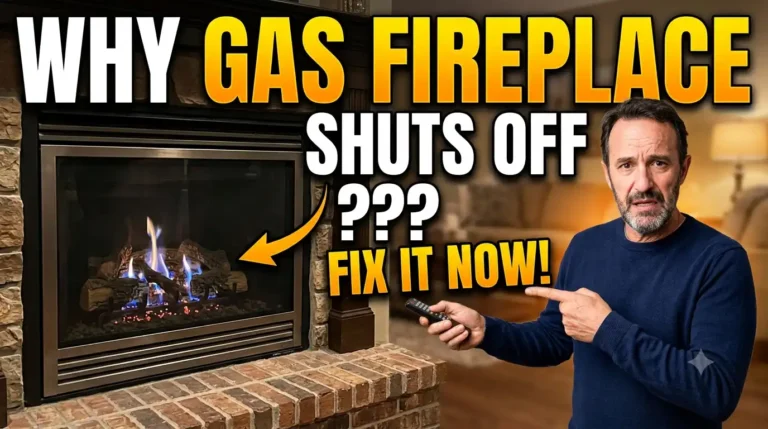
Why Gas Fireplace Wont Light? A gas fireplace is not going to light most of the time due to one of the three reasons: the gas supply is interrupted, pilot light is out, or a safety component (thermocouple, thermopile or control module) is not communicating the signal to the main valve to open. A lesser proportion of cases boil down to something mundane, such as dead remote batteries or a tripped breaker.
Each of the common causes is listed below in rough order of frequency of occurrence, with specific instructions on how to test and repair that type of fault and a distinct boundary of when to give up and call a technician.
Why Gas Fireplace Wont Light?
A gas fireplace will not start due to a variety of reasons, including a basic malfunction of maintenance, as well as due to malfunctioning internal parts. The most frequent reasons are a switched off gas supply, a failed pilot-light, dead remote or wall switch batteries, a clogged pilot assembly, or a failed thermocouple or igniter.
In other instances, the burner blockage by dirt and debris may occur, and a faulty gas valve or safety sensor may not even allow the fireplace to start at all. Before trying to perform any repairs, make sure that the gas is turned on, change the batteries (assuming your fireplace has an electronic ignition) and check the pilot light.
If the fire place still fail to light or you feel that there is the smell of gas, then cease troubleshooting and call an experienced technician to inspect and fix the problem promptly and safely.
Is It Safe to Keep Trying When Gas Fireplace Won’t Turn ON?
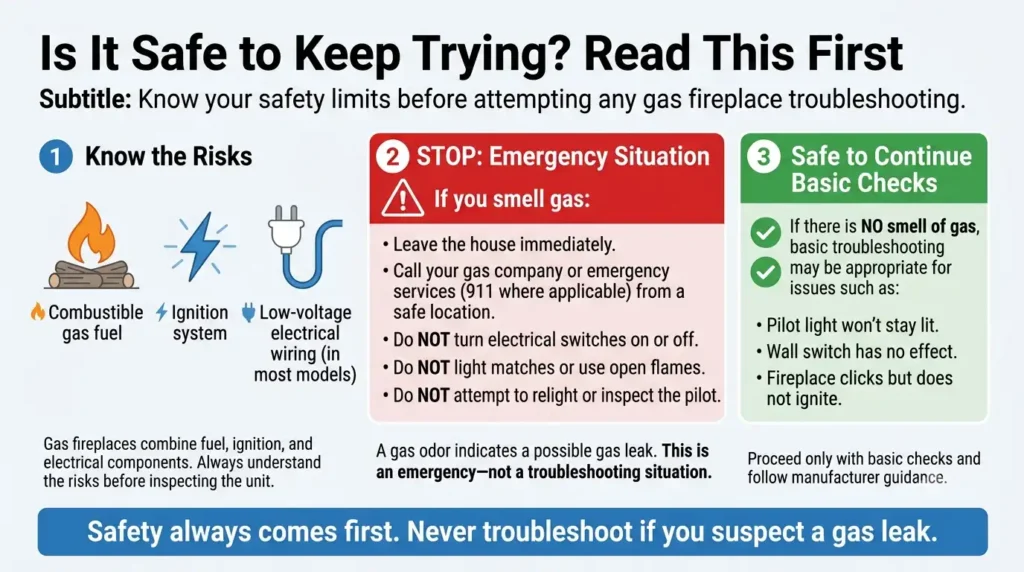
Be aware of your boundaries before you touch anything. Gas fireplaces are basic appliances and yet they have put together three things that cannot be guessed: combustible fuel, a source of ignition, and (in most units) low-voltage electrical wiring.
Stop and go outside the house and call your gas company or 911 if you smell gas, do not turn on or off switches, do not light a match, do not attempt to check the pilot. When a gas odor occurs, then it implies a leak, and it is not a troubleshooting scenario, but rather an emergency.
On all other items, a pilot which will not remain lit, a switch whose actions are useless, a fireplace which clicks but does not light, it is safe to check through the following checks.
How to Diagnose Gas Fireplace Not Turning ON Problem by Symptom?
You can go directly to your probable cause using this table according to what you are actually seeing or hearing.
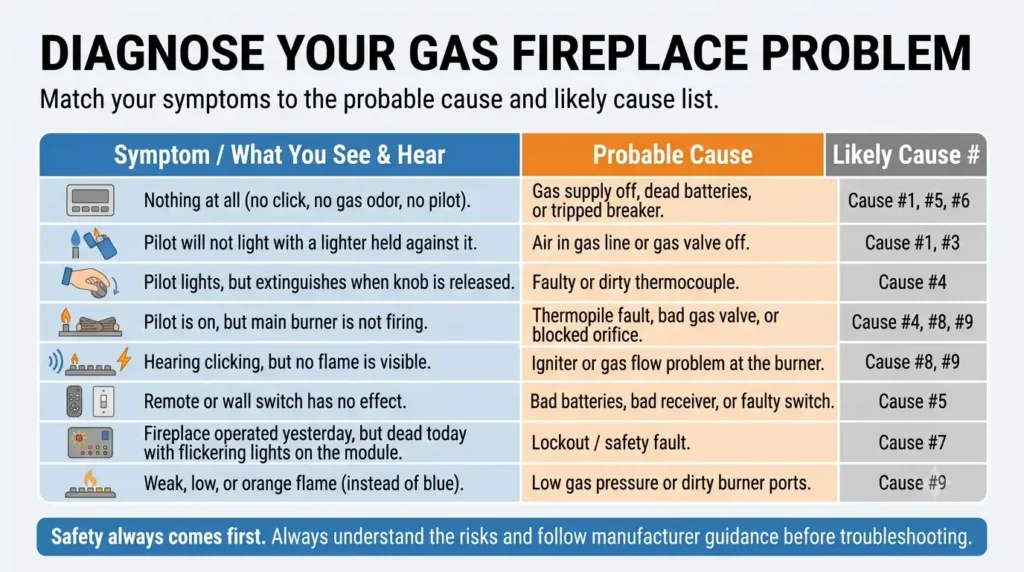
| Symptom / What You See & Hear | Probable Cause | Likely Cause # |
| Nothing at all (no click, no gas odor, no pilot) | Gas supply off, dead batteries, or tripped breaker | Cause #1, #5, #6 |
| Pilot will not light with a lighter held against it | Air in gas line or gas valve off | Cause #1, #3 |
| Pilot lights, but extinguishes when knob is released | Faulty or dirty thermocouple | Cause #4 |
| Pilot is on, but main burner is not firing | Thermopile fault, bad gas valve, or blocked orifice | Cause #4, #8, #9 |
| Hearing clicking, but no flame is visible | Igniter or gas flow problem at the burner | Cause #8, #9 |
| Remote or wall switch has no effect | Bad batteries, bad receiver, or faulty switch | Cause #5 |
| Fireplace operated yesterday, but dead today with flickering lights on the module | Lockout / safety fault | Cause #7 |
| Weak, low, or orange flame (instead of blue) | Low gas pressure or dirty burner ports | Cause #9 |
9 Most Common Causes Gas Fireplace Not Igniting
Cause 1 – Closed or Interrupted Gas Supply.
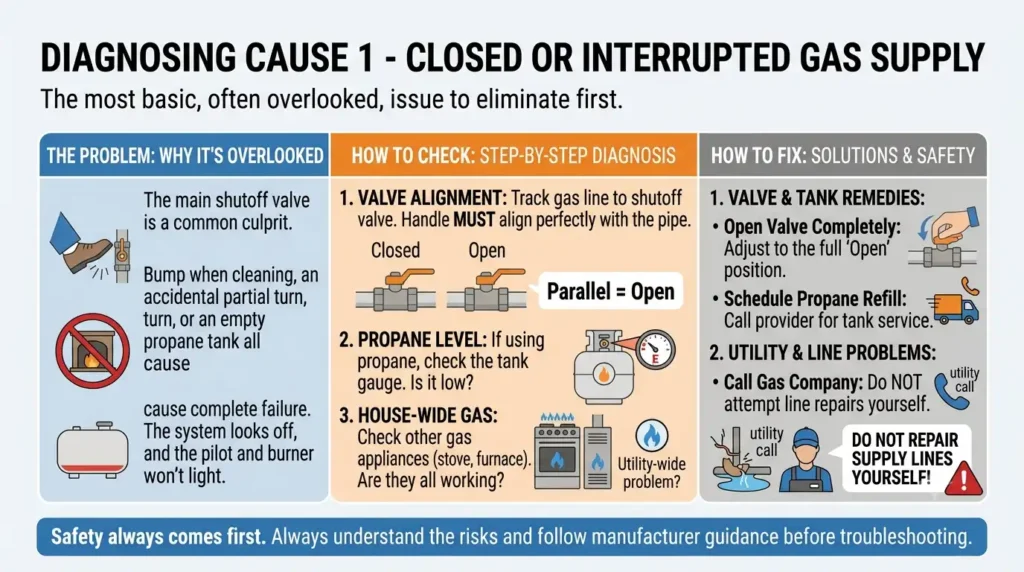
This is the least considered cause, and the initial thing to eliminate. The primary gas shutoff valve, which is usually a lever close to the fireplace or the gas meter, must be in the same plane as the pipe, and completely open. The bump of a valve when cleaning, a quarter-turn off, or even an empty propane tank will all result in the same effect: nothing lights, regardless of what you do.
How to Check:
Track down the line of gas to the shutoff valve and make sure that the handle is aligned with the pipe. Check the tank level gauge in case you use propane. Assuming natural gas, be sure that no other gas appliances in the house have lost their service (this indicates a utility problem, not your fireplace).
How to Fix:
Open valve to the full. When out of propane, schedule a refill. Should you suspect that there is a utility outage or line problem, call your gas company – do not attempt to fix supply-side gas lines yourself.
Cause 2 – Out of Pilot Light
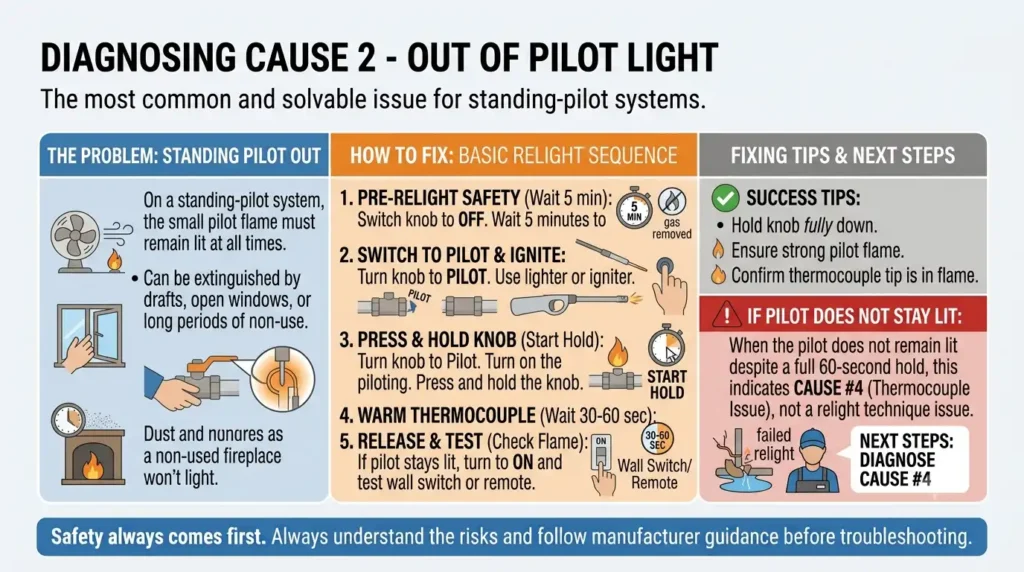
On a standing-pilot system the small flame adjacent to the burner must be maintained lit at all times. It can be put out by drafts, a puff of an open window, or by just a long period of non-use.
How to Fix:
The following basic relight sequence is used in most gas fireplaces:
- Switch gas control knob to Off and allow 5 minutes to remove any remaining gas.
- Turn knob to Pilot.
- Turn on the piloting with a long-reach lighter or the igniter button (built-in). Press and hold the knob.
- Continue to hold the knob down 30-60 seconds after the flame takes hold – this allows the thermocouple time to warm up and keep the valve open by itself.
- Slide the knob. If the pilot stays lit, turn the knob to “On” and try the wall switch or remote.
When the pilot does not remain lit despite a full 60-second hold, that indicates Cause #4, a thermocouple issue, but not a lighting-technique issue.
Cause 3 — Air in the Gas Line
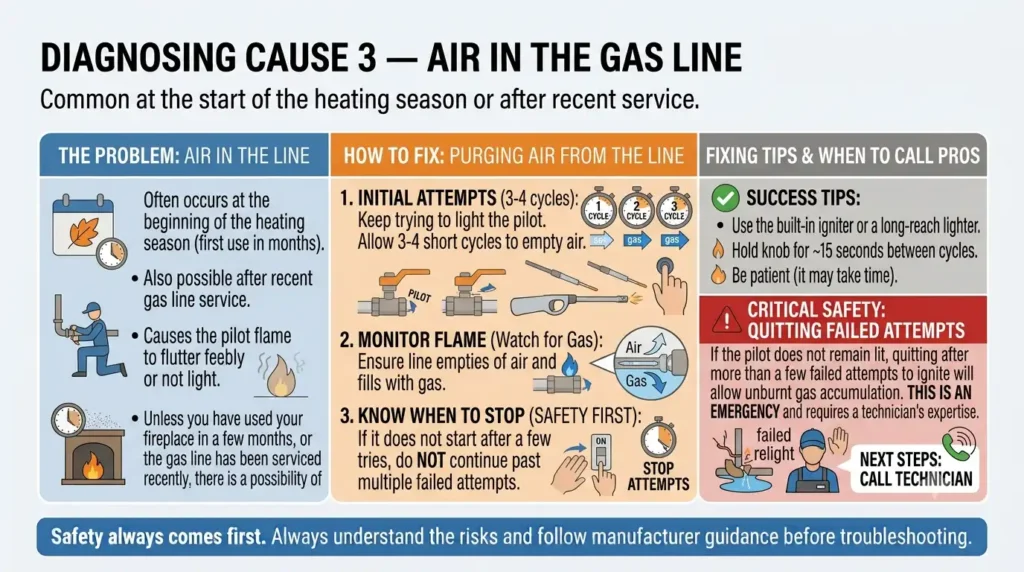
Unless you have used your fireplace in a few months (a very common phenomenon at the beginning of the heating season), or the gas line has been serviced recently, there is always the possibility of air in the line where the gas should be. This causes the pilot flicker to flutter feebly or not to take at all.
How to Fix:
Keep trying to light the pilot until there is at least 3-4 short cycles of time allowing the line to empty the air and fill up with gas. In case it does not start even after a few tries then quitting more than one failed attempt to ignite the engine will allow unburnt gas accumulation and that is a technician job.
Cause 4 — Faulty or Dirty Thermocouple/Thermopile
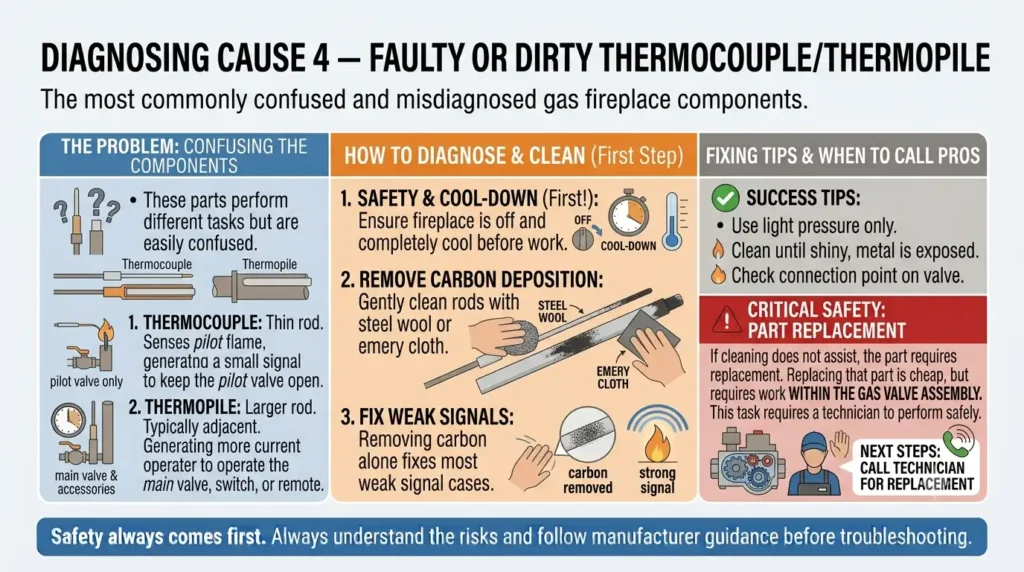
These two parts are similar and perform different tasks but are the most easily confused and the most commonly confused by homeowners.
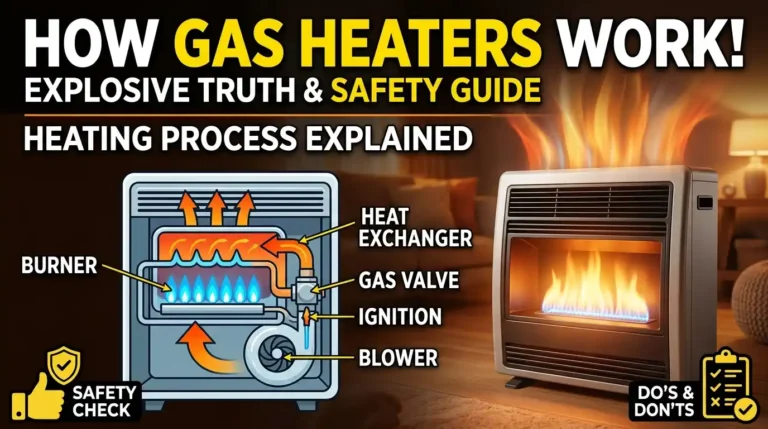
- Thermocouple: This is a thin rod that is placed in the pilot flame. It produces a small electric signal and keeps the gas valve open, only when the pilot. When it does not work, the pilot will not remain lit.
- Thermopile: A larger rod, typically adjacent to the thermocouple, which produces additional current – enough to operate the main valve, wall switch, or remote receiver. When the pilot burns continuously, but the main burner does not fire, the thermopile (or the soot on it) is the likely suspect.
How to Fix:
With the fireplace off and cool, clean up the rod(s) of fine steel wool or emery cloth to remove carbon deposition – this by itself fixes a substantial portion of weak-signal cases. When cleaning does not assist, replacement of that part is cheap, but it will require some work within the gas valve assembly – this is the task that most homeowners have a technician do.
Cause 5 — Dead Batteries or a Bad Remote/Wall Switch.
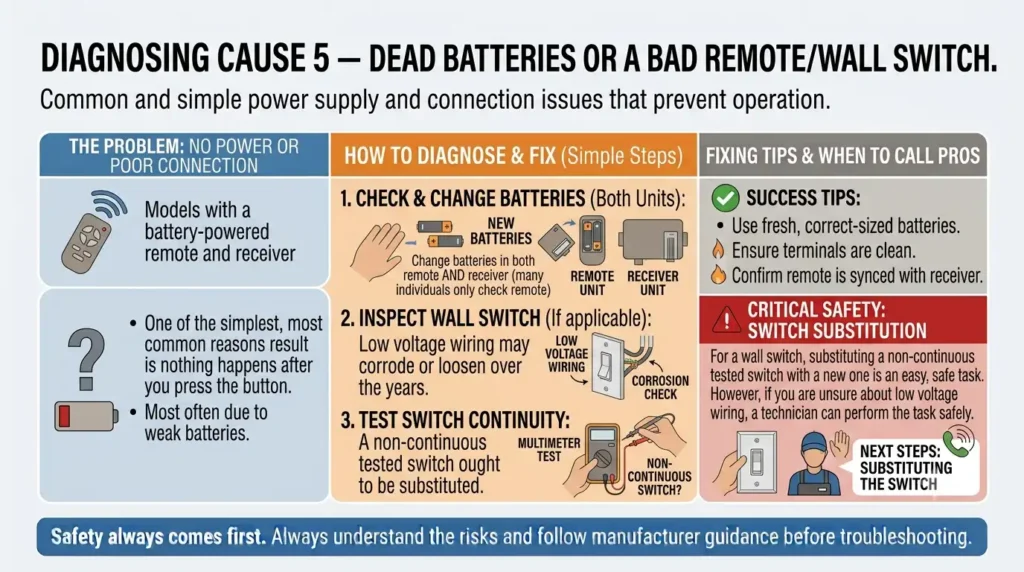
When your model is powered by a battery-powered remote and receiver, one of the simplest most common reasons that result in nothing happening after you press the button is a weak battery.
How to Fix:
Change batteries in both the remote and the receiver unit (many individuals only check the remote). In the event of a wall switch employed in place of this, low voltage wiring may corrode or loosen out over the years; a non-continuous tested switch ought to be substituted.
Cause 6 — Tripped Circuit Breaker or Power Loss
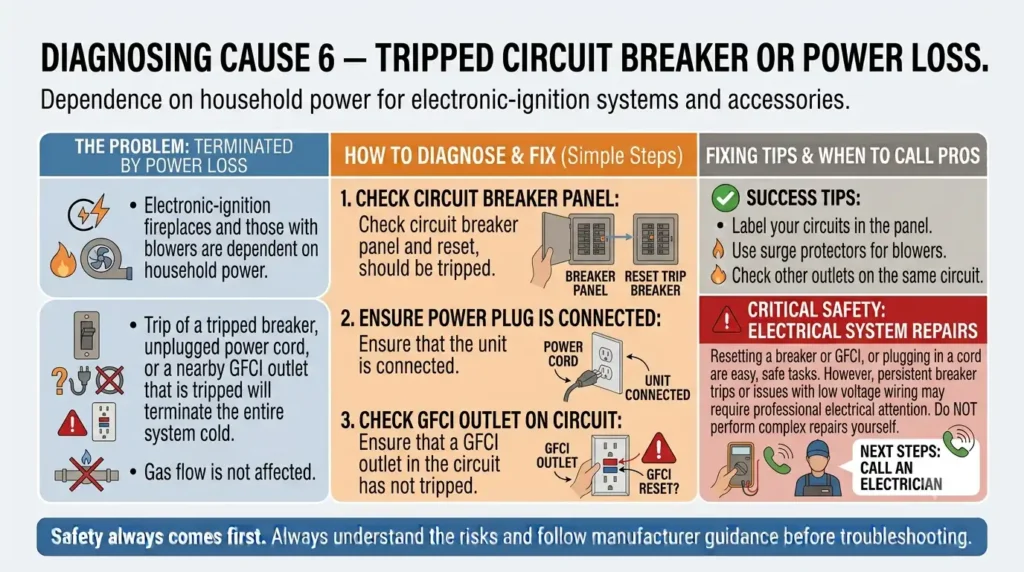
Electronic-ignition fireplaces and those with blowers are dependent on household power. Trip of a tripped breaker, unplugged power cord or a nearby GFCI outlet that is tripped will terminate the entire system cold, although gas flow is not affected.
How to Fix:
Check circuit breaker panel and reset, should be tripped. Ensure that the unit is connected and that a GFCI outlet in the circuit has not tripped.
Cause 7 — Locked-Out Control Module
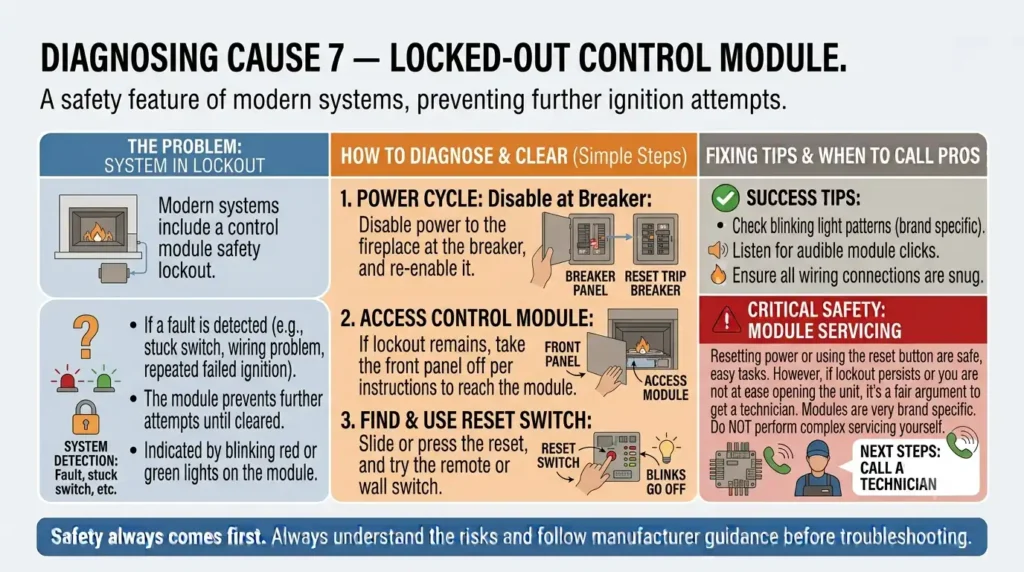
A large number of modern gas inserts and fireplaces include a control module including a safety lockout: should the system detect a fault (a stuck switch, a wiring problem, repeated failed ignition) the control module will lock further attempts until the system is manually cleared. When this happens, you will be able to see blinking red or green lights on the module.
How to Fix:
- Disable the power to the fireplace at the breaker, and re-enable it.
- In case the lockout does not go away, then, according to the instructions, take the front panel off in order to reach the module.
- Find a small reset switch or button close to the LED indicators.
- Slide or press the reset, and try the remote or wall switch.
Unless you are at ease opening the unit, this is a fair argument to get a technician on the phone to come out, modules are very brand specific.
Cause 8 — Blocked Burner Ports or Pilot Orifice
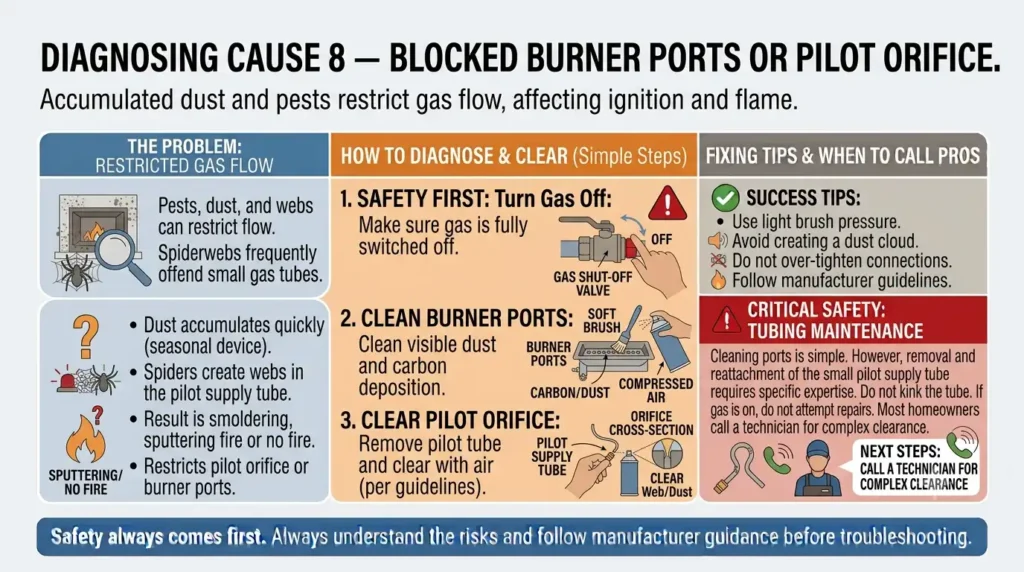
Dust accumulates quickly in a device that is used seasonally, and spiderwebs are a truly frequent offender in the small gas tube that supplies the pilot. Obstructing either may result in a smoldering, sputtering fire or no fire at all.
How to Fix:
When gas is off, clean burner ports with visible dust using soft brush or compressed air. Removal and clearance of the pilot supply tube may be done according to manufacturer guidelines – make sure that the gas is switched off, and do not kink the tube when reattaching it.
Cause 9 — Faulty Gas Valve or Low Regulator Pressure
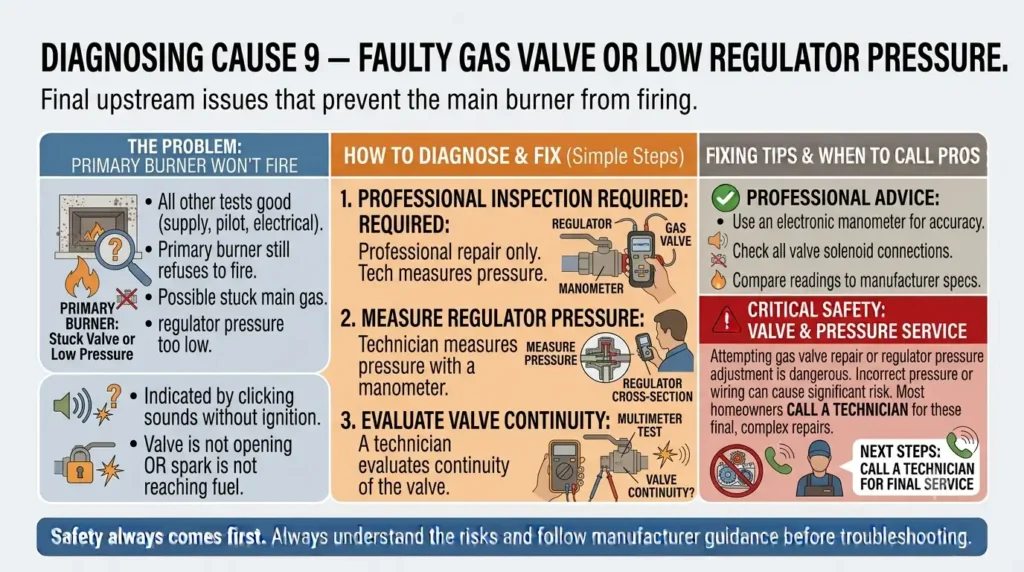
When all the upstream tests are good – supply, pilot, thermocouple, electrical – and the primary burner still refuses to fire, it is possible that the gas valve itself is stuck, or that the pressure on the regulator is so low that it is difficult to open the valve. A clicking without ignition may be heard which usually indicates that a valve is not opening or a spark is not reaching fuel.
How to Fix:
This is a professional repair. A technician measures pressure with a manometer against manufacturer specs and evaluates continuity of the valve before repairing either one.
Here is the step-by-step process to safely troubleshoot a gas fireplace.
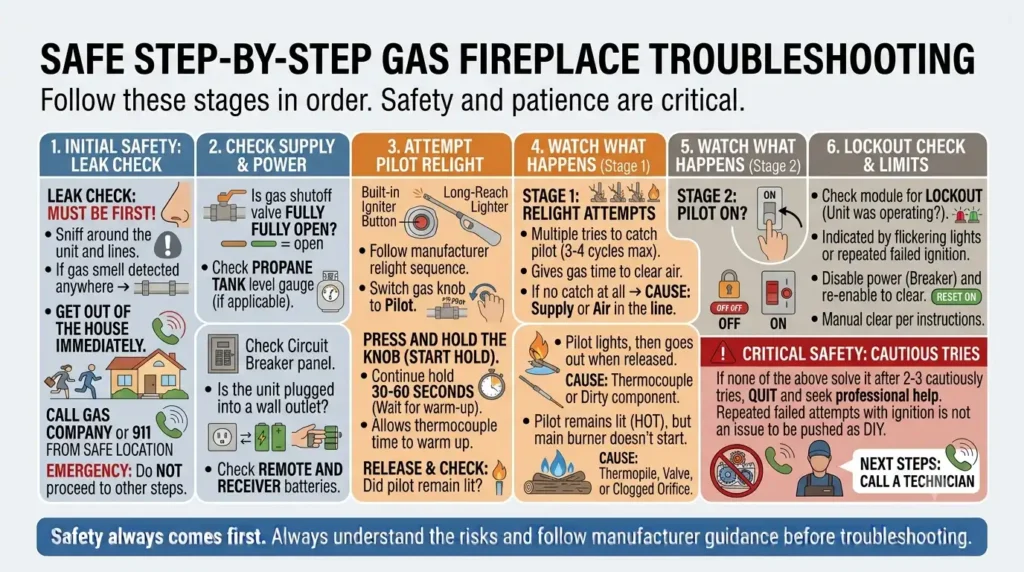
- Make sure that there are no gas leaks first. When you sniff of gas anywhere get out of the house.
- Make sure that the gas supply is open at the shutoff valve (or check propane tank level).
- Check power- Breaker, plug, remote and receiver batteries.
- Attempt to relight the pilot by following the manufacturer relight sequence and holding knob throughout 30-60 seconds.
- Watch what happens:
- Pilot will not catch at all = supply of gas or air in the line.
- Pilot lights, goes out when released → thermocouple
- Pilot remains hot, burner does not start to burn → thermopile, valve, or clogged orifice.
- Check a lockout on the control module in case the unit was operating and then suddenly terminated.
- When none of the above solves it after 2-3 cautious tries, quit and seek professional help. Repeated failed attempts with ignition is not an issue to be pushed through as a DIY project.
Myth vs. Fact
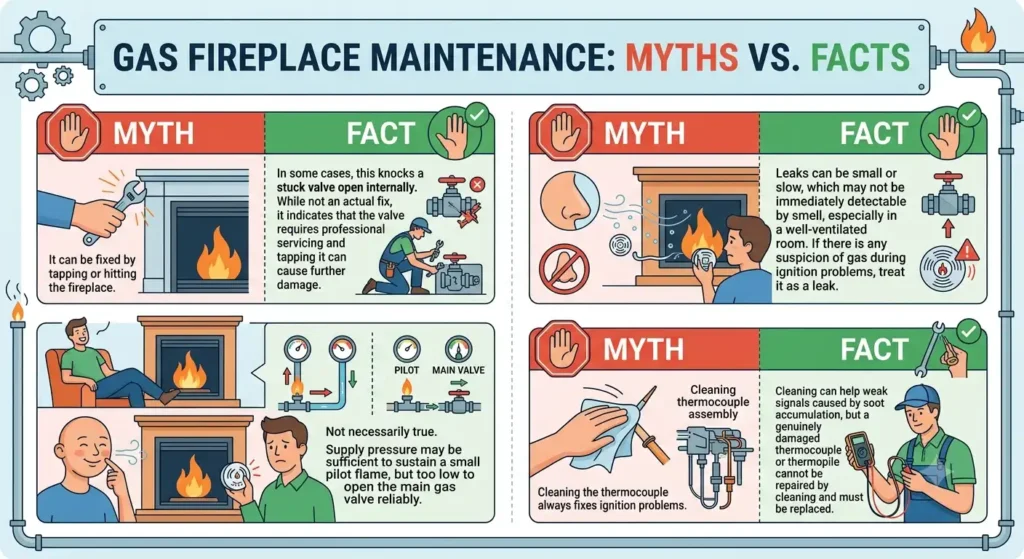
| Myth | Fact |
| It can be fixed by tapping or hitting the fireplace. | In some cases, this knocks a stuck valve open internally. While not an actual fix, it indicates that the valve requires professional servicing and tapping it can cause further damage. |
| When the pilot is lit, there is no problem with the gas supply. | Not necessarily true. Supply pressure may be sufficient to sustain a small pilot flame, but too low to open the main gas valve reliably. |
| “A gas fireplace with no odor can’t have a leak.” | Leaks can be small or slow, which may not be immediately detectable by smell, especially in a well-ventilated room. If there is any suspicion of gas during ignition problems, treat it as a leak. |
| Cleaning the thermocouple always fixes ignition problems. | Cleaning can help weak signals caused by soot accumulation, but a genuinely damaged thermocouple or thermopile cannot be repaired by cleaning and must be replaced. |
How Much Does it Cost to Repair Gas Fireplace Wont Lit Issue.
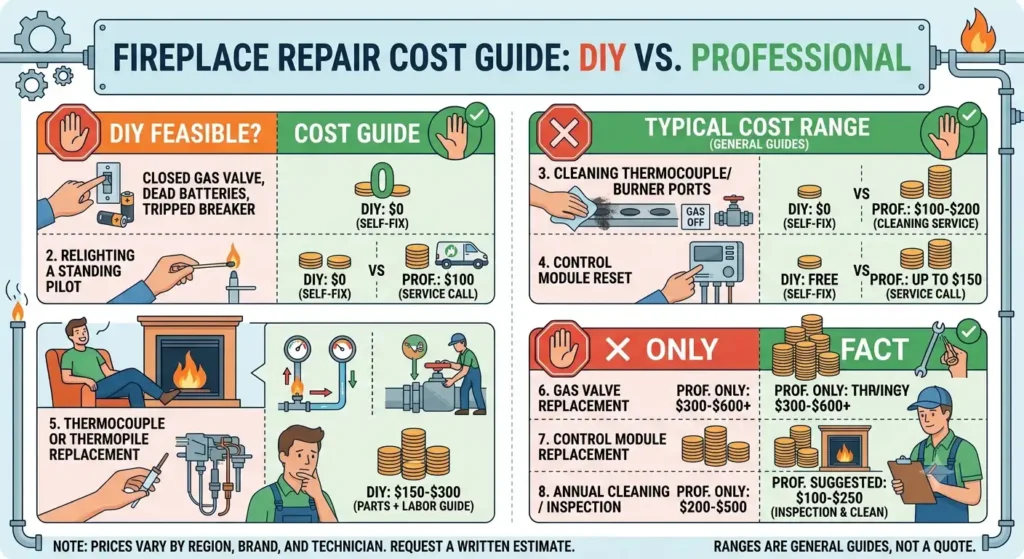
Prices are different according to the region, brand and technician- they are just general guides of what to expect, not a quote.
| Task / Issue | DIY Feasible? | Typical Cost Range |
| Closed gas valve, dead batteries, tripped breaker | Yes | $0 (self-fix) |
| Relighting a standing pilot | Yes, when comfortable | $0 (DIY) / $100 (service call) |
| Cleaning thermocouple/thermopile or burner ports | Yes, with gas turned off | $0 (DIY) / $100–$200 (professional) |
| Thermocouple or thermopile replacement | Experienced DIYers only | $150–$300 |
| Control module reset | Often yes | Free (DIY) / up to $150 (service call) |
| Gas valve replacement | No — professional only | $300–$600+ |
| Control module replacement | No — professional only | $200–$500 |
| Annual cleaning / inspection | No — professional suggested | $100–$250 |
Note: Pricing will vary, depending on your brand of fireplace, the cost of local laborers, and the availability of parts. Request a written estimate of any technician prior to repairs.
When it is Time to Call a professional.
Call a certified fireplace or gas technician if:
- You can smell gas at any location (call first, leave the house first).
- The pilot will not remain lit after cleaning the thermocouple and several relight attempts.
- The unit will not give flame, but sparks or clicks.
- There will be no clearing of a control module following a breaker reset.
To continue, you would have to have access to the gas valve, regulator, or internal wiring. - The fireplace switches off when you are using it normally.
No embarrassment in taking a break early – appliances that use gas are among the few domestic systems where DIY jobs that are good enough today may pose a real hazard in the future.
How to Prevent This Next Season
- Light the fireplace 20-30 minutes at the beginning of every heating season to clear the dust and ensure everything is in order before you really need it.
- wash up the pilot and burner ports at least once every year.
- Change remote and receiver batteries when you check smoke detector batteries.
- Have a professional inspection done at least once a year – the majority of ignition failures can be traced to something that would have been noticed early in a yearly cleaning.
Key Takeaways
- Ignition failures are reduced to gas supply, dead pilot, or weak thermocouple/thermopile signal, not significant mechanical failure.
- It is frequent, and simple, to have dead batteries or tripped breakers, which are worth checking first.
- Smell of gas, stop troubleshooting and call your utility – no exceptions.
- Cleaning, in many cases is a fix to weak-signal problems; replacement parts, and valve work fall under a professional.
Most of the why won’t it light calls are actually avoided by doing annual maintenance.
You May also Read:
FAQs:
Why will not my gas fireplace light though the pilot is on?
Being lit up only indicates that the thermocouple circuit is operating. When the primary burner still refuses to ignite, the common reasons are a weak thermopile signal, an obstructive burner aperture or a gas valve that does not completely open.
Why will my gas fireplace not light but I can hear it clicking?
Your ignition switch is not igniting, most likely the igniter is sparking, but there is insufficient gas flowing to the burner – clear orifices, gas pressure, or valve problem.
What to do to reset a locked-out gas fireplace?
Switch-off the breaker, allow a few seconds, and switch-on. Should the lockout continue, find the reset switch in the control module (behind the front panel) and reset the switch as per your model manual.
Should we continue to attempt to start a gas fireplace that will not start?
A couple of cautious strokes are all right. Once 23 unsuccessful attempts have been made, quit – further attempts may permit unburnt gas to build up, and further unsuccessful attempts are generally indicative of a component problem that would require professional inspection and never more attempts.
Why is it that my gas fireplace pilot light goes out when I release the knob?
This is the typical indication of a bad or contaminated thermocouple. You can always try increasing the duration of the knob press when relighting (a full 60 seconds); this should get you through, otherwise clean the thermocouple or replace it.
Dead batteries should not prevent my gas fireplace to light, right?
Yes. Most remote-start systems use batteries in the remote and receiver unit to provide power. Should either be weak, the signal to open the gas valve may never get to it.
Why did my gas fireplace all of a sudden stop overnight?
Unexpected failures tend to indicate a lockout of a control module, a tripped breaker, or the interruption of gas service – instead of a component being worn out over time. Check the three first.
Weak or orange flame in my gas fireplace? Why?
A low, flickering flame (rather than blue) is a typical indication of uncomplete combustion – typically caused by dirty burner ports, misaligned logs that block airflow or a problem with the gas pressure. When it burns a blue flame, it burns well.