How Much Does It Cost to Install a Gas Fireplace? Full 2026 Price Guide
How much does it cost to install a gas fireplace? Most homeowners pay between $2,500 and $10,000 for a full installation, based on 2026 data from Angi. Your final number depends on the type of unit you pick, how far the gas line has to run, and how much finish work goes around the fireplace.
That range is wide because gas fireplace projects vary so much. A gas log set dropped into an existing fireplace can cost under $1,000, while a brand-new direct-vent unit with new framing, a long gas line run, and a stone surround can pass $10,000. This guide breaks down what each option costs, where your money goes, and which factors push a quote up or down.
Every figure below comes from published 2026 cost data from home-improvement sources like Angi, HomeGuide, and Thumbtack. Prices change by region and over time, so treat these as planning ranges and get itemized quotes from licensed pros in your area.
⚠️ Safety first: gas and carbon monoxide
Gas fireplaces burn real fuel, so they carry carbon monoxide (CO) and gas-leak risks. CO is colorless and odorless. Install CO alarms on every level of your home and near sleeping areas, test them monthly, and replace them on the maker’s schedule. CO alarms also protect pets — birds in particular are very sensitive to CO and fumes.
If you smell gas (a rotten-egg odor): do not touch light switches, flames, or appliances. Get everyone, including pets, out of the house right away. Call your gas utility’s emergency line or 911 from outside. Never try to find the leak or fix it yourself.
Gas line work, venting changes, and repairs beyond basic cleaning and the normal user controls in your manual belong to a licensed gas professional. Never open a gas line, bypass a safety device, block a vent, or disable a CO alarm.
TYPICAL FULL INSTALL
$2,500–$10,000
new unit, gas line, venting, labor
LOWEST-COST ROUTE
$400–$3,800
gas log set in an existing fireplace
BIGGEST BUDGET MOVER
Gas line + venting
distance and routing drive labor cost
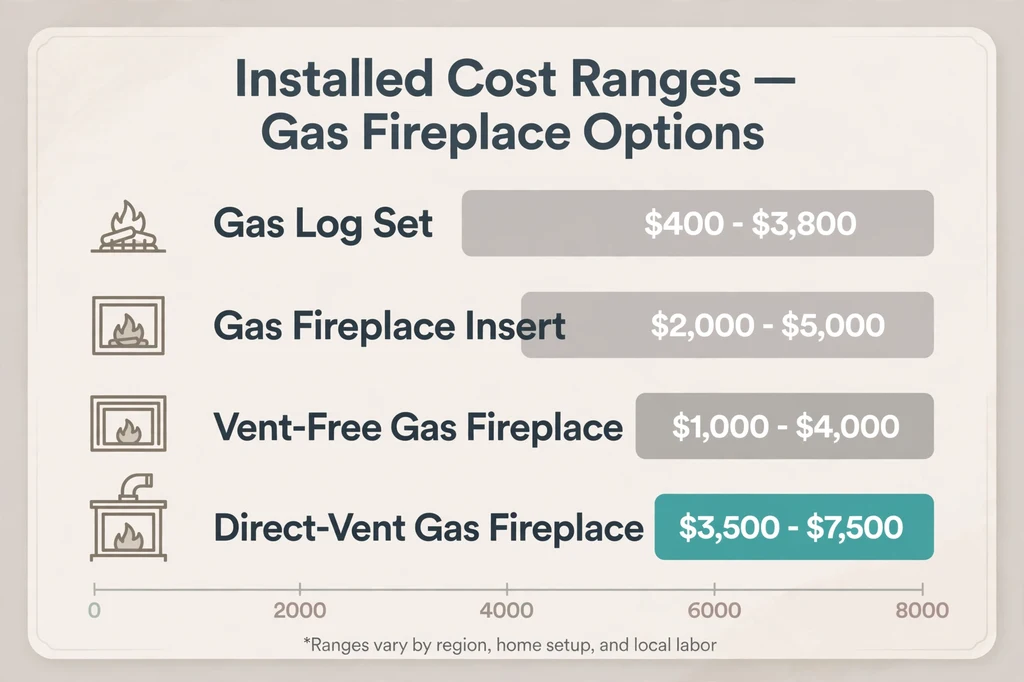
Gas Fireplace Installation Cost by Type
The type of gas fireplace you choose sets the base price. Here is what each option typically costs installed, with the unit, labor, and basic hookup included.
| Fireplace type | Installed cost range | Best for |
|---|---|---|
| Vented gas log set | $400–$3,800 | You already have a working fireplace and want flames on demand |
| Gas fireplace insert | $2,000–$5,000 | Turning an old wood fireplace into an efficient gas heater |
| Vent-free gas fireplace | $1,000–$4,000 | Lowest install cost; no vent pipe needed (check local codes first) |
| Direct-vent gas fireplace (new) | $3,500–$7,500 | Adding a fireplace where none exists; sealed, efficient burn |
| Full replacement with new framing and finish | $8,200–$16,200 | Swapping an old prefab unit plus new surround and mantel |
These ranges line up across several 2026 sources: Angi puts most gas fireplace projects at $2,500–$10,000, HomeGuide prices a gas insert job at $2,000–$5,000 (unit $1,500–$3,500 plus labor $500–$1,500), and Thumbtack data puts direct-vent installs at $3,500–$7,500.
A quick note on vent-free models: they cost less because there is no vent pipe or chimney liner to install.
But vent-free units release combustion byproducts, including CO and water vapor, into the room. They are restricted or banned in some states and cities, so check your local codes before you buy. Our vented vs. vent-free gas fireplace comparison walks through the trade-offs in detail.
Where Your Money Goes: The Cost Breakdown
A gas fireplace quote is really five or six smaller bills added together. Knowing each piece helps you spot an inflated line item — and see where you might save.
| Cost component | Typical range | Notes |
|---|---|---|
| The fireplace unit | $400–$3,500 | Log sets cost least; sealed direct-vent units cost most |
| Gas line work | $350–$2,000 | About $15–$50 per linear foot; extending an existing line runs $250–$500 |
| Venting | $400–$2,000 | Direct-vent pipe through a wall; a new chimney liner runs $900–$3,800 |
| Labor | $300–$3,000 | Licensed gas fitters charge roughly $45–$150 per hour |
| Surround and finish | $1,000–$5,000+ | Simple tile starts near $1,000; marble can pass $5,000 |
| Permits | $50+ | Almost always required for gas line work; varies by town |
The gas line is often the surprise line item. Running pipe from the meter to the fireplace is priced by the foot, so a fireplace on the far side of the house from the meter can add $1,000 or more before the unit is even unboxed. Placing the fireplace near an existing gas line or the meter is one of the easiest ways to keep the total down.
Pro tip: Ask every bidder for an itemized quote that splits out the unit, gas line, venting, labor, and finish work. Itemized quotes make it simple to compare bids line by line — and they reveal when one bidder has padded a single category.
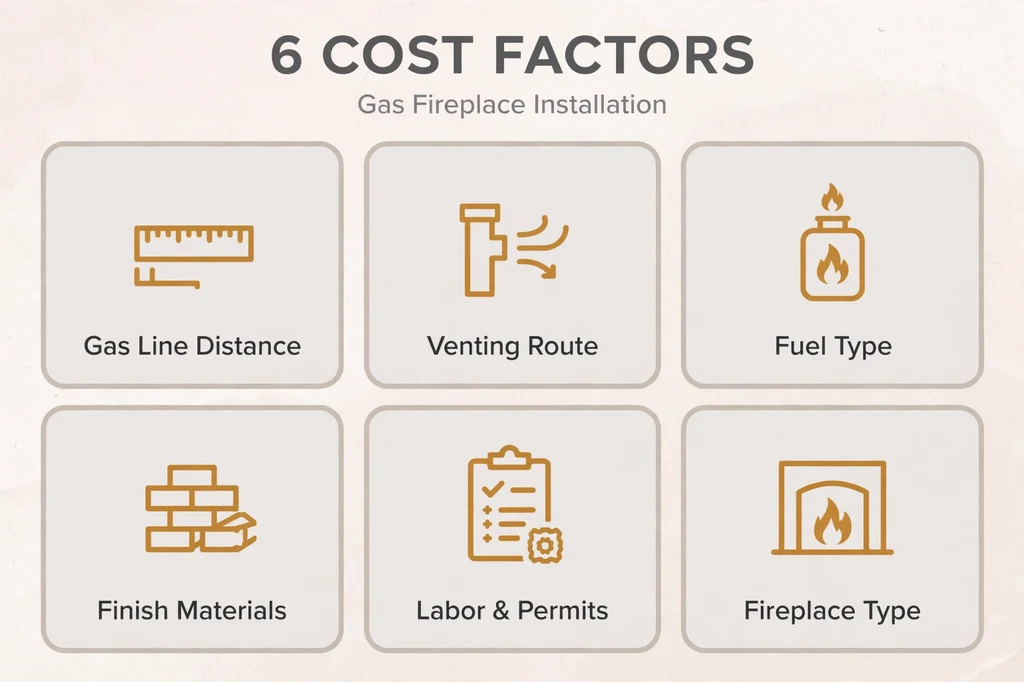
6 Factors That Move Your Quote Up or Down
Two neighbors can buy the same fireplace and pay very different totals. These six factors explain most of the gap.
1. Distance to the gas supply. Every foot of new gas pipe adds material and labor, roughly $15–$50 per foot. A short hop from an existing line may cost only $250–$500; a long run through finished walls can top $2,000.
2. The venting route. A direct-vent unit that vents straight out through an exterior wall is the cheapest venting job. Routing pipe up through the attic and out the roof means more pipe, flashing, and labor — and a bigger bill.
3. Natural gas vs. propane. The fireplace units themselves cost about the same either way. The difference is supply: if your home already has natural gas, hookup is simple.
If you need propane and have no tank, you will need one installed. Tank pricing varies a lot by region and supplier — get a local quote.
4. Vented vs. vent-free. Vent-free units skip the vent pipe entirely, which is why their installed cost runs lower.
The trade-off is indoor air quality: combustion byproducts enter the room, and some jurisdictions restrict or ban them. Factor a working oxygen-depletion sensor and a CO alarm into any vent-free plan.
5. Finish materials. The surround often costs more than the fireplace itself. A simple tile or painted drywall enclosure is the budget pick.
A full stone veneer with a custom mantel can add several thousand dollars. This is the easiest place to control spending without touching safety.
6. Local labor rates and permits. Hourly rates for licensed gas fitters and permit fees differ by city and state. Dense metro areas usually price higher than small towns.
Always confirm permit requirements with your local building department before work starts.
How Much Does It Cost to Install a Gas Fireplace? Three Sample Budgets
Ranges are useful, but examples make budgeting real. Here are three common projects, from cheapest to full build-out.
Budget: gas log set in an existing fireplace — about $1,000–$2,500. You keep your current firebox and chimney. A licensed pro runs a short gas line, sets the burner and logs, and checks the draft. This is ambiance-first heat; log sets warm a room but are not efficient primary heaters.
Mid-range: direct-vent insert in an old wood fireplace — about $4,000–$6,500. The insert goes into the existing opening, and a stainless liner runs up the chimney ($900–$3,800).
The gas line is extended to the firebox, and you get sealed, efficient heat with a thermostat. If you are weighing this against going electric, our gas vs. electric fireplace comparison can help you decide.
Full build: new direct-vent fireplace with framing and stone surround — $8,000–$16,000+. This covers a new unit, a long gas line run, venting through a wall or roof, framing, electrical for the blower or ignition, and a full stone or tile surround with mantel. Large remodels with premium stone land at the top of the range.
One more budget line people miss: electricity. Many gas fireplaces need a standard outlet nearby for the blower, electronic ignition, or remote receiver.
An electrician typically charges $50–$130 per hour for that work. Curious how power affects operation? See whether a gas fireplace can run without electricity.
Costs People Forget to Budget For
Quotes usually cover the obvious parts. These are the extras that catch homeowners off guard.
- Chimney liner. A gas insert in a masonry chimney almost always needs a correctly sized metal liner: $900–$3,800 installed.
- Electrical work. Blowers, electronic ignition, and smart controls need power near the fireplace.
- Old unit removal. Hauling out a dead prefab fireplace or old insert adds labor and disposal fees.
- Permits and inspections. Budget at least $50 for the gas permit, more in strict jurisdictions.
- First-year service. Plan on an annual checkup. Vent-free units run about $75–$150 a year; vented units run higher because of vent and chimney inspection.
5 mistakes that inflate the bill
1. Skipping the permit. Unpermitted gas work can void your homeowner’s insurance and create a hazard no discount is worth.
2. Hiring an unlicensed handyman for the gas line. Gas connections are licensed-pro work, full stop. The savings are not real if the work is not legal.
3. Buying the fireplace before getting quotes. Pros size the unit to your room and venting route. Buy first and you may own a unit that does not fit the plan.
4. Ignoring the venting route. A complex roof run can add thousands versus a simple through-wall vent. Ask how the vent will run before you approve the bid.
5. Forgetting the finish budget. The surround and mantel often cost more than the firebox. Price the finish at the same time as the unit.
Gas Fireplace Installation Cost: FAQs
What is the average cost to install a gas fireplace?
Most standard installations land between $2,500 and $10,000, according to 2026 Angi data. Gas log sets start near $400 installed, while full new builds with framing and premium finishes can pass $16,000.
What is the cheapest way to add a gas fireplace?
A vented gas log set placed in an existing working fireplace, at $400 to $3,800 installed. You keep your firebox and chimney, so there is no venting or framing bill.
Is a ventless gas fireplace cheaper to install?
Yes. Vent-free units typically cost $1,000 to $4,000 installed because there is no vent pipe or chimney liner. But they release combustion byproducts into the room, are restricted or banned in some areas, and need a working oxygen-depletion sensor plus a CO alarm. Check local codes first.
Can I install a gas fireplace myself to save money?
No. Gas line connections, pressure testing, and venting must be done by a licensed gas professional and usually need a permit. Unpermitted gas work can create safety hazards and insurance problems.
How much does it cost to run a gas line to a fireplace?
A new gas line typically costs $350 to $2,000, or about $15 to $50 per linear foot. Extending an existing nearby line is cheaper, usually $250 to $500.
Do I need a permit to install a gas fireplace?
In most places, yes — at least for the gas line work. Gas line permits often start around $50, but rules and fees vary by town, so check with your local building department.
How long does gas fireplace installation take?
A gas log set or insert in an existing fireplace is often a one-day job for a pro. A brand-new direct-vent fireplace with framing, gas line, and finish work can take several days.
Is propane or natural gas cheaper for a fireplace?
The units cost about the same. The difference is supply: natural gas hookup is simple if your home already has it, while propane requires a tank if you do not have one, which adds cost. Tank pricing varies by region, so get a local quote.
Does a gas fireplace add value to a home?
Buyers often see a gas fireplace as a desirable feature, but there is no guaranteed dollar figure it adds to a sale price. Treat it as a comfort upgrade first and a resale bonus second.
Should I get more than one quote?
Yes. Get at least two or three itemized quotes from licensed pros, and compare them line by line — unit, gas line, venting, labor, and finish — before you sign.
Quick Reference: Gas Fireplace Install Costs
| Gas log set | $400–$3,800 |
| Gas insert | $2,000–$5,000 |
| Vent-free unit | $1,000–$4,000 |
| New direct-vent | $3,500–$7,500 |
| Full build with finish | $8,200–$16,200 |
Before you sign: CO alarms on every level · licensed gas pro hired · permit pulled · venting route confirmed · 2–3 itemized quotes compared.
So, how much does it cost to install a gas fireplace? For most homes, plan on $2,500 to $10,000 — less for a log set in an existing fireplace, more for a new direct-vent unit with framing and a premium surround.
Your best next step is simple: pick the fireplace type that fits your home, then get two or three itemized quotes from licensed pros. If you are still torn between vented and vent-free, read our vented vs. vent-free breakdown before you call.
A warm, low-maintenance fire is absolutely within reach. Budget honestly, hire licensed help for the gas work, and keep those CO alarms working — then enjoy the flames.