What Is an Oil Burner? How It Works and What It’s Used For
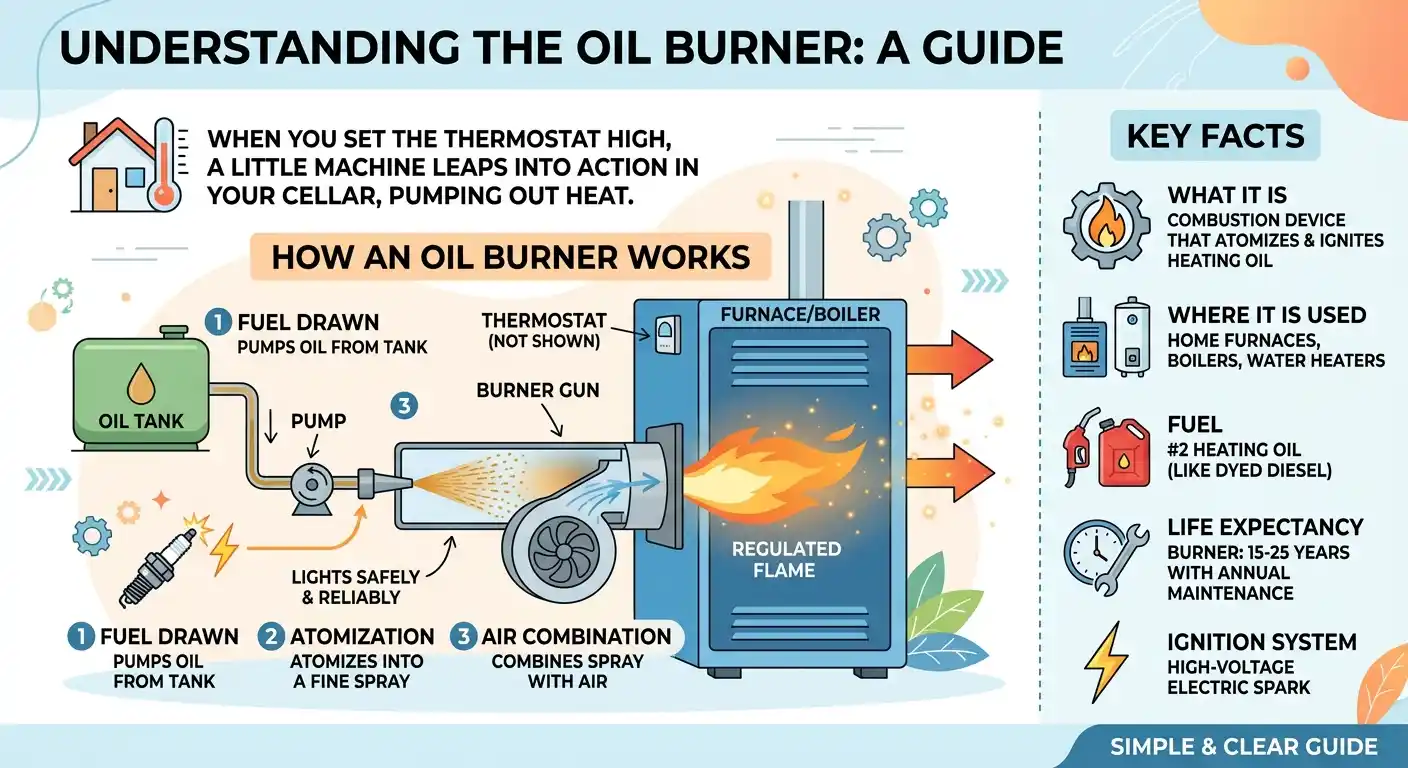
Set the thermostat high in the morning when it is cold and somewhere down in your cellar a little noisy machine leaps into action a few seconds and begins to pump out the heat. That is the oil burner and the majority of the homeowners who have oil heat have never even seen theirs operating, much less known what it is doing in there.
The brief explanation is as follows: an oil burner is the part that transforms liquid heating oil into a regulated flame. It is attached to the front of a furnace, a boiler or a water heater and all it does is to draw the oil out of the tank, atomize it into a fine spray, combine the spray with air, and light it safely and reliably, each time the thermostat needs the heat.
This tutorial takes you step-by-step through how that process actually works, the components involved, the various types of burners you will encounter, what can go wrong, and the comparison of oil heat to the gas and electric options.
Quick Facts
- What it is: A type of combustion device that atomizes and ignites heating oil to create heat.
- Where it is used: Home furnaces, boilers, water heaters and some industrial heating systems.
- Fuel: 2 heating oil, usually, in the U.S., almost the same as on-road diesel, but dyed red to pay the tax.
- Pressure-atomizing “gun” burner: the most common type of residential burner.
- Life expectancy: The burner has a typical life of 15 to 25 years with proper annual maintenance; the furnace or boiler to which it is attached may have a life of many decades.
- Ignition system: High-voltage electric spark, resembling a spark plug.
What Is an Oil Burner?
An oil burner is a self-enclosed combustion chamber that burns liquid heating oil to produce a continuous flame to heat air or water. It isn’t the furnace itself. It is the engine attached to the furnace, boiler or water heater, and it is the element that actually does the combustion.
That housing contains a small electric motor, a fuel-pump, a spray nozzle, a fan, and an ignition system, all of which operate in a series of actions that require only a few seconds. The resulting heat is then sent through a heat exchanger where it heats up the air or water flowing through your home.
When you have ever heard someone say that his furnace kicked on and then heard a sort of whooshing or roaring noise and then heard the warmth, that is the sound of the oil burner being fired.
Oil Burner vs. Oil Furnace: What’s the Difference
People use these terms interchangeably, but they’re not the same thing.
| Term | What It Actually Is |
|---|---|
| Oil burner | The combustion unit that atomizes and ignites the fuel |
| Oil furnace | The full heating appliance, including the burner, heat exchanger, blower, and cabinet |
| Oil boiler | Similar to a furnace, but heats water or produces steam instead of warming air directly |
Consider the burner to be the engine and the furnace or boiler to be the vehicle the burner is in. A burned-out burner is generally replaceable by itself, however when the heat exchanger within the furnace goes dead, you are generally looking at a complete replacement.
How an Oil Burner Works, Step by Step
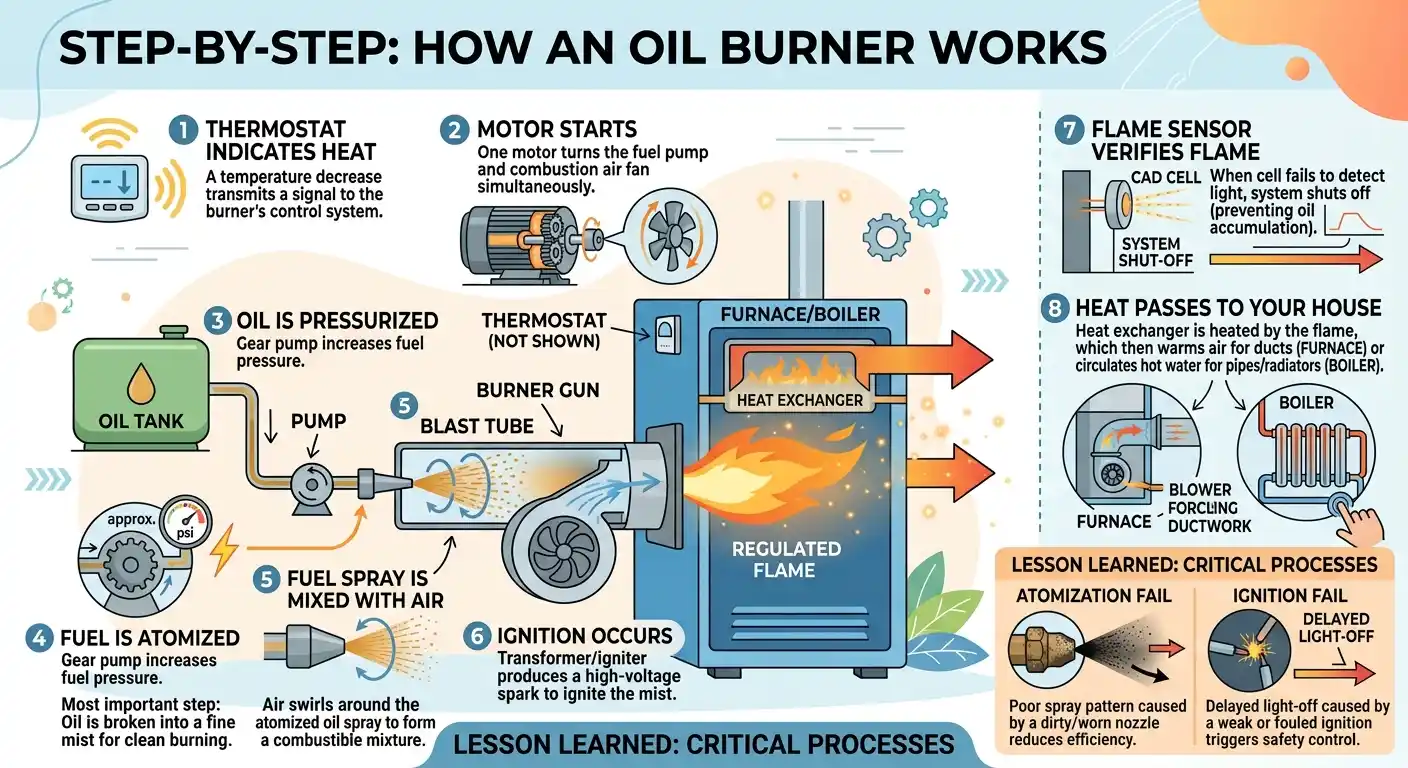
Each time your thermostat requests heat, an oil burner follows the same general procedure. It occurs rapidly, and typically within a few seconds, yet every step counts.
- The thermostat indicates heat. A decrease in temperature activates the thermostat, which transmits a signal to the control system of the burner (also known as the primary control).
- The motor starts. One electric motor serves two purposes. It turns the fuel pump and the combustion air fan simultaneously, typically attached with a common shaft or coupling.
- The oil is pressurized in the pump. A gear pump pumps the oil in the tank via the fuel line and increases its pressure, usually to approximately 100 psi in residential systems, but industrial units may operate at much higher pressures.
- The fuel is atomized in the nozzle. The pressurized oil is then forced through a minute nozzle orifice and it is broken up into a fine cone shaped mist. This is referred to as atomization and it is the most important step in the entire process. Oil which has not been reduced to fine enough droplets will not burn cleanly.
- The fuel spray is mixed with air. Air is forced through a blast tube by a motor driven fan, and swirls around the atomized oil spray to form a combustible air-fuel mixture.
- Ignition occurs. Transformer or electronic igniter produces a high-voltage electric spark that causes the mist to ignite as it exits the nozzle. Other systems employ glow bars rather than a spark, which operate in a similar way as the glow plugs in a diesel engine.
- A flame sensor is used to verify the flame. A cad cell (also known as cadmium sulfide cell) is a light-sensitive component that monitors the flame. When it fails to pick up the light in a few seconds after ignition, the entire system is shut off to ensure that there is no accumulation of unburned oil in the combustion chamber.
- You pass the heat to your house. The heat exchanger is heated by the flame. A blower then forces warmed air through a ductwork (in a furnace) or the system heats water that circulates in pipes and radiators (in a boiler).
- The burner is shut off. The burner is turned off after the thermostat is contented, or when a preset limit is exceeded, until the next heat request.
Lesson learned: The two processes, atomization and ignition are the two processes where nearly everything can go wrong. A poor spray pattern is caused by a dirty or worn nozzle, and delayed light-off is caused by a weak or fouled ignition system, both of which are detrimental to efficiency and may cause the safety control to trip.
The Main Parts of an Oil Burner
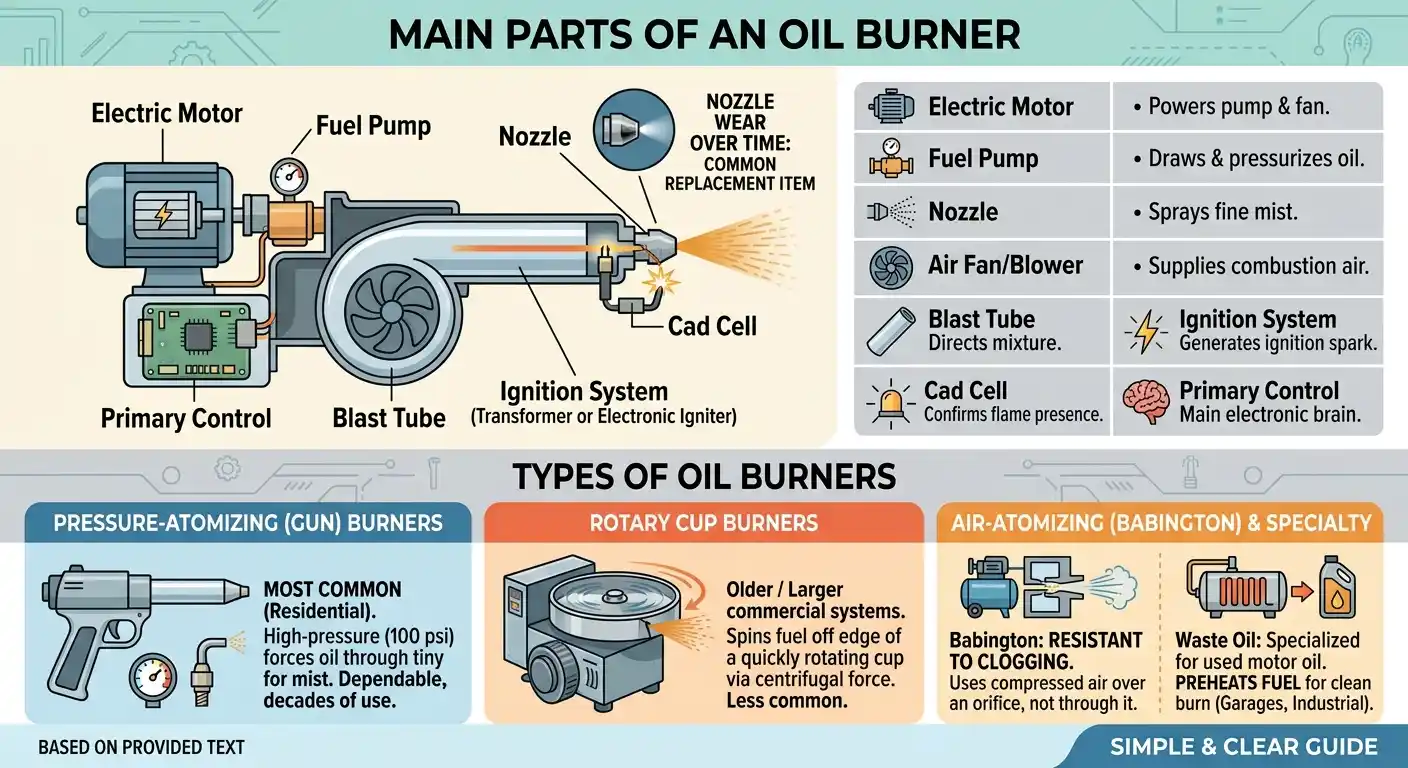
When a technician ever points to your burner and tells you what is not working, it is good to know what each of those parts does.
| Component | Function |
|---|---|
| Electric motor | Powers both the fuel pump and the combustion air fan |
| Fuel pump | Draws oil from the tank and pressurizes it for atomization |
| Nozzle | Sprays pressurized oil in a fine, precisely shaped mist |
| Air fan/blower | Supplies the combustion air that mixes with the atomized fuel |
| Blast tube | Houses and directs the air-fuel mixture toward the combustion chamber |
| Ignition system (transformer or electronic igniter) | Generates the spark that lights the fuel-air mixture |
| Cad cell (or stack sensor) | Confirms the flame is burning; shuts the system down if it isn’t |
| Primary control | The overall electronic “brain” that sequences startup, run time, and shutdown |
Nozzles wear more quickly than any other part, as the oil flowing continuously past the small opening is continually wearing it away. The replacement of the nozzle is a common maintenance procedure by most technicians during every annual tune-up, not because it has failed.
Types of Oil Burners
All oil burners do not atomize fuel in the same manner. The type that has been installed in your house is based on the size of the system, the fuel that is used, and the time period that the equipment was constructed.
Pressure-Atomizing (Gun) Burners
It is the burner you have most likely, should you own a residential oil furnace or boiler in the United States. High pressure, usually approximately 100 psi is applied to the oil forcing it through a small nozzle that shears the oil into a fine mist. It is easy, dependable and can last decades with frequent replacement of nozzles and cleaning.
Rotary Cup Burners
These burners do not force oil through a nozzle but spin the fuel off the edge of a quickly rotating cup, and centrifugal force atomizes the fuel. They are less prevalent in a modern residential environment, but do appear in certain older or larger commercial systems.
Air-Atomizing (Babington) Burners
This design is named after inventor Robert Babington and it circulates oil around the exterior of a small orifice fed with compressed air, instead of forcing oil through the orifice. Since the oil does not squeeze through a small opening, these nozzles are resistant to wear and clogging that plague standard pressure nozzles, and are thus used to burn heavier or dirtier fuel oils.
Vaporizing Burners
Vaporizing burners are older and less complex than designs that atomize the oil, in which the oil is heated until it changes to vapor and then combustion occurs without spraying it in a fine mist of liquid. They are almost phased out of the modern residential heating business, but they are sometimes still present in older systems.
Waste Oil Burners
These are a specialized type, commonly found in auto shops, garages, and industrial facilities, which is used to burn used motor oil or other waste oils as a cheap source of heat. Since waste oil is denser and less uniform than virgin heating oil, such burners usually preheat the fuel prior to atomization, to guarantee that it burns out fully and cleanly.
What is the Burning Fuel of an Oil Burner?
The U.S. residential oil burners are almost entirely operated on 2 heating oil. It is almost identical to on-road diesel fuel chemically, only that it is dyed red to show that it is not subject to road taxes as it is not used to propel vehicles.
More industrial burners can operate using 6 fuel oil (also known as bunker fuel), which is heavier and normally needs preheating before it will atomize sufficiently. There are also some contemporary residential systems that can be used with biodiesel blends, also commonly referred to as Bioheat, which is conventional heating oil mixed with renewable biodiesel to lower emissions.
What Are Oil Burners Used For?
Oil burners appear everywhere, where a building requires a self-sufficient method of heat production not dependent on a natural gas line.
- Home heating (furnaces). Air is heated directly by the burner and distributed by a blower via ductwork.
- Home heating (boilers). Water is heated by the burner and circulated through radiators or in-floor piping, or can be turned into steam to be used in steam-heat systems.
- Domestic hot water. Other oil-fired systems have a tankless coil or an indirect water heater which utilizes the heat of the boiler to provide hot water to the home.
- Commercial and industrial heating. Space heating and process heat of larger buildings, workshops, and facilities that lack gas use are often powered by oil-fired boilers.
- Off-grid and rural properties. Where natural gas infrastructure is lacking, oil heat can be the most feasible choice, as the delivery trucks can fill a tank at the location.
Oil Burner vs. Gas Burner vs. Electric Heat
When you are choosing between the types of fuel, or are simply trying to figure out why your house even has oil heat in the first place, here is a comparison of the two.
| Factor | Oil Burner | Gas Burner | Electric Heat |
|---|---|---|---|
| Fuel delivery | Truck delivery to an on-site tank | Piped in via utility line | Wired to the electrical grid |
| Availability | Works anywhere a truck can deliver | Requires gas line access | Works anywhere with power |
| Heat output | Generally high heat output per unit of fuel | High heat output, very efficient | Consistent, but often costlier per BTU |
| Typical equipment lifespan | 15 to 25+ years, furnace often longer | Similar, often slightly longer | Varies by system type |
| Maintenance | Annual tune-up strongly recommended | Generally lower maintenance | Minimal for resistance heat |
| Price volatility | Can fluctuate more with market prices | Generally more stable, regulated pricing | Tied to electricity rates |
| Storage | Requires an on-site oil tank | No on-site storage needed | No fuel storage needed |
Both are not necessarily better. Oil heat is generally more apt to burn hotter and can be a good option in colder climates or regions without gas infrastructure, whereas gas is generally more convenient where a line is already in place. The reality of actual cost comparisons is that local fuel prices change over the year and therefore it is worthwhile to check the current pricing in your locality than just use a set of rules of thumb.
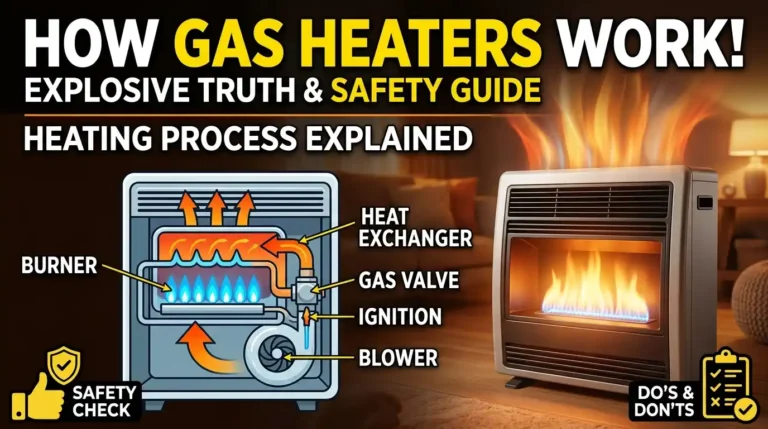
If you’re weighing a switch to gas, it helps to understand which indoor gas heating options are actually safe to install before comparing costs against your current oil system. And since combustion is the common thread between the two fuel types, seeing how a gas-fired unit ignites and moves heat through a home makes the comparison a lot easier to follow.
Common Oil Burner Problems and What They Mean
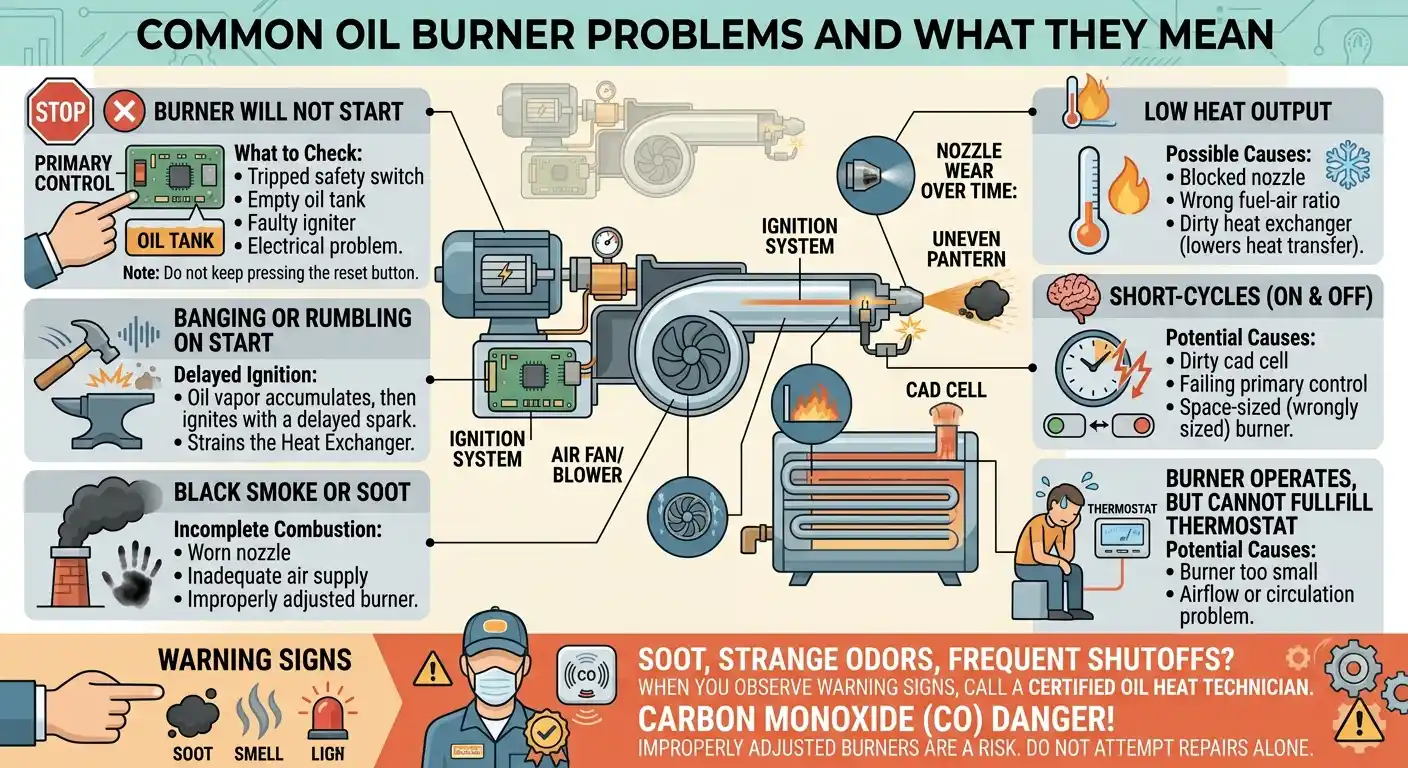
You do not have to be a technician to notice the warning signs of an ailing oil burner. This is what to keep an eye on and what it is likely to indicate.
- Burner will not start. It may be a tripped safety switch, an empty oil tank, a faulty igniter or an electrical problem. Inspect the thermostat and reset button initially, but do not keep pressing the reset button.
- Banging or rumbling on start. It can be a symptom of delayed ignition, in which case the oil vapor accumulates and then the spark ignites. This must be done promptly, as the consistent delayed ignition strains the heat exchanger.
- Burner operates, yet has low heat output. May indicate a blocked nozzle, wrong fuel-air ratio, or a dirty heat exchanger that lowers the heat transfer.
- Black smoke or soot. Typically a sign of incomplete combustion, typically due to a worn nozzle, inadequate air supply, or improperly adjusted burner.
- Short-cycles (on and off). Can be due to a dirty cad cell, a failing primary control, or a space-sized burner.
- Burner is operated continuously and does not fulfill the thermostat. May show that the burner is too small to heat the house, or that there is a problem with airflow or circulation elsewhere in the system.
When you observe any of these, particularly soot, strange odors or frequent shutoffs, it is better to call a certified oil heat technician than to attempt to troubleshoot the combustion equipment on your own. Carbon monoxide can be a result of improperly adjusted burners.
Oil Burner Maintenance: What Actually Needs to Happen Every Year
The most important aspect of the longevity of an oil burner and its efficiency is regular maintenance. A properly maintained system can last decades; an ill-maintained one burns fuel and breaks down prematurely.
- Replace the nozzle. It is worn out by the continuous flow of oil and should be replaced every year as a normal maintenance, not only when it stops functioning.
- Replace the oil filter. Stops any debris of the tank or the fuel lines reaching and blocking the nozzle.
- Replace air filter (on the furnace side). Maintains air flow over heat exchanger.
- Clean heat exchanger and combustion chamber. The accumulation of soot unevenly insulates the heat exchanger, leading to cracking with time.
- Test and tune fuel-air mixture. A combustion analyzer ensures that the burner is operating at the optimum efficiency and not wasting fuel.
- Inspect and clean the cad cell. A contaminated sensor may result in false shutdowns or, worse still, be unable to detect an actual ignition issue.
- Inspect ignition electrodes or igniter. Poorly fitted or damaged electrodes lead to weak or irregular sparks.
A majority of oil heat companies suggest a professional tune-up at least once a year, preferably prior to the heating season.
FAQs
In simple terms, what is an oil burner?
The element of a furnace, boiler or water heater that converts liquid heating oil into a controlled flame by spraying it into a fine spray, mixing it with air and igniting it is called an oil burner.
What is the way an oil burner lights the fuel?
Most residential oil burners use a high-voltage electric spark, generated by a transformer or electronic igniter, to ignite the atomized oil-air mixture as it leaves the nozzle. Glow bars are used on some older or specialized burners.
What are the oil burners fed on?
In residential oil burners, nearly all burn No. 2 heating oil, not dissimilar in chemical makeup to on-road diesel fuel, but dyed red to pay taxes. Some industrial burners burn heavier No. 6 fuel oil, and some more recent systems burn biodiesel blends.
What’s the difference between a gun burner and a rotary burner?
A gun burner (pressure-atomizing burner) is a high-pressure spray of oil forced through a small nozzle, whereas a rotary burner is a centrifugal spray of fuel thrown off an edge by a rotating cup. In contemporary residential systems the burners of guns are much more prevalent.
Is oil heat safe?
Yes, when well installed and maintained. Oil burners have safety measures such as the cad cell that automatically shut the system should the ignition not take place effectively to avoid unburnt fuel.
Are there carbon monoxide burners in oil burners?
Every combustion appliance emits a certain amount of carbon monoxide. A well-maintained oil burner is a properly functioning burner which vents safely through the flue. Carbon monoxide may be a hazard due to poor maintenance, blocked venting, or a faulty burner, hence the importance of annual servicing and a functioning CO detector.
Why is there black smoke in an oil burner?
The black smoke is normally an indication of incomplete combustion, which may be due to a worn or clogged nozzle, incorrectly adjusted fuel-air mixture, or lack of sufficient combustion air.
Is it possible to change oil heat to gas heat?
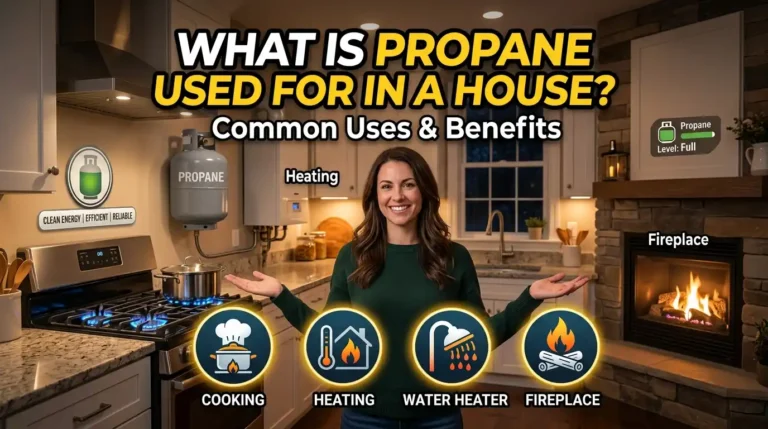
It can be done, but it would need new equipment (a gas furnace or boiler) instead of modifying the existing oil burner because the two systems are not compatible. Such conversion is a major undertaking that should be considered by a certified HVAC contractor. If propane is part of the conversation, it’s also worth reviewing the full range of jobs propane can handle around a home before deciding which fuel makes the most sense for your setup.
What is a cad cell and why is it important?
A cad cell is a photoresist safety sensor that indicates that the burner has been ignited successfully. In case it fails to sense the light of the flame after a few seconds of start-up, it closes the burner to avoid the accumulation of unburned oil in the combustion chamber.
Final Thoughts
Once you disassemble an oil burner, it is not a difficult thing to do: pump the oil, spray it, combine it with air, light it, and make sure that it lit. It is a mechanism that consists of a few simple mechanical actions that occur rapidly and occur each time your thermostat requests heat.
Maintenance nearly always goes wrong, rather than design. A nozzle that is long overdue a change, a cad cell full of soot, or a fuel-air mixture that has drifted out of adjustment will silently cost you money and efficiency long before it is actually out of business. The best thing you can do with an oil-fired heating system is to make the appointment that annual tune-up before the cold weather sets in, instead of waiting until a problem presents itself.
Unless your system is behaving in a manner that you are not aware of, do not attempt to diagnose combustion equipment yourself. Request a certified oil heat technician to test, fine-tune, and verify that the system is operating safely and efficiently.