How Much Electricity Does a Fan Heater Use? Real Cost Per Hour, Day, and Month
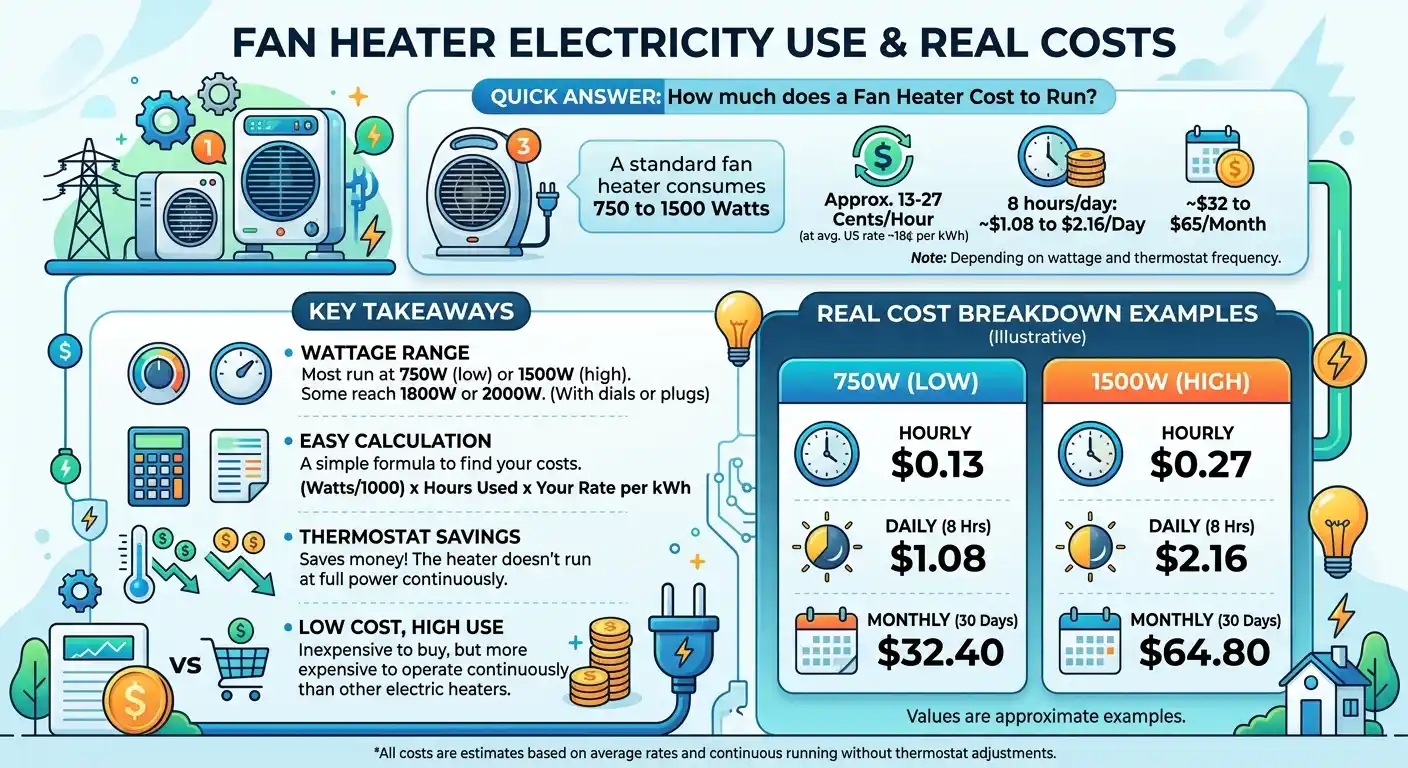
Quick Answer: How much does a Fan Heater Cost to Run?
A standard fan heater consumes 750 to 1500 watts, or approximately 13 to 27 cents an hour at the average electricity price in the U.S. of approximately 18 cents per kilowatt hour. Eight hours a day is approximately 1.08 to 2.16 a day or 32 to 65 a month, depending on the wattage and the frequency of the thermostat turning the heating element off.
That’s the short version. The remainder of this guide is a breakdown of the sources of those numbers, how to determine your own cost, with your own rate and heater, and a comparison of a fan heater to other forms of electric heating.
Key takeaways
- Most fan heaters run at 750W (low) or 1,500W (high), with some models topping out at 1,800W or 2,000W.
- It is easy to compute: (watts/1000) x hours used x your rate per kilowatt hour of electricity.
- A thermostat will save a lot of money in the real world, as the heater does not have to be running at full power all the time it is on.
- Fan heaters are the most inexpensive type of heater to purchase, yet one of the more expensive to operate on a continuous basis than some other types of heaters since they are fully dependent upon resistive heating.
How Much Electricity Does a Fan Heater Use?
A fan heater is a small electric resistance heater that has a fan attached to it. Electricity is sent through a heating component (typically a coil of ceramic or metal), the component gets hot and the fan blows air over the component to force warm air into the room. Since the fan is used to push air and not to use the air to naturally rise, a fan heater warms a small room more quickly than a simple radiant or oil filled heater, but it does not heat any better.
All the electricity that a resistance heater consumes is virtually all heat, thus the wattage is a direct, dependable proxy of running cost.
Typical Fan Heater Wattage
Most fan heaters sold for home use fall into a fairly narrow wattage range:
| Heater size | Typical wattage | Best suited for |
|---|---|---|
| Small personal/desk heater | 750W to 900W | A single desk, small office, or spot heating |
| Standard room heater | 1,000W to 1,200W | A bedroom or home office |
| Full size room heater | 1,500W | A living room or larger bedroom |
| High output models | 1,800W to 2,000W | Larger or poorly insulated rooms |
Most fan heaters do not have a fixed wattage, but offer you a range of settings. You will often encounter a heater that has a rating of 750W/1,500W, meaning that it can be run on low (750W) or high (1,500W) and also a fan only mode that only consumes a few watts and no heat is produced at all. The quickest method to get a proper cost estimate is to look at the rating label on the box of your own heater, or the wattage in the manual, as the category of fan heater covers a relatively broad power range.
Watts, kWh, and What They Mean for Your Bill
Your electric bill is not in watts but in kilowatt hours (kWh). One kWh is the amount of energy used by a 1,000 watt device running for one hour. As such a 1500W heater consumes 1.5 kWh of energy in an hour of full operation and a 750W heater consumes 0.75 kWh of energy in one hour of full operation. Your utility is your total kWh used times your rate per kWh to produce your bill, and that is what the calculations below are constructed on.
Fan Heater Running Cost Calculator (By Wattage)
These numbers assume the current average residential electricity rate in the U.S. of approximately 18.3 cents per kWh (according to the 2026 data provided by the U.S. Energy Information Administration). In case you are aware of your own rate, you can go ahead to the next part and enter your own figures.
Cost Per Hour
| Wattage | kWh used per hour | Cost per hour (at $0.18/kWh) |
|---|---|---|
| 750W | 0.75 kWh | $0.14 |
| 1,000W | 1.0 kWh | $0.18 |
| 1,200W | 1.2 kWh | $0.22 |
| 1,500W | 1.5 kWh | $0.27 |
| 1,800W | 1.8 kWh | $0.32 |
| 2,000W | 2.0 kWh | $0.36 |
Cost Per Day (8 Hours of Use)
| Wattage | kWh per day (8 hrs) | Cost per day |
|---|---|---|
| 750W | 6.0 kWh | $1.08 |
| 1,000W | 8.0 kWh | $1.44 |
| 1,200W | 9.6 kWh | $1.73 |
| 1,500W | 12.0 kWh | $2.16 |
| 1,800W | 14.4 kWh | $2.59 |
| 2,000W | 16.0 kWh | $2.88 |
Cost Per Month (30 Days, 8 Hours a Day)
| Wattage | kWh per month | Cost per month |
|---|---|---|
| 750W | 180 kWh | $32.40 |
| 1,000W | 240 kWh | $43.20 |
| 1,200W | 288 kWh | $51.84 |
| 1,500W | 360 kWh | $64.80 |
| 1,800W | 432 kWh | $77.76 |
| 2,000W | 480 kWh | $86.40 |
These monthly values are based on the assumption that the heater is used full power and eight hours a day, which is a worst case scenario. The thermostat on most fan heaters will turn the element off when the room reaches the desired temperature, so real world monthly cost may be less, as much as 20 to 40 percent less, depending on your insulation and how cozy you are making the room.
How to Calculate Your Own Fan Heater Cost
You do not have to use averages. Use this formula with your own heater’s wattage and your own electricity rate, which you’ll find listed on your utility bill:
Cost = (Wattage ÷ 1000) × Hours Used × Your Rate per kWh
Worked problem: You have a 1,500W fan heater that you use 5 hours a day, and your rate is 0.16 per kWh.
- 1,500 ÷ 1000 = 1.5 kW
- 1.5 kW × 5 hours = 7.5 kWh
- 7.5 kWh × $0.16 = $1.20 per day
Divide that amount per day by the days you anticipate using the heater to obtain a monthly or seasonal amount.
Does Your Electricity Rate Change the Answer?
Significantly. The real cost of operating the same heater will be different in different states and different utilities because electricity rates are highly variable. By 2026, the U.S. residential average is approximately 18.3 cents per kilowatt hour, with a range of between 13 cents per kilowatt hour in lower cost states such as Nevada and over 50 cents per kilowatt hour in Hawaii, with some states in the New England region also well above the national average.
| Electricity rate scenario | Rate per kWh | Cost per hour (1,500W heater) | Cost per month (8 hrs/day) |
|---|---|---|---|
| Lower cost state (example: Nevada) | $0.13 | $0.20 | $47.16 |
| U.S. national average | $0.18 | $0.27 | $64.80 |
| Higher cost region (example: New England) | $0.30 | $0.45 | $108.00 |
| Highest cost state (example: Hawaii) | $0.53 | $0.79 | $189.60 |
Assuming you are not aware of your rate, refer to the price per kWh line or the supply charge line on a recent electric bill. That one number is the most significant variable in this whole calculation, more significant than the particular heater you have.
How Much Does It Cost to Run a Fan Heater All Night?
Operation of a 1500W fan heater 8 hours overnight at the U.S. average rate would cost approximately 2.16 or about 65 a month were it run nightly. An overnight run at 750W costs approximately 1.08 or about 32 a month. Those values are based on full power operation with no thermostat cycling, so the real cost in practice would be a bit less at night.
With that said, the majority of safety recommendations are not to leave any portable space heater unattended overnight, no matter the cost, unless the device has tip over protection, overheat protection, and ETL or UL certification. The next consideration after fire safety, as far as overnight use is concerned, is cost.
Fan Heater vs Other Heater Types: Which Costs More to Run?
Any plug in electric resistance heater of the same wattage is equally expensive to operate, since a watt is a watt no matter what the design of the heater. The actual distinction between the types of heater is the efficiency with which the heat is delivered to you and the way the thermostat acts, rather than the amount of electricity consumed per watt.
| Heater type | Typical wattage | How it delivers heat | Running cost pattern |
|---|---|---|---|
| Fan heater | 750W to 1,800W | Fan forced air across a heating element | Heats a room fast, but cools quickly once switched off |
| Ceramic heater | 750W to 1,500W | Similar to a fan heater, using a ceramic heating plate | Comparable running cost to a fan heater at the same wattage |
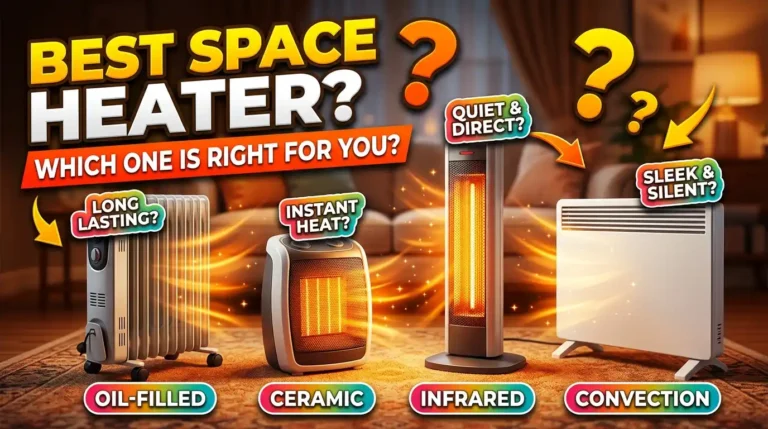
| Oil filled radiator | 700W to 1,500W | Heats oil inside sealed fins, radiates heat slowly | Same watts, same cost, but retains heat longer after cycling off, which can reduce total run time |
| Infrared/quartz heater | 750W to 1,500W | Radiant heat that warms objects and people directly rather than the air | Can feel warm at a lower wattage since it heats you directly, sometimes lowering effective cost |
| Convection panel heater | 500W to 2,000W | Slowly heats and circulates room air | Similar cost profile to a fan heater at matching wattage |
The real world lesson: a fan heater is not necessarily more costly to operate than an oil filled radiator or a ceramic heater of the same wattage. The place where fan heaters may prove to be more expensive in the long run than a season is that it warms air rapidly and that air cools rapidly after the unit has turned off, and may result in more frequent on and off cycling in a drafty room.
If you’re weighing a fan heater against the alternative, this breakdown of oil filled radiator running costs walks through the same math for that heater type, and this look at whether oil filled heaters are actually energy efficient covers the tradeoffs in more depth.
What Actually Affects a Fan Heater’s Running Cost
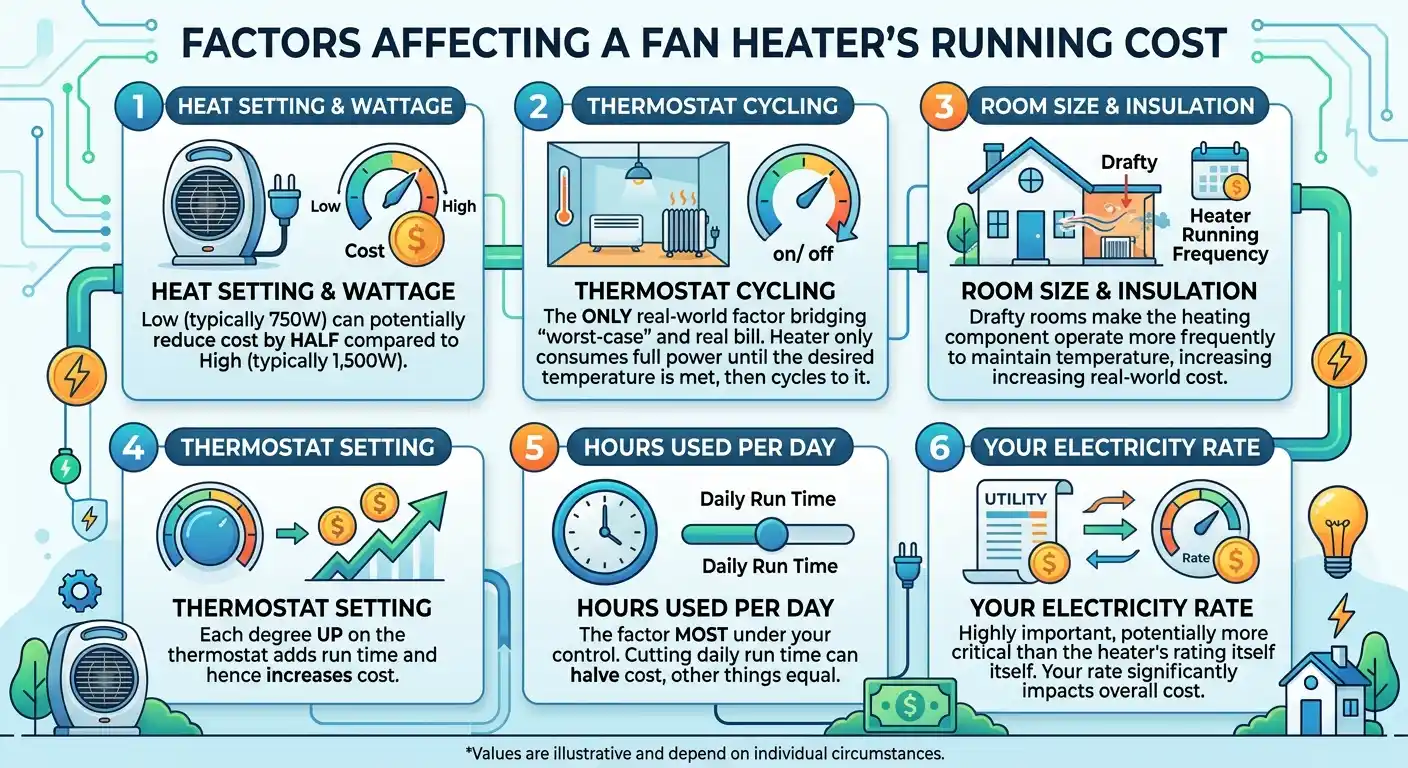
- Heat setting and wattage. Operating at a low (typically 750W) rather than a high (typically 1,500W) power can potentially reduce your cost by half the time.
- Thermostat cycling. A thermostat-controlled heater only consumes full power until the room reaches the desired temperature, and then switches off and on to hold the temperature steady. This is the one and the only real world factor between the above numbers of the worst case and your real bill.
- Room size and insulation. A drafty room will cause the heating component to operate more frequently to maintain a constant temperature, increasing real world cost although the wattage rating will never change.
- Thermostat setting. Each degree up on the thermostat adds run time and hence cost.
- Number of hours used per day. This is the factor that can be controlled the most. Cost is half the daily run time, other things being equal.
- Your electricity rate. This can be more important than the heater itself as demonstrated above.
Is a Fan Heater Cheaper Than Central Heating?
It is determined by the extent of your home you are actually heating. A fan heater can be inexpensive compared to central heating when you just need to heat one room because you are not using energy to heat hallways, bedrooms or rooms that are not in use. Warming only the room you are in, also known as zone heating, with a fan heater and leaving the central thermostat set at a lower temperature in other parts of the house can save on total heating expenses.
But when you have more than one or two rooms to heat, then operating more than one or two space heaters or a single fan heater all day long can turn out to be more expensive than an efficient central heating system, particularly when your central heating uses gas or a heat pump instead of electric resistance heat, which typically is cheaper per unit of heat than any plug in electric heater.
8 Ways to Lower Your Fan Heater’s Running Cost
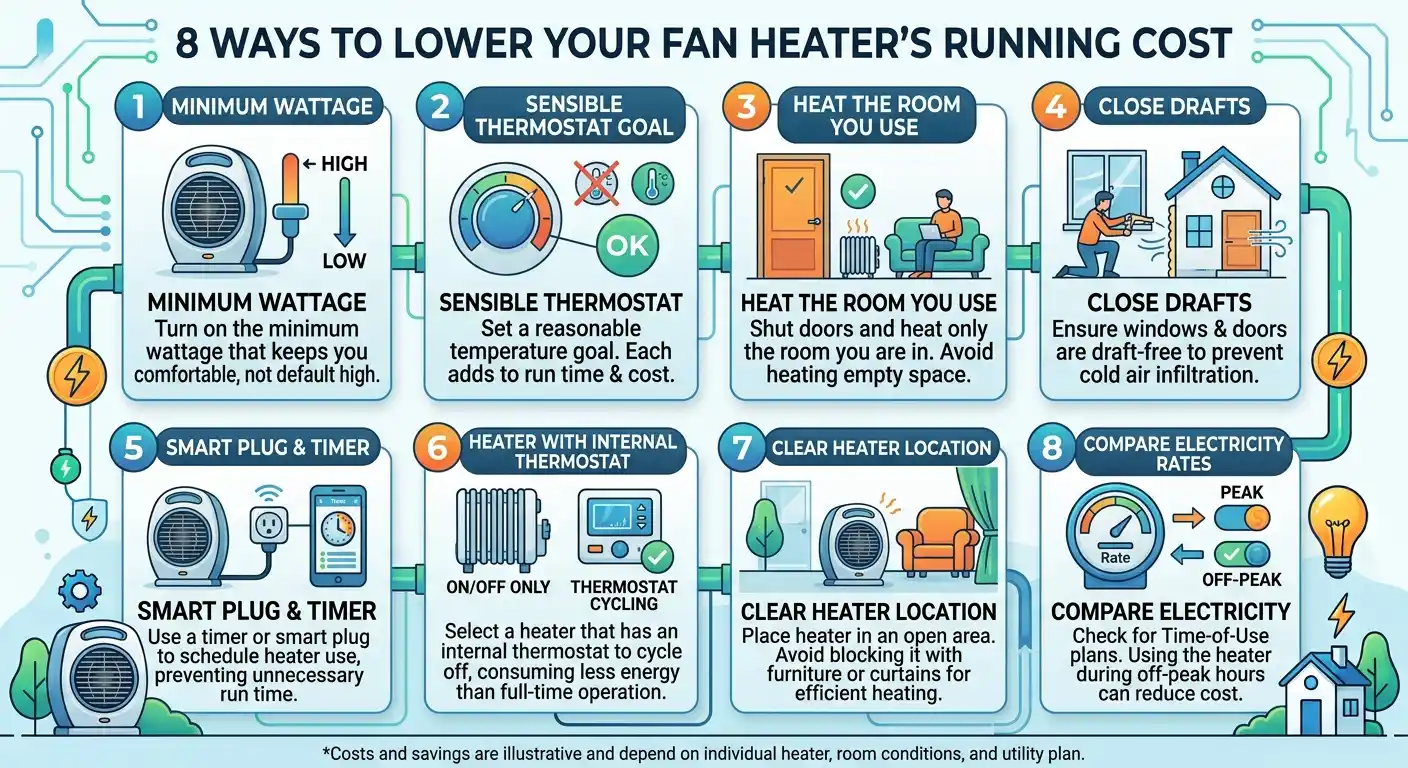
- Turn on the minimum amount of wattage that makes you comfortable, instead of turning to the default high.
- Have a sensible thermostat goal. Each extra degree adds to run time and cost.
- Shut the doors and turn on the heater in the room you are staying in.
- Close apparent drafts in and around the windows and doors, to ensure that the heater is not struggling with cold air infiltration.
- Have a timer or smart plug, so that the heater does not have to run when you are not in the room or sleeping.
- Select a heater that has an internal thermostat as opposed to a plain on/off switch, as the act of cycling consumes actual energy as compared to operating at full blast all the time.
- Have the heater in a place where it does not have to heat the air blocked by furniture or curtains, and thus it does not have to work harder than it has to.
- Compare your electricity rate between time of use plans (where available) because using a heater during off peak hours can reduce cost on some plans.
Fan Heater Safety and Running Cost: What to Know
Calculations of costs are based on the assumption that a heater is functioning properly and safely. Some of the basic safety considerations which also influence real world running cost and heater life:
- Simply insert the heater into a wall outlet. Extension cords and power strips should be avoided and will overheat when a heater is loaded and are a frequent cause of fire.
- Find ETL or UL certification and such features as tip over shutoff and overheat protection.
- Maintain a distance of three feet between the heater and bedding, curtains and furniture.
- Periodically remove dust in air intakes. The blocked fan heater will be less efficient and will have a shorter life span due to the motor, and this will not save money.
For a deeper dive into how these units work and where the safety risks actually come from, see this explainer on space heater mechanics and safety. If you’re also considering a radiator style unit for a room where sound matters, this step-by-step setup guide for oil filled radiators covers settings and safety for that option too.
FAQs
What is the power consumption of a fan heater in an hour?
The average fan heater consumes 750-1500 watts, or about 14-27 cents per hour at the average electricity rate of 18 cents per kilowatt-hour in the United States.
What is the number of kWh per day of a fan heater?
A 750W heater (run 8 hours/day) consumes approximately 6 kWh of energy, and a 1,500W heater (run 8 hours/day) consumes approximately 12 kWh of energy, but in practice thermostat cycling can typically reduce this.
Are fan heaters very electrically consuming as compared to other appliances?
Yes, when compared to most domestic appliances. A fan heater consumes more power than most kitchen appliances, television sets, or even lighting at 1,500W, so operating one several hours a day can have a significant impact on a monthly bill.
Is it more expensive to have a fan heater on low throughout the day or to switch it on and off?
Turning a heater on and off on a thermostat whenever you need it is nearly always cheaper than having any heater running all the time, because you only use the electricity when you really need more heat in the room.
What is the cost of a fan heater operating at night?
A 750W heater in an 8 hour overnight run would cost approximately 1.08 at average electricity rates in the U.S. and a 1,500W heater would cost about 2.16.
Will a fan heater significantly increase my electric bill?
Yes. Operating a 1,500W fan heater 8 hours per day throughout an entire month will increase a bill by an average of about 65 dollars, and a lot more in more expensive states.
Generally, is a space heater more expensive to operate than a fan heater?
Fan heater is a variant of space heater, so this analogy typically refers to fan heaters in comparison to other types of space heaters such as oil filled radiators or ceramic heaters. Running costs are virtually identical at identical wattage.
Which wattage fan heater will I require in my room?
One popular guideline is approximately 10 watts per square foot of a room with average insulation and normal ceiling height, thus a 1,500W heater is usually appropriate in a room of about 120 to 150 square feet.
Does a fan heater consume additional power to run the fan in addition to the heating coil?
The fan motor itself consumes a low power, usually a few watts, which is insignificant to the draw of the heating element, and which is already accounted in the total wattage rating of the heater.
Final Thoughts
The operating cost of a fan heater is reduced to two numbers you can control and one you cannot, the amount of watts you select, the number of hours you have it on and the rate of electricity that your utility charges. On average U.S. rates, you can anticipate between $0.14 and $0.36 an hour, based on the wattage, and between 30 and 90 a month with normal daily usage.
Actually reducing that figure is best done by not changing brands of heater, but by running a lower wattage when you need it, using a thermostat rather than leaving the unit on all the time, and heating only the room you are in.