Patio Heater Won’t Stay Lit? 7 Troubleshooting Fixes
When your patio heater won’t stay lit, the whole evening starts to unravel. You hold the knob down, the pilot catches, you let go — and the flame dies. Two winters ago, this exact thing happened to me with guests already outside in their coats, and I spent twenty minutes relighting the same heater before I found the real problem. That pattern — pilot lights, flame dies on release — has a short list of causes, and almost every one is fixable without a repair bill.
This guide walks you through 7 troubleshooting fixes in the order you should try them, starting with the fastest checks. Give yourself about 20 to 30 minutes and a few basic hand tools. By the end, your heater should light, stay lit, and keep burning on its own.
A quick safety note before you start: propane heaters belong outdoors in open air. Never run one in a garage, tent, or enclosed patio, and keep a carbon monoxide detector nearby when burning fuel close to doors or windows. If you ever smell gas, turn the tank valve off, step away from the heater, and do not relight it until the smell is completely gone. If anything feels off, call a licensed gas technician. See our full guide to propane heater safety for more.
- Fine steel wool or fine-grit sandpaper
- Needle-nose pliers
- Phillips screwdriver
- Toothpick or thin wire
- Dish soap and water in a spray bottle
- Full spare propane tank (smart to have)
- Work gloves
- Soft cloth
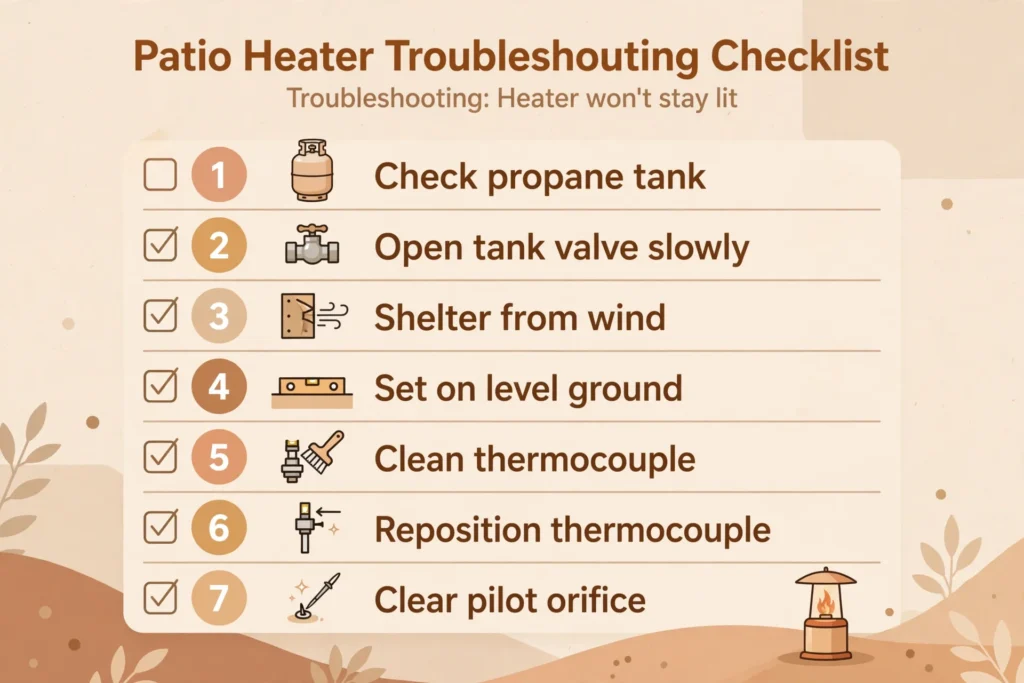
- Check the propane tank level
- Reopen the tank valve slowly
- Move the heater out of the wind
- Set the heater on firm, level ground
- Scrub the thermocouple tip clean
- Nudge the thermocouple into the pilot flame
- Restore full gas flow to the pilot
Check the propane tank level
A nearly empty tank is the number-one reason a patio heater won’t stay lit. The flame gets weaker as fuel runs low, and the pilot is the first thing to give up. Lift the tank — a full 20-pound cylinder feels clearly heavier than an empty one. You can also pour a little warm water down the side and feel for the cool line where the liquid propane sits inside. If the tank is low, swap in a full one before touching anything else. Knowing how long a propane tank lasts on a patio heater helps you avoid this surprise next time.
Reopen the tank valve slowly
If the tank is full but the flame is weak, the tank’s built-in safety valve probably tripped. This valve senses a sudden rush of gas — exactly what happens when you crank the valve open fast after a tank swap — and chokes the flow down to a trickle. That trickle can’t sustain the pilot, so the heater lights and dies. Turn the tank valve fully off, wait about 60 seconds, then reopen it slowly: a quarter turn every few seconds until it’s fully open. Then try relighting, following your manual or our guide on how to use a patio heater.
Move the heater out of the wind
The pilot flame is tiny, and a steady breeze can push it sideways off the thermocouple. The sensor cools down, the gas valve shuts as designed, and your heater goes out. Move the heater to a sheltered corner, along a fence line, or behind a windbreak such as a hedge or patio screen. Keep it clear of open doorways and walkways where gusts funnel through — the pilot is most vulnerable right at startup, before the burner head warms up.
Set the heater on firm, level ground
A heater that lights fine and then dies a few minutes later is often tripping its anti-tilt switch. Most patio heaters carry this safety switch, which cuts the gas if the unit leans. Even a slight wobble on uneven pavers or soft lawn can trigger it as the heater settles. Stand the unit on flat, solid ground — concrete or level pavers are best. Rock it gently with both hands; if it shifts at all, reposition it until it’s rock steady.
Scrub the thermocouple tip clean
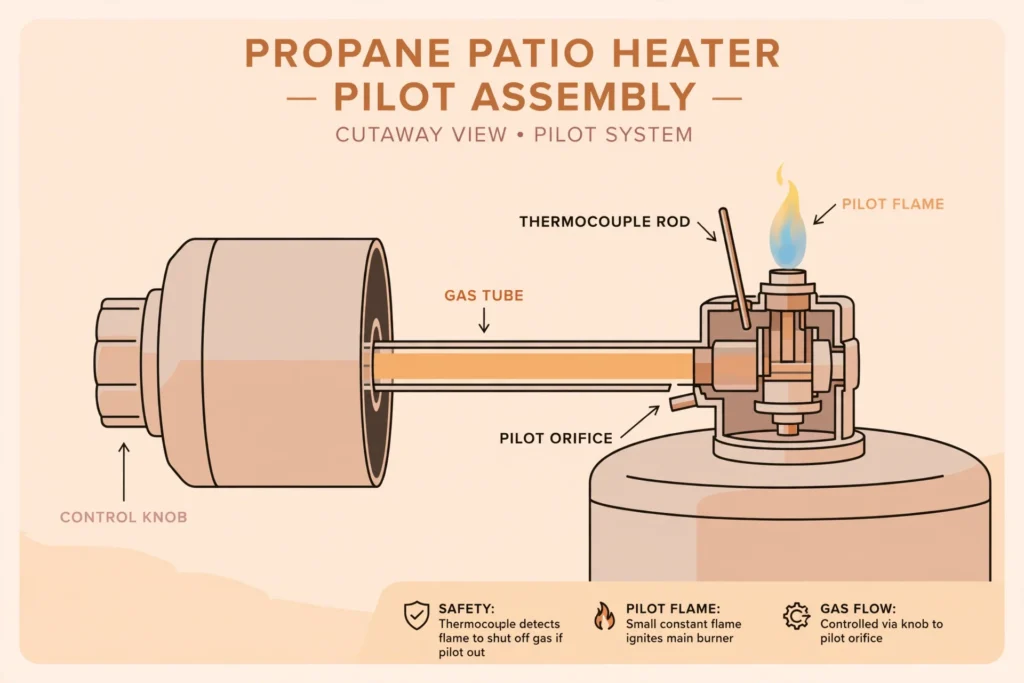
The thermocouple is a thin metal rod that sits beside the pilot flame. Its job is to get hot and hold the gas valve open — and when the pilot flame dies on release, this part is the usual suspect. Carbon and soot from burning propane coat the tip over time, insulating it from the heat it needs. Turn everything off and let the heater cool completely (15–20 minutes). Remove the access panel near the control knob with your screwdriver, then polish the thermocouple tip with fine steel wool or fine-grit sandpaper until the metal shines. Wipe it with a soft cloth, reassemble, and relight. This is the same fix recommended by Family Handyman’s patio heater maintenance guide, and it resolves a large share of won’t-stay-lit problems.
Nudge the thermocouple into the pilot flame
If the sensor is clean but still sits too far from the flame, it can’t get hot enough to hold the valve open. With the heater off and fully cool, remove the access panel and use your needle-nose pliers to bend the thermocouple bracket very gently until the tip sits inside the blue part of the pilot flame. Move it a millimeter or two at a time, then eyeball the alignment before reassembling. The flame must touch the tip directly — near it isn’t enough.
Restore full gas flow to the pilot
With the gas turned off, work through these three checks. Each one takes a minute and covers a different way the pilot can be starved of fuel:
- Clear the pilot orifice. Poke the tiny pilot opening with a toothpick or thin wire to dislodge debris and spider webs. Never use a drill bit — it can widen the opening and ruin the flame pattern.
- Straighten the hose. Run your hand along the gas hose from tank to heater. Untwist any kinks or sharp bends that choke the flow, and replace a cracked or brittle hose.
- Purge trapped air. If the heater sat unused for weeks, air may be blocking the line. Open the tank, then press and hold the control knob for 2–3 minutes before striking the igniter.
If the pilot stays lit but the main burner still won’t catch, the burner’s own ports may be clogged with debris — brush them gently with a soft brush and try again.
- Holding the knob down for only a few seconds. The thermocouple needs 30–60 seconds of pilot heat to generate the signal that holds the valve open. Count it out — impatience is the top self-inflicted cause.
- Cranking the tank valve open fast after a swap. The sudden rush trips the tank’s safety valve and starves the heater. Slow and steady wins here.
- Skipping the level check. A wobbling heater trips the anti-tilt switch over and over. Test for rock-solid footing before you blame the parts.
- Sanding the thermocouple with coarse abrasive. Coarse grit can chew through the sensor’s coating. Stick to fine steel wool or fine-grit sandpaper.
- Relighting while you still smell gas. If the rotten-egg smell is there, stop. Shut the valve, walk away, and get help — no heater is worth the risk.
Why does my patio heater go out when I release the knob?
The thermocouple hasn’t gotten hot enough to hold the gas valve open. Hold the knob down for 30–60 seconds so the sensor heats fully, and if it still dies on release, clean the thermocouple tip and nudge it into the pilot flame.
Can wind blow out a patio heater?
Yes. Even a moderate breeze can push the small pilot flame off the thermocouple, which shuts the gas off by design. Move the heater to a sheltered spot away from open doorways and walkways.
Why is the flame weak even with a full tank?
The tank’s excess-flow safety valve likely tripped when it was opened too quickly, restricting gas to a trickle. Close the valve, wait a minute, and reopen it slowly.
Can I use my patio heater in the garage in winter?
No. Patio heaters are for open outdoor spaces only — enclosed areas trap carbon monoxide, which is odorless and can be deadly. See can you use a patio heater indoors for the full explanation.
How often should I clean the thermocouple?
At least once a season, or whenever the heater starts dying on release. A quick polish with steel wool takes about five minutes and prevents most won’t-stay-lit problems.
Steel wool, needle-nose pliers, Phillips screwdriver, toothpick or thin wire, soapy water spray, spare propane tank, gloves.
- Check the tank — swap it if low.
- Reopen the valve slowly to reset the safety valve.
- Move the heater out of the wind.
- Set it on firm, level ground.
- Scrub the thermocouple tip clean.
- Nudge the thermocouple into the pilot flame.
- Clear the pilot orifice, straighten the hose, purge air.
Work through these seven fixes and your patio heater should light and stay lit on its own again. Most of the time, the culprit is the thermocouple — a little cleaning goes a long way.
If your patio heater won’t stay lit after all seven, the thermocouple itself may be worn out, or the gas valve may need a professional’s eyes. Call a licensed technician rather than forcing parts.
Ready for warmer evenings? If you’re thinking about an upgrade or a second unit, our guide to choosing the right patio heater is a good next read.