Which Space Heaters Use the Least Electricity? The Complete Guide to Heating Your Space for Less
You switch on a space heater, the room heats up, and you ask yourself what it just did to your electric bill.
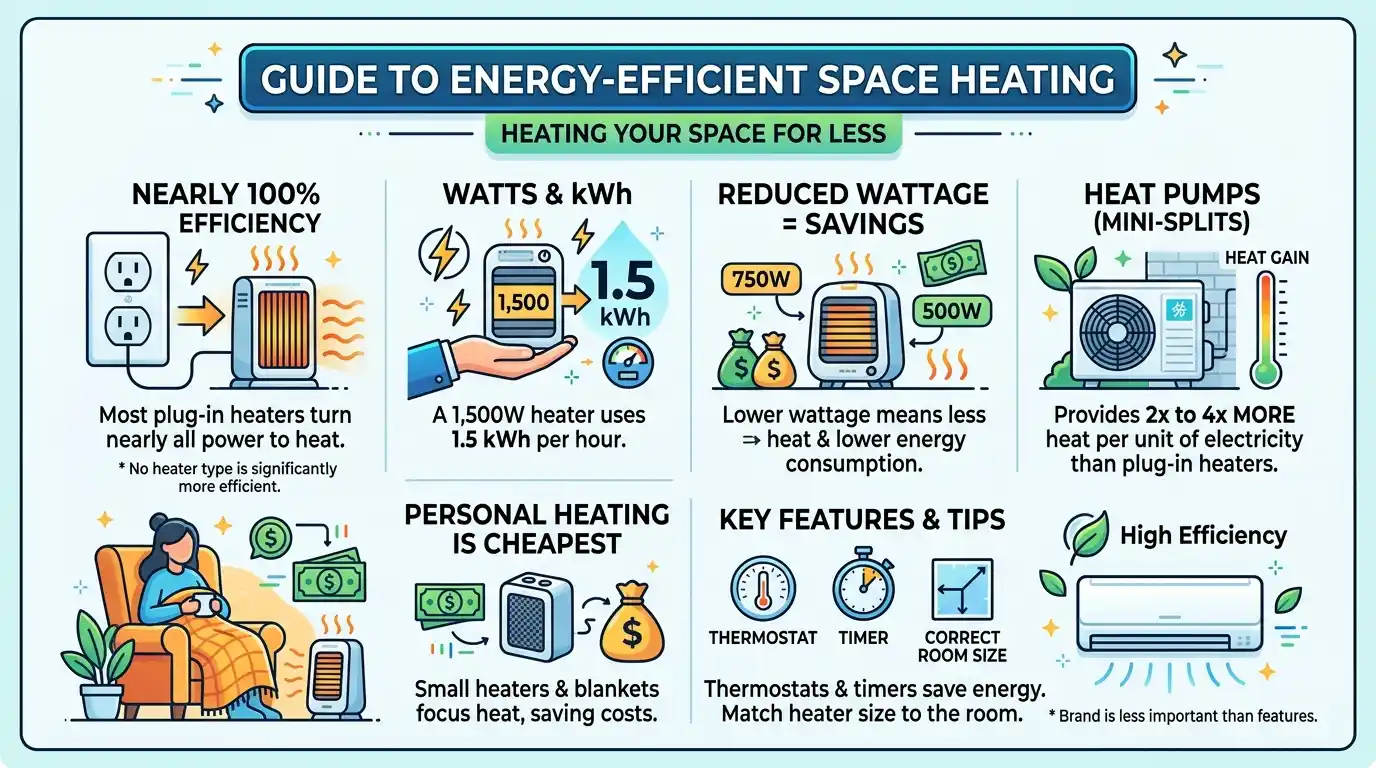
The answer to this is as follows. Low wattage heaters consume the least amount of electricity and heat pumps (mini-splits) provide the highest amount of heat per unit of electricity. There is no more efficient type of plug-in heater than the others. The energy savings is achieved through wattage, thermostat control and heating the area or individual that requires it.
That last point surprises most people, so let’s start there. If you want a broader look at how models differ in comfort, safety, and cost, this breakdown of what really separates one space heater from another is a useful companion read.
Key Takeaways
- Nearly all plug-in electric heaters transform nearly 100% of its power into heat.
- A 1,500 watt heater uses 1.5 kilowatt-hours (kWh) for every hour at full power.
- Reduced power consumption translates to reduced heat, and electricity consumption.
- Heat pumps are able to provide two or four times the amount of heat per unit of electricity than any plug in heater.
Personal heaters and warm blankets are the least expensive method of being warm in one place. - The brand is not as important as a thermostat, timer and the correct size of the room.
How Space Heaters Use Electricity
The space heater is rated in watts. Watts are used to inform you about the amount of power it consumes when running. Your kilowatt-hours of utility bills, which is 1,000 watts an hour.
Here is the formula:
Watts ÷ 1,000 × hours used × your price per kWh = cost
One hour of 1,500 watt heater consumes 1.5 kWh. Assuming that you pay 0.17 per kWh (a fictitious number, but use your own number, which is on your bill), then that hour would cost you about 26 cents.
The majority of home-use portable heaters have a maximum of 1,500 watts. That is the limit since a typical 15 amp, 120 volt domestic circuit can comfortably carry approximately 1,440 watts of continuous load.
Why “Efficient” Can Be Misleading
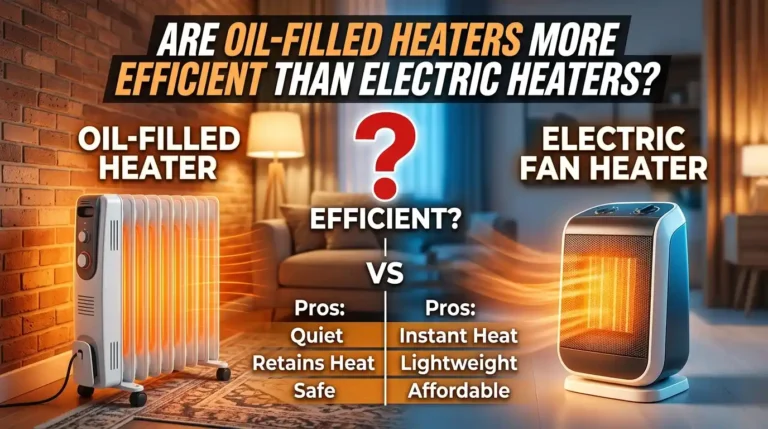
Resistive electric heaters, such as ceramic, oil-filled, infrared, fan, and convection, all convert virtually all the watts into heat. A 1,500 watt ceramic heater and a 1,500 watt oil-filled radiator added the same amount of heat to your home.
The same argument is put forward by the U.S. Department of Energy in its advice on portable heaters. If you want to see the mechanics behind this, here is a plain explanation of the science behind how space heaters produce warmth.
The actual question is not then which type is more efficient. It is:
- What is my actual wattage requirement?
- How can I be able to supply heat where it is of use?
- Does it have a technology that generates more heat per watt?
Which Space Heaters Use the Least Electricity?
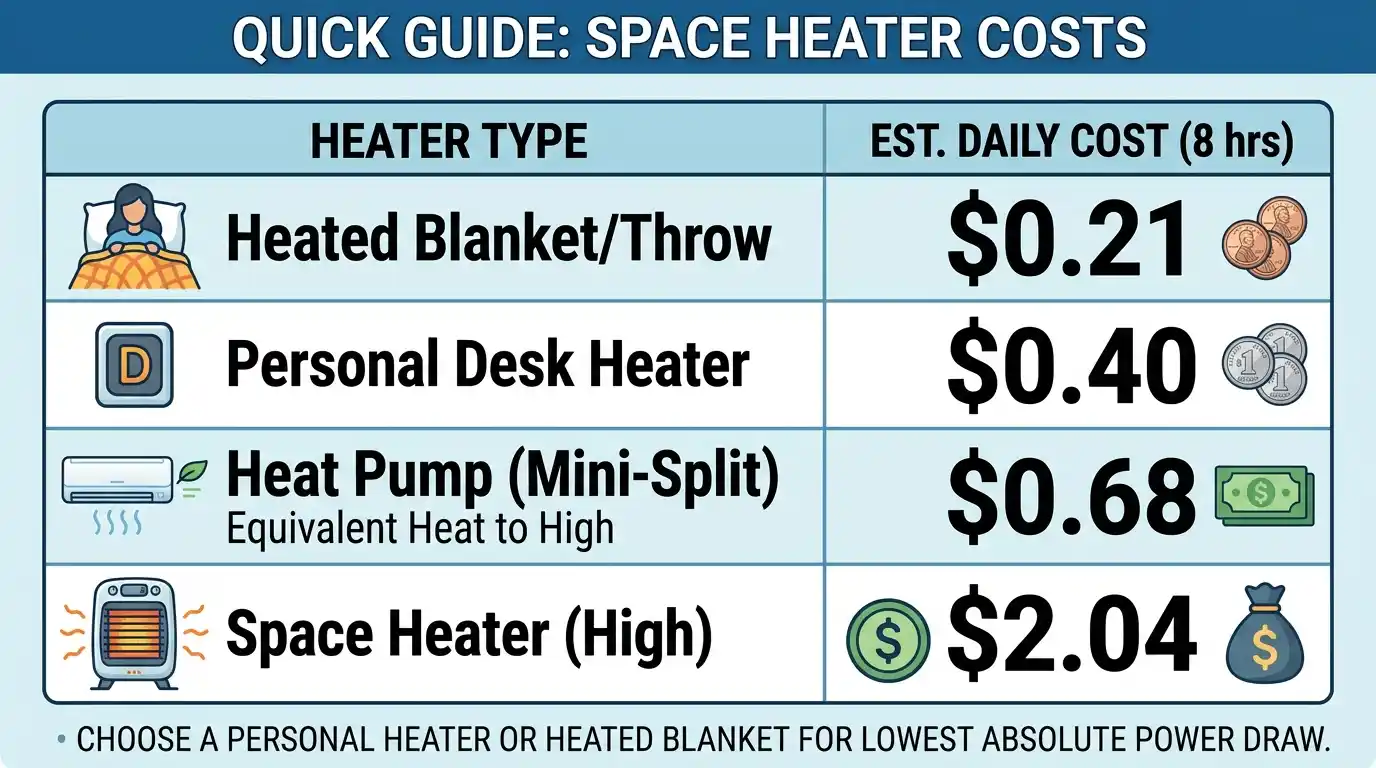
To have the least possible draw, choose a personal heater or a heated throw. A heat pump will provide the most heat per unit of electricity. A thermostat-controlled oil-filled radiator or infrared panel is one of the standard portable heaters that is likely to be the least wasteful in practice.
Running Cost Comparison
These estimates have an example rate of 0.17 per kWh and the unit is running at full capacity.
| Heating option | Typical watts | Cost per hour | Cost for 8 hours |
|---|---|---|---|
| Heated blanket or throw | 100 to 200 | $0.02 to $0.03 | $0.14 to $0.27 |
| Personal desk heater | 200 to 400 | $0.03 to $0.07 | $0.27 to $0.54 |
| Space heater on low setting | 750 to 900 | $0.13 to $0.15 | $1.02 to $1.22 |
| Space heater on high | 1,500 | $0.26 | $2.04 |
| Mini-split heat pump (equal heat to 1,500 W, COP of 3) | about 500 | $0.09 | $0.68 |
The wattage is not precise but is normal. Test the label of your personal heater. COP is the abbreviation of coefficient of performance which is the amount of heat produced divided by the amount of electricity consumed. Actual performance of a heat pump varies with the outdoor temperature.
Space Heater Types Compared
| Type | How it heats | Best for | Electricity notes |
|---|---|---|---|
| Ceramic fan | Blows air over a hot element | Small rooms, quick warmth | Fast but stops heating the moment it shuts off |
| Oil-filled radiator | Heats oil that radiates warmth | Bedrooms, long periods | Slow to start, keeps releasing heat after cycling off |
| Infrared | Warms people and objects directly | Spot heating, garages, desks | Good when you sit in front of it, weak for whole rooms |
| Convection or panel | Warms air gradually | Quiet rooms, offices | Steady, low noise, moderate speed |
| Micathermic | Mix of radiant and convection | Medium rooms | Slim, light, middle of the road |
| Heat pump or mini-split | Moves heat instead of making it | Whole rooms, regular use | Lowest cost per unit of heat, higher upfront price |
Want exact numbers for a specific model type? See this hourly, daily, and monthly cost of running a fan heater and this look at what an oil-filled radiator adds to your power bill.
The Real Ways to Use Less Electricity
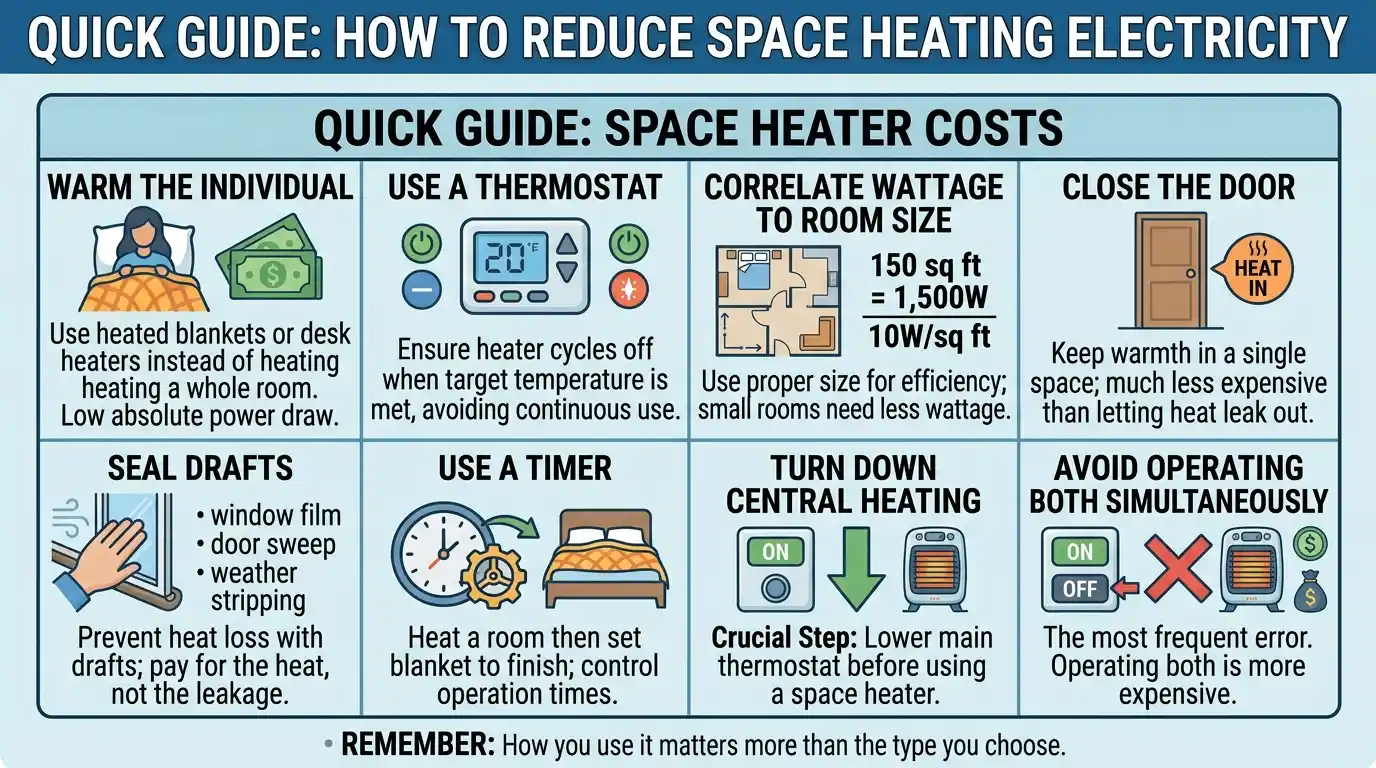
The type you choose is not as important as how you utilize it. These are the steps that have the greatest impact.
- Warm the individual, not the space. Heated blankets, infrared heaters and desk heaters consume much less power than heating an entire room.
- Use a thermostat. A heater which switches off when the room is hot consumes less compared to one that operates continuously.
- Correlate wattage with room size. One of the general guidelines is 10 watts per square foot, which means that a 150 square foot room requires approximately 1,500 watts. A lower wattage unit can be used in a smaller room.
- Close the door. It is much less expensive to heat a single closed room than to leak heat into the corridor.
- Seal drafts. The heat you pay to have is held in by door sweeps, window film, and weather stripping.
- Use a timer. Heat the bedchamber, and leave a blanket to finish the work.
- Turn down your central heating when you zone heat. A space heater will not save any money unless you reduce the main thermostat when using it.
The most frequent error is that one. It is more expensive to operate central heat and a space heater simultaneously rather than less.
Are Space Heaters Cheaper Than Central Heating?
Sometimes. Space heaters may be less expensive when you only have to heat one small room a few hours and reduce the thermostat in the rest of the house. They tend to be more costly to heat up larger areas or when you already have gas heating since in most areas natural gas can cost per unit of heat cheaper than electricity.
When you have electric baseboard heaters or electric resistance furnaces in your home, a space heater does not mean anything more expensive per unit of heat. The actual upgrade would be a heat pump.
Heat Pumps and Mini-Splits: The Low-Electricity Champion
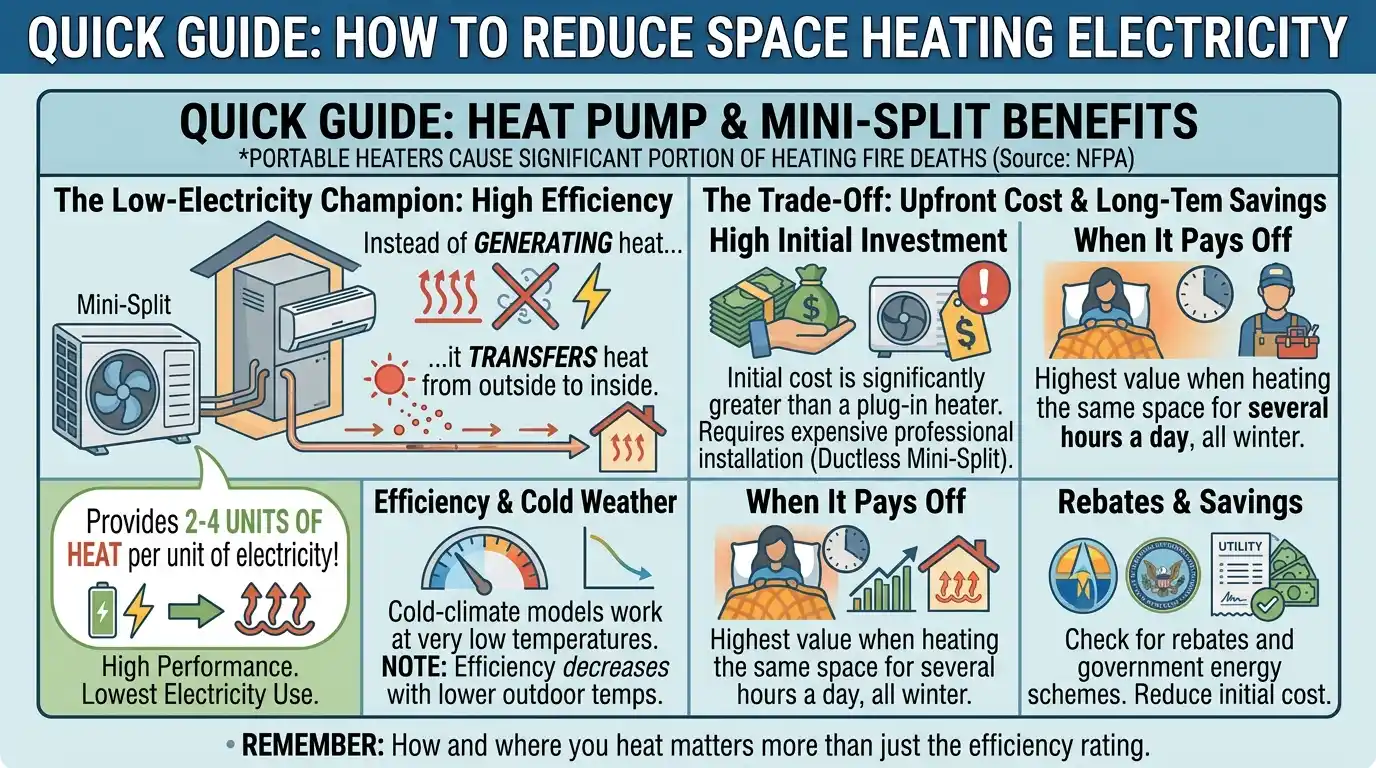
Since a heat pump does not generate heat, it tends to provide two to four units of heat per unit of electricity due to the fact that it takes the heat outside and transfers it to the inside. Cold-climate models continue to operate at low outdoor temperatures but their efficiency decreases further with lower temperatures.
The cost tradeoff is cost. It requires a ductless mini-split, which can be rather expensive to install (usually by a professional), and the initial cost is significantly greater than a plug-in heater. When you heat the same space several hours a winter, it can pay off in the long term. Certain areas have rebates, so look at your utility and government energy schemes.
Best Choice by Situation
Use this quick decision path:
- You have cold feet at a desk? A mini personal heater or foot warmer.
- Cold in bed or on the couch? A warm blanket or cover.
- Bedroom through the night? An oil-filled radiator with thermostat on a low setting.
- Little room, hurry up and be warm? A fan heater with thermostat and timer is made of ceramics.
- Garage or workshop location? A heater directed at your work area.
- Warming the same room throughout the winter? Look into a mini-split heat pump.
Still unsure which style fits your home? This guide to choosing the best kind of space heater for your needs walks through the options in more detail.
What to Look For When Buying
- Adjustable wattage settings (for example 600, 900, 1,500)
- An actual thermostat, not low, medium, high.
- A programmable timer
- Overheat and tip-off protection.
- A safety certification mark from a recognized lab such as UL or ETL
- Cord and plug are in good condition and not loose.
It is important to note that ENERGY STAR does not endorse portable electric space heaters and as such you will not find that tag on them. Compare wattage, controls, and safety features instead.
Safety: The Cheapest Heater Is Not Worth a Fire
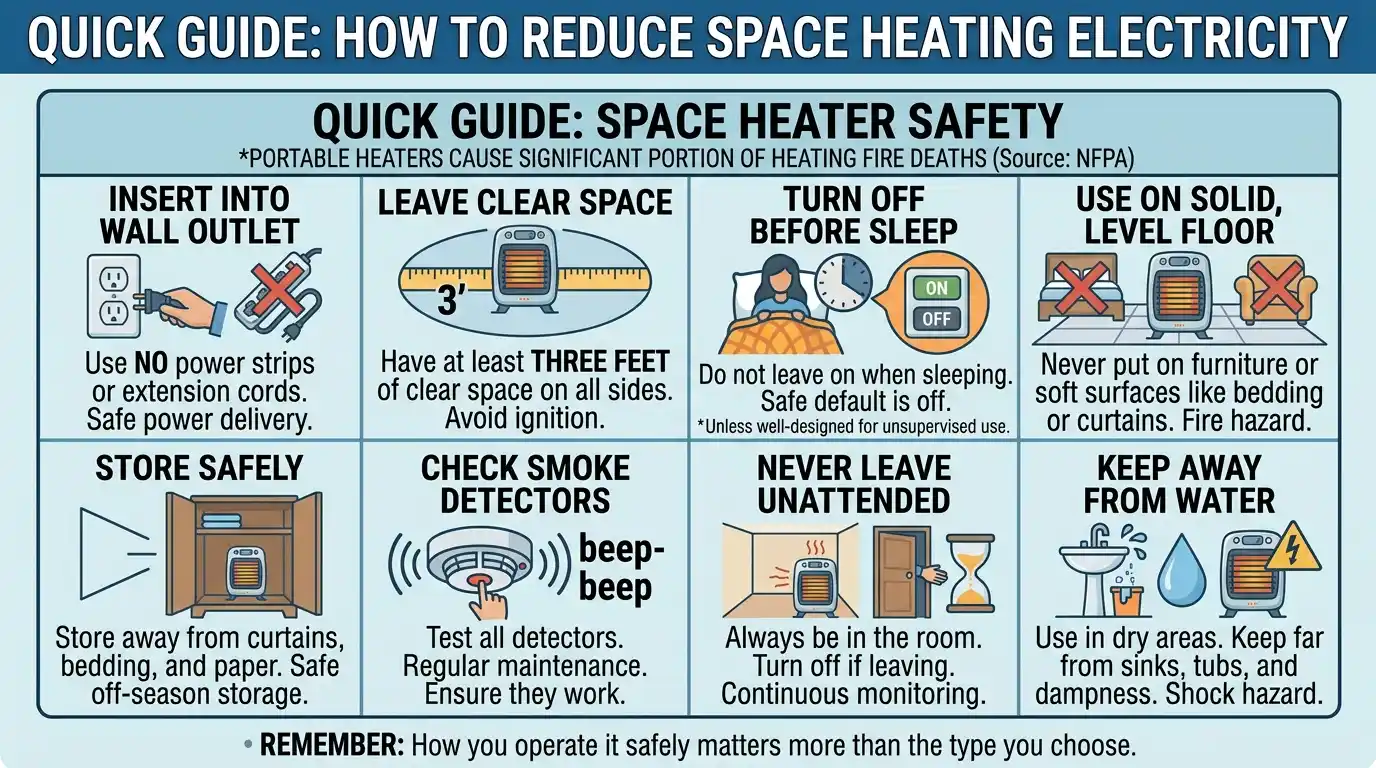
The National Fire Protection Association has found heating equipment to be one of the primary causes of residential fires and that a significant portion of deaths caused by heating fires is attributed to portable space heaters. Follow these basics:
- Insert the heater into a wall. Use no power strips and extension cords.
- Have at least three feet of clear space around it.
- Do not leave it on when you go to sleep unless it is well-designed and you are confident that it is safe.
- Do not put it on furniture or soft surfaces.
- Store it in the absence of curtains, bedding, and paper.
- Check smoke detectors.
Common Mistakes That Waste Electricity
- Operating a space heater and a central heat simultaneously.
- Purchasing a heater much larger than the room will require.
- Having the heater on full blast without a thermostat.
- warming a room with an open door or large drafts.
- Thinking that a more costly heater is more efficient.
- Forgetting the price of your electric bill.
The oil-filled myth comes up constantly. For a deeper look at the numbers, read this explanation of how oil-filled heaters really perform on energy use and this running cost breakdown sorted by wattage.
FAQs
What kind of space heater consumes the least amount of electricity?
The least amount of electricity is consumed by low-wattage personal heaters and heated blankets. Heat pumps provide the highest amount of heat in terms of electricity.
Are space heaters energy consuming?
A 1,500-watt heater consumes 1.5 kWh per hour when operating at full power, which is higher than most domestic appliances. The actual total is reduced by thermostat cycling.
What is the cost of operating a space heater for 8 hours?
A 1,500-watt heater running continuously for 8 hours costs approximately $2.04 at a sample electricity rate of $0.17 per kWh. Use your own electricity rate to determine your actual cost.
Are oil-filled radiators cheaper to operate?
Not per watt. They produce the same amount of heat as other heaters with the same wattage, but they continue to radiate heat after the heating element cycles off, which may feel more effective.
Is a space heater more expensive than a heat pump?
Typically, yes, for normal use, because a heat pump transfers heat rather than directly generating it. The main drawback of a heat pump is the higher installation cost.
How many watts of a space heater do I require?
A general guideline is about 10 watts per square foot. Approximately 1,500 watts may be required for a 150-square-foot room, while smaller rooms may require less.
Is using a space heater cheaper to heat one room?
It may be cheaper if you turn down your central thermostat and heat only the occupied room while keeping other areas closed off.
Is a 500-watt heater sufficient?
It can heat a very small area or provide personal warmth for someone sitting at a desk, but it may not adequately heat an entire room.
Are infrared heaters less electricity-consuming?
They use the same amount of electricity as other heaters with the same wattage. However, they can be effective for spot heating because they heat people and objects directly.
Is it safe to leave a space heater on overnight?
It is generally not recommended by safety experts. If used, choose a unit with tip-over and overheat protection, plug it directly into a wall outlet, and keep the surrounding area clear.
Do heated blankets use less electricity than space heaters?
Yes. Most heated blankets use about 100 to 200 watts, which is much less than a typical 1,500-watt space heater.
Will switching the heater to low conserve power?
Yes. A low setting generally consumes fewer watts, although the room will not warm as quickly.
Will a space heater blow my breaker?
Yes, particularly when other high-power devices are operating on the same circuit. When possible, use a dedicated wall outlet for the space heater.
Are energy-saving modes effective in saving electricity?
Typically, they work like a thermostat by switching the heater on and off to maintain a set temperature. This can reduce electricity use but does not make the heater itself more efficient.
Final Thoughts
The heater consuming the lowest amount of electricity is the one that provides you with the amount of warmth you require with the least amount of watts operating the least amount of hours. To the majority of individuals, that would be a smaller heater, a real thermostat, a closed door, and a blanket to cover the time between. A heat pump is something to consider in case you heat the same space most of the winter.
What you need to do next: find out your electricity rate, identify the size of the room you want to heat, and select the minimum wattage that will accomplish this. Then turn down your central thermostat so you can see the savings on your bill.