How Much Is a Full Cord of Wood? What It Costs, What You Get, and How to Avoid Overpaying
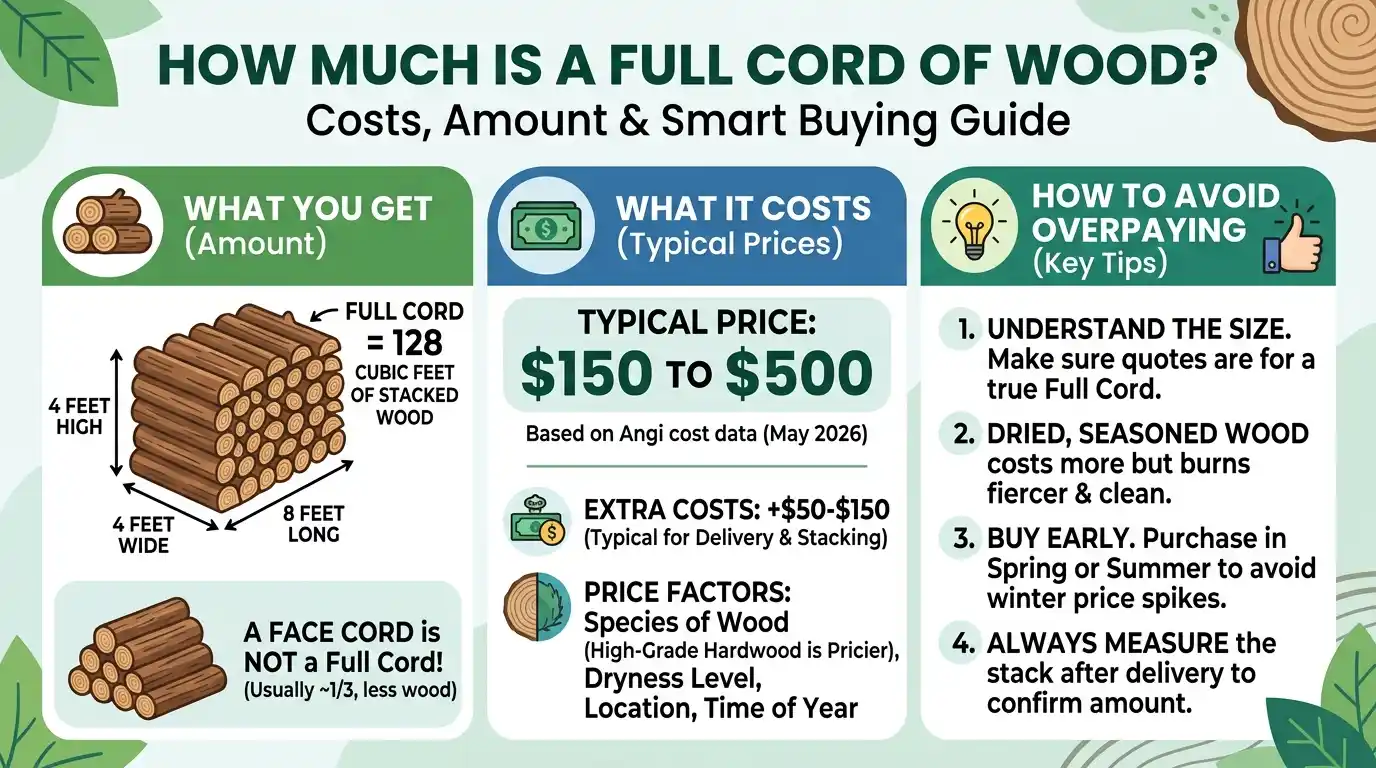
An average of 300, between 150 and 500, is a typical price of a full cord of wood, according to Angi cost data of May 2026. Before delivery and stacking which may cost an extra $50-150 or more. The species of wood, the level of dryness, the time of the year and the location you are in determine your ultimate price. For a deeper look at real buyer costs, see this breakdown of what you’ll really pay for a cord of firewood.
This is where most guides leave off. The sign price will not make any sense unless you are certain of the amount of wood you are purchasing. A cord is of rigid size. There are too many sellers with similar words that are spelled in the same way, but offer much less. As soon as you realize the size, the quotes begin to make sense.
Key takeaways
- A full cord consists of 128 cubic feet of stacked wood, normally 4 feet high, 4 feet wide, and 8 feet long.
- Typical price: $150 to $500. High grade aged hardwood may be pricier.
- A face cord is not a complete cord. It is usually a third of a third.
- Dried, seasoned wood is more expensive initially, but burns more fiercely and clean.
- Purchase during spring or summer to escape winter price increases.
- Always measure the stack after delivery.
What Is a Full Cord of Wood?
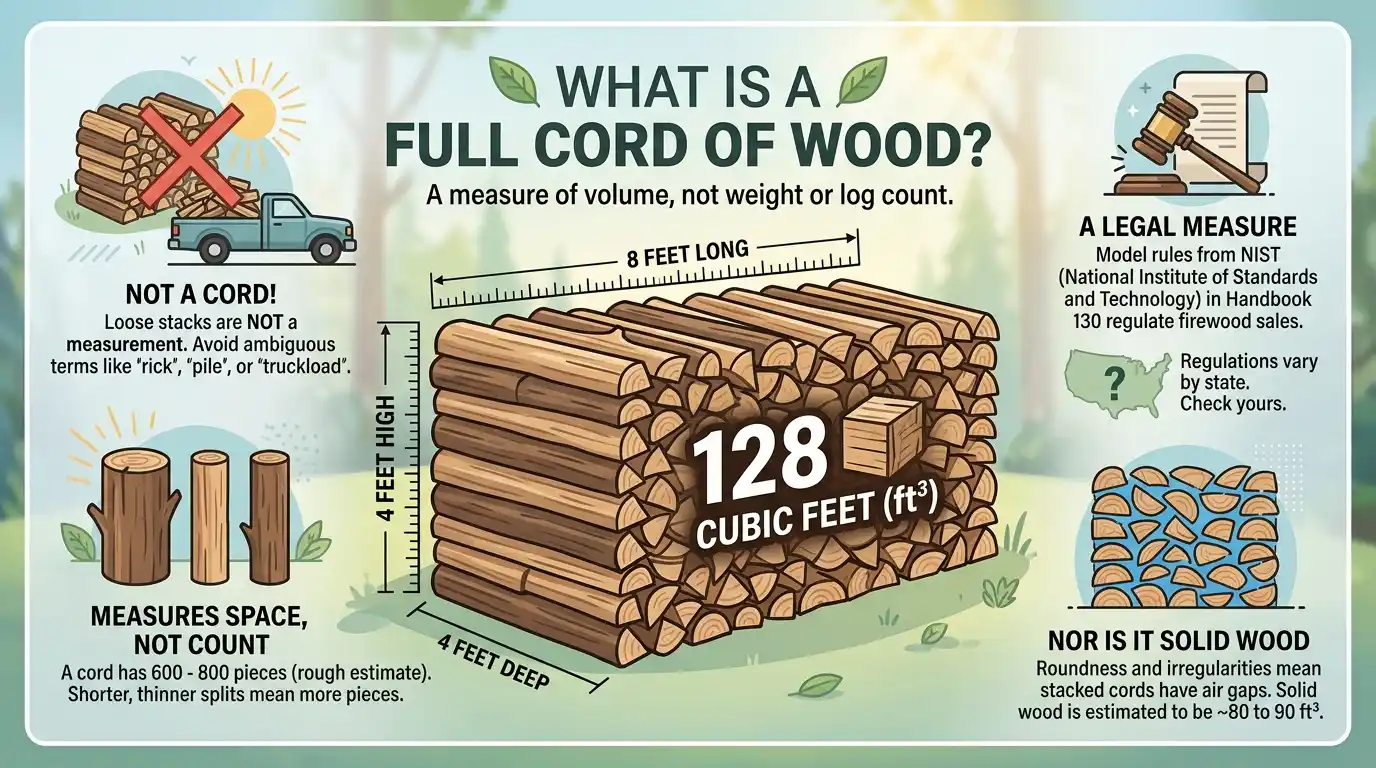
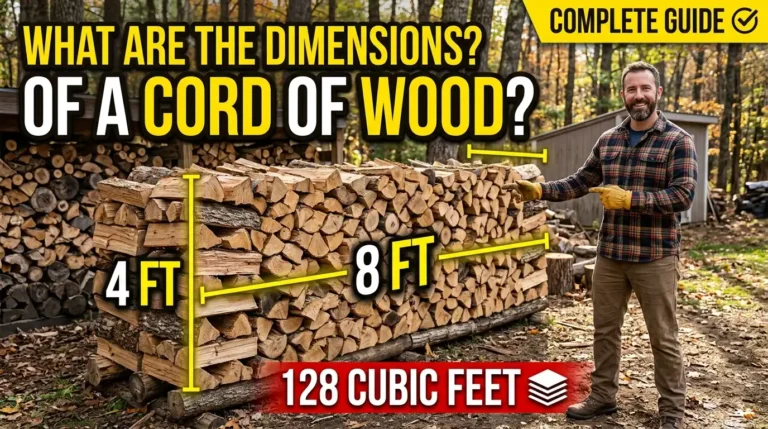
A stack of wood that is 128 cubic feet is called a full cord of wood, and is most often 4 feet high by 4 feet deep by 8 feet long. The timber should be stacked in a proper manner with the pieces facing each other and closely packed. A loose stack in a truck bed is not a cord, even though it may appear to be a lot. If you want to picture it, this guide to the exact dimensions of a cord of wood shows how the numbers translate to a real stack.
The cord is a legal measure. Model rules, published by the National Institute of Standards and Technology (NIST), in Handbook 130, are used by several states to regulate the sale of firewood. Those regulations specify the cord and discourage the ambiguous words such as rick, pile, or truckload since they cannot be measured in size. Regulations vary by state, check yours.
A cord is not a measure of weight, but a measure of space, not of count of logs. The logs will vary in quantity according to the length and thickness of each piece. Angi reckons that a cord carries 600 to 800 logs, but take that as a guesst. The shorter, the thinner the splits, the more pieces.
Nor is a cord solid wood. Due to the roundness and irregularity of logs a stacked cord has much air in it. The real wood is usually estimated to be about 80 to 90 cubic feet by the sources of forestry, and the remainder is gaps. For more on volume and what fits inside, read this complete guide to how much wood is in a cord.
How Much Is a Full Cord of Wood?
The average price of a full cord is about 300, with most buyers spending between 150 and 500 on a full cord. Any price under 150 is hard to find and usually signifies green, unseasoned wood. Prices over 500 tend to be high quality hardwood, kiln drying or an area with a dearth of local timber.
Price by volume
| Volume | Cubic feet | Typical price range |
|---|---|---|
| Full cord | 128 | $150 to $500 |
| Half cord | 64 | $100 to $300 |
| Face cord (16 inch pieces) | about 43 | $75 to $200 |
| Quarter cord | 32 | $50 to $125 |
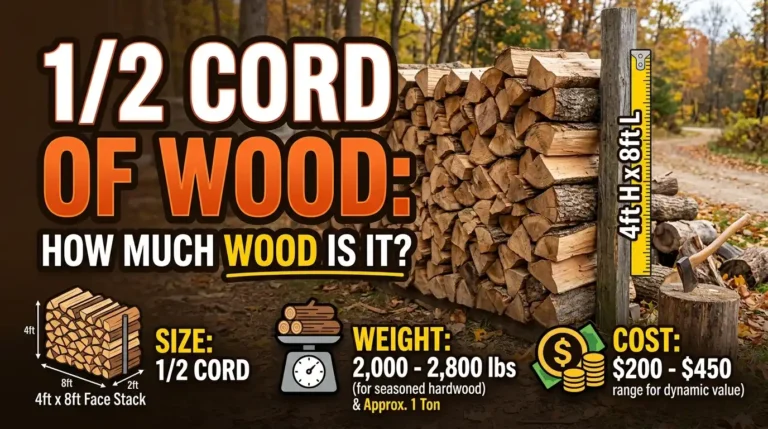
The ranges are sourced: Angi, May 2026. Local prices are different and you should call two or three of the sellers nearby before you make your decision. If a full cord is more than you need, this explainer on buying a half cord of wood covers size, weight, and cost.
Price per cubic foot
This is the gimmick that makes quotes similar. Divide the price by the cubic feet.
- Full cord at $300 is about $2.34 per cubic foot.
A face cord at 150 sold as a bargain, is equal to 3.50 per cubic foot when 43 cubic feet. - The same face cord price is equivalent to a full cord of price at $450.
A smaller size with a lower price tag does not necessarily cost less. Always do the math.
Real world example: A homeowner gets two quotes. Seller A sells a full cord of mixed hardwood at a price of 320 delivered. Seller B sells a rick at a price of 200. Seller B will not say the dimensions.
Assuming that that rick is a 16 inch face cord, the cost per full cord will be approximately 470. Seller A would win unless Seller B can establish the size.
Full Cord vs Face Cord vs Rick
A face cord is 4 feet high, and 8 feet long, but no more than a row of logs, which is commonly 12 to 18 inches. It is one-third of a full cord at a depth of 16 inches.
A “rick” is a regional term with no standard size. You can dig into the differences in this comparison of a face cord vs a full cord of wood and this guide to the size, weight, and cost of a rick of firewood.
| Term | Dimensions | Share of a full cord |
|---|---|---|
| Full cord | 4 x 4 x 8 ft | 100% |
| Face cord (16 in) | 4 x 1.33 x 8 ft | about 33% |
| Face cord (12 in) | 4 x 1 x 8 ft | 25% |
| Rick | Varies by seller | Unknown |
Ask any seller to tell the depth of the stack in inches. A good one will respond without any hesitation.
Price by Wood Type
Hardwoods are generally expensive since they are thick, burn longer and give more heat. Angi quotes hardwood as about 250-500 per cord and softwood as 150-300. This is altered by local supply. Oak is one of the cheapest in oak country.
| Wood | Type | Approximate heat per cord | Notes |
|---|---|---|---|
| Hickory | Hardwood | Very high | Long, hot burn, often premium priced |
| Oak | Hardwood | High | Slow to season, long lasting coals |
| Sugar maple | Hardwood | High | Clean burn, widely used |
| Ash | Hardwood | Medium to high | Dries faster than oak |
| Birch | Hardwood | Medium | Easy to light, burns quickly |
| Douglas fir | Softwood | Medium | Good value in the Pacific Northwest |
| Pine, spruce | Softwood | Lower | Great kindling, fast burn |
Precise heat values depend on the source, moisture content, and tree. Dense hardwood such as oak and hickory is usually much more efficient at providing heat per cord than pine or spruce, though a few exceptions exist. The US Forest Service, most university extension offices, have BTU charts by species, if you desire the numbers.
Shopping tip: Pine will be less expensive to purchase at first, but burn twice as quickly, so it will cost you more.
What Affects the Price of a Cord of Wood?
The price is most moved by five things; species, dryness, season, location, and service. Angi reports delivery is generally 25-75 per load and stacking 25-80 with winter prices 20-30 higher and seasoned wood 30-50 higher than green.
| Factor | Typical effect |
|---|---|
| Wood species | Hardwood costs more than softwood in most markets |
| Seasoned vs green | Seasoned costs about 30% to 50% more |
| Time of year | Winter can run 20% to 30% higher |
| Delivery | $25 to $75 per load, or about $2 per mile |
| Stacking | $25 to $80 per load |
| Location | Areas with little local timber can cost far more |
| Splitting | Pre-split costs more than log length |
Sample budget
| Item | Cost |
|---|---|
| Full cord of seasoned hardwood | $300 |
| Delivery | $50 |
| Stacking | $50 |
| Total | $400 |
Seasoned vs Green vs Kiln-Dried Firewood
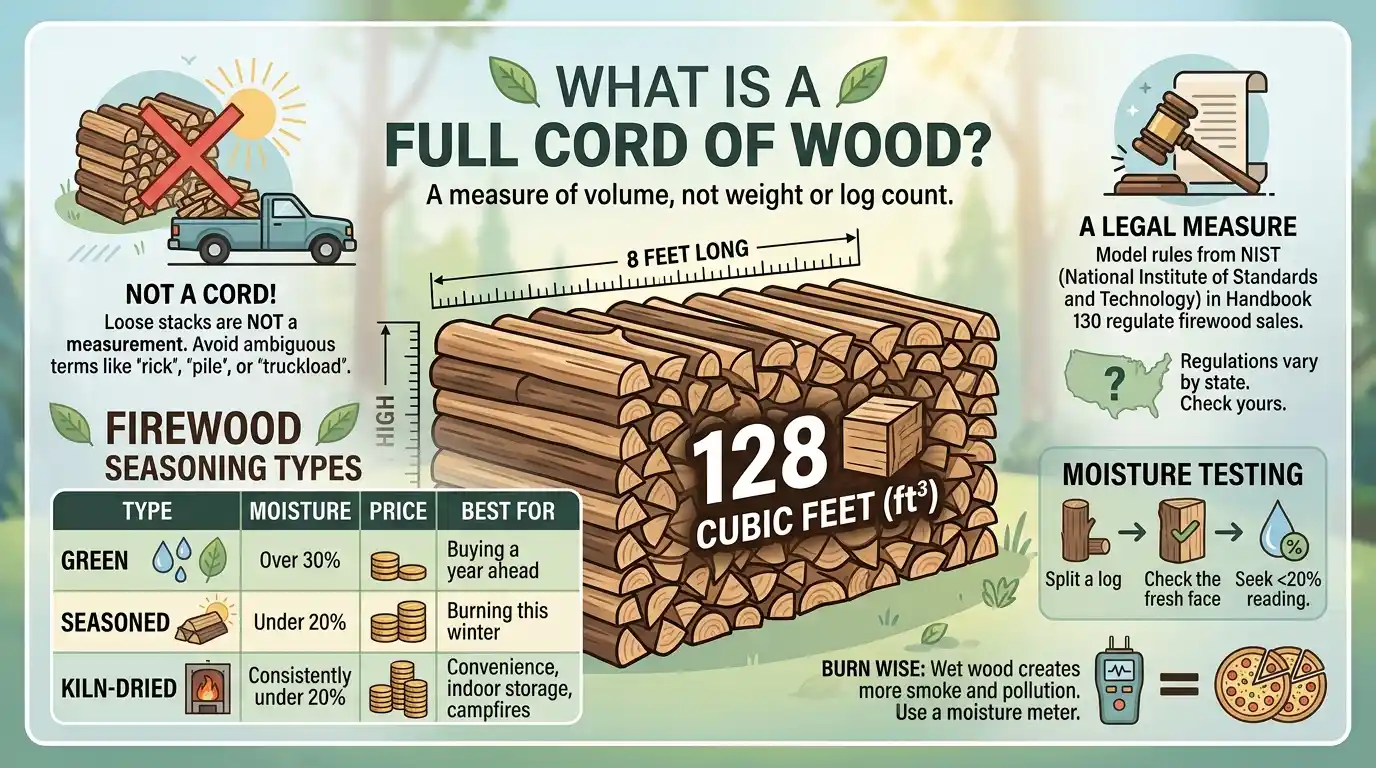
Experienced firewood is that which has been drying over months or years and has a moisture level of less than approximately 20%. It ignites readily, burns more intensely and produces less smoke and creosote. Green wood is new, cheaper, and wet, thus it hisses, smokes, and loses heat boiling water.
| Type | Moisture | Price | Best for |
|---|---|---|---|
| Green | Often above 30% | Lowest | Buying a year ahead to season yourself |
| Seasoned | Under 20% | Mid | Burning this winter |
| Kiln-dried | Often under 20%, consistent | Highest | Convenience, campfires, indoor storage |
According to the EPA, Burn Wise program, wet wood produces more smoke and pollution hence it is advisable to burn dry wood. A simple moisture meter is roughly the same price as two pizzas and eliminates the guesswork. Split a log, check the fresh face and seek a reading of less than 20%.
The time of seasoning varies according to species and climate. Softwoods can be prepared within six months to a year. Hardwoods such as oak usually require a year or two.
How Much Does a Full Cord Weigh, and Will It Fit in a Truck?
An average cord of seasoned wood weighs about 2,000 to 5,000 pounds depending on the species and moisture. Pine is towards the low end, dry oak or hickory towards the high end. Green wood is heavier due to the water.
A full cord will not fit in a car. The typical pickup bed has a capacity of approximately half a cord, loosely packed, and thus you will need two trips. Do not overload a truck to its payload capacity. The amount of dense hardwood in a single pickup of a half ton can be more than what a half ton pickup can safely carry.
How Long Does a Full Cord Last?
It will be dependent on your heating requirements. A cord will last one month or two when you use wood as your primary heating source and burn every day. In the case of occasional fires one cord is sufficient to last several winters.
| Use | Rough cords per season |
|---|---|
| Occasional fireplace fires | Under 1 |
| Weekend fires and supplemental heat | 1 to 2 |
| Primary heat in a cold climate | Several, sometimes 5 or more |
The size of the house, insulation, efficiency of the stove, climate, and the type of wood are all important. Efficient EPA certified stoves consume less wood than open fireplaces which radiate a lot of heat along the chimney.
How to Make Sure You Get a Full Cord
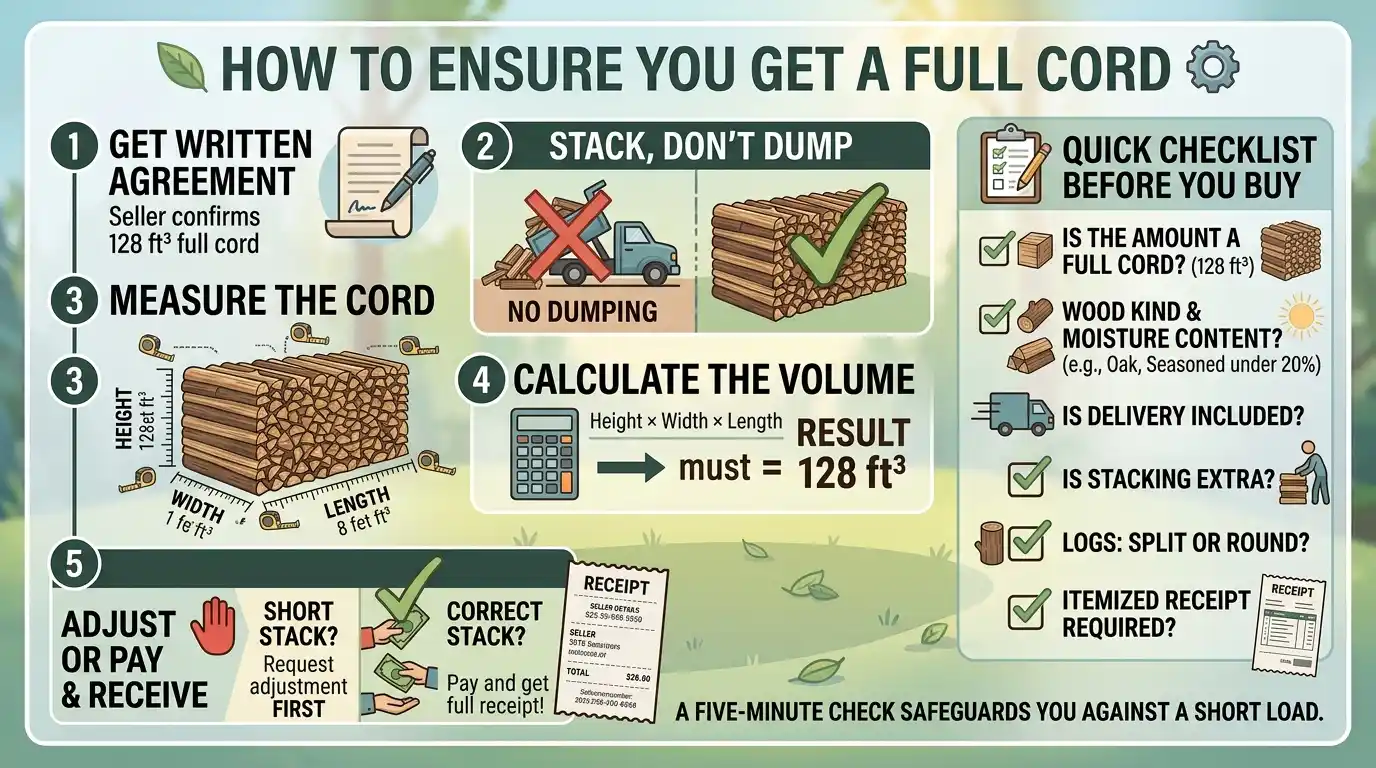
Lay it up and gauge it. This lasts five minutes and safeguards you against a short load.
- Have the seller put it in writing that you are purchasing a full cord of 128 cubic feet.
- The wood should be stacked not dumped.
- Determine height, width and length in feet.
- Multiply them. You should get 128.
- In case of short stack, request price adjustment or additional wood prior to payment.
- Keep your receipt. A written receipt with seller details, quantity and price is expected by many states.
Quick checklist before you buy
- Is the amount given a full cord?
- What kind and what moisture content?
- Is delivery included?
- Is stacking extra?
- are pieces divided or round?
- Does the receipt show an itemization?
Ways to Save on a Full Cord
Buy in bulk, buy green and season it, or get free wood. Prices are lower in spring and summer and Angi reports that savings may be up to 20-30 percent. Green wood is half to one-third the cost, too, but requires a year or more to dry.
- Take in spring or summer and pile it to dry before winter.
- Inquire of tree services and arborists regarding free or inexpensive logs. Some even pay to get rid of them.
- Buy in bulk. A number of cords tend to reduce the unit price of cord.
- Do not stack up, do it yourself.
- Take the wood yourself in case you have a truck and trailer.
- Self-cut when you are allowed to, have the right equipment and training. Chainsaw operation is hazardous, and equipment can be very expensive, ranging between 200 and 600 dollars.
Common Mistakes
- Purchasing a truckload, which is not measured.
- Buying wood that is still green and burning it immediately.
- Species comparison without price comparison.
- Piling wood on the house, which attracts pests and poses a fire hazard.
- Delaying order till the first freeze.
- Transporting firewood. Invasive insects such as the emerald ash borer can be carried by firewood. Campaigns like The Nature Conservancy, which include Don’t Move Firewood, encourage consumers to purchase local wood.
FAQs
What is the amount of a full cord of wood?
Full cords range between $150 and $500, with an average of about $300. Stacking and delivery are usually additional.
What is the size of a cord of wood?
It is 128 cubic feet, typically a stack 4 feet high, 4 feet deep and 8 feet long.
What is the number of logs in a full cord?
About 600-800 pieces of firewood on average, but it depends on the size of each piece.
What is a cord and a face cord?
A face cord is 4 feet by 8 feet, but is only one log deep, usually 16 inches, or a third of a cord.
What is the weight of a full cord of wood?
Approximately 2,000 to 5,000 pounds, depending on the wood species and dryness.
What is the duration of a cord of wood?
One cord can last one to two months of daily heating, or it may last through a few winters if used only for occasional fires.
When is the cheapest time to purchase firewood?
Spring and summer are often the cheapest times to buy firewood because demand is usually lower.
Is aged firewood worth the additional price?
Yes, properly seasoned firewood is usually worth paying more for because it ignites readily, produces more usable heat, and creates less smoke.
Which type of wood should be burned?
Dense hardwoods such as oak, hickory, maple, and ash are commonly used for long, hot burns.
Will a full cord fit in a pickup?
Usually not. Most pickups can carry approximately half a cord at a time, depending on the truck and how the wood is loaded.
What is the measurement of a cord once delivered?
Stack the wood and measure its height, depth, and length in feet, then multiply the three measurements. A full cord should equal 128 cubic feet.
What is the price of having firewood delivered?
Delivery charges vary by location and supplier. Angi cites about $25-$75 per load or around $2 per mile in some cases.
What do I do with firewood?
Pile firewood on the ground or on a raised rack, not directly against the house. Keep the top covered while leaving the sides open to allow air circulation.
Final Thoughts
Most people would spend $150 to 500 on a full cord of wood, yet the figure will only assist you when you are aware of what you are purchasing. Keep in mind 4 x 4 x 8, request the dimensions in inches, examine the moisture and compare the prices per cubic foot. Get the wood in the off-season when you can, and have it where you can measure it before you pay.
Next: Obtain estimates of two or three local peddlers, request each to give you the species, the degree of moisture, and the precise size of the stack, and make your reservation in the spring or summer.