Rick of Firewood: Size, Weight, Cost, and Everything Else You Need to Know Before You Buy
A rick of firewood is about 4 feet tall, 8 feet long, and the depth of the rick may vary depending on the length of the logs cut, but is typically between 12 and 24 inches. It is precisely this variable depth which makes two ricks of wood of two different sellers contain appreciably different quantities of wood. This is how you can be sure of what you are paying.
What Is a Rick of Firewood?
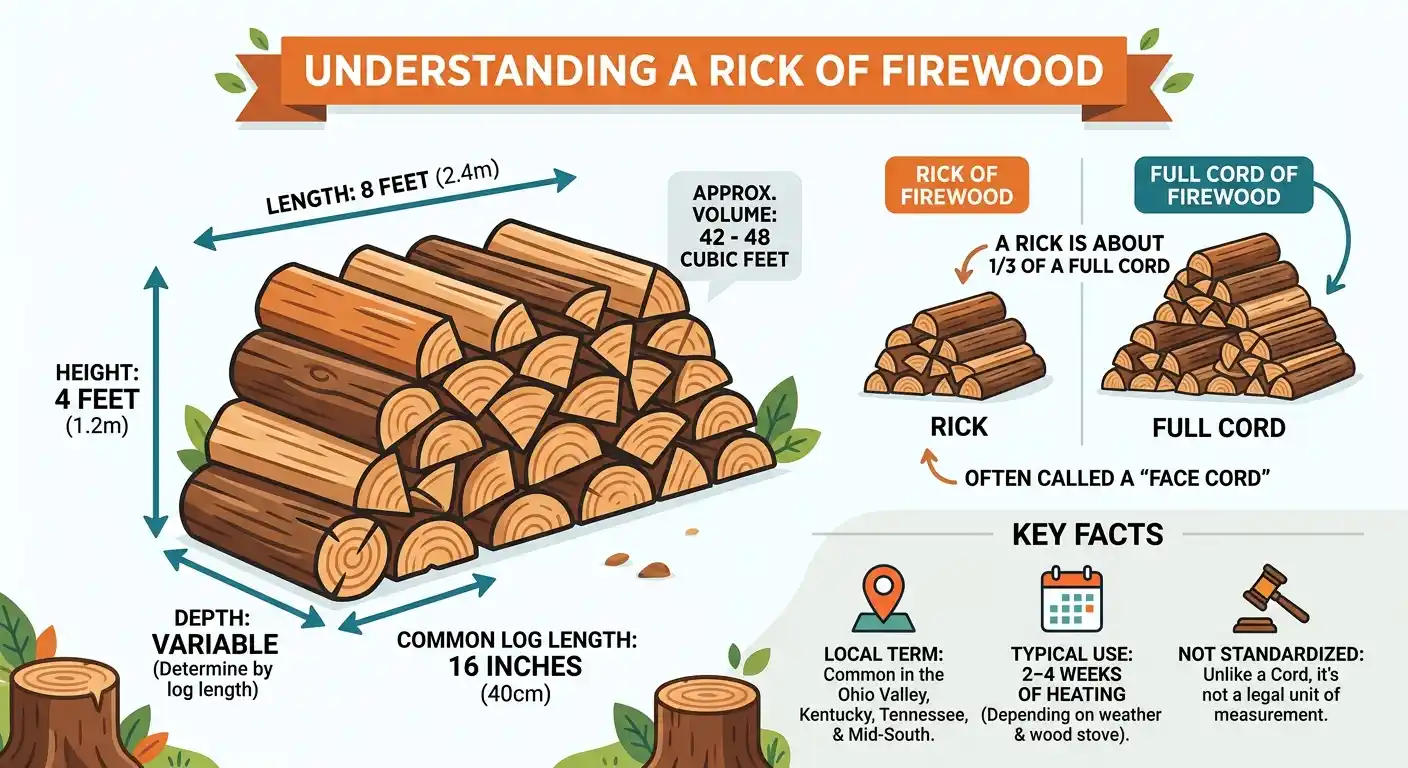
A rick of firewood is a pile of split wood, about 4 feet high and 8 feet long, and the depth is determined by the length of the logs. The common size of logs sold is 16 inches and a typical rick is about a third of a full cord, or about 42 to 48 cubic feet of wood.
It is not a standardized term in the law like a cord. Rick is a localism, and is most frequently used in the Ohio Valley, Kentucky, Tennessee, and the Mid-South in general, where it is used to mean what other regions of the country call a face cord or a stove cord. Practically, the majority of sellers consider rick and face cord to be one and the same.
Quick facts:
- Height: 4 feet
- Length: 8 feet
- Depth: 12 to 24 inches (16 inches is most typical)
- Volume: approximately 42 to 48 cubic feet.
- Fraction of a full cord: about 1/3
- Typical application: 2-4 weeks of normal heating using wood stove, depending on climate.
Rick vs. Cord vs. Face Cord: What’s the Actual Difference?
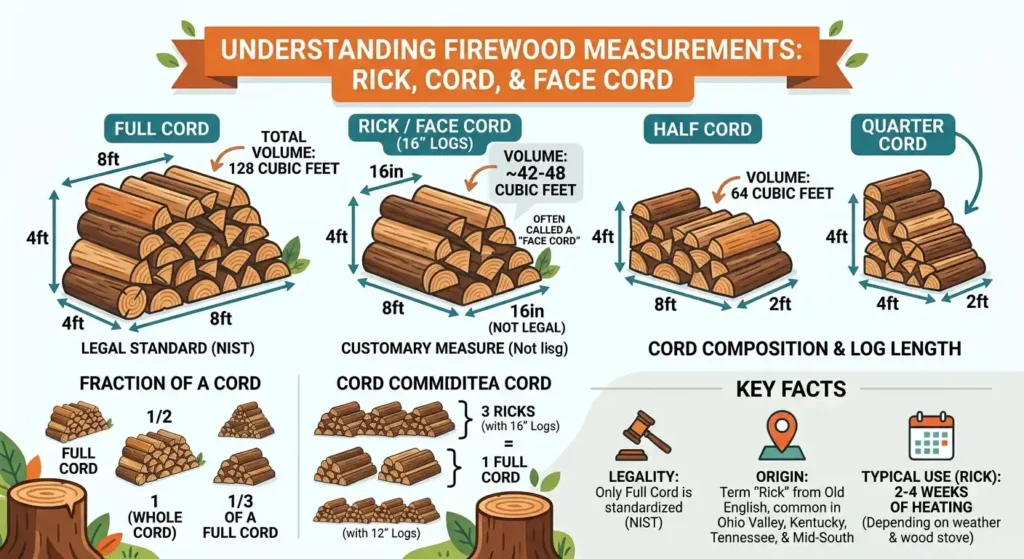
The misunderstanding of the firewood measurements is reduced to the name of one word that does too much work, cord. The only unit of firewood that has a legal definition is a full cord. Rick and face cord are not legal measures, they are customary measures and it is where buyers are shortchanged.
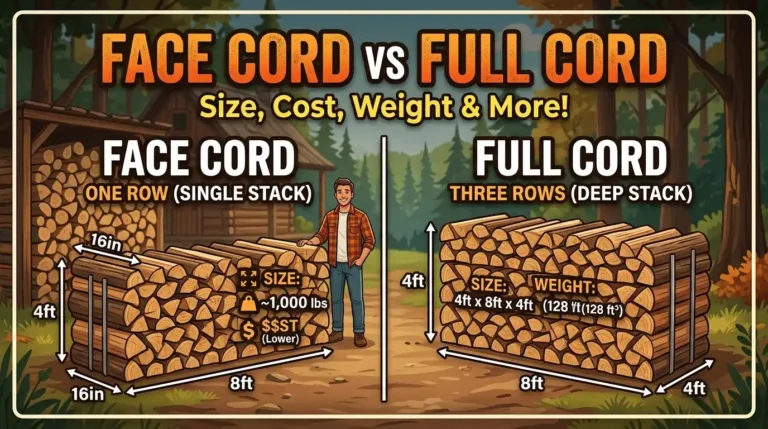
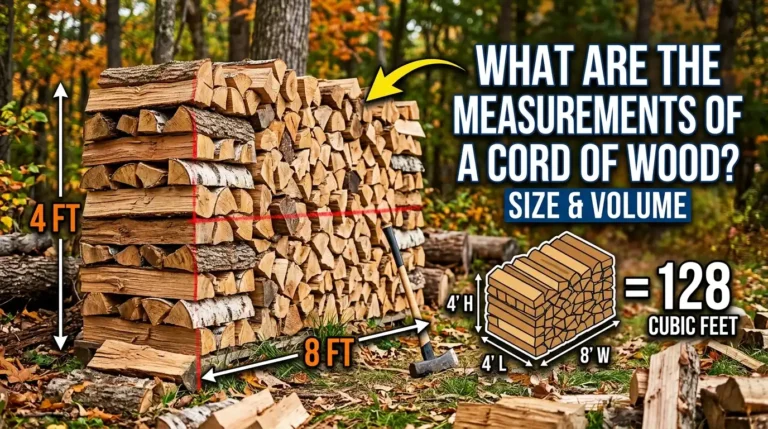
A full cord is defined by NIST Handbook 130, the federal weights-and-measures reference most states adopt by statute, as a stack measuring 4 feet by 4 feet by 8 feet, totaling exactly 128 cubic feet of wood, bark, and air space. Selling firewood by a non-standard unit like a rick without disclosing its cord-equivalent volume can technically violate state weights-and-measures rules, though enforcement varies a lot by state. If you want to see exactly how those measurements translate into a stack you can picture, this breakdown of a full cord’s exact size walks through it in detail.
For buyers who are still mixing up the terminology, our guide on telling a face cord apart from a full cord covers the cost and size differences side by side.
Why “rick” means different things in different places
The term is ancient. It is a word derived in Old English of hreac, or stack of hay or grain, and as early as the 1800s had expanded to include any well-constructed outdoor stack, such as firewood. Sellers ultimately had to bend on the name of a rick rather than face cord due to a very simple reason: the customers continued to believe that a face cord was equal to a full cord, as both contain the word cord in the name.
That confusion is avoided by “Rick,” but it brings in another one, since the depth of it also remains to be wholly dependent on the length of the log.
Cord, Rick, and Face Cord Compared
| Measurement | Height | Length | Depth | Volume | Fraction of a Cord |
| Full cord | 4 ft | 8 ft | 4 ft | 128 cu ft | 1 (whole cord) |
| Rick / Face cord (16″ logs) | 4 ft | 8 ft | 16 in | ~42-48 cu ft | ~1/3 |
| Half cord | 4 ft | 8 ft | 2 ft | 64 cu ft | 1/2 |
| Quarter cord | 4 ft | 4 ft | 2 ft | 32 cu ft | 1/4 |
Main lesson: a rick and face cord are used to describe the same stack shape. The ricks in a cord are all a matter of length of logs. Three ricks used are one full cord with 16 inch logs. Only two logs make a cord with 24-inch logs. It requires four with 12-inch logs.
How Big Is a Rick of Firewood?
Standard dimensions
Rick height and length are relatively fixed to 4 feet by 8 feet due to the fact that that size is stacked, stored and loaded by most people without the need of special equipment. The depth is the variable, which is determined by the length of the individual splits.
How log length changes the depth
- 12-inch logs: depth 12 inches, volume approximately 32 cubic feet, about 1/4 of a cord.
- 16-inch logs (most used): depth is 16 inches, volume is approximately 42.7 cubic feet, or about 1/3 of a cord.
- 18-inch logs: depth is 18 inches, volume is about 48 cubic feet
- 24 inch logs: depth 24 inches, volume 64 cubic feet, a half cord.
This is the one most important thing to look at before you purchase. Should a seller offer you a rick, without specifying the length of the log, enquire. A rick of 12-inch logs contains distinctly less wood than a rick of 24-inch logs, although both are technically 4 feet by 8 feet.
Will a rick fit in a pickup truck?
Yes, in most cases. A 16-inch-deep logs rick is nearly the size of an 8-foot truck bed, and can also be placed in a 6-foot bed, so long as it is stacked over the bed rails. This is, in fact, one of the reasons why the unit became popular among small-scale sellers: it is an easy, deliverable load that does not require a flatbed or dump truck, like a full cord does.
How Much Does a Rick of Firewood Weigh?
Weight is determined by two factors; the wood species and its dryness. The standard 16-inch-deep rick is said to range widely, usually between 900 and 2,200 pounds, the heavier hardwoods and drier wood being at the upper end of the scale.
Weight by wood species (seasoned, per rick, approximate)
| Species | Estimated Weight (lbs) | Heat Output |
| Oak (red or white) | 1,100-1,450 | High |
| Hickory | 1,300-1,500 | Very high |
| Maple (sugar) | 1,150-1,300 | High |
| Ash | 1,050-1,200 | High |
| Cherry | 900-1,000 | Medium |
| Birch | 1,000-1,150 | Medium |
| Pine (softwood) | 700-900 | Low to medium |
| Cedar (softwood) | 600-750 | Low |
These are estimates constructed based on published cord-weight data scaled down to a one-third-cord (16-inch) rick. The real weight of any particular delivery will depend on the tightness of the stack and the actual moisture content of that batch of wood, so take them as ranges of plans, not as guarantees.
Seasoned vs. green wood weight
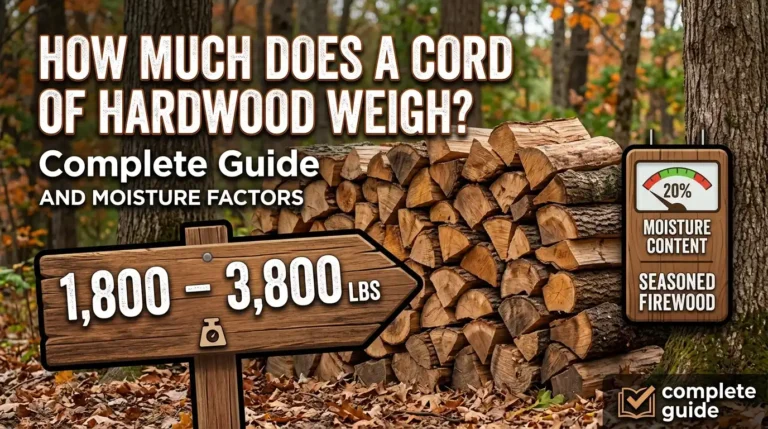
The weight of freshly cut wood can be 40-70 percent greater than that of the same wood after seasoning, simply due to the presence of water. A tree draws moisture up through the trunk and that water does not drop out of the wood as soon as it is cut. Seasoning, allowing split wood to dry in a stack covered and well-ventilated over 6 months to 2 years, depending on species, reduces the moisture content of split wood, which may be up to 80 percent, to the 20 percent or less that is optimal to burn.
This is not only important to the weight of the wood to be carried. Green wood is more difficult to light, burns less, and leaves more creosote in your chimney or flue. When a seller is offering you a suspiciously heavy rick, enquire whether the wood is seasoned. You are possibly paying water weight.
How Much Does a Rick of Firewood Cost in 2026?
A single rick usually sells between 75 and 250 with most purchasers falling in the 100-180 bracket of experienced hardwood. Softwood ricks are less expensive, usually between $50 and 120, as they are quicker to burn and generate less heat per log.
Average price by wood type
| Wood Type | Typical Rick Price | Notes |
| Softwood (pine, spruce, fir) | $50-$120 | Cheaper, burns fast, good for starting fires |
| Mixed hardwood | $90-$160 | Common all-purpose firewood |
| Premium hardwood (oak, hickory) | $120-$250 | Burns longest, highest heat output |
What affects the price
- Species: Dense hardwoods such as oak and hickory are more expensive since they contain more usable heat per log.
- Seasoning: Seasoned wood is usually 20-30 percent higher than green wood, but it burns better and you are not spending money to transport water weight.
- Delivery and stacking: Most suppliers impose an additional delivery fee, which can be per mile or an extra charge of $25 to 75 to have the wood stacked instead of dumped.
- Season and demand: You can save significantly by purchasing in spring or summer, before the winter rush, than by placing orders in December.
- Local supply: Areas that contain hardwood forests in large numbers tend to be cheaper than those which require the transportation of firewood.
Regional price differences
Firewood pricing follows the local supply. Oak, hickory, and maple areas such as much of the Midwest, Appalachia, and the Northeast are more competitive and priced lower per-rick. The higher end of the range is common in areas with less native hardwood, or generally higher cost of living. When a quoted price appears to be way out of these ranges in either direction, it is worth inquiring what the actual length of log and species is.
Fast fact: A rick is not a unit which is legally standardized. The full cord (128 cubic feet) is the only one that is formally defined in most states. Always request the length of the log and, where possible, the cubic footage be written down before payment.
How Many Pieces of Wood Are in a Rick?
A standard rick typically holds somewhere around 275 to 325 individual splits, compared to roughly 550 to 650 pieces in a tightly stacked full cord. The exact count depends on how thick each split is and how tightly the stack was built. Thinner splits pack in more pieces per rick; thick, unsplit rounds pack in fewer. If you’re trying to figure out the total volume you’re getting at the full-cord level, our guide to exactly how much wood fills a cord is a useful companion to the numbers above.
How Many Ricks Do You Need for Winter?
This is very much determined by your climate, the effectiveness of your stove or fireplace and the extent to which you depend on wood heat as opposed to using it infrequently.
- Fireplace (weekends, atmosphere, mild climate): 1 to 2 ricks per season.
- Frequent supplemental heat (several nights a week during a cold winter): 3 to 5 ricks.
- Main heat source (wood stove most days, cold climate): 8 to 12+ ricks, commonly more economical to purchase as 3 to 4 full cords instead.
An easy method of calculation: determine how many cords you would require in the entire season at the usual output of your stove, and divide by three, to have the rick equivalent, as a rick is approximately one-third of a cord.
How Long Does a Rick of Firewood Last?
A rick of well-seasoned hardwood will last approximately 2 to 4 weeks when used regularly on a daily basis in a wood stove, and even nearer to 4 to 8 weeks when used infrequently, like weekend fires. Softwood burns much faster as it is not as dense and therefore a rick of pine may only take 1 to 3 weeks under the same circumstances of normal use.
Real burn time is determined by the efficiency of your stove, the outside temperature, the frequency of burning, and the moisture content of the wood you are burning. Wetter wood burns less efficiently and burns up more quickly to produce the same quantity of heat.
How to Measure a Rick So You Don’t Get Shorted
Since the size of rick is not fixed legally, the safest action is to check it yourself prior to or immediately after delivery.
- Measure the height of the stack in feet. Standard is 4 feet.
- Measure the length of the stack in feet. Standard is 8 feet.
- Determine the depth, i.e. length of a single log in the front to back of the stack. This typically is 12 to 24 inches.
- Multiply height x length x depth (convert inches to feet first) to get total cubic feet.
- Compare it with what the seller quoted. An average 16 inch rick ought to fall between 42 and 48 cubic feet.
- Request the number in writing on your receipt or invoice, species, length of logs, and cubic footage, particularly on large or repeat orders.
When a seller is not going to provide you with a straight answer on cubic footage or length of logs, that should be treated as a red flag.
Rick of Firewood Myth vs. Fact
| Myth | Fact |
| A rick and a cord are the same thing | A rick is roughly one-third of a full cord; a cord is exactly 128 cubic feet |
| All ricks are the same size | Rick depth varies with log length, so volume can range from about 32 to 64 cubic feet |
| Heavier wood is always a better deal | Extra weight in unseasoned wood is often just water, not more usable fuel |
| “Rick” is a legal, standardized unit | Only the full cord has a legal definition in most states; rick is a customary term |
| Green wood burns just as well as seasoned wood | Green wood burns cooler, is harder to light, and creates more creosote |
How to Stack and Store a Rick of Firewood
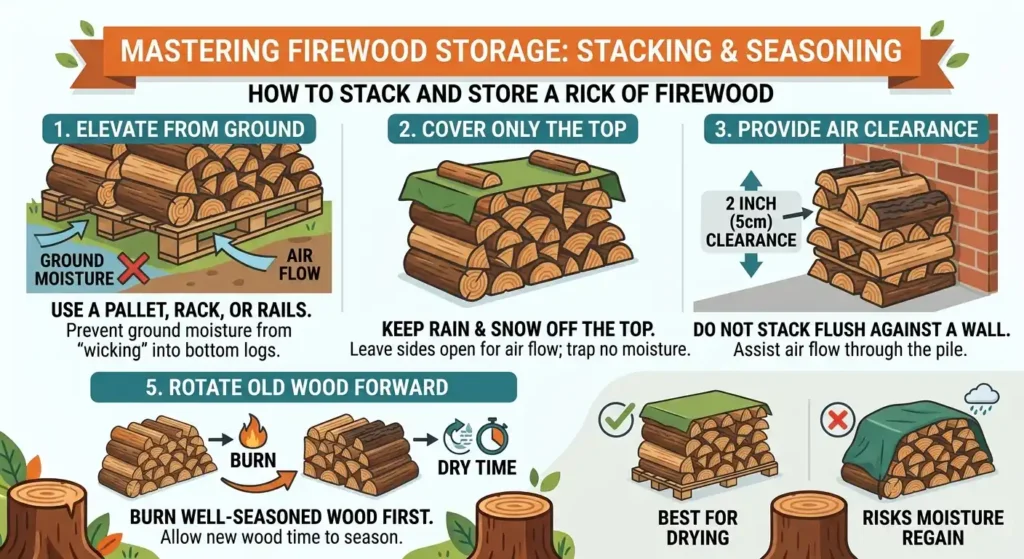
A good rick is no good unless it is put away in a proper way, because badly put away wood will take up moisture again, and lose the benefit of being in season.
- Do not touch it to the ground. Prevent wicking of ground moisture into the bottom logs by the use of a pallet, rack, or rails.
- Only cover the top. A tarp or roof on the top of the stack keeps the rain and snow off, but leaves the sides open to allow air to flow and keep the wood dry instead of keeping the moisture trapped.
- Have air holes. Don’t stack wood flush against a wall on all sides. A couple of inches of clearance assists in the flow of air through the pile.
- Bark-side up on the top row, unless you have a cover, as the bark sheds water naturally.
- Turn old wood forward so you burn out all of the splits that are well seasoned, first, and allow the new wood time to dry.
Common Mistakes When Buying a Rick of Firewood
- Failure to enquire about the log length. This one fact alters the very amount you are receiving more than nearly anything.
- Rick and cord are assumed to be interchangeable. They are not and when you confuse them in a discussion with a seller you may end up having a much smaller delivery than anticipated.
- Purchase of green wood at seasoned prices. Inquire, point-blank, how many years it has been split and stacked, and look for the giveaways of gray, cracked ends of splits seasoned to the proper degree.
- omitting a written quote. Oral contracts of a rick are too open to interpretation. Take species, length and price, in writing.
- Purchasing only what is needed at the moment. The prices of firewood are usually at their lowest during spring and summer. Next winter can be purchased in advance and can save money.
FAQs
What is a rick of firewood?
A rick of firewood is a pile of wood, about 4 feet high, 8 feet long, and the depth is determined by the length of the logs, which is normally 16 inches. It is about a third of a cord.
Is face cord a rick?
Yes, in most cases. A stack 4 feet by 8 feet with a depth that varies according to the length of the logs is referred to as both “rick” and face cord. The terms are regionally different names for the same idea.
What is the number of ricks in a cord?
Three ricks of 16-inch logs make a complete cord. That number changes with shorter or longer logs, as a full cord is an unchanging 128 cubic feet whereas the volume of a rick varies with the length of the log.
What is the weight of a rick of firewood?
An experienced rick will have a weight of between 900 and 1,500 pounds of hardwood, and less of softwood. Unseasoned wood is green and may contain 40-70 percent more water.
What is the price of a rick of firewood?
The average experienced hardwood ricks range between $100 and 250 with or without delivery and stacking. Softwood ricks are generally less expensive and may be as low as 50-120.
What is the duration of a rick of firewood?
A rick of seasoned hardwood normally lasts 2 to 4 weeks with frequent daily use. That can be extended to 4 to 8 weeks when occasionally used.
Do I have enough wood to put in my pickup truck?
Usually, yes. A typical 16-inch-deep rick is about the size of an 8-foot truck bed and can even fit in a 6-foot bed stacked neatly over the rails.
How many wood are in a rick?
The number of splits per person, which is about 275 to 325, in comparison with about 550 to 650 in a complete cord, varies with the thickness of the individual splits.
Is it a good deal to buy by the rick?
It may be, particularly when it comes to smaller families or infrequent wood burners who do not require a full cord. You can just ensure that the length of the log and cubic footage are correct so that you know what you are comparing to the cord pricing.
What’s the difference between green and seasoned firewood?
Green wood is newly cut and still contains a lot of moisture, usually 60 to 80 percent. Experienced wood is dried over 6 months to 2 years and its moisture content is reduced to approximately 20 percent or lower and therefore, is light, easy to light, and burns clean.
Why are prices of a rick so different among sellers?
Since the depth is not legally standardized as rick, sellers can have their way in defining depth. A rick of 12 inch logs will contain less wood than a rick of 24 inch logs, and two ricks of the same price can really mean two very different quantities of firewood.
Is sale of firewood per rick illegal?
Many states do not necessarily, but sellers are required to disclose the cord-equivalent volume when non-standard measures such as rick or face cord are used. Each state has different rules, and it is always a good idea to check your local weights-and-measures rules in case you are concerned.
Which kind of wood will burn the longest in a rick?
Dense hardwood such as oak, hickory, and hard maple are the longest burning and generate the most heat per log because they have a higher BTU output than softwoods such as pine or cedar due to their density.
Is it possible to pile a stack of firewood myself and save money?
Yes. A lot of sellers charge between 25 and 75 as a stacking fee. Unless you are not comfortable doing it yourself and you have the space, purchasing unstacked and stacking it on the delivery day may reduce your overall cost.
Would you prefer to purchase firewood by the rick or the cord?
When you burn wood every now and then or when you have a small storage area, a rick is most likely more convenient. When you are heating mostly with wood and you have a complete winter on it, purchasing by the cord is generally cheaper per cord of wood.
Final Thoughts
A rick of firewood is a truly practical measurement, to one who does not require or cannot store a cord of wood. The trick is that it does not measure as such as a cord does, and thus the same word may refer to meaningfully different quantities of wood, depending on who is selling it and how long their logs are.
The cure is easy: you should enquire of the rick-owner before you pay, what the length of the logs is, whether the cubic footage is correct, and whether you can have it in writing. As soon as you understand what it is that you are really comparing, a rick becomes a simple and convenient way to purchase just as much firewood as you really need, without either paying too much or having to stop in mid-cold snap.