How Much Wood Is in a Cord? A Complete Size, Weight, and Buying Guide
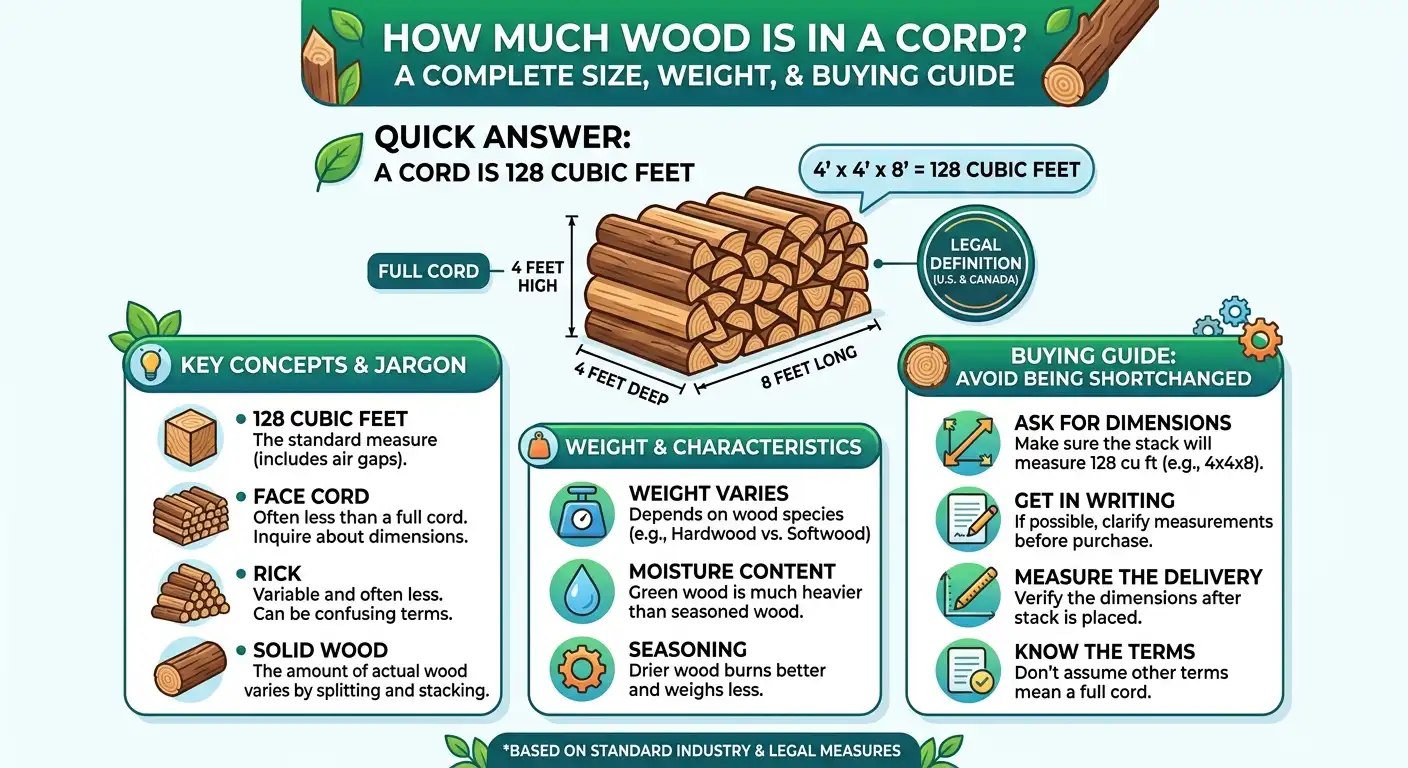
How Much Wood Is in a Cord? A stack of firewood is 128 cubic feet. The legal definition in the United States and Canada is that, and it is typically a stack 4 feet high, 4 feet deep, and 8 feet long. When a seller sells you less than that, but he calls it a cord, you are not getting all.
The quick answer is that. But when you have ever stood before a pile of logs that has been delivered, and have asked yourself whether you have got what you paid, you will know that the question is a more complex one. Face cord, rick, half cord, etc. are used interchangeably and the amount of solid wood you receive may be quite different depending on the way the wood is split and stacked.
This tutorial takes you step by step through the actual calculations, the jargon, the weight and the price of a cord and how to avoid being shortchanged.
Quick Answer: A Cord of Wood Is 128 Cubic Feet
One of the common cords measures 128 cubic feet of stacked wood, including air gaps. The typical form is a stack that is 4 feet high, 4 feet deep and 8 feet long. Any other combination of dimensions which multiplies to 128 cubic feet is also a full cord.
This is not an industry in the firewood business. It’s a legal standard. A cord is defined in the weights and measures laws of most U.S. states, and is mentioned in the National Institute of Standards and Technology (NIST) guidebook 130, which is used by states in their guide books to control what sellers are allowed to advertise.
Key takeaway: When somebody makes an offer to sell you a cord, but does not mention the size of the stack, inquire. An actual cord is to be 128 cubic feet, period.
What Is a Cord of Wood, Exactly?
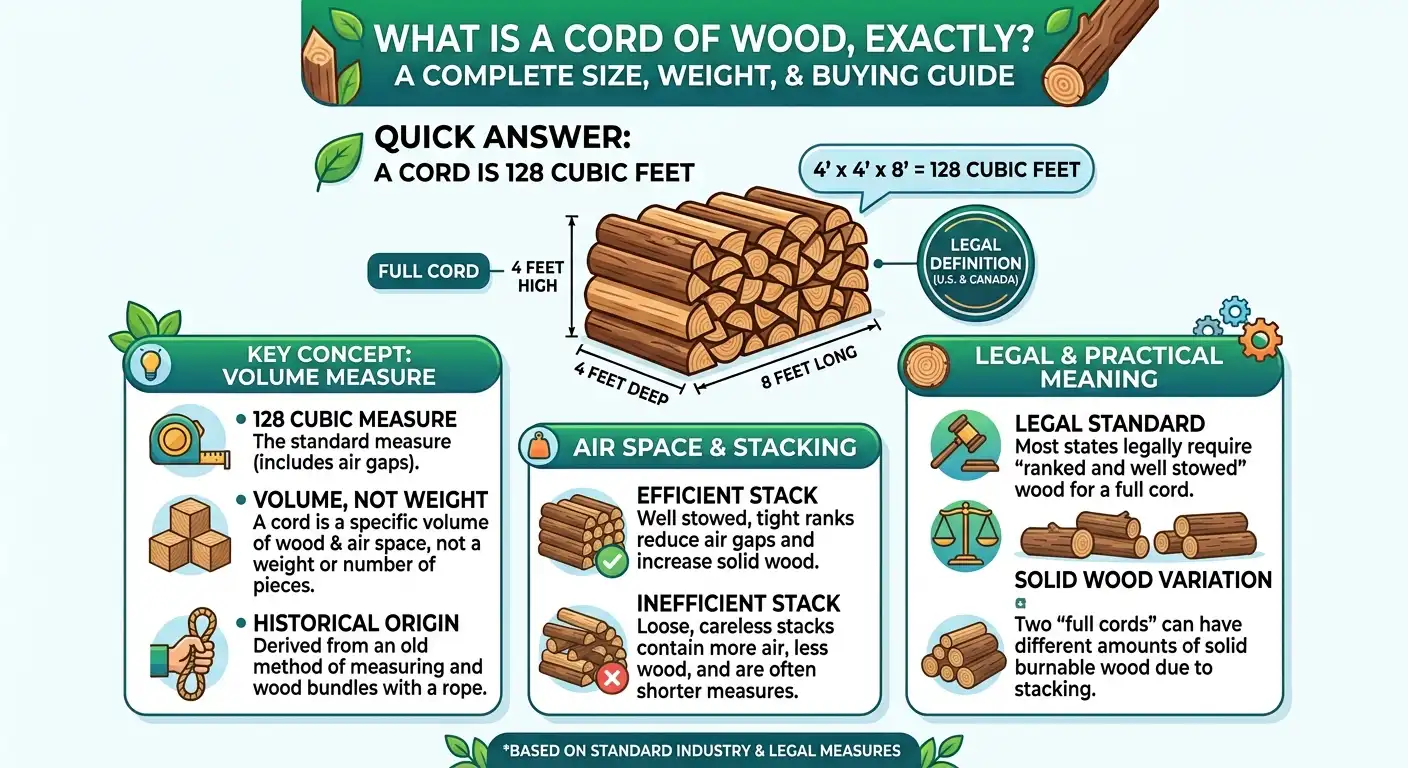
A cord is a volume, rather than a weight or number of pieces, but is specifically used to measure stacked firewood. It derives its name after the old method of measuring and tying bundles of wood with a piece of cord or a rope and then selling them.
The measurement is of the wood and of air spaces between the split, irregularly shaped pieces. That is important, as even two different cords of wood, which are technically full, may have significantly different quantities of solid burnable wood, depending on the tightness and evenness with which they are stacked.
To be a legal cord, most states insist that wood be ranked and well stowed. This implies that the pieces must be arranged in approximately the same direction, in tight stacks, with little space wastage. A carelessly stacked stack of the same wood would occupy more space and have no additional fuel.
Cord of Wood Dimensions (With a Simple Math Breakdown)
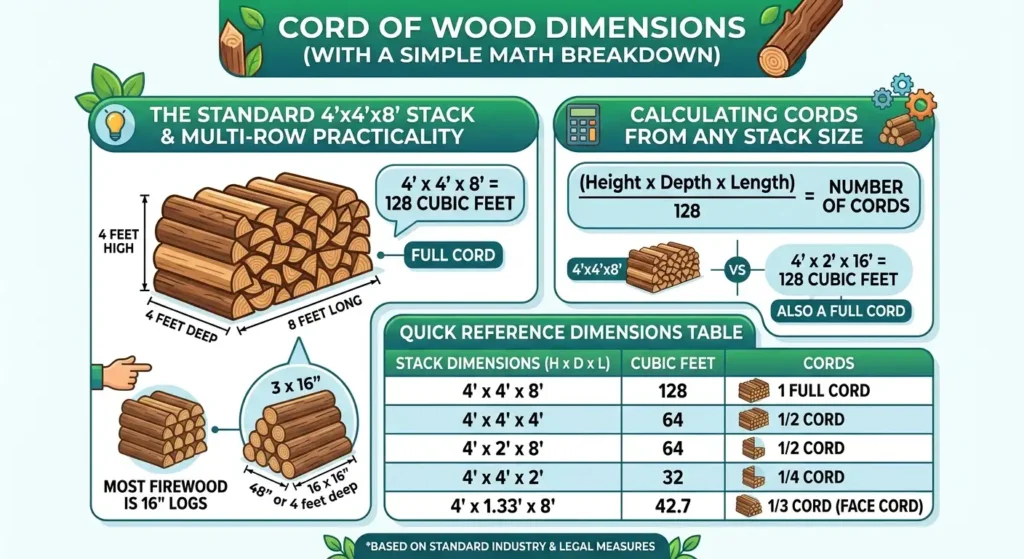
The Standard 4x4x8 Stack
The most frequently used stacking of a cord is:
- Height: 4 feet
- Depth: 4 feet
- Length: 8 feet
Multiply those together: 4 x 4 x 8 = 128 cubic feet. That’s your cord.
Practically the bulk of firewood is reduced to 16-inch logs and thus an actual cord is piled into 3 rows (3 16-inch rows constitute the 4-foot depth) 4 feet high and 8 feet long.
How to Calculate Cords From Any Stack Size
You don’t need a 4x4x8 stack to have a full cord. Any dimensions that are multiplied to 128 cubic feet do work. Divide the height, depth and length of a stack in feet, multiply them, and then divide by 128.
Formula: (Height x Depth x Length) / 128 = number of cords
The 4 feet high, 2 feet deep, 16 feet long stack, which is also 128 cubic feet, is also a full cord, despite bearing no resemblance to the traditional 4x4x8.
Quick reference table:
| Stack Dimensions (H x D x L) | Cubic Feet | Cords |
| 4′ x 4′ x 8′ | 128 | 1 full cord |
| 4′ x 4′ x 4′ | 64 | 1/2 cord |
| 4′ x 2′ x 8′ | 64 | 1/2 cord |
| 4′ x 4′ x 2′ | 32 | 1/4 cord |
| 4′ x 1.33′ x 8′ | 42.7 | 1/3 cord (face cord) |
How Much Solid Wood Is Actually in a Cord?
The 128 cubic feet of a cord is not all solid wood, by the way, as most of the sellers will not volunteer that. Since split logs are not regular shapes, there will be air gaps between them as they are stacked.
Air spaces normally occupy 20 percent to 40 percent of a cord, depending on the manner in which the wood is split, and the tightness of the stacking. That is to say the real solid wood content will normally be between 75 and 100 cubic feet even in a legitimate full 128 cubic feet cord.
It is not a hoax or a miscalculation. It’s just physics. Unsplit logs are not stacked as well as split, flat-sided pieces and thus a cord of round logs will not contain as much solid wood as a cord of well-sawed logs of the same kind.
Practical tip: When you are comparing prices of two sellers, inquire about the splitting of the wood. Squeezed, uniformly sized pieces tend to provide you with more useful wood per cord of cord than large, round, or irregularly shaped rounds.
Cord vs. Face Cord vs. Rick vs. Half Cord: What’s the Difference?
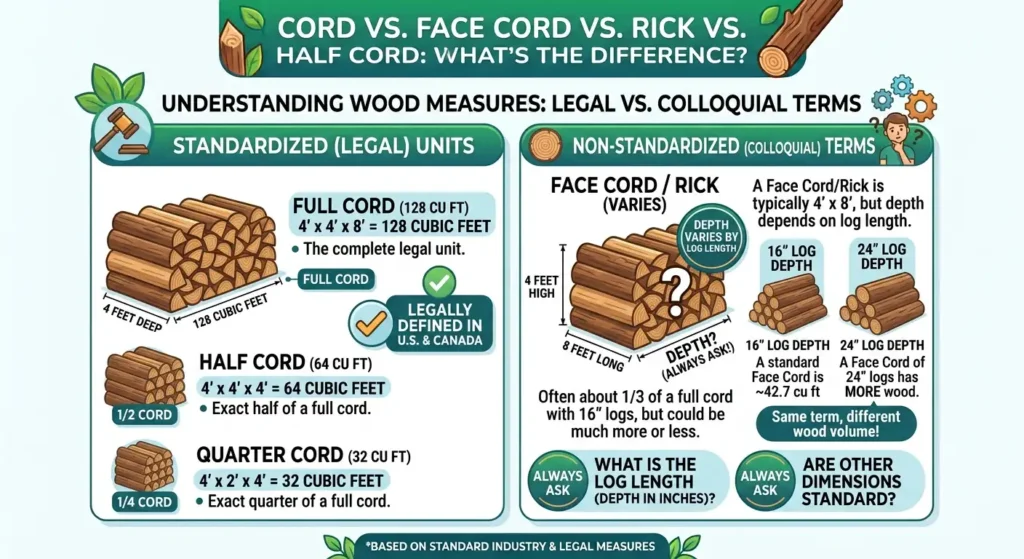
It is at this point that the majority of buyers are confused and at this point that the majority of arguments occur. Standardized units that have a legal definition are only cord and its exact fractions (half cord, quarter cord). Such terms as face cord, rick are colloquial and depend on location and seller.
Cord: The entire unit of law. 128 cubic feet.
Half cord: A half a full cord. 64 cubic feet.
Face cord (in most parts called a rick): A stack of 4 feet high and 8 feet long, but not the entire 4 feet deep. As the majority of firewood is cut to 16 inches, a standard face cord is approximately 4′ x 8′ x 16″ or about 42.7 cubic feet or about 1/3 of a full cord.
Rick: The same as face cord in most of the country, but the depth may be modified to suit local practice, and the length of the log. When a seller is using this term always request the depth in inches.
The problem is that “face cord” and “rick” aren’t standardized. A face cord of 12-inch logs has less wood than a face cord of 24-inch logs, although both could be referred to as the same by other sellers. Always request the length of the log when one quotes you a face cord or a rick price.
Comparison Table
| Term | Standardized? | Typical Dimensions | Approx. Cubic Feet | Fraction of a Full Cord |
| Full Cord | Yes | 4′ x 4′ x 8′ | 128 | 1 |
| Half Cord | Yes | 4′ x 4′ x 4′ (or equivalent) | 64 | 1/2 |
| Face Cord / Rick (16″ logs) | No | 4′ x 8′ x 16″ | ~42.7 | ~1/3 |
| Quarter Cord | Yes | 4′ x 2′ x 4′ (or equivalent) | 32 | 1/4 |
How Many Logs Are in a Cord of Wood?
This will differ greatly with the log diameter and length, but as a guiding rule, a full cord of wood is about 600 to 800 pieces of split firewood when the logs have been cut to a standard length of 16-inches and split to an average width of 4- to 6-inches.
Smaller, more fissured fragments will drive that number upwards. The less-split rounds will reduce it to a thicker one. When a seller informs you that there are a certain number of pieces in a piece of cord, it should only be regarded as an approximate and not a definite number. The real legal criterion is volume, not the number of pieces.
How Much Does a Cord of Wood Weigh?
Weight is extremely dependent on two factors: the wood species and its dryness (seasoned).
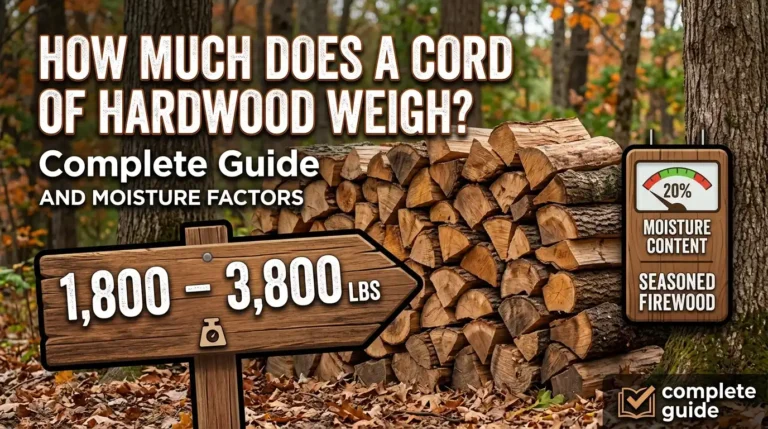
A full cord of seasoned hardwood will weigh between 3,000 and 5,000 pounds, as a general range. Unseasoned (green) wood has a greater weight due to the fact that it contains a large percentage of water weight, up to 50 percent or even more of the total weight.
Oak and hickory are denser hardwoods that are found at the heavier end of that range. The lighter hardwoods and softwoods such as pine are found at the bottom.
Practical hint: When loading your own firewood with a truck or a trailer, be sure to budget on the upper end of that weight range, particularly with green or unseasoned wood, lest you end up overloading your vehicle.
How Much Wood Is in a Cord Cost in 2026?
A full cord of seasoned hardwood will cost a country average of between 250 and 400 dollars, with the market range being a bit lower, at approximately 150 on the low end to 500 or more on the high end, depending upon the region, species of wood and time of year. High quality hardwoods bought immediately before or during winter when demand is high may cost as much as $600 or more in certain markets.
Cost by Wood Type
| Wood Type | Approx. Cost per Full Cord |
| Softwood (pine, spruce) | $150 – $300 |
| Mixed hardwood | $250 – $400 |
| Premium hardwood (oak, hickory, maple) | $300 – $600+ |
Note: These are typical national ranges, which will differ depending on local market, delivery distance and season. Always check with suppliers on existing local prices.
What Affects the Price
- Season: Purchasing in spring or summer, when demand is not at its highest, can be 20-30 percent less than the winter price.
- Seasoning: Unseasoned (green) wood is usually cheaper than wood that is seasoned or dried in the kiln, but requires time, usually 6 to 12 months, to dry out before it will burn efficiently.
- Delivery distance: Depending on the distance that a supplier has to cover, delivery fees are usually an addition of 25-100 dollars per load.
- Stacking service: There are sellers who offer to stack the wood on top of the seller for an additional $20 to $80 per cord instead of the seller simply dumping it.
- Species density: Hardwoods are more difficult to burn, and the length of burning time and intensity is a portion of the reason they are more expensive per cord than softwoods.
How Many Cords of Wood Do You Need for Winter?
This will be based on your climate, frequency of burning and whether you use wood as your main or supplementary source of heat.
- Occasional use (weekend fires, ambiance): A quarter to half a cord can be used to cover a complete season.
- Frequent additional heat (several nights per week): Estimate about 1-2 cords.
- Heat source in a cold climate: In colder climates (north) many households burn 3 to 5 cords, or more, in a complete winter.
When you use your wood stove or fireplace most evenings during a cold season it is wiser to overestimate and stock the extra to the next year than to run out part way through the winter.
How to Measure and Verify a Cord Delivery
Do not believe the pile. Measure it.
- Stack the delivered wood, which may not be stacked, in such a way that the pieces are aligned and in contact with each other with the minimum gaps.
- Find the height, depth and length of the stack in feet.
- Multiply the three measurements and get cubic feet.
- divide by 128 to determine the number of cords you actually got.
When the figure turns out to be significantly less than what you paid, then you can bring up the matter with the seller. The weights and measures offices of many states, which are referred to by standards such as NIST Handbook 130, enable consumers to make complaints against sellers who falsely represent the quantity of cord.
Common Firewood Scams and How to Avoid Them
- Imprecise language: A seller sells a cord when in fact, he or she sells a face cord or rick without specifying. Always ask for exact dimensions in feet.
- Unpiled, loose wood: Wood that is dumped in a loose pile occupies more visual space than it will occupy when stacked and compacted. Request that it be stacked, or check it after stacking it.
- Truck bed as a cord: An average pickup truck bed has about one-third to half a cord, not one cord, as some unscrupulous sellers might say.
- Mixed or unspecified species: Paying hardwood prices on a load that is predominantly softwood. Inquire what kind of species you are purchasing.
- No receipt or written quantity: always have the quantity, price, and the date of delivery in writing in order to have something to refer to in case of short delivery.
How to Stack and Store a Cord of Wood
Correct storage will ensure that your wood is dry, it seasons properly and burns well.
- Do not put it on the ground. A pallet, rack or rails will help keep the moisture off the bottom layer.
- Stack loosely so that air can pass through but tight enough so that the pile is held in place.
- Only cover the top and leave the sides open, to allow the moisture to escape instead of being trapped under a complete tarp.
- Keep out of the exterior wall of your house, where possible, because woodpiles may be of interest to insects.
- Store 6-12 months prior to burning, when the wood was green cut, to minimize smoke and enhance efficiency of the burning process.
Myth vs. Fact
Myth: A pickup truck bed is full of a cord of wood.
Fact: A typical truck bed will carry approximately 1/3 to 1/2 of a cord of wood, depending on the size of the truck and the manner in which the wood is stacked.
Myth: Face cord and cord are synonymous in terms of amount of wood.
Fact: A face cord is about a third the size of a full cord, as it is not as deep as a full 4 feet, but only a length equal to one log.
Myth: All cords weigh about the same.
Fact: Weight is very dependent on wood species and moisture content. Green oak is much heavier than pine, when in cord form.
You may Also Like to Read:
FAQs
What is a cord of wood?
A cord of wood is a standard measure of volume that is equal to 128 cubic feet of stacked firewood, most commonly stacked in the form of a stack 4 feet high, 4 feet deep and 8 feet long.
What is the amount of wood in a face cord?
A face cord measures approximately 42.7 cubic feet, or one-third of a full cord, as it is piled 4 feet high and 8 feet long, but no more than as deep as a single log (usually 16 inches).
Is a rick a cord?
No. A rick is typically the size of a face cord, approximately a third of a full cord, but the size may vary depending on region and length of logs. It is not a legal term that is standardized like cord.
There are how many logs in a cord of wood?
Approximately 600-800 split firewood pieces, using standard 16 inch logs. The precise number will be determined by the diameter of the logs and the splitting of the wood.
What is the weight of a cord of wood?
An average cord of seasoned hardwood weighs about 3,000 to 5,000 pounds. Unseasoned or green wood is heavier because it contains more water.
What is the price of a cord of wood?
Nationally, you can expect to spend between $250 and $400 on a full cord of seasoned hardwood, with prices ranging from $150 to $500 or more depending on the region, species and season.
Is there any air between logs in a cord of wood?
Yes. The 128 cubic feet is comprised of the solid wood and the air space between the stacked pieces. The content of solid wood is usually between 75 and 100 cubic feet.
Is a full pickup truck bed a cord of wood?
No. The size of the pickup truck bed can typically carry about a third to half of a cord of wood, not a full cord, depending on the size of the truck and how the wood is loaded.
Why are the prices so different by area?
Regional pricing is influenced by the availability of local wood, the distance of transportation, demand due to climate, and availability of species. Areas that are close to large forests are usually lower priced than those that depend on imported wood.
Final Thoughts
A cord of wood is reduced to a single figure: 128 cubic feet. All the rest, the weight, the price, the number of logs, is an extension of that one measure; and of the kind and dryness of the wood you are purchasing.
The words that confuse people, face cord, rick, half cord, aren’t, is not confusing when you are aware that they are referring to fractions or informal versions of the same 128-cubic-foot standard. The surest way to prevent being shorted is straightforward: order what you want to be a certain size, take the size that arrives, and do not think a stacked pile is a full cord because it has been called such by someone.
Stocking up to spend a warm weekend at home or heating your entire house during a long winter, you will always know the true mathematics behind a cord, and how much you are actually paying.