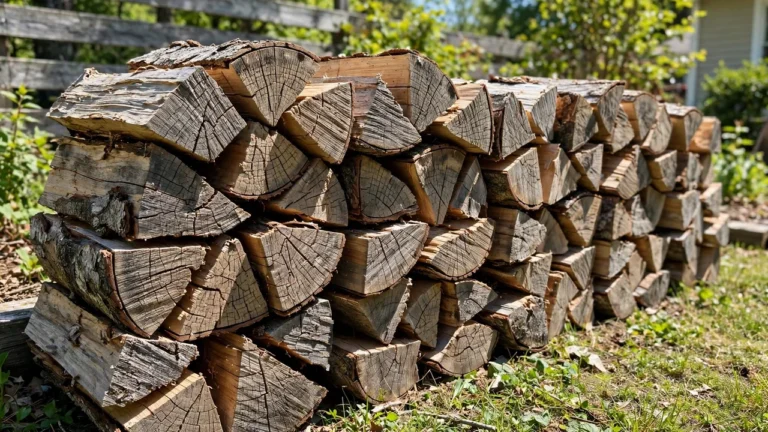
Oak Tree Firewood: BTU, Seasoning Time, Benefits, and Everything Else You Need to Know Before You Burn It
When you have ever stood in front of a fireplace and wondered why your fire keeps going dead, there is a good possibility that it is the wood that is the problem, rather than the stove. Oak is a very reliable firewood in North America, yet it will only perform to its reputation once you get some idea about it first: how much heat it will actually give off, how long it will take to dry, and how to know when it is ready to burn.
All that is in this guide, and not guesswork, but based on the actual extension and forestry research, so you can buy or season oak without worrying.
Quick facts before you start:
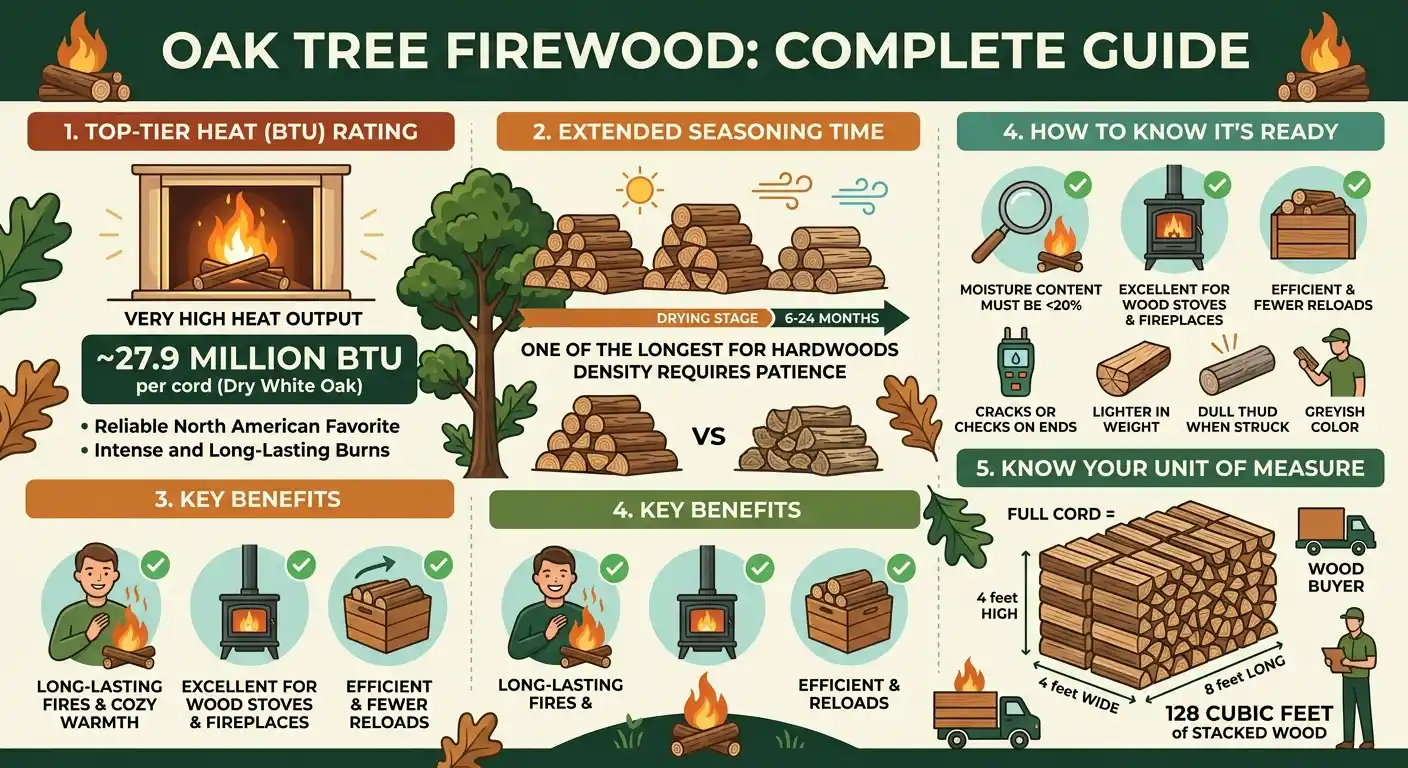
- White oak is rated at about 27.9 million BTU per cord when dry, one of the highest ratings of any commonly found firewood species.
- Oak requires 6-24 months to season well, which is longer than most other hardwoods, due to its density.
- Oak must be properly seasoned and at a moisture content of not more than 20%.
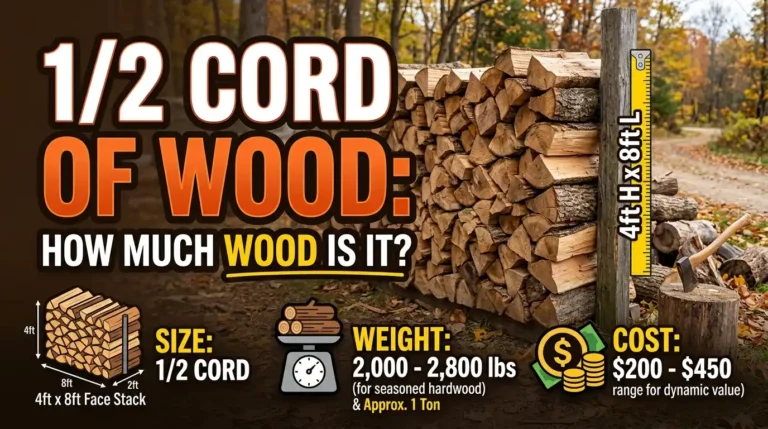
- A complete cord is 4 feet by 4 feet by 8 feet (128 cubic feet of stacked wood).
What Is Oak Firewood?
Oak tree firewood is wood cut out of any of the over 90 species of oak indigenous to North America, most often red oak, white oak, bur oak, pin oak and live oak. It is a hardwood, or in other words, the wood of a slow-growing broadleaf tree with dense wood fibers. It is that density that makes oak such a good firewood: dense wood can squeeze more burnable mass into the same size log, which means more heat and longer burn times than the lighter woods such as pine or poplar.
Not every oak is the same, however. Different species come into or out of season at varying rates and generate a little more or a little less heat, which we will disaggregate below.
Is Oak Good Firewood?
Yes. Oak is regarded as one of the most versatile firewoods in the United States as it burns long, leaves a good bed of coals and extinguishes more heat per cord than most other common hardwoods. Its chief drawback is time: oak is slower to season than other light woods, such as ash or cherry, and thus is more rewarding to plan ahead than any other wood.
Why people choose oak firewood:
- Large power output per cord.
- Long, sustained burn with good coaling (perfect to use overnight fires)
- Found in most parts of the US.
- Can be used in fireplaces, wood stoves, fire pits, and to smoke meat.
- cuts quite easily when experienced.
Where oak falls short:
- Prolonged seasoning period as opposed to light hardwoods.
- Heavy to move and stack
- Green (unseasoned) oak is actually bad firewood: smoky, difficult to light, and ineffective.
Oak Firewood BTU: How Much Heat Does It Actually Produce?
BTU is the British Thermal Unit, or the amount of heat required to increase the temperature of one pound of water one degree Fahrenheit. The BTU per cord of firewood gives you an idea of the amount of total heat that a full, properly stacked cord of dry wood can produce. It is the best number to use to compare firewood species, since it takes into consideration the energy density of the wood in addition to the amount of solid wood that can normally be stacked into a stacked cord.
The following is a comparison of the main oak species based on the data on firewood property gathered by the US Forest Service and university forestry research, as well as some other common firewoods to provide some context.
Comparison Table Firewood BTU (million BTU per cord, at about 20 percent moisture content)
| Species | Million BTU per Cord | Weight per Cord (dry) | Splitting Difficulty |
| Hickory | 29.3 | 3,560 lbs | Good |
| Black locust | 28.3 | 3,440 lbs | Good |
| White oak | 27.9 | 3,392 lbs | Good |
| Bur oak | 26.3 | 3,192 lbs | Good |
| Sugar maple | 25.9 | 3,144 lbs | Good |
| Red oak | 25.9 | 3,144 lbs | Fair |
| Pin oak | 25.9 | 3,144 lbs | Fair |
| White ash | 24.6 | 2,992 lbs | Excellent |
| Black cherry | 20.5 | 2,496 lbs | Good |
| White pine | 15.0 | 1,744 lbs | Good |
The numbers are based on the data of firewood property collected by university forestry extension programs. Since there is always a small air space between pieces in a “cord” and since moisture content and growing conditions in various regions vary, published BTU values vary slightly across sources. Consider these as comparisons to be trusted, not lab-perfect measurements.
What this table informs you: Oak is not the highest-BTU firewood on the market (it is slightly outperformed by hickory and black locust), but it is always in the highest category, and it is much more common than either of the two species in most areas. It is that heat production and easy accessibility that makes oak the standard firewood in most households.
Red Oak vs. White Oak Firewood: Which Should You Buy?
They are both good firewood, but they are not the same.
| Feature | Red Oak | White Oak |
| BTU per cord | ~25.9 million | ~27.9 million |
| Seasoning time | 1 to 2 years | 2 to 3 years |
| Grain and bark | Open grain, reddish bark with ridges | Tighter grain, lighter gray, flaky bark |
| Splitting | Fair, moderate effort | Good once dry |
| Best use | General heating, everyday burning | Long overnight burns, smoking meat |
| Moisture resistance | Lower | Higher (tighter grain slows both drying and rot) |
When you are purchasing already-seasoned or kiln-dried wood, this difference is not as important as the seller has already done the drying. When cutting and seasoning your own wood, red oak is the more forgiving option since it dries quicker.
How Long Does Oak Firewood Take to Season?
This is the one thing that is the most important to get right with oak and the area that beginners fail with.
Short answer: Oak normally requires 12 to 24 months of good seasoning to fall below the 20% moisture content required to burn efficiently and without pollution. In humid climates, dense white oak may require as long as 3 years. This is approximately twice the seasoning period of light hardwoods such as ash or cherry.
Freshly cut (“green”) oak starts out at 70% to 80% moisture content. That water must be evaporated before the wood can be properly burned, and that the tight-grained structure of oak retards that operation much more than in other woods which have a higher porosity.
Estimated seasoning time by species and conditions
| Species | Minimum Season Time | Recommended Season Time |
| Red oak | 12 months | 18 to 24 months |
| White oak | 18 months | 24 to 36 months |
| Live oak | 18 months | 24 to 36 months |
| Pin oak | 12 months | 18 to 24 months |
These numbers are also influenced by climate. Wood in dry, windy, sunny areas dries out more quickly than in humid or shaded areas. The process is also meaningfully expedited by splitting wood into smaller pieces and stacking it with good airflow.
Moral of the story: When somebody tells you that fresh-cut oak will be available to burn next winter, be suspicious. Pine or cherry will do that timeline. Oak must have a head start.
How to Season Oak Firewood the Right Way
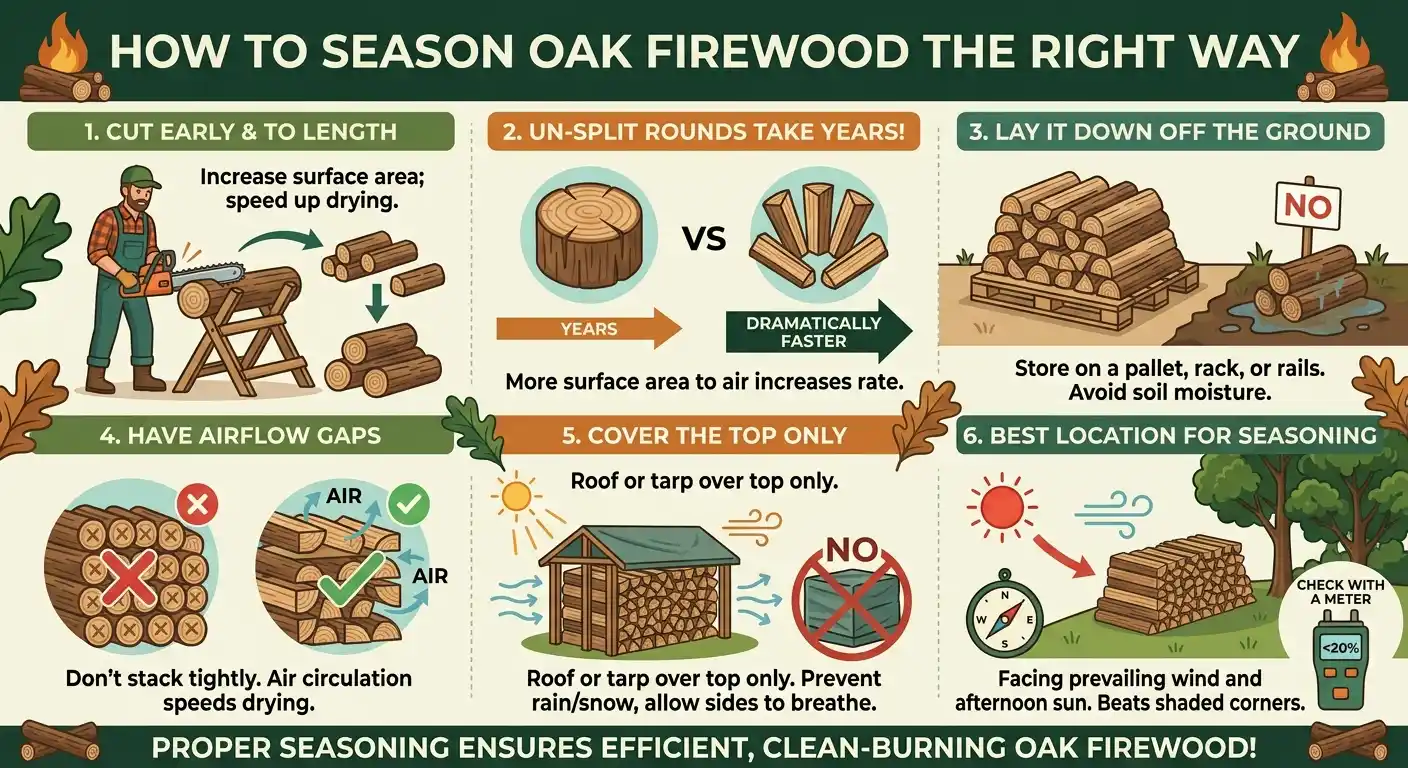
- Cut early and cut it to length. The exposition of more surface to air by splitting increases the drying rate dramatically. Un split round of oak may require years to season.
- Lay it down off the ground. Store wood on a pallet, rack or rails to avoid soil moisture.
- Have airflow gaps. Don’t stack tightly. The circulation of air is more important than exposure to the sun to speed up drying.
- Just cover the top. A roof or tarp over only the top of the stack prevents rain and snow, but allows the sides to breathe. Complete wrapping of stack prevents moisture and retards seasoning.
- Have the stack facing the prevailing wind and sun. A location with afternoon sun and a constant wind will beat a shaded corner by months.
- Do not guess the moisture, check it with a meter. The only sure method of determining whether your wood is ready or not is by a basic moisture meter (approximately 20-30 dollars).
How to Tell If Oak Firewood Is Seasoned
You do not have to go to the lab to get a good reading of your wood.
- Below 20% moisture on a meter, on a freshly split face of the log.
- Color change: Old oak is no longer fresh and pale, but gray or a bit darker on the end.
- Checking (end cracks): Radial cracks on the cut ends are a good indication that the wood has been left by moisture.
- Weight: Experienced oak is much lighter than green oak of the same size.
- Sound: Two experienced pieces struck together give a sharp hollow crack. Green wood is hollow and thuddy.
- Bark: Bark on old oak tends to peel or loosen off.
When one of the pieces passes most of these tests, provide it with time. One of the most common and most preventable firewood errors is burning oak too early.
Kiln-Dried Oak vs. Air-Seasoned Oak
Kiln-dried oak is dried in a controlled room to quickly take out the moisture, typically to less than 20, sometimes less than 15, in a few days instead of years. It is more costly, but it addresses two issues simultaneously: it is already ready to burn, and the heat treatment will kill insects and fungal spores, hence many state and national parks have regulations that mandate the use of kiln-dried or certified heat-treated wood in campfires.
| Air-Seasoned Oak | Kiln-Dried Oak | |
| Time to ready | 12 to 36 months | Ready immediately |
| Cost | Lower, especially if self-cut | Higher |
| Pest risk | Higher unless properly seasoned | Very low, heat-treated |
| Moisture consistency | Variable, needs testing | Consistent, usually under 20% |
| Best for | Homeowners planning ahead | Immediate use, travel, camping where regulations require it |
Both of them are not wrong. Air-seasoning is time-consuming rather than money-consuming, kiln-drying is money-consuming rather than time-consuming.
Benefits of Burning Oak Firewood
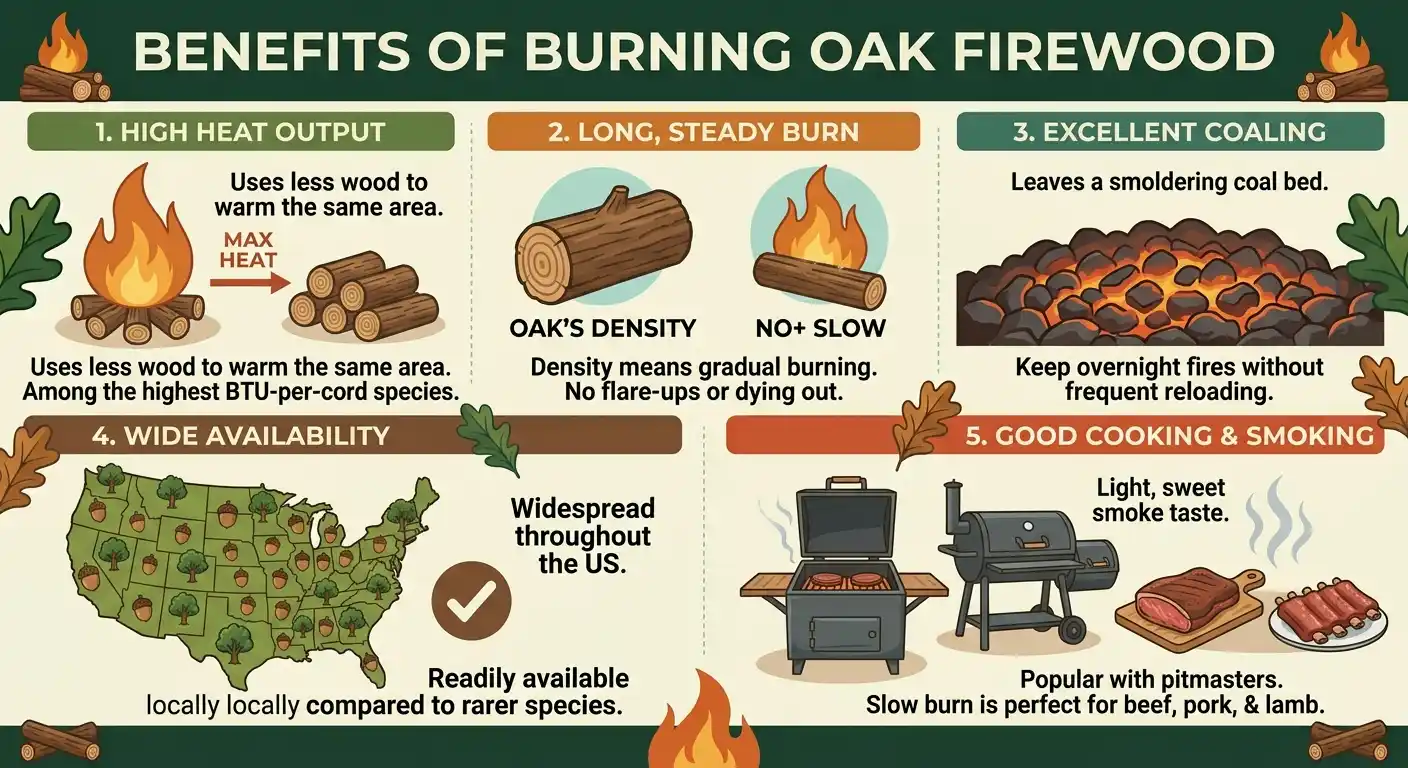
- High heat output. In the category of the highest quality firewoods in BTU per cord, therefore, you use less wood to warm the same area.
- Long, steady burn. Density of oak implies that it does not flare up and die out but burns gradually.
- Excellent coaling. Oak leaves a rich, smoldering coal bed, just what you desire to have to keep an overnight fire without having to keep reloading.
- Wide availability. Oak is widespread throughout the continental US, so it is more readily available locally compared to other species, such as hickory or black locust.
- Good cooking and smoking. The light, slightly sweet smoke taste of Oak is a good match with beef, pork, and lamb, and is also popular with pitmasters due to its slow burn.
Common Mistakes People Make With Oak Firewood
- Burning it prematurely. Green oak smokes much, is difficult to light, and spends the greater part of its energy in evaporating internal moisture, rather than in giving off heat.
- Purchasing unchecked wood that is experienced. The word “seasoned” isn’t regulated. Take a moisture meter or request the seller to provide you with a reading before you bulk purchase.
- Piling wood too closely or completely covering it with a tarp. This captures moisture and may take months to season.
- All oak seasons assumed to be equal. White oak requires significantly longer than red oak. Mixed loads are not evenly seasoned.
- Storing firewood against the house. It is a pest-control problem, and a fire-safety problem. When you can, place stacks at least 20-30 feet away from your house.
Myth vs. Fact
| Myth | Fact |
| “If it’s split, it’s seasoned.” | Splitting speeds up drying, but it doesn’t season wood on its own. Time and airflow still matter. |
| “Oak is the highest-BTU firewood you can buy.” | It’s near the top, but hickory and black locust typically rate slightly higher. Oak wins on availability and consistency. |
| “Wet wood just burns a little less efficiently.” | Wet wood burns significantly less efficiently and produces far more creosote, which raises chimney fire risk. |
| “A full cord and a face cord are the same thing.” | A full cord is 128 cubic feet. A face cord is typically one row, 4 feet by 8 feet, at whatever length the logs are cut, and is usually a third to a half of a full cord. |
Buying Oak Firewood: What the Terms Mean
- Full cord: 128 cubic feet, piled 4 feet high by 4 feet wide by 8 feet long. It is the unit of measure of the sale of firewood that is used in most states.If you want the exact stack dimensions and what that volume looks like in person, this breakdown of cord sizing walks through it visually.
- Face cord (or rick): One row of wood, 4 feet by 8 feet, with depth equal to the length of the logs (commonly 16 inches). A face cord is not a fixed volume, so always confirm the log length before buying. For a closer look at how the two units differ in cost and volume, see this side-by-side comparison of stacking measurements.
- Price: Species, seasoning (air-dried or kiln-dried), length of logs and delivery distance influence price. Kiln-dried oak is normally more expensive per cord than air-seasoned oak because of the energy and time used to process it.Since sellers don’t always stack wood the same way, it also helps to know roughly how much wood you’re actually getting for the price before you commit to an order.
Buying checklist:
- Be sure to purchase a full cord or face cord and have the dimensions written down.
- Inquire directly about whether the wood is kiln-dried, air-seasoned or green.
- Ask to be told the moisture content of the wood being sold when purchasing so-called seasoned wood, particularly when making a big purchase.
- Make sure that logs are divided to a size that fits into your stove or fireplace opening.
- Inquire on delivery and stacking service in case you are ordering in large quantities.
- If the seller’s measurements seem off, cross-check them against the standard size specs for a stacked cord before you pay.
Safety Notes
Not only is it inefficient to burn unseasoned or poorly stored oak, it is dangerous. Wet wood burns at a lower and incomplete combustion temperature that generates more creosote, a flammable byproduct that accumulates in chimneys and flues. One of the major causes of residential chimney fires is creosote build-up.
Get chimneys and stove flues checked once a year, particularly when you burn wood that was not well seasoned.
FAQs
Is oak good firewood?
Yes. Oak is an excellent hardwood which has high BTU production, prolonged burn times and coaling, and is considered one of the most dependable firewoods in the US. Its primary disadvantage is that it requires more time to season than the lighter woods.
Is it possible to burn green oak firewood?
You can, but you shouldn’t. The moisture content of green oak is 70 to 80 percent, and this results in a lot of smoke, low heat production and lots of creosote in your chimney or flue.
Is oak firewood spurty or poppy?
No. Oak burns relatively quietly and steadily as compared to other woods such as pine or spruce which pop and spark as their resin is trapped.
What’s the difference between a cord and a face cord of oak?
A cord is 128 cubic feet (4 feet × 4 feet × 8 feet). A face cord is a row, 4 feet by 8 feet, the depth being the length of the log, and generally a third or half of a full cord.
Which makes better firewood red oak or white oak?
Both are excellent. White oak has slightly higher BTU output and burns longer, but takes longer to season. Red oak dries quicker and is simpler to split, so it is more convenient in case you are drying your own wood.
What do I do to know whether my oak firewood is seasoned?
Look to see that the moisture content is less than 20 percent, the gray color is faded, the cut ends are cracked, the weight is light, the bark is loose, and the hollow sound is sharp when two pieces are struck together.
Is kiln-dried oak firewood better than seasoned oak?
Kiln-dried oak can be burned right away, and has more uniform, lower moisture content, but is more expensive. Oak that is air-seasoned is less expensive but needs 1-3 years of planning.
Is it possible to smoke meat with oak firewood?
Yes. Oak is a very widely smoked wood, as it burns long and the smoke has a pleasant well-balanced flavor that is compatible with most meats.
Why so heavy is my oak firewood?
Oak is thick hard wood, and that is precisely what makes it have high BTU output. The weight of a cord of dry white oak is about 3,400 pounds, or nearly twice the weight of a cord of dry pine.
What is the price of a cord of oak firewood?
Prices differ greatly depending on the region, length of logs, and whether the wood is kiln-dried or air-seasoned, with kiln-dried oak typically being more expensive because of processing time and energy. Inquire of local suppliers about the prevailing prices in your locality.
Is it better to cover or uncover oak firewood?
Only cover the top of the stack. Completely wrapping a woodpile seals moisture in and retards seasoning, while exposing the top to rain can add moisture.
Is oak firewood high in ash?
Oak works well on its own, but many pitmasters blend it with a fruitier wood for a sweeter finish. If you want to compare options, here’s a full breakdown of using pecan for smoking, including which cuts it pairs best with.
How to divide oak firewood?
Split it immediately after cutting, preferably when the wood is still green, because when it is dry oak is much more difficult to split. An axe is not as effective as a maul or hydraulic splitter on oak with its dense grain.
Final Thoughts
Oak wood has been known to be one of the best all-round firewoods you can burn, but all this is based on the fact that it must be allowed time to season. A cord of well-dried oak will do nearly as well as anything that you can put in a stove or fireplace. An oak cord of green will smoke you out of the room, and will cover your chimney with creosote. The wood is similar. The distinction is forbearance and a bit of planning.
When you are cutting and drying your own supply, you had better begin now, to get it ready next year, cut it in small pieces, pile it up loose, and test it with a moisture meter before you can depend upon it. When purchasing, be direct about the moisture content and do not expect “seasoned” to have the meaning that you think it has. In any case, when you get the timing, oak firewood is nearly a sure thing as firewood.