How to Use a Propane Heater Safely: A Step-by-Step Guide to Heat Without the Hazards
Propane heaters are quick to heat a room, do not use electricity and are cheaper to install compared to most systems. They also happen to be one of the more frequent causes of home fires and carbon monoxide poisoning every winter, and nearly always due to a step that someone missed, rather than a problem with the heater itself.
This tutorial will step-by-step show you how to install one, operate it and store it in such a way that you can enjoy the heat without the danger. It is addressed to anyone who has a portable propane heater, be it a small indoor cylinder heater, a garage rated heater, or a radiant heater used in camping or a patio.
Quick Answer: The Short Version
And should you read but one part, read this.
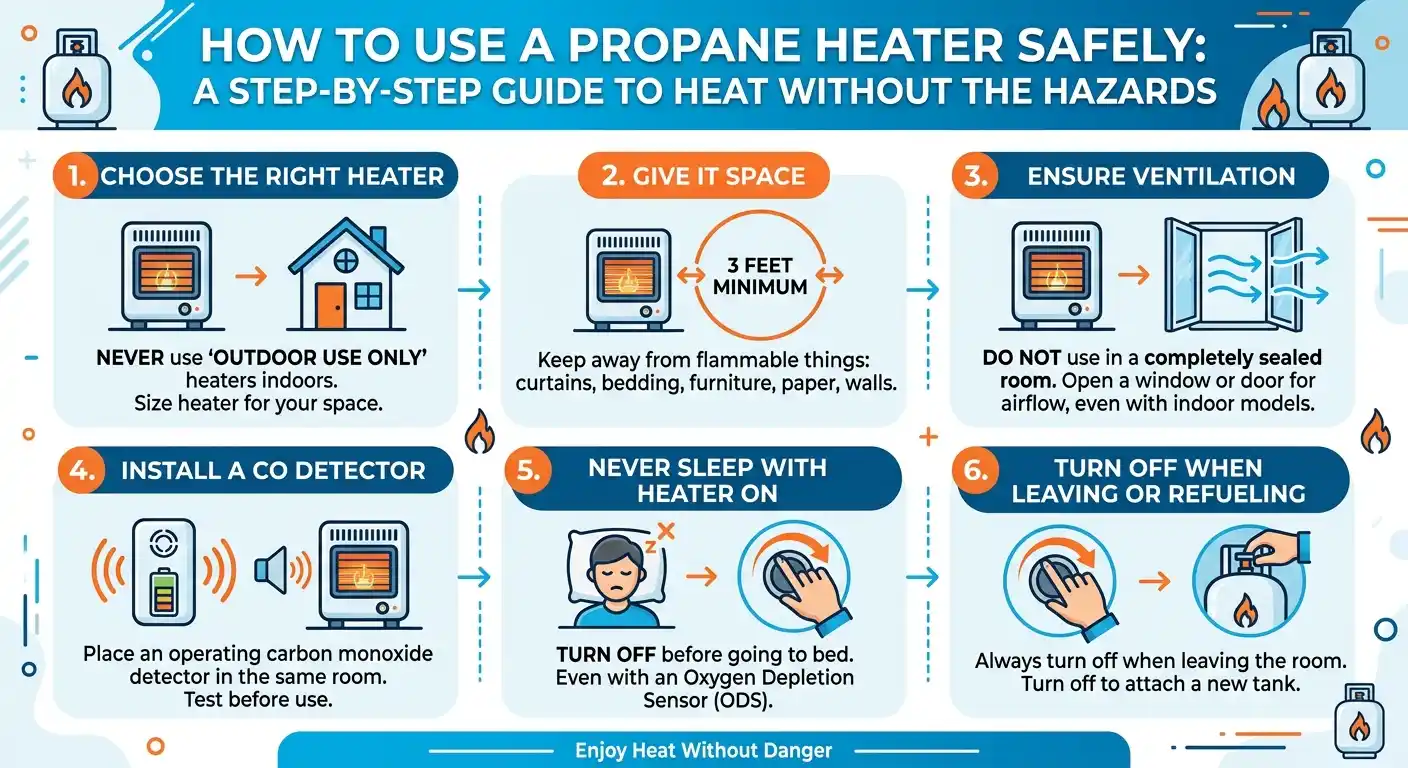
- Do not use a heater that is higher than the space you are heating. There should never be a heater that has the label outdoor use only.
- Store it at least 3 feet away, not in contact with anything flammable: bedding, curtains, furniture, paper, walls.
- Do not operate a fuel-burning heater in a completely sealed room. Open a window or door to get some air, even indoor-rated models require it.
- Put a carbon monoxide detector in any room you use the heater and make sure it is operating prior to starting.
- Do not sleep with a propane heater on, even those with an oxygen depletion sensor.
- When leaving the room or going to bed, always turn it off, and when refueling or attaching a new tank, always turn it off.
All the following are reasons why you should be able to reason out everything below so that you can apply these rules to your particular circumstance rather than merely blindly follow them.
How Propane Heaters Actually Work (And Why That Matters for Safety)
Propane heater is a device that burns liquid propane gas to generate heat. That burning action burns the air surrounding it and results in byproducts, such as carbon dioxide and, incomplete burns, carbon monoxide. That fact alone motivates virtually all safety regulations in this guide: such heaters require a constant supply of fresh air to combust cleanly and to maintain the oxygen concentration in the room at a safe level to breathe.
Vented vs. Vent-Free (Unvented) Heaters
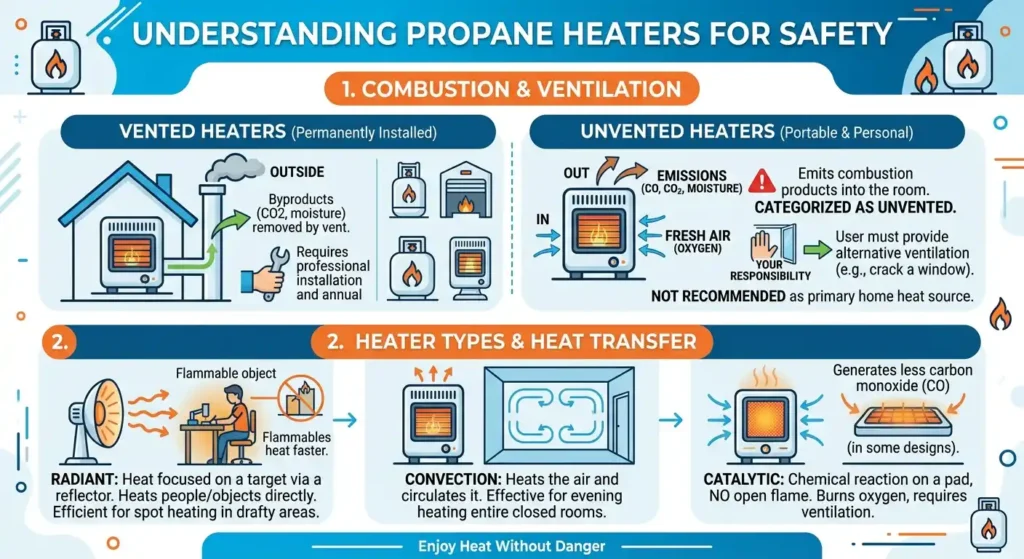
Vented heaters are attached to a chimney or flue that transfers the byproducts of combustion. They are not portable units but are usually permanently installed and require professional installation and annual inspection to ensure that the venting is not obstructed, disconnected, or corroded.
Vent-free (unvented) heaters emit the products of combustion into the room. This covers nearly all the portable propane heaters you would purchase to use in a garage, workshop or on a camping trip. All portable propane and kerosene heaters are categorized by health and safety authorities as unvented, and are usually not recommended as a primary heat source in the home due to the pollutants they emit into the environment.
This does not imply that an unvented heater should not be used indoors. It implies that you are doing your own ventilation that would otherwise be taken care of by a vented system.
Radiant vs. Convection vs. Catalytic Heaters
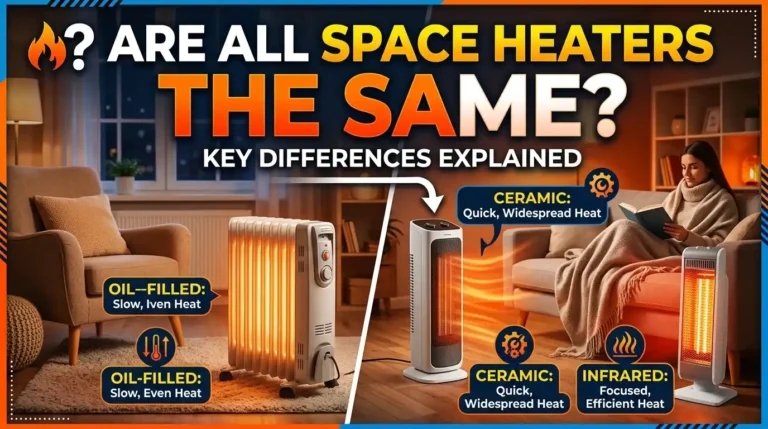
- Radiant heaters are designed to focus heat on a target, such as a workbench or a person, with the help of a reflector. They warm objects and individuals directly instead of the entire room and thus are efficient in drafty places but not effective at warming up a garage as a whole.
- Convection heaters heat the air itself and circulate it throughout the room, and is more effective with a closed area that you want to evenly heat.
- Catalytic heaters involve a chemical reaction over a pad rather than an open flame, which generates less visible flame and in some designs, less carbon monoxide, but still burns oxygen, and still requires ventilation.
Being aware of the type you have will assist you in the correct placement. Anything flammable can be heated much faster by a radiant heater than by a convection heater.
Before You Light It: Setup and Placement
Get the set-up correct and you will have most of the risk eliminated even before you switch on the heater.
- Put it on a hard, level, non-flammable surface. Tile or concrete works. Carpet, rugs and wood floors do not, as they can be set on fire by a tipped heater or radiant heat.
- Have a minimum of 3 feet of clearance around. That will be bedding, curtains, furniture, boxes, and any other item that can be burned. Radiant heaters require additional clearance where they are facing.
- Test tip-over safety switch. The majority of the current portable propane heaters have one that automatically shuts the gas supply in case the unit is knocked over. Make sure that yours has this feature and is not disabled or blocked.
- Do not use the heater with children or pets, and use some sort of physical barrier in case you cannot be in the room all the time.
- Do not install a heater in a doorway or a hallway or any place where it obstructs an exit path. In case something does go wrong you must have a way out.
- Compare the room size with the heater cover. A small room with a large heater will run out of oxygen before the room can supply it.
Ventilation: The Rule That Matters Most
This is the part that averts the injuries you actually read on the news. Even a certified indoor safe heater still requires fresh air to breathe.
Combinating oxygen, the process of combustion results in carbon monoxide, a gas that is colorless and odorless and disrupts the way your blood delivers oxygen to your body. You can neither smell it, nor see it, nor taste it, and this is precisely why it kills so many people during sleep when they are not aware of the initial symptoms.
The U.S. Consumer Product Safety Commission advises that at least an inch of a window should be open when operating any type of fuel-burning space heater, to allow fresh air to enter the room and prevent pollutants to accumulate. That one-inch crack is significant than people think.
It has nothing to do with losing heat efficiency, it has everything to do with providing the combustion process with the oxygen it requires and providing byproducts with a place to exit.
What an Oxygen Depletion Sensor Does (and Doesn’t Do)
The majority of heaters designed to be used indoors have an oxygen depletion sensor (ODS). It is a tiny gadget that keeps an eye on the pilot flame and automatically switches off the gas supply when the oxygen content in the room decreases to about 18 to 18.5 percent which is lower than the usual 21 percent in fresh air.
This is where you can get a clear idea: an ODS will save you when you are suffocated by low oxygen. It is not a sure way to prevent carbon monoxide poisoning, since CO can accumulate to hazardous levels before oxygen levels drop enough to cause the sensor to go off. Use the ODS as an addition to the protection, not to replace ventilation and a separate carbon monoxide detector.
Always use an ODS-equipped heater as a supplemental safety measure in a closed area such as a tent, camper or sealed room. It is just one of the safeguards, not in place of fresh air.
How to Light and Run a Propane Heater Safely (Step-by-Step)
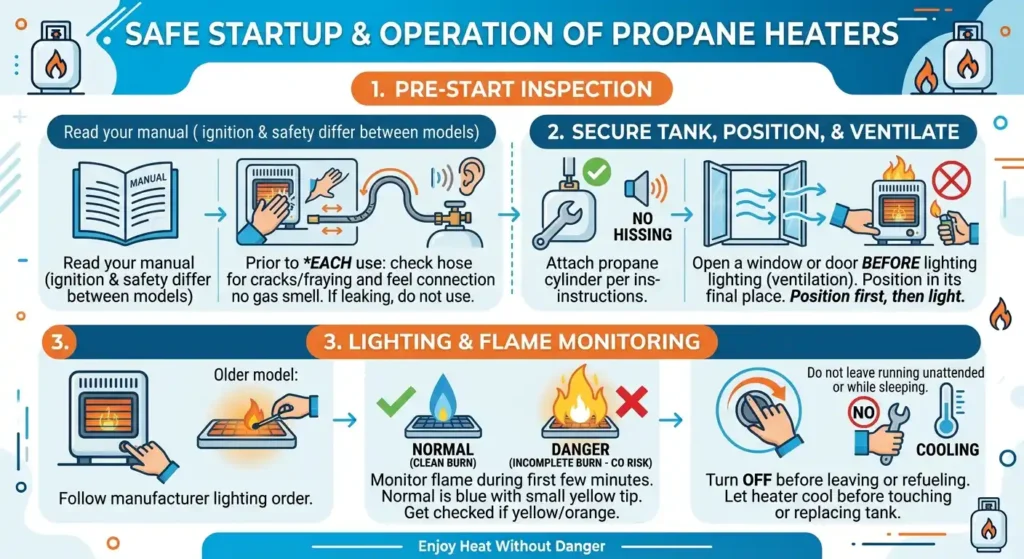
- The first thing to do is to read the manual of your particular model. The ignition procedures and safety measures differ between the manufacturers and this guide is general practice and not model specific.
- Check the heater and hose prior to each use. Look for cracks, fraying, or a smell of gas. Do not use a heater that has a broken hose or connector.
- Attach the propane cylinder or tank as per the instructions of the manufacturer ensuring that the connection is tight and that there is no hissing noise, which is a common sign of a leak.
- Position the heater to last position and then light it. Don’t light it and then move it.
- Before starting the heater, open a window or door ajar to provide ventilation, not afterwards.
- Adhere to the lighting order of the manufacturer. A majority of portable propane heaters have a push-button igniter; older models might require a match.
- Keep an eye on the flame during the initial few minutes. A normal propane flame is primarily blue with a small yellow tip. A huge flickering yellow or orange flame may be a sign of incomplete burning and increased carbon monoxide production; disconnect the heater and get it checked in case you notice this.
- Do not leave a running heater unattended in the room, or running when you sleep, even if labeled as continuous.
- Before leaving the room, going to sleep, or refueling, turn the heater off.
- Do not touch, move or replace the tank before the heater is cool.
Propane Tank and Cylinder Safety
Half the equation is the heater itself. The way you keep and store the propane fuel is also of great importance.
Storing Propane Tanks Safely
- Keep extra propane cylinders outside, never in a basement, closet, or attached garage where a leak can be anywhere.
- Stand tanks straight, out of direct sunlight, and out of any source of ignition, such as electrical outlets, vents, and appliances with pilot lights.
- In small cylinders (1-pound bottles or 20-pound tanks with portable heaters), maintain a minimum of a few feet distance between them and ignition sources and building openings such as windows or vents, and store them in a well-ventilated place.
- Do not keep a propane cylinder in a car in direct sunlight over long periods; it heats up and the inside pressure increases.
- Before refilling or changing the tank, verify the valve and point of connection is not rusted, damaged, or has expired certification date (stamped on the collar).
Spotting a Propane Leak
Propane is heavier than air, and therefore, a leak will settle at the bottom, close to the floor instead of spreading upwards. The odorant is a sulfur-like smell that manufacturers add to ensure that leaks are detectable, and is commonly referred to as a smell of rotten eggs.
In case you smell gas or hear a hissing sound around a connection:
- Do not light a match, flick a light switch or use a phone in the space. A minor spark can spark off a build up of propane.
- Disable the tank valve, and do so safely and expeditiously.
- evacuate the building or vehicle as quickly as possible and leave the doors open on the way out to air the building or vehicle.
- External call to the fire department and not inside the building under fire.
- Do not re-enter until emergency responders can assure that it is safe.
Carbon Monoxide: Symptoms, Detection, and Response
The initial symptoms of carbon monoxide poisoning resemble the flu, which is one of the reasons why it is so harmful: headache, dizziness, fatigue, nausea, and confusion. When it is very high it may lead to loss of consciousness and death, usually when the individual is asleep and is not aware that something is amiss.
Put a carbon monoxide detector in any room where a propane heater operates and test it prior to the heating season. A CO detector is not an extension of a smoke alarm, or of the heater itself, and its own oxygen sensor; you need all three layers, not one.
Should a CO alarm go off, or should anyone in the area experience an abrupt headache, dizziness, or nausea when the heater is on:
- Turn off the heater.
- Immediately get everybody outside.
- See a doctor in case the symptoms do not clear up soon after being outside.
- Do not turn on or turn on the heater again until you find the cause and fix it, preferably with a professional check.
Propane Heater Safety by Location
The risks in different spaces vary, and thus the same heater can be safe in one environment and hazardous in another.
Garage
Garages are usually bigger and leakier than living rooms, and this aids in ventilation, but they also commonly hold flammable liquids such as gasoline, paint thinner and cans of aerosols. Have the heater as distant as possible to any stored fuel or chemicals, and ensure that the heater is certified to be used in the garage or workshop, not only on the patio.
Open the garage door only half-way, not all the way, to keep air moving in the garage, and never operate a heater when the engine of a vehicle is running, because it will contribute its share of carbon monoxide.
Tent or Camping
It is the most dangerous environment in this whole guide, and most of the CO-related portable heater deaths and injuries have historically been in this environment, as CPSC investigations have shown. A tent is small, tightly closed and has very little natural air exchange.
Never use an unmarked heater unless it is marked as an indoor or tent heater that includes an inbuilt oxygen depletion sensor, always leave a vent or door flap ajar, never sleep with it on and carry a battery-operated CO detector with a camping label.
RV or Camper
The same small, closed-space risks are involved. Only use heaters that are rated to the enclosed area that you are in, have a roof vent or window open, install a CO detector that is designed to be used in RVs, and never leave a heater on overnight without someone awake to watch it.
Patio or Outdoor Space
Outdoor propane heaters (the tall standing patio type) are typically less prone to CO accumulation as they are in an open air environment, although fire and tip-over hazards remain. Keep them out of umbrellas, overhangs, string lights, and seating fabric, and fasten them down against the wind, as a powerful gust of air is a frequent cause of tip-overs out of doors.
Choosing the Right Propane Heater (Sizing and Certifications)
Purchasing the appropriate heater to your area avoids much downstream safety issues.
| Factor | What to Look For |
| Certification | Look for CSA (Canadian Standards Association) certification and compliance with the ANSI Z21.63 standard for portable propane heaters, which covers combustion safety testing. |
| Indoor labeling | Confirm it’s explicitly labeled for indoor use with an oxygen depletion sensor, not just “for outdoor use only.” |
| Safety features | Tip-over shutoff switch, oxygen depletion sensor, and a sturdy fuel connection are the baseline features to check for. |
| BTU rating vs. room size | Match the heater’s BTU output to the manufacturer’s recommended square footage. An oversized heater in a small room can burn through oxygen faster than the space can replace it. |
| Fuel type match | Make sure the heater is designed for the propane cylinder size you plan to use (1-pound disposable bottles vs. 20-pound refillable tanks aren’t always interchangeable without an adapter hose). |
Manufacturers also provide certain BTU-to-square-footage guidelines on each model, and these figures differ enough across designs to make a single formula unreliable. Do not estimate the coverage rating of your heater but look it up in its manual or product listing.
Common Mistakes That Cause Injuries
- Operating a heater that is only designed to operate outdoors in a tent, garage, or room.
- Closing all the windows and doors to keep warm, and cutting off the fresh air which the heater requires.
- Sleeping with the heater turned on, even a so-called safe ODS-equipped one.
- Heater is too near bedding, curtains, or furniture.
- Failure to have the annual inspection of any vented or fixed heater.
- Keeping an extra propane tank inside or in direct sunlight.
- You do not need a separate CO detector assuming that you have a working ODS.
- Reusing a hose on a heater that has a broken or worn out hose because it still appears to work.
Myth vs. Fact
| Myth | Fact |
| “My heater has a low-oxygen sensor, so it’s safe to run all night.” | The sensor protects against low oxygen, not against carbon monoxide buildup. Never run a heater unattended overnight. |
| “Propane heaters don’t need ventilation if they’re rated for indoor use.” | Even indoor-rated heaters need fresh air; the rating means the design includes safety features, not that ventilation is optional. |
| “You’ll smell carbon monoxide before it becomes dangerous.” | Carbon monoxide has no smell, color, or taste. Only a detector can reliably warn you. |
| “A small propane heater can’t produce enough CO to matter in a big garage.” | Enclosed, poorly ventilated spaces of any size can trap CO; size alone isn’t a safety guarantee. |
Propane Heater Safety Checklist
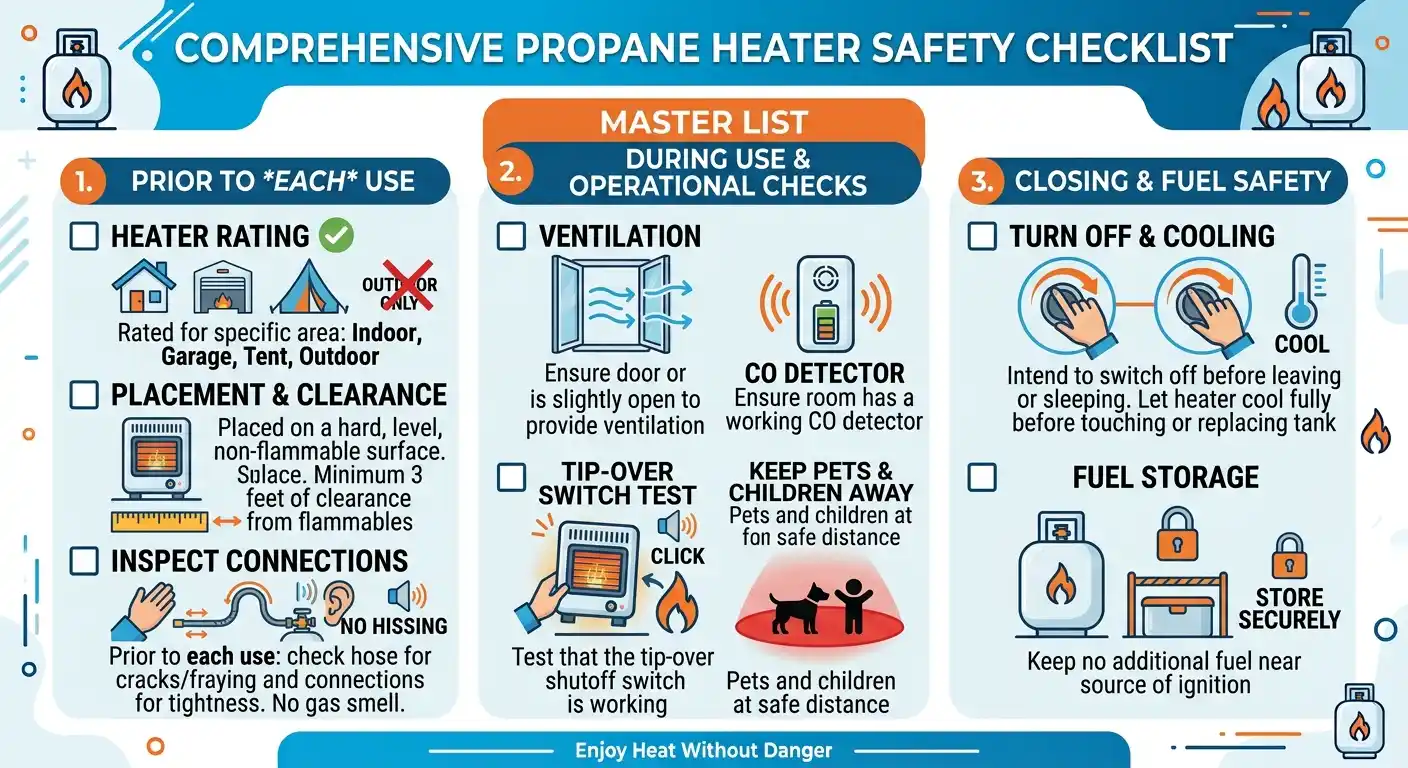
Apply prior to each usage, not only the initial usage.
- Heater that is rated to this particular area (indoor, garage, tent, or outdoor only)
- Placed on a hard, level, non-flammable surface
- Minimum of 3 feet of clearance of anything flammable.
- Tip-off shutoff switch tested working.
- Window or door forced open to ventilate.
- Room has a working carbon monoxide detector.
- Propane hose and connections checked to see whether there is any damage or leakage.
- No additional fuel kept in the vicinity of a source of ignition.
- Intend to switch off heater before going to sleep or leaving the room.
- pets and children away of the unit.
Maintenance and Off-Season Storage
- Check the heater, hose and connections, at the beginning of each heating season, prior to first use.
- Clean vents and burner ports as per the instructions of the manufacturer; blocked ports may lead to incomplete combustion.
- Keep the heater in a dry place that is not exposed to moisture, which will corrode fuel connections with time.
- Uncouple and store the propane cylinder separately, as per the outdoor storage instructions above.
- Change your carbon monoxide detector batteries when you do the heater, so you get used to it.
- In case of permanently vented heater, it should be checked by a professional at least once a year, as the consumer is not usually well-equipped to detect any venting issues.
FAQs
Is it safe to run a propane heater indoors?
Only when the heater is markedly indoor-only, has an oxygen sensor, and you supply continuous ventilation, like a cracked window. There should be no instances when heater with the label outdoor use only is used indoors.
Will a propane heater result in carbon monoxide poisoning?
Yes. Complete combustion of all fuels, such as propane, generates some carbon monoxide and incomplete combustion generates more. The primary cause that enables the accumulation of CO to hazardous levels inside the premises is poor ventilation.
What is the maximum time you can use a propane heater?
The safe number of hours is not fixed; it is determined by the ventilation, room size, and supervision. The less risky thing to do is to never leave it running unattended and never leave it running when sleeping, no matter how long you have been using it without any problems before.
Should I have a carbon monoxide detector in case my heater has a low-oxygen switch?
Yes. The oxygen depletion sensor and a carbon monoxide detector safeguard against various risks, and one is not a replacement of the other.
Why is my propane heater turning off?
This is usually the oxygen depletion sensor doing its job, which means that the oxygen level in the room has reduced. Enhance ventilation instead of attempting to circumvent or disable the sensor.
Is it possible to have a propane heater in a garage with the door shut?
It is better to keep the door half open to allow air to pass. Carbon monoxide and oxygen that has been used up can accumulate rapidly in a fully sealed garage, particularly a small garage.
Can a propane heater be left on in a tent?
No. It is one of the most dangerous scenarios to be poisoned by carbon monoxide, and the authorities on safety particularly caution against it, despite having heaters with a low-oxygen shutoff.
What is a normal propane flame like?
Bluish in colour, with only a small yellow tip. The bigger yellow or orange flame may indicate an incomplete combustion and increased carbon monoxide production.
What is the distance that a propane heater should be?
No less than 3 feet in all directions, and more clearance in the direction to which a radiant heater is directed.
Are propane tanks allowed to be kept inside?
There should be spare cylinders that are kept outside in a shaded and well-ventilated place, not in a basement, a closet, or an attached garage, and thus a leak can be dispersed safely.
What do I do in the event that I detect gas around my heater or tank?
Do not use switches, flames or phones. Close the tank valve, where possible, in a quick and safe manner, evacuate everybody, and call the fire department at a safe distance.
Are kerosene heaters safe in comparison to propane heaters?
Propane tends to emit less carbon monoxide than kerosene when burned, and both still need the same fundamental safety measures: ventilation, clearance, and a functioning CO detector.
What is the size of propane heater that I require?
Compare the BTU rating of the heater with the size of the room that the manufacturer has suggested instead of just basing it on the square footage because insulation and ceiling height alter the amount of heat a room actually requires.
Are vent-free propane heaters acceptable in all areas of building code?
Certain states and local jurisdictions prohibit or limit the use of vent-free heaters, or their use as a primary heat source. Before installing or using one, check local codes.
Is it advisable to get my propane heater professionally inspected?
The visual inspection of hose, connections, and burner should be the primary check of portable heaters before each season. Vented heaters permanently installed should have a complete professional check-up annually.
Final Thoughts
A propane heater is not hazardous in nature. Using it in an area that it is not designed to operate in, without ventilation, without a functional CO detector, or with no one monitoring its operation, is dangerous. All the rules in this guide are all brought back to one of those four things.
One habit that you may take of the entire article is this: open a window, and never go to sleep with it on. The two options eliminate most of the events that headline the news each winter.