What Are the Measurements of a Cord of Wood? Size, Volume & Weight Explained
What Are the Measurements of a Cord of Wood? A cord of wood measures 4 feet high, 4 feet deep, and 8 feet long. That works out to 128 cubic feet of stacked firewood. It’s the only legally standardized way to sell firewood in the United States, which matters more than it sounds like it should, because “face cord,” “rick,” and “truckload” get thrown around like they mean the same thing. They don’t.
This is all you should know about the real size of a cord of wood, how it is measured, how much it weighs and how to ensure that you are not being short-changed.
Quick Answer: The Exact Size of a Cord of Wood
A standard (full) cord of wood is:
- 4 feet high
- 4 feet deep
- 8 feet long
- 128 cubic feet total
- Split logs in 2 or 3 rows, piled up tightly with the pieces usually cut to 16 to 24 inches in length.
Any stack of wood, in any arrangement, that adds up to 128 cubic feet counts as a cord. The 4x4x8 layout is just the most common shape because it’s practical to stack and split logs at that length. If you want a closer look at what that stack actually looks like in person, see our visual breakdown of a full cord’s size.
What Is a Cord of Wood, Officially?
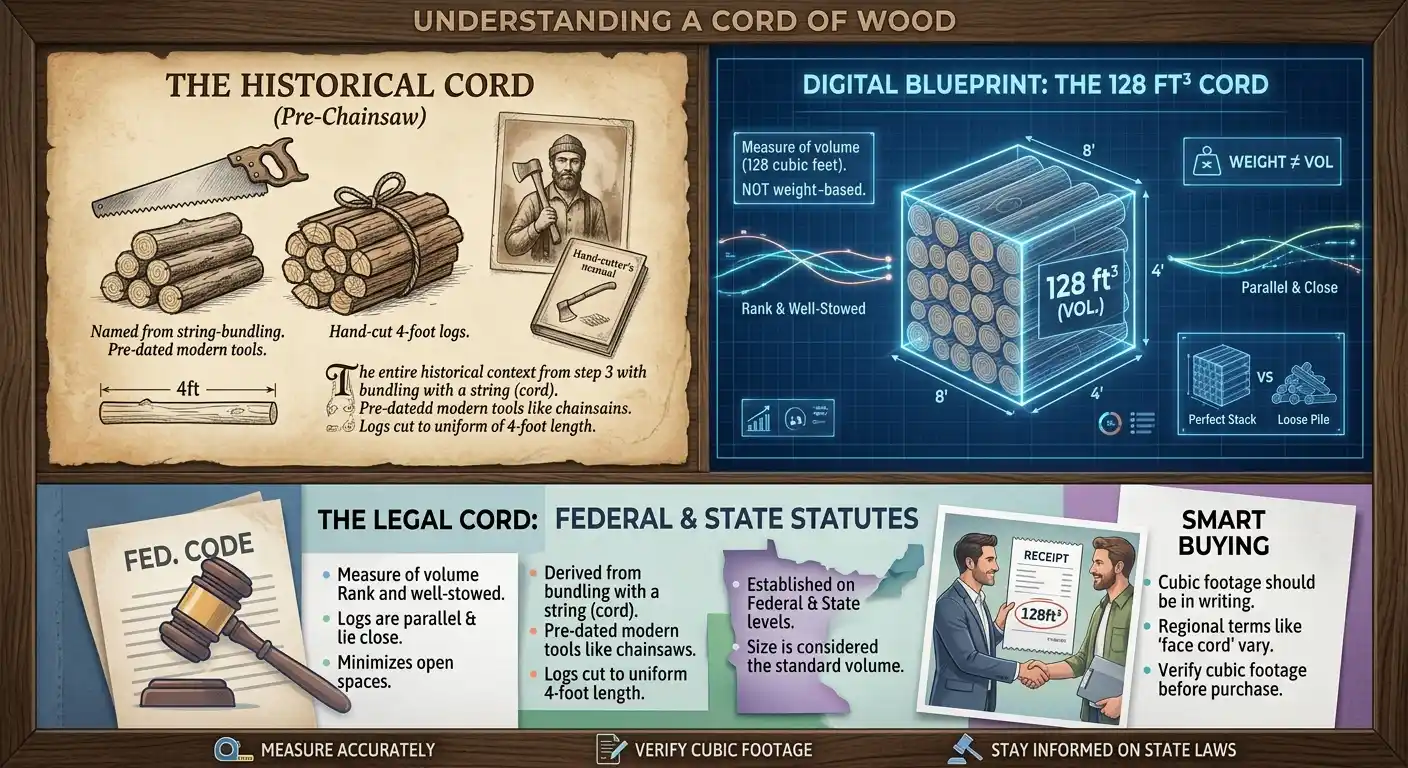
A cord is a measure of volume, not weight, which is used to measure stacked firewood and pulpwood. It is calculated by the number of feet of wood which fill 128 cubic feet when the pieces are rank and well stowed, that is to say, stacked up so that the logs are parallel, lie close together, and leave but a little space between them.
What Are the Measurements of a Cord of Wood & From Its Comes?
The name is probably derived out of the habit of tying and measuring bundled wood with a cord or a string. The unit has been in use in North America centuries before there were chainsaws or hydraulic splitters, when only a hand cutter could be used to cut logs to a uniform 4-foot length and stack them in racks of the same depth.
Is a Cord of Wood a Legal Measurement?
Yes. In the United States, the cord is established both on the federal and state level:
- The size of 128 cubic feet is what is considered the standard size of the area that a stack of firewood takes.
- The Maine state law says that a standard cord is wood 4 feet wide, 4 feet high, and 8 feet long, or its equivalent, with 128 cubic feet when stacked and well packed, and that any openings larger than can hold a log are to be counted against the total.
- Minnesota law also defines a cord as 128 cubic feet of wood, bark and air when cut in four-foot lengths, but has different cubic-footage requirements on sawed or split wood sold loose and ranked.
Since states have a slight difference in defining related terms such as face cord, it is always best to ensure that cubic footage is in writing when purchasing, not by a regional term.
The Exact Dimensions of a Cord of Wood
Cord of Wood Dimensions in Feet and Inches
| Measurement | Feet | Inches |
| Height | 4 ft | 48 in |
| Depth | 4 ft | 48 in |
| Length | 8 ft | 96 in |
| Total volume | 128 cubic feet | 221,184 cubic inches |
This 4x4x8 arrangement isn’t the only valid shape. Any stack that multiplies out to 128 cubic feet is technically a cord, regardless of the individual measurements. A stack that’s 2 feet high, 4 feet deep, and 16 feet long is also a cord, because 2 x 4 x 16 = 128. For a deeper walkthrough of how these numbers work across different stack shapes, check out our full size guide covering every common cord dimension.
How to Calculate Cubic Feet in Any Wood Stack
This is a simple formula to use on any stack, regardless of shape:
Height (ft) x Depth (ft) x Length (ft) = Total cubic feet
Then divide by 128 to find out how many cords you have:
Division of total cubic feet by 128 = Number of cords.
Example: A stack of 4 feet high, 2 feet deep, and 8 feet long is 64 cubic feet, half a cord.
How Much of a Cord Is Actually Solid Wood?
It is what most guides omit and it counts. The 128 cubic feet of a cord is the sum of the wood and the air spaces between the irregularly shaped pieces.
Since even the pieces of split wood are not regular in shape, the air spaces between them usually occupy about 30 to 40 percent of the total volume of the stack, that is, the actual solid wood in a well stacked cord is usually only about 3/4 to 1/2 of the total volume of the stack. The difference is much affected by the manner in which the wood is split and stacked. Uniformly cut round pieces are more compact and leave you with more wood to use out of a cord than gnarled, irregular rounds.
Quick fact: An average 128 cubic foot cord of wood will produce 75 to 90 cubic feet of solid, burnable wood. The remainder is inescapable air space, not an indication that you were shorted.
Cord vs. Face Cord vs. Rick: What’s the Difference?
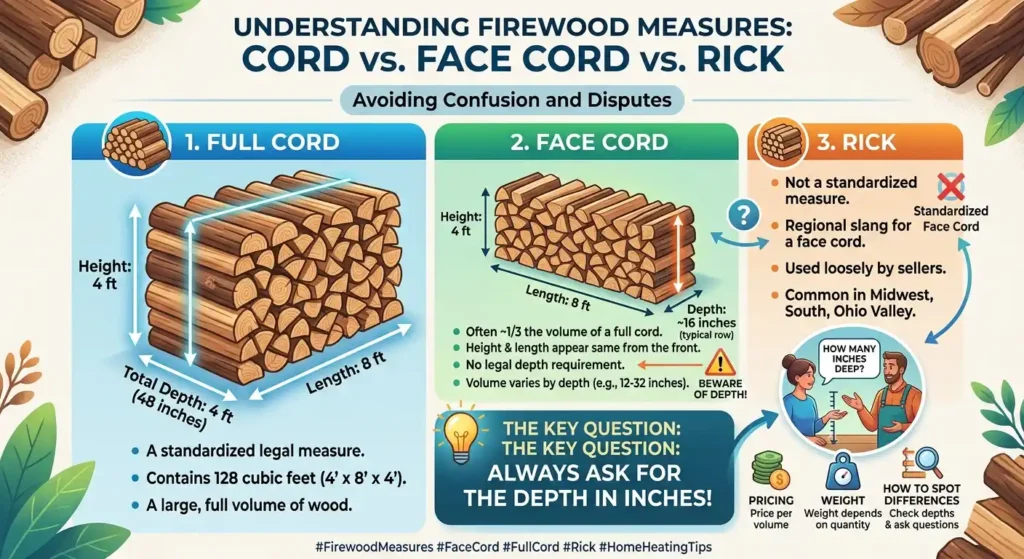
It is here that the greatest confusion, and most of the disputes, in reality, occur.
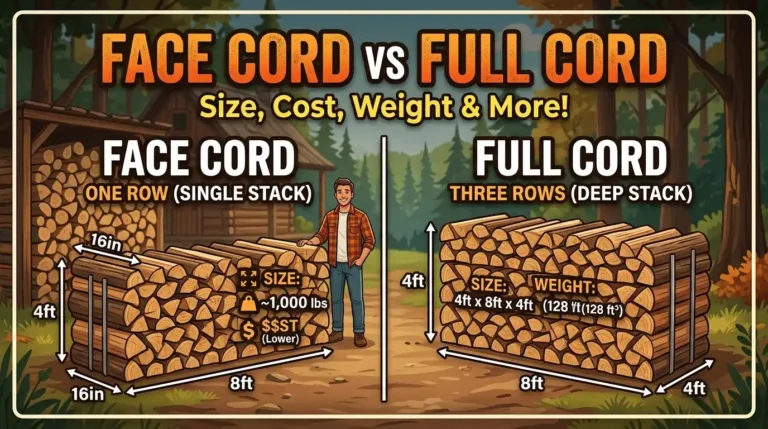
A face cord (also known as a rick in the Midwest, South, and Ohio Valley) is the same height (4 feet) and length (8 feet), but is only a single row (usually 16 inches), the standard length firewood is cut to fit most residential stoves and fireplaces. It is that single-row depth that causes a face cord to be about a third the volume of a full cord.
The depth of a face cord is not a legal requirement but may be between 12 and 32 inches depending on the seller, altering the volume you actually receive even though the stack appears to be the same size on the front. That is the snare: a face cord and a full cord are the same when you are in front of them, as they both show the same 4×8-foot face. The only question you need to know what you are actually purchasing is to enquire how deep the stack is.
Key point: “Rick” has no legal or standardized definition anywhere in the U.S. It’s regional slang for a face cord, but nothing stops a seller from using it loosely. Always ask for the depth in inches. For a side-by-side look at pricing, weight, and how to spot which one you’re actually being quoted, this comparison lays out the differences in detail.
Comparison Table: Cord, Face Cord, Half Cord, Quarter Cord
| Unit | Dimensions | Volume | Fraction of a Full Cord |
| Full Cord | 4 ft x 4 ft x 8 ft | 128 cu ft | 1 (whole cord) |
| Half Cord | 4 ft x 2 ft x 8 ft | 64 cu ft | 1/2 |
| Face Cord / Rick (16 in. logs) | 4 ft x 1.33 ft x 8 ft | ~42.7 cu ft | 1/3 |
| Quarter Cord | 4 ft x 1 ft x 8 ft | 32 cu ft | 1/4 |
| Face Cord (24 in. logs) | 4 ft x 2 ft x 8 ft | 64 cu ft | 1/2 |
Note: Fraction of a full cord on a face cord varies with the length of a log. Always ensure that the piece length is checked and then compare prices.
How Much Does a Cord of Wood Weigh?
Weight isn’t fixed, since a cord is a measurement of volume, not weight, and wood density plus moisture content both swing the number significantly. As a general range, a seasoned (dried) cord typically weighs between 2,000 and 4,500 pounds, while a green (freshly cut) cord can weigh 3,500 to 5,500 pounds because it still holds a large amount of water weight. If you want the full species-by-species math behind these figures, this guide breaks down weight by moisture level and wood type.
Weight by Species (Approximate, Seasoned/Dry)
| Species | Approx. Weight per Cord |
| Hickory | 4,300 to 4,500 lbs |
| White Oak | 4,000 to 4,200 lbs |
| Sugar Maple | 3,500 to 3,800 lbs |
| Red Oak | 3,350 to 3,700 lbs |
| White Ash | 3,400 to 3,500 lbs |
| Birch | 3,000 to 3,300 lbs |
| Elm | 2,900 to 3,000 lbs |
| Soft Maple | 2,600 to 2,900 lbs |
| Douglas Fir | 2,500 to 2,600 lbs |
| Yellow Pine | 2,500 to 2,600 lbs |
| White Pine | 2,000 to 2,300 lbs |
| Cedar | 1,800 to 2,100 lbs |
Numbers are rough averages based on firewood industry and forestry sources; the weight will depend on the precise amount of moisture and the way the wood was cut and stacked.
Green Wood vs. Seasoned Wood Weight
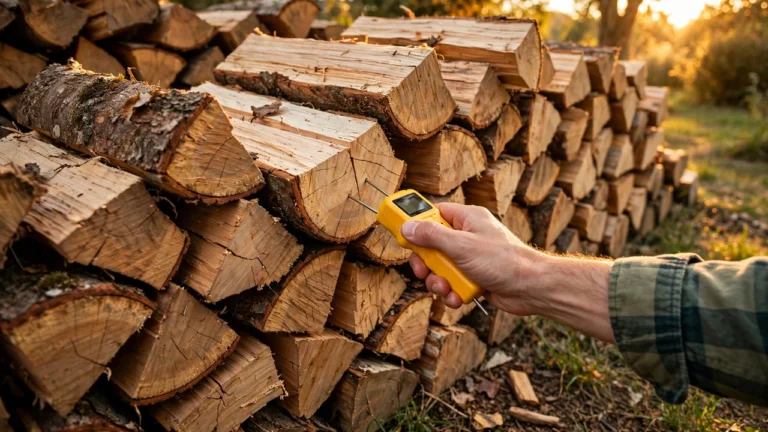
A cord of freshly cut (green) firewood typically weighs 70 to 100 percent more than a cord that has fully seasoned, since green wood can contain almost half its weight in water. The drier the firewood the less fuel value it loses, it simply loses its water weight, hence seasoned wood is easier to carry, lights quicker, and burns better with less creosote in your chimney.
Pro tip: When loading a cord in a pickup truck, you should not think that one truckload = one cord. A hardwood cord of full season at 3,500 to 4,500 pounds is more than most half-ton and even many three-quarter-ton pickups can legally and safely carry in one load. A more realistic single pickup-bed load is a face cord (approximately a third of the weight).
How Many Pieces of Wood Are in a Cord?
A complete cord is approximately 700 to 900 separate pieces when the timber is cut to approximately 18 inches in length. The number varies with piece length and diameter, smaller splits (or thinner rounds) give a higher total number of pieces, larger rounds (or thicker) give fewer.
How to Measure Your Own Cord of Wood (Step-by-Step)
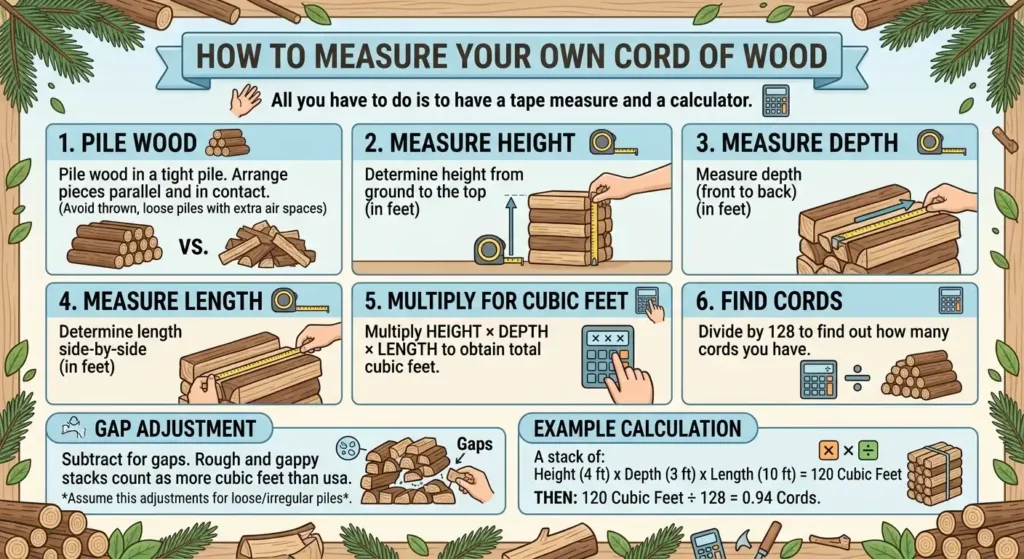
All you have to do is to have a tape measure and a calculator.
- Pile the wood in a pile. Arrange the pieces parallel to one another and place them in contact with each other. Thrown, loose piles are larger than they are due to additional air spaces.
- Determine the height of the stack in feet, ground to top of the pile.
- Measure the depth of the stack (front to back) in feet.
- Determine the length of the stack, side by side, in feet.
- Multiply height, depth, length to obtain total cubic feet.
- Divide by 128 to find out how many cords you have.
- Subtract for gaps. When the stack is unusually loose or irregular, in the head, assume it; a stack that is rough and gappy will be counted as more cubic feet than the actual amount of wood usable in it.
Calculation: A stack of 4 feet high, 3 feet deep, and 10 feet long has a volume of 120 cubic feet, or 0.94 cords, slightly less than a full cord.
How to Avoid Getting Shorted When You Buy Firewood
- Have cubic feet in writing prior to the wood being delivered and not a quote of a price of a cord.
- Request specific piece length when purchasing a face cord or rick, as that single figure can dictate the actual volume.
- Pay after delivery: Before paying in full, measure the delivered stack yourself using the formula above.
- Watch out of truckload pricing. It is not a standardized unit, and may refer to very different volumes to one seller and another.
- Buy locally where possible, and enquire of other local buyers what a reasonable cord price would be in your locality, as there is a wide range in prices depending on the region and supply of wood.
- Check on whether the price includes stacking and delivery as some sellers pile wood loosely, which is larger in volume than a tightly stacked cord but has the same amount of actual wood.
For a fuller walkthrough of what a fair delivery should actually contain, from piece count to how sellers sometimes shortchange the stack, see our complete buying and sizing guide.
How Much Wood Do You Actually Need?
This depends on how you’re using it:
| Use Case | Typical Seasonal Need |
| Occasional weekend fireplace use | 1/2 to 1 face cord |
| Regular fireplace use, a few times a week | 1 to 2 face cords |
| Primary heat source (wood stove) | 3 to 5 full cords |
| Wood-fired outdoor boiler | 5 to 8+ full cords |
These numbers vary with climate, insulation of homes, efficiency of stoves, and wood species, so this is just an approximate figure to use in your household.
Myth vs. Fact
Myth: A cord of wood is always 4 feet by 4 feet by 8 feet.
Fact: Those are just the most common dimensions. Any stack of 128 cubic feet is legally considered a cord, no matter what its shape is.
Myth: A face cord and a full cord are the same thing.
Fact: A face cord is usually one-third the size of a full cord, as it is not a full 4 feet deep, but only a log-length.
Myth: “Rick” is an official measurement.
Fact: Rick is local slang that cannot be defined legally. It’s usually used to mean a face cord, but depth can vary by seller.
Myth: The heavier the load of wood the more firewood.
Fact: Moisture content is a major driving factor in weight. A green cord may weigh a lot more than a seasoned cord of the same species and of the same actual bulk of wood.
FAQs
What is a cord of wood?
A cord of wood is a standard measure of stacked firewood, which is 128 cubic feet. It’s most commonly arranged as a stack 4 feet high, 4 feet deep, and 8 feet long.
What is the number of cubic feet of a cord of wood?
One entire cord is 128 cubic feet of stacked wood.
How many feet of a cord of wood?
The typical size is 4 feet high, 4 feet deep and 8 feet long. Any set of measurements which is multiplied to 128 cubic feet is also considered a cord.
Is a face cord a cord of wood?
No. A face cord is usually one-third the size of a full cord, as it is heaped to the same height (4 feet) and length (8 feet) but only the length of a single log, which is typically about 16 inches.
What’s the difference between a cord and a rick?
A rick is a localism, used in the Midwest and South, which generally refers to the same thing as a face cord: 4 feet by 8 feet by one log-length deep. There is no legal or standard definition of it, and thus depth may vary depending on the seller.
What is the weight of a cord of wood?
An experienced cord usually weighs 2,000-4,500 pounds based on the species. Fresh green wood is 70-100 percent heavier with water.
What is the number of pieces of wood in a cord?
Approximately 700 to 900 pieces when the wood is cut to approximately 18 inches long, but this depends on the length and thickness of pieces.
What is the amount of solid wood in a cord?
Approximately 75 to 90 cubic feet of the 128 cubic feet. The remaining is air between the irregularly shaped pieces.
How can I measure a cord of wood?
Pile the wood up, and measure the height of the pile, the depth, and the length of the pile in feet, and multiply these three things by each other and then divide the result by 128 to obtain the number of cords.
How much is a half cord of wood?
A half cord consists of 64 cubic feet, which is usually piled up in 4 feet high, 2 feet deep, and 8 feet long.
How much is a quarter cord of wood?
A quarter cord equals 32 cubic feet, usually piled in 4 feet high, 1 foot deep, 8 feet long.
Why are the prices of cord of wood so different among sellers?
Prices are species, moisture content, split or rounds, distance to delivery, local demand, and whether you are purchasing a full cord or face cord or rick at a different price per cubic foot.
Is it possible to stack a cord of wood in any other shape than 4x4x8?
Yes. As a cord is a measure of volume, any stack that contains 128 cubic feet is eligible, no matter what its height, depth or length are.
How much wood will I require to get me through winter?
It depends on use. Fireplace use may only require half to one face cord each season, whereas a home with a wood stove as the main heating system may require 3 to 5 full cords.
Is it a law to purchase firewood in cords?
Yes, in the majority of states of the U.S. Offering firewood in defined or misleading units rather than in cords or in stated cubic footage may be a violation of state weights-and-measures laws.
Key Takeaways
- A full cord of wood is 4 ft x 4 ft x 8 ft or 128 cubic feet and is the only legally standard unit of firewood in most states in the U.S.
- A stack of wood of 128 cubic feet is a cord, irrespective of its shape.
- A cord will have about 75 to 90 cubic feet of solid wood; the remainder is natural air space between pieces.
- A face cord (or rick) is usually one-third of a full cord, depending on a standard depth of 16 inches, but that is not a legally determined depth.
- Experienced cord weight is about 2,000-4,500 pounds, species-dependent; green wood is 70-100 percent heavier.
- Never purchase cubic feet and piece length orally or you will be shortchanged.
Final Thoughts
The lengths of the pieces of wood behind a cord are not difficult to measure when reduced: 128 cubic feet, most usually piled up 4 feet high, 4 feet deep, and 8 feet long. The problem is not the cord itself, it is the unchecked conditions that are sold to accompany it such as face cord, rick and truckload that may appear the same as a full cord but with a fraction of the wood.
The fix is simple. Request cubic footage in writing, verify the length of the piece when purchasing a face cord, and check the delivered before you deem the transaction complete. All you have to know is the price of the item you are purchasing is known by measuring it with a tape measure and using the formula in this guide.