Are Electric Fireplaces Worth It? An Honest Answer
You’re scrolling through electric fireplaces online and asking one question: are electric fireplaces worth it? I understand the hesitation. They promise cozy flames with zero chimney work, and the price tags look tempting. But is this a real heater or an expensive decoration?
Here is the short answer: for the right home, yes. An electric fireplace can be one of the smartest buys in home heating. For the wrong home, it becomes a glowing ornament that never quite warms the room. This guide walks through the real costs, the real heat output, the honest pros and cons, and exactly who should buy one.
One quick safety note before we start: most plug-in models draw up to 1,500 watts — that is a serious heater, not a night-light. A few electrical safety rules apply, and I’ll spell them out below.
The Short Answer
Worth it if…
You rent or live in an apartment. You want one warm room, not a whole house. You love the look of flames without wood, ash, or a chimney.
Think twice if…
You need to heat a big open space. Your power goes out often in winter. You mostly want the feel of a real wood fire.
Skip it if…
You’re shopping for your home’s main heat source. You need heat during power outages. The room has no outlet where the unit would go.
What It Costs to Run: Do the 30-Second Math
Running cost is the number one thing buyers get wrong. They guess. You don’t have to guess — the math takes half a minute. Grab your electric bill first, because your rate per kilowatt-hour is the key number.
Your 30-Second Cost Formula
Watts ÷ 1,000 × hours × your rate per kWh = cost
Example: 1,500 W ÷ 1,000 = 1.5 kW. Run it 3 hours: 1.5 × 3 = 4.5 kWh. At 15¢ per kWh, that’s about 68¢. Flame-only mode (no heat) uses a few watts — pennies.
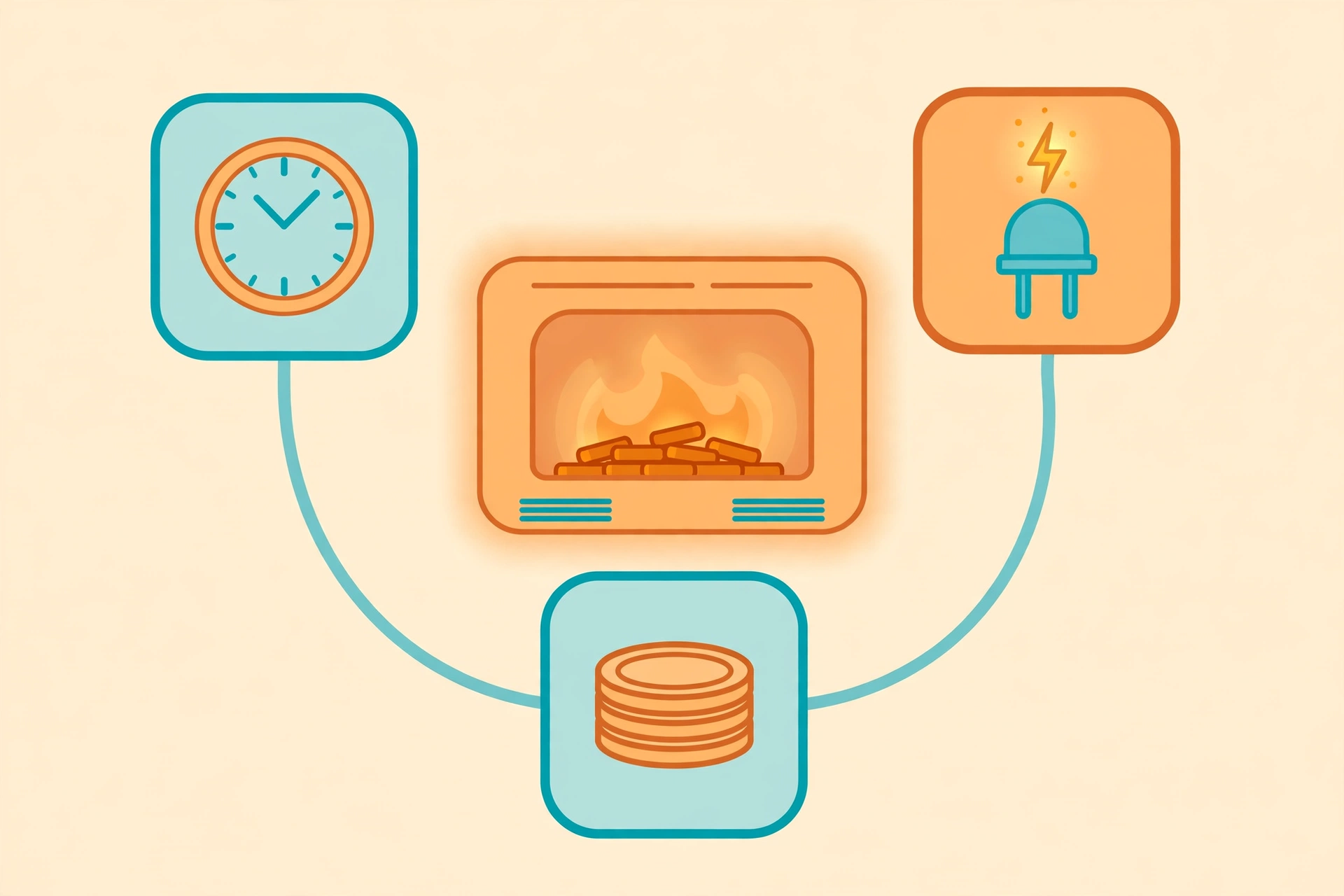
Two things make this number friendly. First, you usually run the heater a few hours in the evening, not all day. Second, flame-only mode costs almost nothing — you can enjoy the glow all year without touching the heater.
Compare that to the upfront cost of an electric fireplace: many basic plug-in models cost less than a single month of some heating bills, and there is no chimney, venting, or professional installation to pay for.
What Electric Fireplaces Get Right
Real heat for one room. Most plug-in models put out up to 1,500 watts, which works out to roughly 5,100 BTU per hour. Many brands say that’s enough for spaces up to around 400 square feet. Your room size and insulation decide the truth of that — check your manual’s rating for your space.
Zone heating that can save money. Warm the room you’re actually in and turn the main thermostat down a few degrees. Heating one room with electricity while the furnace rests can trim your overall bill, especially in shoulder seasons. Here’s how electric fireplace efficiency works in practice.
No chimney, no vent, no ash. There is nothing to sweep, no creosote, no wood to haul, no embers to babysit. Renters and condo owners finally get a fireplace. Here’s how the heat and flame effects actually work inside the unit.
Ambiance on demand. Flame-only mode gives you the glow without the heat. Movie night in July? Go ahead. Try that with a wood stove.
Simple setup for most models. Wall-mount and freestanding plug-in units hang or stand where you want them, then plug into a standard outlet. Built-in models are a bigger project — see how to install an electric fireplace before you buy one.
⚠ Heads Up: Treat It Like the Heater It Is
A 1,500-watt heater pulls serious current. Plug it directly into a wall outlet — skip extension cords and most power strips, which can overheat. Keep at least 3 feet of clear space in front of the unit (check your manual for exact clearances), and never leave it running unattended or while you sleep.
If your breaker trips when the fireplace runs, don’t keep flipping it back on. That circuit may be shared with other heavy loads. Have an electrician check it before you run the unit again.
Where They Fall Short
Limited heat output. 1,500 watts is a hard ceiling on a standard outlet. It warms a bedroom or living room. It will not heat a whole house, and a big open-plan space with high ceilings will barely notice it.
Useless in a power outage. No electricity, no flames, no heat. If winter storms knock out your power, an electric fireplace gives you nothing. It is not backup heat.
Running costs add up with heavy use. A few hours each evening is cheap. Running the heater all day, every day, as your main heat will show up on your bill. This is a zone heater, not a furnace replacement.
The flames aren’t real. Modern LED flames look surprisingly good, but they are still light on a screen. If you want crackling wood, real embers, and the smell of a fire, no electric unit will satisfy you.

When an Electric Fireplace IS Worth It
You rent or live in an apartment. No landlord is letting you cut a chimney through the roof. A plug-in unit gives you a fireplace with zero permanent changes — you take it with you when you move.
You want to zone-heat one room. If you spend evenings in the living room, heat that room and let the rest of the house sit cooler. That’s the use case where electric fireplaces shine brightest.
You love the look, not the labor. Flames at the push of a button, off with another push. No splitting, stacking, hauling, or cleaning. For busy households, that convenience is the whole point.
Your home has no chimney. Newer builds, condos, and homes in warm climates often have no flue at all. An electric unit is the only fireplace option that needs nothing but an outlet.
Small bedrooms and home offices. A chilly office or a bedroom that never quite warms up is the perfect-sized job for 1,500 watts of focused heat.
When It’s Probably NOT Worth It
You need whole-home or primary heat. One room is the limit. If this purchase is supposed to replace your furnace or heat pump, save your money — it can’t.
Your power goes out every winter. Storm-prone areas need heat that works without the grid. An electric fireplace goes dark exactly when you’d need it most.
The room is huge and drafty. Great rooms, vaulted ceilings, and poor insulation eat 1,500 watts for breakfast. You’d feel a faint warmth near the unit and cold everywhere else.
You want a real fire experience. Be honest with yourself here. If the goal is wood smoke, crackle, and glowing embers, compare your fuel options instead — start with gas vs. electric fireplace to see which trade-offs matter to you.
How Long Do They Really Last?
There is no chimney to sweep and no ash to shovel, so maintenance is light. LED flame effects last a very long time, and many heater elements and bulbs are replaceable when they wear out. The most common “repair” owners do is dusting the vents so airflow stays strong.
Keep the manual. When something eventually needs a part, the model number on that manual is what gets you the right replacement. For the full breakdown, see what an electric fireplace’s lifespan really looks like.
Frequently Asked Questions
Do electric fireplaces actually heat a room?
Yes. Most plug-in models produce up to 1,500 watts (about 5,100 BTU per hour) of supplemental heat, which suits one room. They are not whole-home heaters.
Are electric fireplaces expensive to run?
Not for typical evening use. The heater draws up to 1.5 kW, so your cost is 1.5 × hours × your electricity rate. Flame-only mode uses a few watts and costs almost nothing.
Are electric fireplaces safe to leave on?
Never leave one running unattended or while you sleep. Plug it directly into a wall outlet, keep combustibles at least 3 feet away, and follow your manual’s clearance rules.
Do electric fireplaces work during a power outage?
No. They need electricity for both the flames and the heat, so they can’t serve as backup heat when the power is out.
Should I get an electric fireplace or a space heater?
Heat output is similar — most of both top out around 1,500 watts. Choose the electric fireplace if you want the look and feel of a fireplace; choose a plain space heater if you only care about warmth and the lowest price.
How long do electric fireplaces last?
With light maintenance — dusting vents and replacing worn bulbs or heater elements — they serve for many years. There is no chimney or ash system to wear out.
Quick Reference Card
Heat: up to ~1,500 W (~5,100 BTU/hr) — one room, not a house
Cost math: 1.5 kW × hours × your rate = cost (flame-only = pennies)
Best for: renters, zone heating, ambiance, no-chimney homes, small rooms
Skip if: primary heat needed, frequent outages, huge drafty rooms
Safety: wall outlet only, 3 ft clearance, never unattended, check the manual
So, are electric fireplaces worth it? If you want affordable, on-demand warmth and glow for one room — especially as a renter or in a home with no chimney — the answer is a confident yes. If you need serious whole-home heat or warmth during outages, look elsewhere.
If the price is your last question, start with how much an electric fireplace costs to buy, then run the 30-second math above with your own electric rate. You’ll know in minutes whether this purchase makes sense for your home.