Can You Put an Electric Fireplace in a Cabinet? A full Safety Guide & 7 Essential Tips
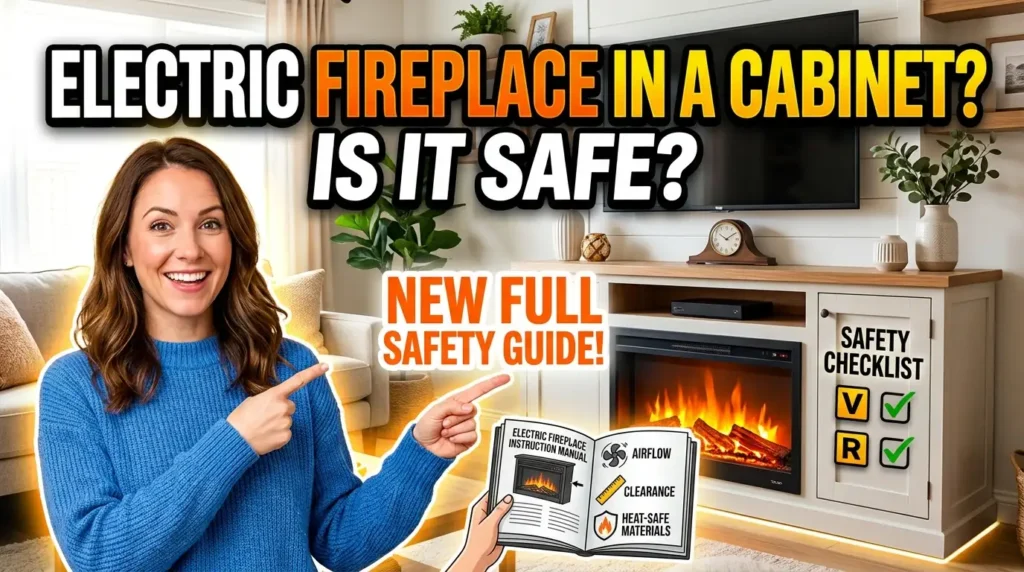
Can You Put an Electric Fireplace in a Cabinet? Yes, an electric fireplace can be installed in a cabinet provided the cabinet provides the insert with airflow, clearance and heat safe materials as its manual dictates. But they do produce actual heat by way of a resistive or infrared element and that heat must be dissipated. It can be warped, discolored, or in extreme instances a fire hazard in a cabinet that traps it, or that is made of the wrong materials.
One of the most common methods of introducing the ambiance of a fireplace to a room with no chimney whatsoever is by having a cabinet built to specification.
This guide explains what it really means to be safe in practice: clearances that manufacturers need, which type of cabinet material supports, what a build will cost, and what blunders are likely to bring most new DIYers to their knees.
Why This Question Comes Up So Often

The majority of the homeowners who pose this question are not new to the electric fireplace insert – they have already purchased (or are considering purchasing) an electric fireplace insert and are now wondering where it can fit in a room that has neither a chimney, nor any masonry, nor an existing fireplace opening. That issue can be resolved with a cabinet: it provides a completed frame to the fireplace, doubles as storage or a TV stand, and can be placed virtually anywhere there is an outlet.
The reluctance is typically regarding warmth – individuals envision the open fire in a fireplace and think that the same risk of fire can be present. It does not, yet the element within an electric insert is a real appliance, and the issue of considering the cabinet as mere furniture is where all the trouble begins.
Quick Facts
- Electric fireplace inserts are vent-free – no chimney, gas or flue is needed.
- Majority of manufacturers need about 1 inch of space on the sides and the back and 3 feet of open space at the front, but it depends on the model.
- An open front is not a ventilation cutout that is required by the cabinet – heat requires an outlet and, on some models, a small fan must be ventilated.
- The most common safety error is a completely sealed and airtight cabinet.
- You can spend about $150-600 on a DIY build of a cabinet or buy an electric fireplace cabinet pre-assembled in a factory (800-2500 and up).
Key Takeaways
- It is safe and common to install an electric fireplace in a cabinet – provided that the cabinet is constructed or purchased to accommodate the clearance and ventilation needs of the insert.
- The installation manual of the insert itself is the last word on clearances, and not on the rules of thumb.
The most frequent (and preventable) error is a sealed, airtight cabinet that does not have airflow. - Ready-made cabinets cut out the trial-and-error; self-assembled cabinets are cheaper, but need to be assembled to the manual.
- To be on the safe side of wiring, a dedicated circuit, or a local code, hire a licensed electrician to do that portion of the work.
You can use the spec sheet of the fireplace insert as your starting point when planning your build and then design or shop the cabinet based on those values, but not vice versa.
What Does “Putting an Electric Fireplace in a Cabinet” Actually Mean?
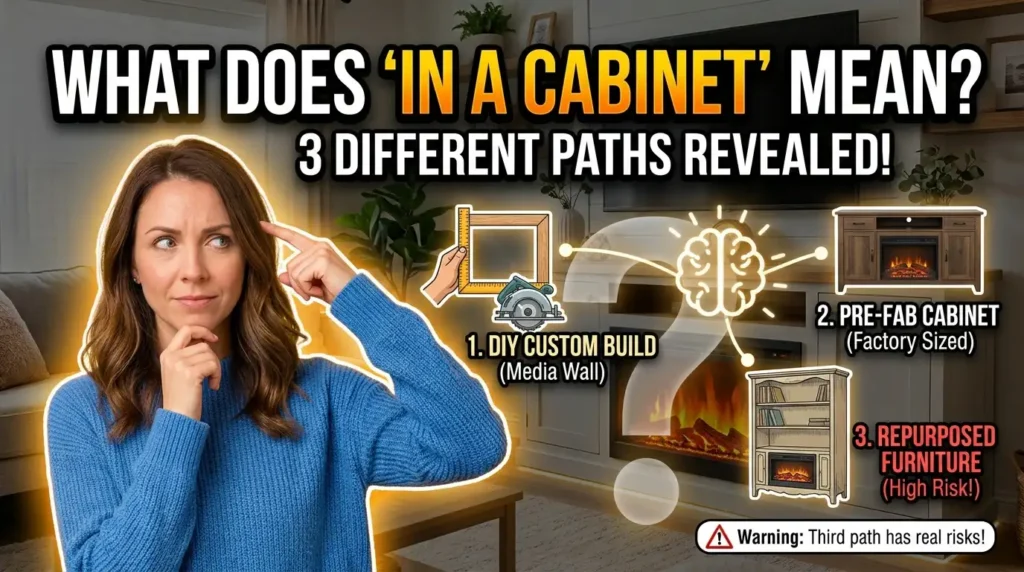
People have three different projects in mind when they pose this question, and they have varied rules:
- Making your own cabinet around a recessed or built-in insert – the DIY path, which is often used when woodworkers are creating a media console, room divider, or accent wall feature.
- Purchasing a pre-fabricated electric fireplace cabinet – a ready-made (such as the ones offered by Stoll Industries or Touchstone), pre-sized and pre-vented to fit a particular insert.
- Installing a freestanding or insert-type unit within a pre-existing piece of furniture – sliding a fireplace insert into a bookshelf, credenza, or old TV cabinet that is not built in.
The initial two are not usually hazardous provided they are carried out to specifications. The third one carries the majority of the actual risk as existing furniture was never designed with a heat source in consideration.
The Real Answer: What Determines Safety
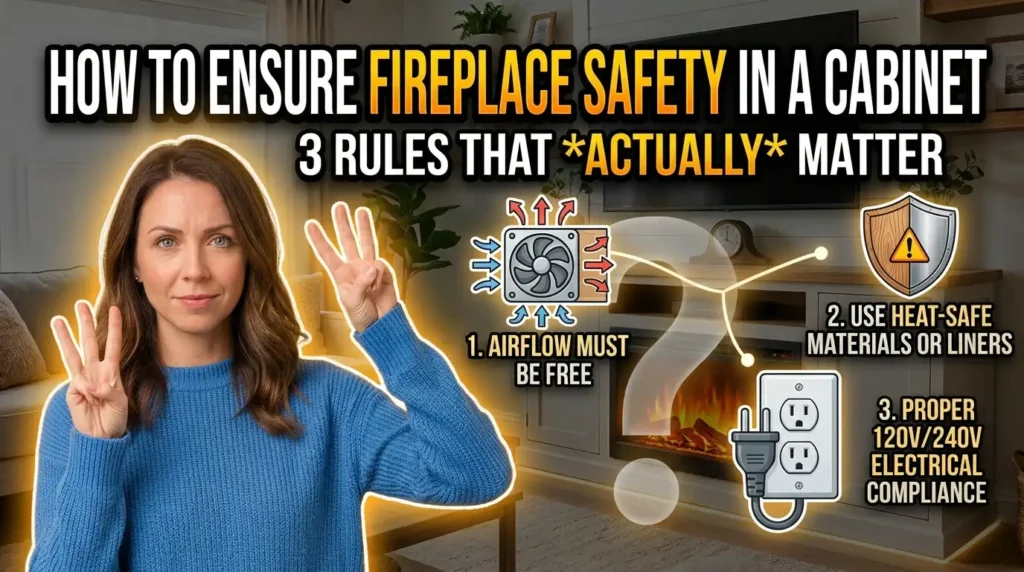
Each electric fireplace insert includes an installation manual, which specifies clearance and cutout specifications of each particular model. Those numbers are different, yet there are three considerations in each instance:
- Airflow. The insert draws air at room temperature, heats it and expels it. With that airflow obstructed, internal temperatures can rise and the thermal safety switch of the unit can be continuously switched off – or, in a sloppily assembled enclosure, the heat can accumulate around the wiring and trim.
- Material. Wood, MDF, and laminate are flammable and may discolor, warp or crack when too near the heating element too long. Cabinets should be designed with additional clearance, or a heat-resistant lining (metal, cement board, or an approved shield designed by the manufacturer) along the opening of the firebox.
- Electrical compliance. The majority of residential inserts operate on a typical 120 V, 15 amp circuit; higher power inserts require a special 240 V circuit. Using an overloaded plug or placing a damaged extension cord in a cabinet are both fire hazards regardless of the cabinet.
It Also Depends on the Type of Insert
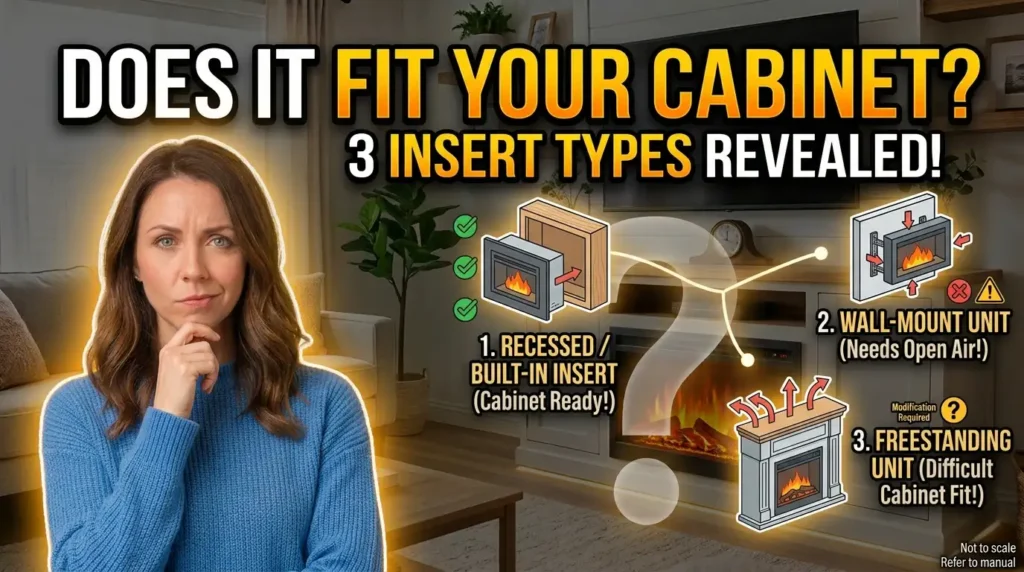
Not all electric fireplaces are constructed identically, and the kind you have will alter the manner in which it ought to be positioned within a cabinet:
- Recessed / built-in inserts These are specifically created to be enclosed on all sides, rear and top by framing these are the intended match to a cabinet project, as their clearance charts already assume an enclosed installation.
- Wall-mount units are intended to be hung on a flat surface and have empty air in front of them and are not intended to be enclosed on all sides.
- Freestanding/mantel-style units are designed to be a free-standing unit placed in an empty area; when installed in a cabinet, this affects the air draw and release characteristics of the unit, and thus it is the type that is most likely to require actual modification before becoming cabinet friendly.
It is more important to know in what type your cabinet has to be in, and to correlate that with the degree of enclosure of the cabinet design, than it is to the exterior appearance or finish of the cabinet.
Clearance Requirements at a Glance
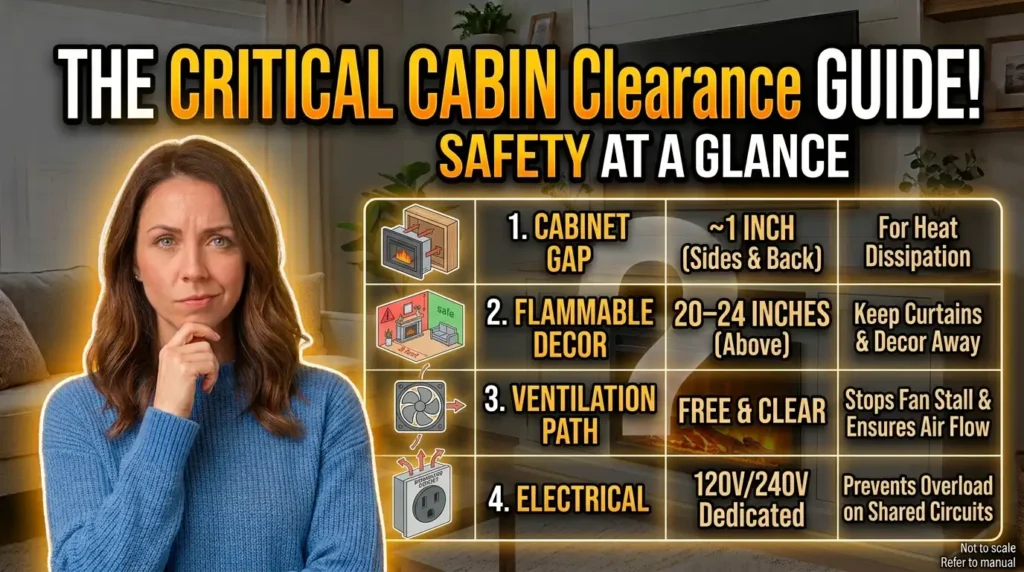
Always consult the manual of your particular model. it is not a general rule, but a range.
| Requirement | Typical Minimum | Reason It Is Important |
| Sides and back of the insert to the wall of the cabinet | ~1 inch | Lets heat dissipate rather than pooling against wood. |
| Above the firebox opening to flammable decor | 20–24 inches | Keeps dry mantels, garlands, and stockings out of the heat path. |
| Clearance in front of the unit | 3 feet | Keeps furniture, curtains, and people away from the direct heat vent. |
| Below/behind to allow airflow | Free, clear vent path | Stops the internal fan or convection loop from stalling. |
| Power supply | Dedicated 15A (120V) or 240V circuit | Prevents overloaded wiring and nuisance circuit breaker trips. |
Step-by-Step: Building or Buying a Safe Electric Fireplace Cabinet
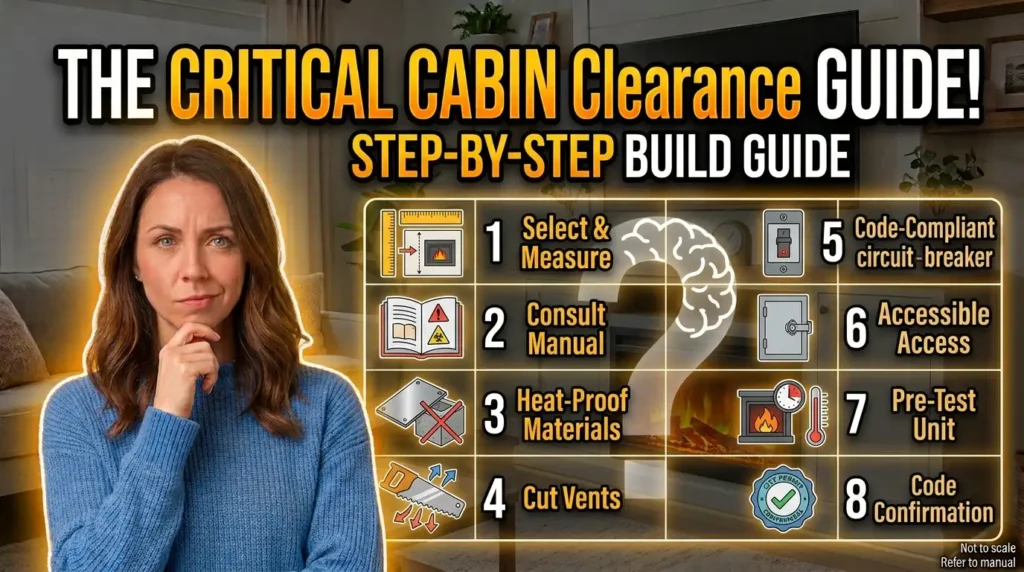
- Select insert then design cabinet around it. Each insert is rough-opening-dimensioned and clearance-charted separately – the most frequent planning error is to construct the cabinet without having purchased the fireplace.
- Read through installation manual page by page. This is the document that supersedes any general advice including this article. Particularly look at the rough-opening size, minimum clearances along all sides, any necessary vent cutout size, and the electrical requirements (voltage, amperage, is a dedicated circuit needed).
- Use heat-resistant materials around the opening. Solid wood and MDF are okay at the necessary clearance distance; and in tight constructions, line the inside close to the firebox with cement board or a metal liner.
- Cut ventilation openings not an open front. A large number of inserts require a rear or top vent cutout to allow warm air to escape rather than to be recirculated within the box.
- Install power properly. Run a dedicated circuit or code-compliant outlet into the cavity of the cabinet never run power strips on a daisy-chain or run a cord under the trim where it can be pinched.
- Keep the top and back accessible. You will need to access the unit to replace the bulb, LED or control-board in future; do not permanently cover it.
- Pre-test before final assembly. Turn the fireplace on to a high setting and then leave it on at least 30-60 minutes with the cabinet completely together (but not trimmed/painted) and inspect surrounding surfaces to ensure they are not too hot or discolored.
- Confirm local code, where necessary. Fully built-in electrical work may sometimes need a permit or inspection, particularly when adding a new circuit – check with your local building department.
Cabinet Materials: What Holds Up Near an Electric Fireplace
| Material | Heat Tolerance | Best Use | Notes |
| Solid wood | Moderate | Framing, exterior panels | Fine at the correct clearance; may dry out/crack during years of cyclical heat. |
| MDF/particleboard | Low-moderate | Non-facing panels, shelving | Keep well away from the firebox opening; laminate will bubble up when too close. |
| Cement board / Metal liner | Very high | Interior liner behind/around firebox | A common solution to tight-clearance construction. Sheet metal liners are used in factory cabinets (such as Stoll cabinets). |
| Stone/tile veneer | Extremely high | Decorative surround | Heavy—ensure the cabinet framing is capable of supporting the weight. |
DIY Build vs. Factory Cabinet vs. Repurposed Furniture
| Option | Typical Cost | Safety & Code Compliance | Skill Needed | Customization | Best For |
| DIY Custom Build | $150–$600 (materials) | High, provided you follow the manufacturer’s clearance manual | Moderate woodworking | Complete control of size and finish | Woodworkers who have a specific insert in hand |
| Factory Electric Fireplace Cabinet | $800–$2,500+ | Highest—engineered specifically for heat dissipation and standard inserts | None (only basic assembly) | Limited to manufacturer models and finishes | Buyers who desire a polished look with zero guesswork |
| Repurposed Furniture | $0–$150 (plus modifications) | Lowest—not originally engineered for heating units | Low to moderate (requires structural modifications) | Dependent on the existing piece of furniture | Budget builds, but requires proper ventilation retrofits; proceed with caution |
Common Mistakes People Make
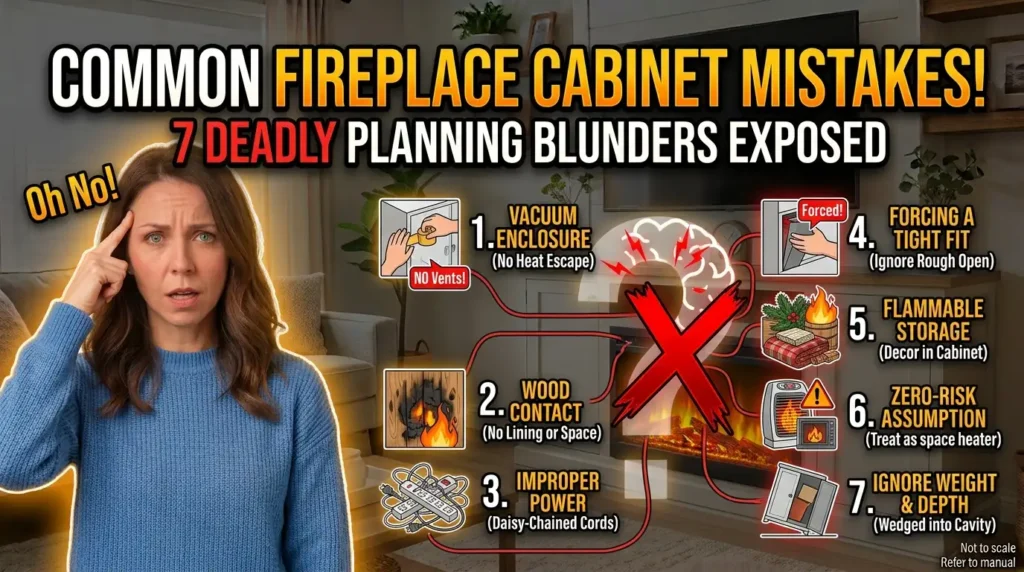
- Close the cabinet like a vacuum, even around a mounted television, therefore there is no place where heat can escape.
- Inserting the insert against a wood back panel without any liner or space.
- Extension cord or power strip in lieu of a proper outlet run to code.
- Skipping the size of the opening of the manual by roughly a quarter inch and forcing a slightly-too-large insert into the aperture.
- Storing flammable objects (blankets, decor, holiday greenery) in the same cabinet or inside it.
- Supposing electric is zero risk. Electric fireplaces are much less risky than wood or gas, but still, the heating component deserves the same respect as any space heater.
- Disregarding the weight and depth of the insert when fitting the cabinet cavity, resulting in a unit that can be forced into the cavity so wedged that not a single clearance is available.
Limitations of This Guide
Clearance numbers, circuit needs and even the necessity of venting at all can differ significantly among brands and models – the values given in this article are not universal. No national statistic exists as to the frequency of the occurrence of incidents involving cabinet-mounted electric fireplaces and, as such, no specific risk numbers are quoted here; general fire-safety organizations, such as the National Fire Protection Association and the Consumer Product Safety Commission, do publish general heater-safety statistics that you may wish to review to provide that background, however. Nothing on this site replaces your particular unit installation manual, or a licensed electrician, in the case of wiring.
Cost Breakdown
| Item | Estimated Cost |
| Mid-size electric fireplace insert | $300–$900 |
| Plywood/MDF/hardware for a DIY cabinet | $100–$400 |
| Cement board or metal liner | $30–$120 |
| Dedicated electrical circuit (if needed, professional install) | $150–$400 |
| Factory-built electric fireplace cabinet (complete) | $800–$2,500+ |
These are market estimates of the U.S. market in general and will be different depending on the region, insert size and finish – always take a local quote on electrical work.
Expert Tips
- Purchase fireplace insert prior to determining cabinet dimensions – manuals contain precise rough-opening tolerances, and close is never good.
- Test-fitting With the unit unplugged first, make sure that the unit fits in the existing furniture before dedicating time to permanent changes.
- Find a UL, ETL or CSA listing on any insert – this assures that the unit has been independently tested regarding its safety as residential use.
- In case the cabinet will also contain a TV, do not stuff the heat vent of the fireplace with the lower edge of the TV: the persistent exposure to heat may reduce the life of a screen.
- Tag any special fireplace circuit breaker after the electrical installation is completed it is a lot quicker to troubleshoot or service later.
- store somewhere (on or near) your insert manual (or a photo of it) after the cabinet is completed because you will almost certainly need the clearance and wiring specifications again in the event you ever change location or size of the piece.
Cabinet Placement: Where It Works Best in a Room
Oh, and where the completed cabinet is depends nearly as much as is the method of its construction. Some of the placement notes that should be considered prior to the finalization of a floor plan:
- On an interior wall is typically the easiest, as it sets the cabinet out of the exterior-wall drafts and provides you with convenient access to an existing outlet.
- As a room divider or a two-sided item – the type of construction Jon Peters and company, Touchstone project, uses is a good choice when you want a fireplace to feel on both sides, but doubles the ventilation planning as you need heat to leave both sides.
- Below or even next to a mounted television is typical, though provide ample vertical or horizontal distance so that the heat vent does not blow directly against the screen during hours at a time.
- Finished basement or bedroom Electric is often the only feasible choice as there is no chimney to tap into, and merely ensure the room has sufficient outlets to support the amperage of the unit.
You May Also Read:
- What Does Green Fire Mean? 7 Crucial Facts & Safety Tips
- Do You Need a Fireplace Screen?5 Essential Safety Benefits Explained
FAQs:
Is it possible to install an electric fireplace insert in any cabinet?
It is only when you alter it to fit the clearance of the insert, the ventilation, and material needs, that a stock cabinet as-is is not designed to accommodate a source of heat.
Do electric fireplaces require a cabinet to be ventilated?
Yes. They do not require a chimney, although the cabinet requires clear airflow channels, without any heat being confined around the unit.
What is the distance that an electric fireplace must maintain between wood?
It varies with the model, but about 1 inch on the sides/back and 3 feet in front of the heat vent is standard – refer to your manual as to specifics.
Is an electric fireplace a potential cause of a house fire?
It is infrequent, and much less probable than with wood or gas units, but clearance, frayed cords, or air obstruction may nonetheless lead to a hazard.
Would it be safe to install an electric fireplace under a television in a cabinet?
Yes, often, when the heat vent is directed away on the TV or there is adequate clearance up and down the side of the fireplace – see the instructions of the fireplace and TV manufacturers.
Can I make my own electric fireplace cabinet?
Yes, it is a typical DIY project; the trick is to design it by working out the manual of the particular insert, and not by taking a series of guesses at sizes.
Are electric fireplaces to be connected to a special electrical circuit?
To operate, smaller units may only need an existing 15-amp circuit; larger or 240 V units will often require a dedicated circuit – see the spec sheet.
What can be placed around an electric fireplace insert that is safe?
Solid wood and MDF are fine at the proper clearance; cement board or metal liners are used when clearance is tight.
Will an electric fireplace insert fit into a bookshelf?
It can only be changed in real; most bookshelves have no airflow and heat-safe backing an insert requires; modify them and then install.