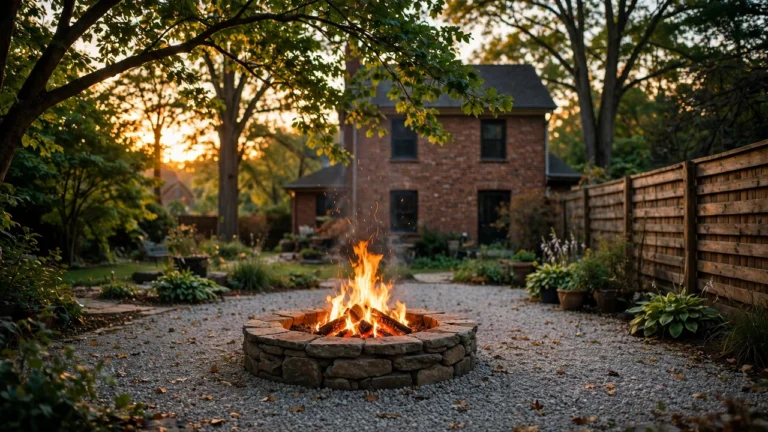
Propane vs Natural Gas Fire Pits: How to Pick the Right Fuel for Your Backyard
You have picked the fire pit. Maybe it is a round bowl for the patio, or a built-in stone ring for the yard. Then the fuel question hits, and it feels bigger than it should: propane vs natural gas fire pits — which is better? The answer is not the same for every home, because the two fuels are built for different lives. Propane runs on a portable tank you can buy almost anywhere. Natural gas runs on a fixed line tied to your house, so the flame never dies from an empty tank. This guide walks you through six short checks so you can pick the fuel that fits your home, your budget, and how you actually spend your evenings.
By the end, you will know which fuel wins for your situation, what each one really costs to run, and how to place and run your fire pit safely. There is no wrong answer here — only the fuel that matches your yard. A quick safety note before we start: both fuels are flammable gases and both give off carbon monoxide, so gas fire pits are for outdoor use only. If you ever smell gas, leave the area and call your gas company or emergency services from outside. Never hunt for a leak yourself, and leave all gas line work to a licensed professional.
- A tape measure
- Your last gas bill, or your gas company’s phone number
- The measurements of your patio or the yard spot where the pit will sit
- A photo of that spot, taken from a few steps back
- A rough budget range — what you can spend now, and per month on fuel
- Check what fuel your home already has
- Compare the real upfront costs
- Compare what each fire actually costs you
- Weigh flame quality when comparing propane vs natural gas fire pits
- Match the fuel to your lifestyle
- Place and run your fire pit safely
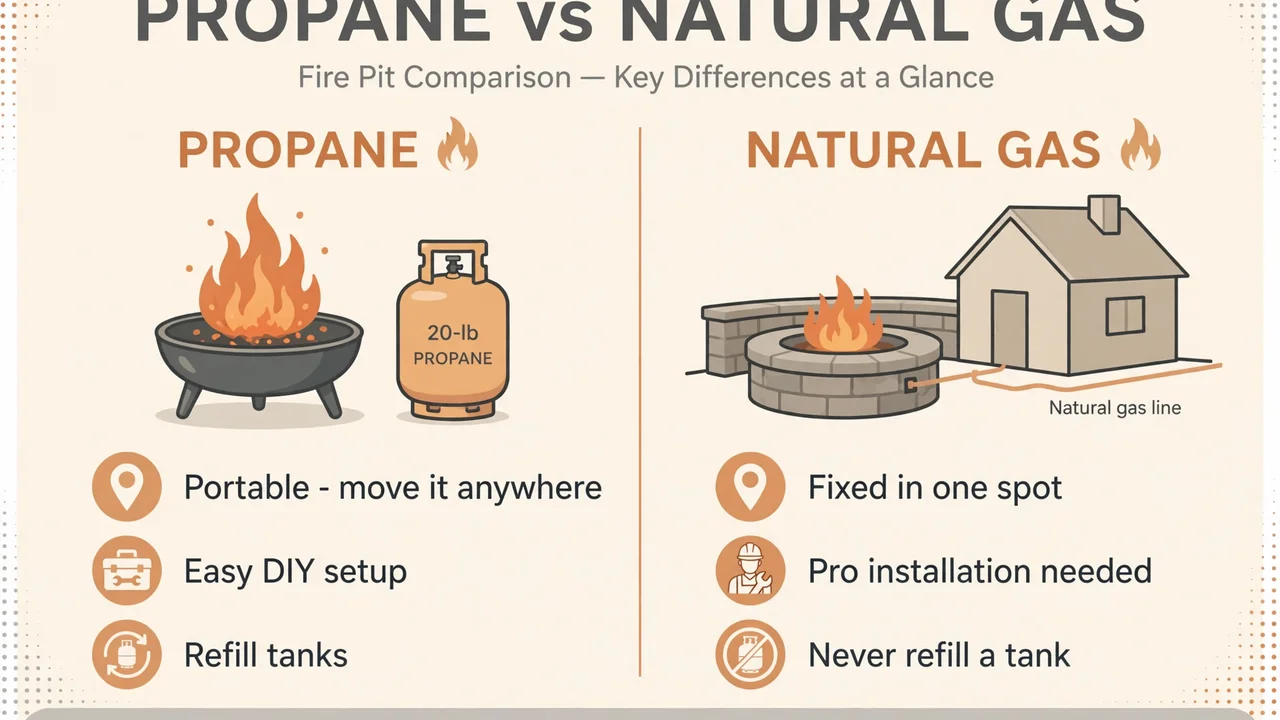
Pick propane if you want a portable fire pit you can set up yourself and move whenever you like — you will refill or swap tanks as they run out. Pick natural gas if you have a gas line near your patio and want a permanent fire feature that never needs a tank. Propane wins on flexibility. Natural gas wins on convenience.
Check What Fuel Your Home Already Has
Walk to your patio and look for a gas line stub or a gas grill hookup nearby. If your home already runs on natural gas and a line sits within a few feet of where the fire pit will go, natural gas is the path of least resistance. A licensed pro can tie into that line and give you an endless fuel supply.
No gas line in sight? Propane is the natural fit. You buy a standard 20-pound tank — the same kind used for gas grills — connect it, and you are burning in minutes. If natural gas service is not available on your street at all, propane is your only gas option.
Compare the Real Upfront Costs
Propane keeps day-one costs low. The fire pit itself is the main purchase; after that, a tank and a fill are all you need to start. There is no trenching, no permit paperwork, and no installer visit.
Natural gas asks more of your wallet up front. A licensed professional has to run a gas line to the fire pit spot, which can mean digging a trench, pulling a permit, and pressure-testing the line. That labor varies a lot from home to home — a short run across an open yard costs far less than a long run under a finished patio — so collect two or three quotes before you decide.
Over time, the math often flips. Natural gas usually costs less per hour of burning than propane, so heavy users can earn back the install cost across a few seasons. Occasional users rarely burn enough to close that gap. If you are still shopping for the pit itself, our fire pit buying guide covers the styles and sizes first.
Compare What Each Fire Actually Costs You
Fuel cost per hour depends on your local rates, which move around by region and season. The pattern holds steady, though: natural gas typically burns cheaper per hour, while propane costs more per hour because you are buying fuel in tanks, not through a pipe.
With propane, the question becomes how often you refill. A standard 20-pound tank gives roughly 4 to 4.5 hours of burn at full flame, or about 8 to 9 hours on a moderate setting. Two or three long evenings a week adds up to real tank money over a summer — see our full breakdown of how long a propane tank lasts on a fire pit for the details.
Keep a second full propane tank on hand. Tanks always run out mid-party, never mid-week. A spare tank costs far less than the drive to the store while guests sit around a dead fire pit.
Weigh Flame Quality When Comparing Propane vs Natural Gas Fire Pits
Propane packs more energy per unit of fuel — about 91,500 BTU per gallon of propane versus roughly 1,030 BTU per cubic foot of natural gas. In practice, that means propane flames tend to burn brighter and bolder, with a flame that reads well even in daylight.
Natural gas burns softer and steadier, with a classic yellow flame that looks right at home in a built-in stone pit. Here is the part most shoppers miss: real heat depends on the fire pit’s BTU rating, not on the fuel alone. A 60,000 BTU natural gas burner warms more than a 30,000 BTU propane one, no matter what the fuel label says.
So compare the BTU ratings on the actual models you are considering. Flame looks are a preference; warmth is a number. Both fuels give you real flame and real heat, and both can carry an evening on the patio.
Match the Fuel to Your Lifestyle
Renters, movers, and serial patio-rearrangers belong with propane. You can take the fire pit to your next home, shift it to follow the shade, or pack it for a tailgate. Nothing is bolted down, and nothing requires your landlord’s permission beyond the usual fire rules.
Homeowners who are staying put and burn often belong with natural gas. The pit stays where it is, the flame starts with a switch or a match, and nobody ever hauls a tank. If you host weekly, burn through most of the summer, or want a built-in look that lifts the whole yard, natural gas pays you back in ease.
Never burn the wrong fuel in your fire pit. A burner built for natural gas cannot safely run on propane, and a propane burner cannot safely run on natural gas — the orifices and pressure settings are different. Buy the version built for your fuel, or a conversion kit that the manufacturer lists for your exact model.
Place and Run Your Fire Pit Safely
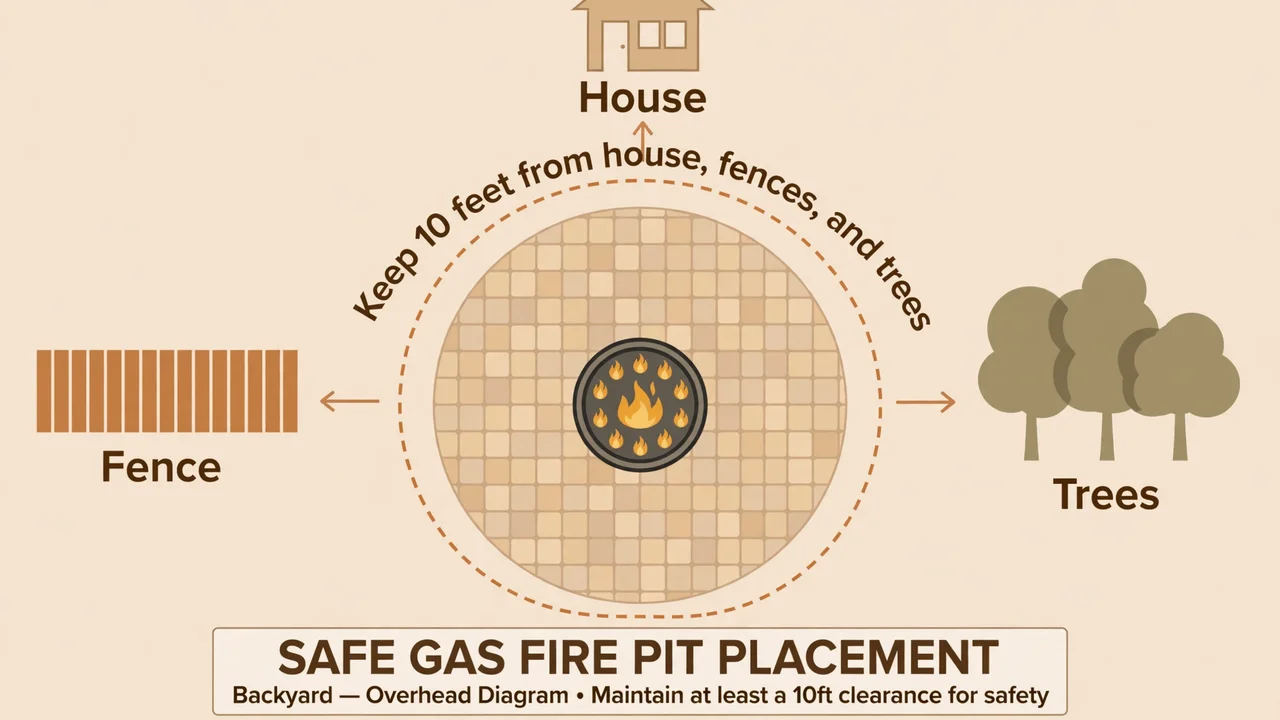
Set your fire pit on a flat, non-combustible surface — pavers, concrete, or gravel — and keep at least 10 feet of clear space between the flames and your house, fences, and tree branches. That 10-foot rule is the common minimum; your fire pit’s manual may ask for more, and its manual wins. Our fire pit clearance rules go deeper if your yard is tight.
Before the first burn, check whether backyard fire pits are legal where you live — some cities restrict open flames, require permits, or set burn hours. Keep a fire extinguisher or a hose within reach, never leave the flames alone, and let everything cool fully before you cover it.
Both fuels need outdoor air. Never run a gas fire pit indoors, in a garage, or on a fully enclosed porch — the carbon monoxide is odorless and dangerous. If you ever smell gas (it is added to smell like rotten eggs), do not light anything and do not look for the leak. Leave the area and call your gas company or emergency services from outside. The U.S. Consumer Product Safety Commission (cpsc.gov) publishes more guidance on safe gas use at home.
- Buying the wrong-fuel model. A propane pit and a natural gas pit look identical on the shelf. Read the label twice — the fuel is printed on the box and the rating plate.
- Skipping the clearance check. Squeezing a fire pit under a low covered patio or against a fence invites heat damage and worse. Measure first, burn second.
- Storing a propane tank indoors. Spare tanks live upright, outdoors, in the shade. Never in a garage, basement, or hot car trunk.
- Assuming fire pits are legal everywhere. Local rules change by city and by season. One call to your city office or a check of your local fire department’s site takes five minutes.
Frequently Asked Questions
Can I convert a propane fire pit to natural gas?
Not by swapping a hose. Burners and orifices are fuel-specific, so a safe conversion needs a kit the manufacturer lists for your exact model — otherwise, buy the unit built for your fuel.
Which fuel costs less to run?
Natural gas usually costs less per hour of burning where it is available. Propane costs more per hour, but needs no gas line installation. Check your local rates for exact numbers.
Do gas fire pits give off carbon monoxide?
Yes — both propane and natural gas produce carbon monoxide when they burn. That is why gas fire pits are for outdoor use only, in open air.
How long does a propane tank last on a fire pit?
About 4 to 4.5 hours at full flame, or 8 to 9 hours on a moderate setting, for a standard 20-pound tank. See our full guide to how long a propane tank lasts on a fire pit.
Can I put a gas fire pit on my wooden deck?
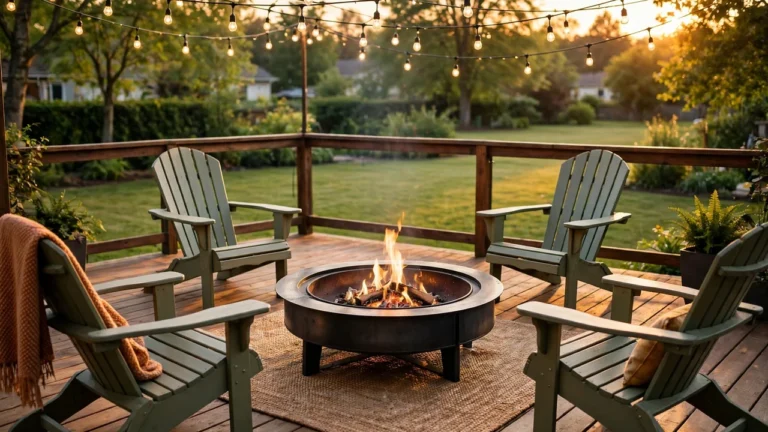
Check your fire pit’s manual first. Many models allow decks with a heat barrier or non-combustible mat underneath, but you still need full clearances from rails and walls.
Gather: tape measure, gas bill or gas company number, patio measurements, photo of the spot, budget range.
- Check what fuel your home already has
- Compare the real upfront costs
- Compare what each fire actually costs you
- Weigh flame quality when comparing propane vs natural gas fire pits
- Match the fuel to your lifestyle
- Place and run your fire pit safely
Remember: propane = portable and easy to start, with tank refills. Natural gas = permanent and hassle-free, with pro installation. Never burn the wrong fuel; keep 10+ feet of clearance; gas smell means leave and call from outside.
You have done the homework most buyers skip. You know how propane vs natural gas fire pits stack up on cost, heat, and hassle — and which one fits your home. Pick your fuel, place your pit with room to breathe, and enjoy the first flame. If you are still choosing the pit itself, the fire pit buying guide is the natural next step.