What Does Green Fire Mean? The Science, Safety Signs and Symbolism behind it.
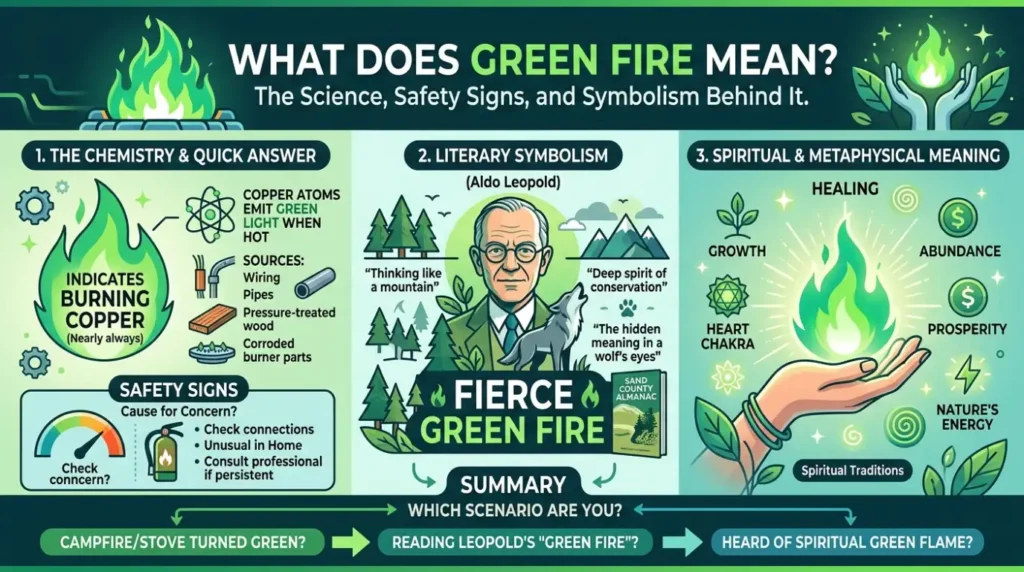
What Does Green Fire Mean? Quick answer: Green fire nearly always indicates burning of copper. When copper atoms (wiring, pipes, pressure-treated wood, corroded burner parts, etc.) become hot enough, they emit energy as green light. That’s the chemistry. However, there are two other meanings of green fire, one of them being a well-known literary image of conservationist Aldo Leopold, and one of plenty in certain spiritual traditions. We will go through all three below, as well as how to determine whether a green flame in your home is a cause of concern or not.
The Short Answer
In case you typed in what does green fire mean then chances are that you are either in one of three scenarios:
- You have recently observed a flame in a fireplace, campfire, or stove turn green and you would like to know why.
- You have read or listened to Aldo Leopold in his book, A Sand County Almanac or read the phrase fierce green fire and need to know what he means by it.
- You heard green flame in spiritual or metaphysical sense and you are interested in knowing what people are referring to it.
All the answers are totally different; thus, we have structured this guide to address all three of them and the first one that most of the people actually require is the chemistry and safety angle.
What Causes a Flame to Turn Green? (The Chemistry)
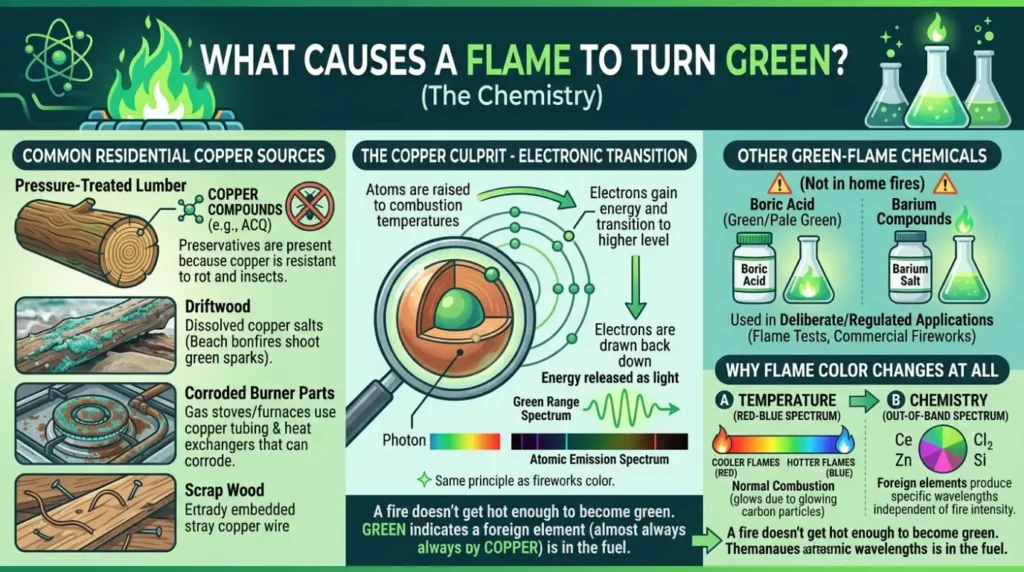
When fire is ordinary, as with wood, candles wax, charcoal, it burns orange and yellow due to glowing particles of carbon in the fire. Green is different. It is not a temperature effect; that is a chemical effect.
Copper Is the Main Culprit
By far copper and copper compounds are the most common cause of any flame going green. When copper atoms are raised to combustion temperatures, their electrons gain energy and transition to an energy level. When such electrons are drawn back down, they give up that energy in the form of light, and, in the case of copper, that light falls directly in the green range of the spectrum. This is what chemists refer to as an atomic emission spectrum and it is the same principle that is used in fireworks to produce color.
Copper finds its way into a flame in a number of different ways in day-to-day life:
- Pressure-treated lumber. The copper compounds in older and modern wood preservatives (such as CCA and ACQ) are also present because copper is resistant to rot and insects. Burn the wood and burn the copper.
- Driftwood. Wood that has been in seawater or brackish water may take on dissolved copper salts, and this is the reason as to why beach bonfires may sometimes shoot green sparks.
- Rusted burner parts. Gas stoves, gas fireplaces and furnaces frequently employ copper tubing, jets, or heat exchangers. That copper may corrode, and these salts of copper vaporize into the flame; and after years of moisture exposure.
- Scrap wood that contains stray copper wiring or nails, or copper-based residue of cleaning a burner.
Boric Acid and Other Green-Flame Chemicals
Copper isn’t the only element that burns green. Green or pale-green flames are also produced by boric acid and by certain barium compounds, hence the prevalence of green in both chemistry classroom “flame tests” and commercial fireworks. These are deliberate, regulated applications – not something that ought to ever be found accidentally in a residential fire.
Why Flame Color Changes at All
The color of flame is usually controlled by two different factors that can be confounded by people:
- Temperature regulates the red-orange-yellow-white-blue spectrum that you observe with normal combustion (cooler flames are red, hotter flames are blue).
- Chemistry determines colors that are not in that natural range, out-of-band, i.e. green, purple, pink, and some strong blues, since certain elements produce certain wavelengths of light independent of the intensity of the fire.
That is the main difference: a fire does not get hot enough to become green, but it gets hot enough to become white or blue. Green indicates that a foreign element (almost always copper) has made its way into the fuel.
Is a Green Flame Dangerous? (Safety Guide)
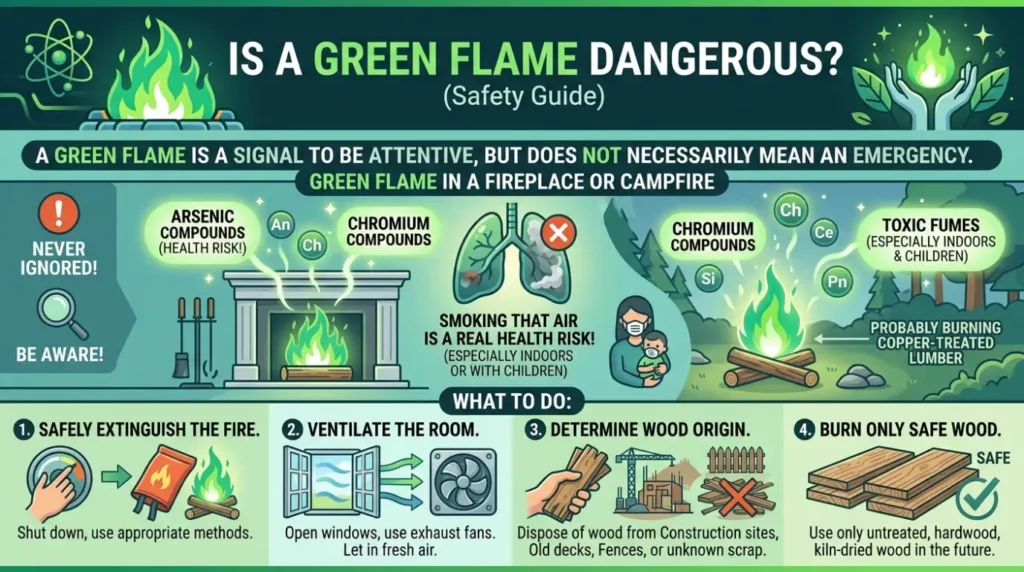
This is the bit that most of the searchers really want to know, and hence, we must be honest and direct this is a green flame, which is a signal to be attentive, it does not necessarily mean emergency, however, it should never be ignored.
Green Flame in a Fireplace or Campfire
When you observe the green flames when burning the wood either inside the house or outside, use it as a stop and check moment. Copper-treated lumber is probably the cause and when treated wood is burned, it does not only give out copper but can also give out arsenic and chromium compounds depending on the treatment applied. Smoking that air is a real health risk particularly in the house or when in the presence of children.
What to do:
- Safely extinguish the fire.
- Get the room ventilated – open out of the window, run exhaust fans.
- Determine the origin of wood. Dispose of all wood that originated at a constructionsite, old deck, fence or scrap wood of unknown origin.
- Burn only untreated, hardwood, kiln-dried in the future.
Green Flame on a Gas Stove or Furnace
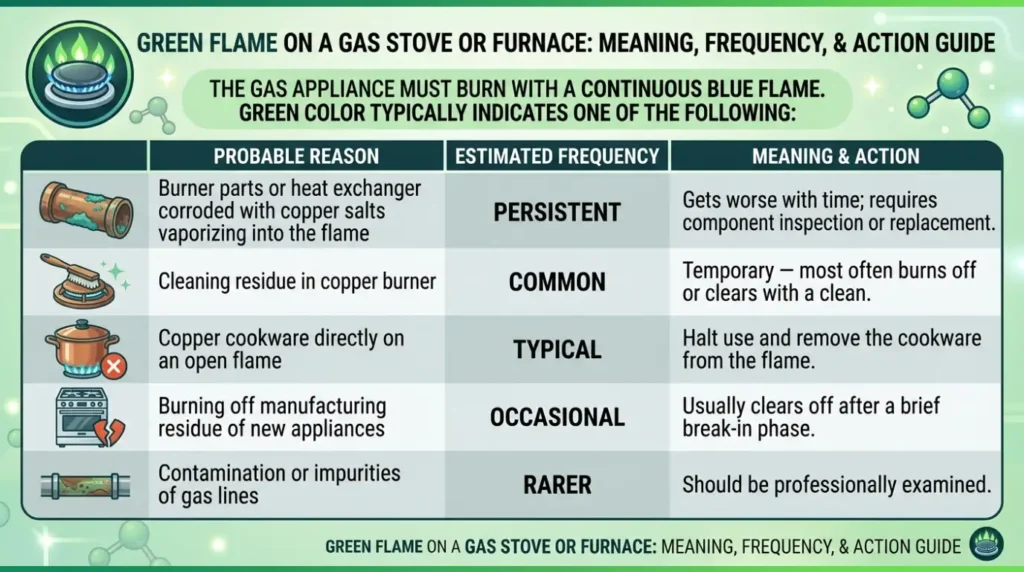
The gas appliance (stove, furnace, water heater, gas fireplace) must burn with a continuous blue flame. One of the following is typically indicated by a green color:
| Probable Reason | Estimated Frequency | Meaning |
| Burner parts or heat exchanger corroded with copper salts vaporizing into the flame | Persistent | Gets worse with time; requires component inspection or replacement. |
| Cleaning residue in copper burner | Common | Temporary — most often burns off or clears with a clean. |
| Copper cookware directly on an open flame | Typical | Halt use and remove the cookware from the flame. |
| Burning off manufacturing residue of new appliances | Occasional | Usually clears off after a brief break-in phase. |
| Contamination or impurities of gas lines | Rarer | Should be professionally examined. |
A green gas flame, by itself, is not typically an active carbon monoxide emergency but incomplete combustion tends to accompany it – and incomplete combustion is precisely the state of affairs that results in the production of hazardous carbon monoxide. It is that intersection that makes it worth considering.
When to Call a Professional
Notice a qualified gas technician or HVAC professional in case:
- The green flame does not go away after cleaning the burner.
- A hissing sound, strange smell, or soot formation with a color shifting are observed.
- The fire does not burn a single color but flickers among green, yellow and orange.
- You possess any operating carbon monoxide detector that is operating, whether or not the flame is colored.
Always beware of diagnosing a suspected gas line or carbon monoxide problem by visual inspection. Visual indicators such as the color of the flame can be used, but not to replace a CO detector or a professional inspection.
Common Causes of Green Fire, Ranked
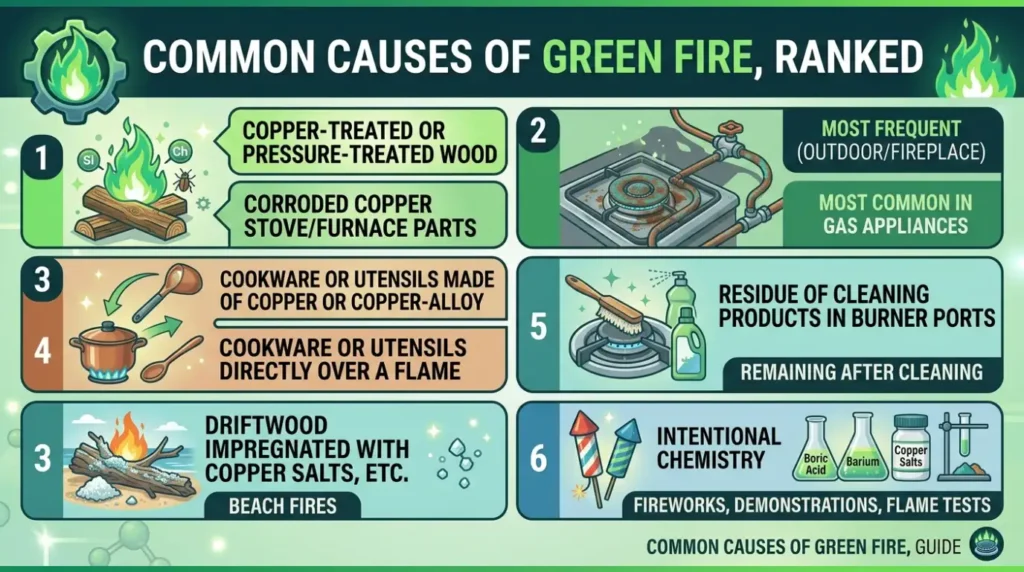
- Copper-treated or pressure-treated wood, – the most frequent source of outdoor and fireplace fires.
- Corroded copper stove/furnace parts– most common in gas appliances.
- Driftwood impregnated with copper salts, etc.— beach fires.
- Cookware or utensils made of copper or copper-alloy directly over a flame.
- Residue of cleaning products remaining in burner ports.
- Intentional chemistry – purposely added boric acid, barium, or copper salts in fireworks, flame tests, or demonstrations.
Flame Color Comparison Chart
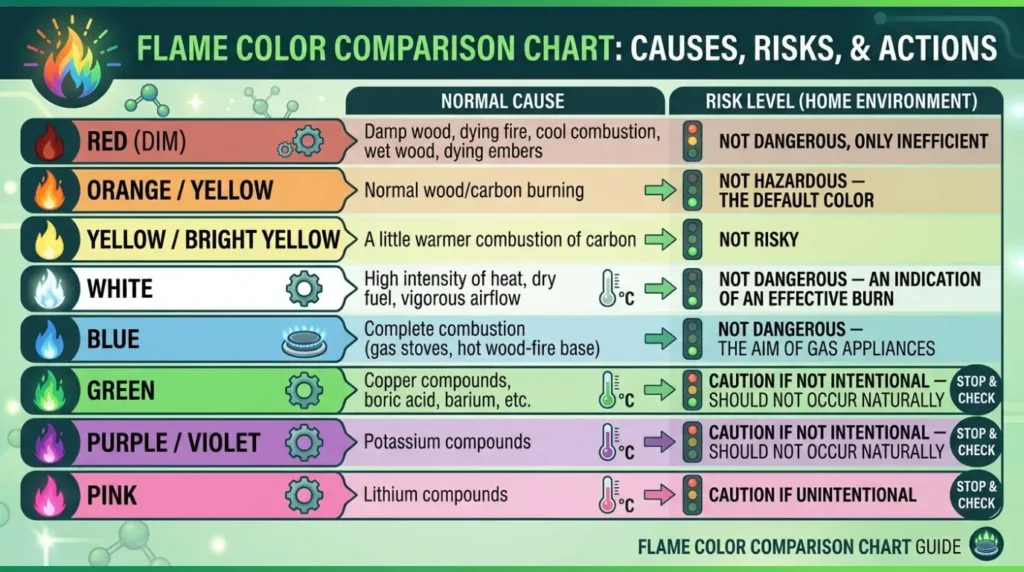
| Flame Color | Normal Cause | Risk Level (Home Environment) |
| Red (dim) | Damp wood, dying fire, cool combustion, wet wood, dying embers | Not dangerous, only inefficient |
| Orange / Yellow | Normal wood/carbon burning | Not hazardous — the default color |
| Yellow / Bright Yellow | A little warmer combustion of carbon | Not risky |
| White | High intensity of heat, dry fuel, vigorous airflow | Not dangerous — an indication of an effective burn |
| Blue | Complete combustion (gas stoves, hot wood-fire base) | Not dangerous — the aim of gas appliances |
| Green | Copper compounds, boric acid, barium, etc. | Caution if not intentional — should not occur naturally |
| Purple / Violet | Potassium compounds | Caution if not intentional — should not occur naturally |
| Pink | Lithium compounds | Caution if unintentional |
What Does “Green Fire” Mean in Literature? (Aldo Leopold)
Outside chemistry, the phrase “green fire” has a well-known literary meaning thanks to conservationist and writer Aldo Leopold. In one of his 1949 essay collections, A Sand County Almanac, in a chapter titled Thinking Like a Mountain, Leopold recalls an early experience as a hunter when he and his friends killed a wolf and he could see what he termed a fierce green fire diminish out of her eyes as she died.
The picture was a turning point in the essay– and in the philosophy of Leopold himself. The observation of the green fire extinguishing made him doubt the belief that the killing of predators will always be beneficial to an ecosystem, a concept that would subsequently influence the contemporary conservation of wildlife and ecology. In this literary context, “green fire” symbolizes:
- A flash of life or wildness- something essential and wild which may be lost.
- Moral realization moment- the moment when the worldview of a person changes.
- The interrelatedness of nature – The larger point Leopold makes that predators and prey and land are interrelated in a way that is usually not acknowledged by humans until it is too late.
The word has no relation to combustion chemistry – it is a metaphor of vitality and ecological consciousness, and one of the most quoted in American nature writing. When you read about green fire in your English course, ecology course, or a conservation article, this is most probably the meaning intended.
What Does Green Flame Mean Spiritually?
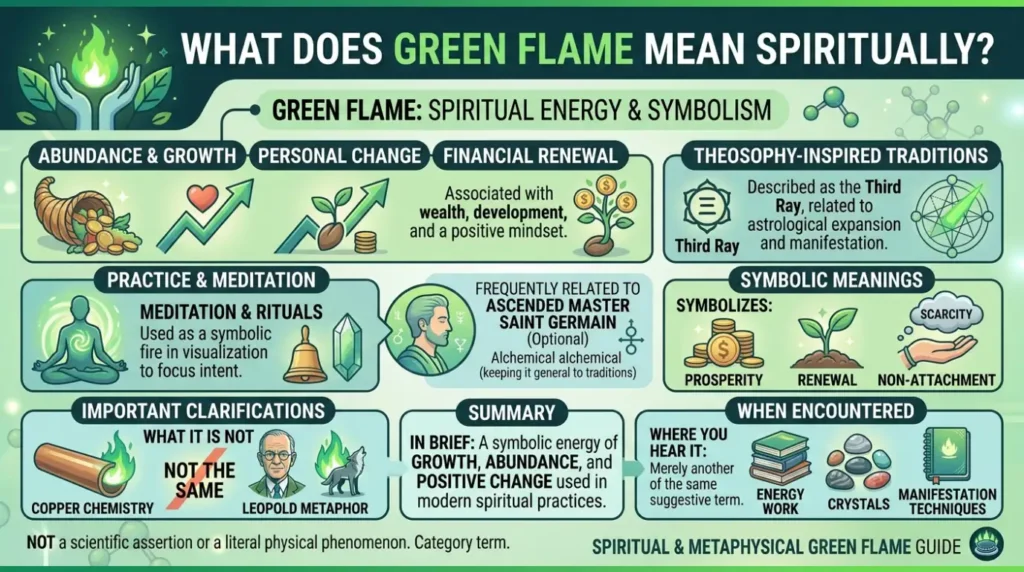
A green flame, a spiritual energy associated with abundance, growth and financial or personal change, is described in certain New Age traditions and metaphysical traditions in relation to the Third Ray in Theosophy-inspired traditions. Within this paradigm, practitioners speak of the green flame as a symbolic (not literal) fire to be used as a part of the meditation or ritualistic practice to symbolize renewal, prosperity and non-attachment to scarcity-based thinking, frequently related astrologically to growth and expansion.
It is well to make it clear that this is a category term, not a scientific assertion, and that it has nothing in common with the copper-based green flame chemistry above or with the literary metaphor of Leopold. When you are studying crystals, energy work or manifestation techniques, this is what you have probably heard the term mean, and it is merely another application of the same suggestive term.
Green Fire vs. Other Colored Flames
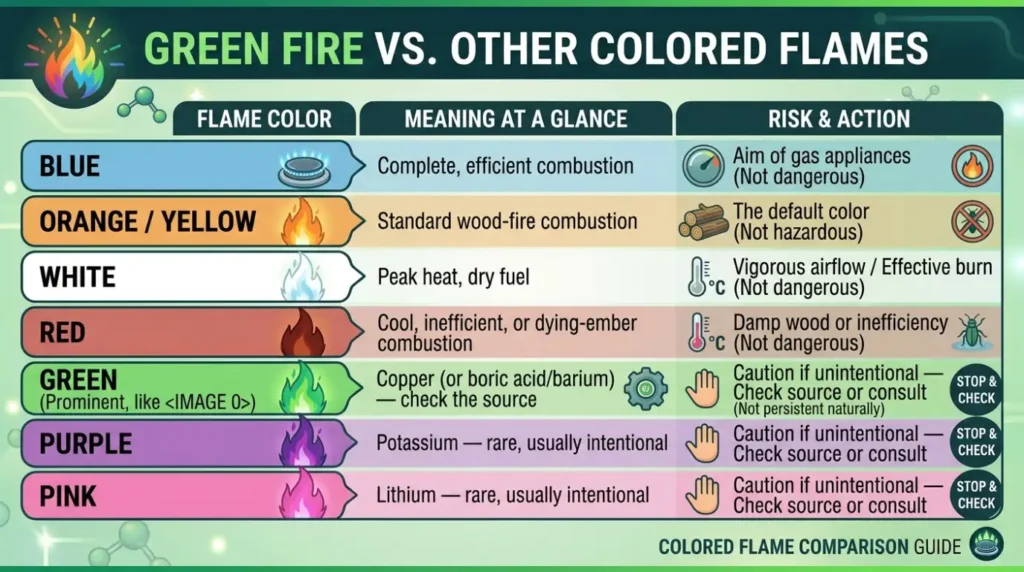
| Flame Color | Meaning at a Glance |
| Blue | Complete, efficient combustion |
| Orange / Yellow | Standard wood-fire combustion |
| White | Peak heat, dry fuel |
| Red | Cool, inefficient, or dying-ember combustion |
| Green | Copper (or boric acid/barium) — check the source |
| Purple | Potassium — rare, usually intentional |
| Pink | Lithium — rare, usually intentional |
How to Test for a Green Flame Safely (Flame Test Basics)
A controlled technique known as a flame test, used by chemists and educators to determine which element is causing a color, and, in fact, a very useful reference to why fires turn green:
- The suspected compound is placed on a loop of wire or in a spray bottle prepared to test.
- The sample is added to a low-luminosity flame (such as a Bunsen burner).
- The obtained color is matched to the reference colors known: copper can always give green or blue-green.
It is a laboratory or classroom experiment that cannot be replicated at home with an open fire or gas appliance. Or, in case you are wondering whether it is copper that makes your flame green at home, it is always better to just take out the possible source (treated wood, corroded fitting, copper cookware) down to the bare material and see whether or not the color goes back to normal.
Key Takeaways
- Copper (treated wood, corroded gas elements, driftwood, or copper cookware) is the most frequent cause of green fire.
- A green flame is a signal to enquire, not necessarily an emergency, but do not disregard, particularly on a gas appliance.
The literary sense of green fire is due to Aldo Leopold in his book, A Sand County Almanac, which implies a sense of life and a change in ecological knowledge. - In some metaphysical traditions, the spiritual meaning considers green flame as a symbol of abundance and rejuvenation.
- When green flame does not subside with simple troubleshooting, call in a professional and do not guess.
You May Also Read:
- Do You Need a Fireplace Screen?5 Essential Safety Benefits Explained
- 3 Best Electric Fireplace Trim Kits?
FAQs:
When fire turns green what does it imply?
It nearly always refers to copper burning away, be it in treated wood, rusty metal components, or in copper-contaminated fuel. It is not a temperature effect, but a chemical reaction.
Is a green flame bad?
It can be. Burning treated wood can produce green flames that emit toxic compounds and gas appliances can also have green flames indicating a maintenance problem worth fixing. It is not necessarily an emergency, yet it cannot be disregarded.
What is the chemical that causes fire to change to green?
The most common cause is copper and copper compounds. Green flames can also be produced by boric acid and some barium compounds.
Why does the gas stove flame turn green?
Typically, corroded copper parts within the burner or heat exchanger, residual cleaning products, and copper cookware that is too near the flame.
Will a campfire naturally become green?
Not of common timber. A green campfire flame nearly always indicates that the wood has copper, either in the form of pressure treatment or copper hardware or leached copper salts (as in driftwood).
What is the meaning of green fire in literature?
It is a well-known quote of Aldo Leopold in his Sand County Almanac, where he tells of witnessing a fierce green fire in the eyes of a dying wolf, an experience that changed his perceptions of ecology and predators.
What is the spiritual meaning of the green flame?
Green flame in certain metaphysical and New Age traditions is a symbol of plenty, financial rejuvenation, and personal development, and in certain cases associated with the Third Ray of Life.
Is green fire real, or real in fireworks?
It exists in reality and is not limited to fireworks only, it is most likely to appear in any kind of fire, where copper-bearing materials are involved, such as treated wood or corroded copper fittings.
Would I halt a fire as soon as it turned green?
In the case of a wood fire, yes – put it out, air the place and find out what kind of wood before relighting. In the case of a gas appliance, switch to off as far as it can be safely done, and have it checked.
Green flame, does this imply carbon monoxide?
Not directly, however, green flames on a gas appliance frequently co-exist with incomplete combustion, which is the identical state that results in high levels of carbon monoxide. Any abnormal color of flames on a gas appliance is enough to alarm you that you should check your CO detector and have the unit serviced.
which is the hottest of the fires?
Blue, as of total combustion – but that is an independent question to flame color due to chemistry, such as green.
Can copper wire or pennies be burnt to form a green flame?
Yes, A green tint will be produced when copper in any type; coins, wire, pipe, or salt, will reach the temperature of combustion. It should never be attempted as an unsupervised, uncontrolled demonstration, in a home fireplace or stove.
Does green fire mean green flame in spiritual practice?
No, they are two entirely different things which by coincidence have a similar name. One is a chemical phenomenon; the other is a symbolic or devotional concept applied in meditation and metaphysical practice.
My Final Thoughts:
Green fire proves to be three ways to go, depending on where you met it. In the real world, it is chemistry almost always copper, and almost always something to investigate and not to panic about. In literature, it is the image of the dying wolf and the ecological awakening that Aldo Leopold had in the eyes of the wolf that will remain forever. And a sign of plenty and renaissance in spiritual practice. The quickest way of getting the right answer is to know what one you are asking about which you now have all three.