Electric Fireplace not spinning? And Here are How to Make it Right.
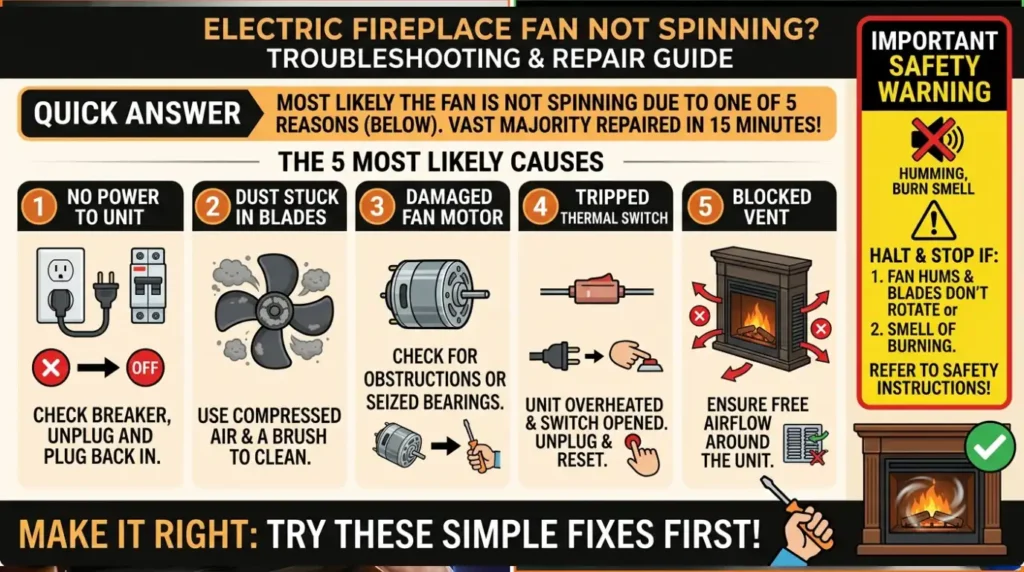
Electric Fireplace Fan Not Spinning? And Here are How to Make it Right. Quick Answer: Unless your electric fireplace fan is spinning, it is nearly always due to one of five things: no power to the unit, dust stuck in the blades, a damaged fan motor, a tripped thermal safety switch or a blocked vent that causes the unit to overheat and turn off the fan. The vast majority of them can be repaired within 15 minutes without cracking the unit. Should the fan hum and the blades not rotate, or you smell of burning, halt and read the section on safety before you proceed to do anything further.
Why Your Electric Fireplace Fan Isn’t Spinning
Electric Fireplace not spinning? Electric fireplaces rely on a small blower fan to draw room air over a heating unit and force the warm air out of the front through the vents. Once that fan is switched off, you will continue to see the flame effect operating as usual, as most of them have the flame display and the heater on different power. That is a good tip by the way: when your flame is operating well, but no air flows, it is virtually always confined to the blower motor, or to the vents, or a safety switch – not to the entire unit.
Here’s the short version of what’s typically going on:
- None of the power is getting to the fan – although the flame effect has its own circuit and is still active.
- Blades or intake vent have accumulated dust or pet hair which has increased drag or completely blocked airflow.
- The motor itself is worn out, which is a normal event following 5-10 years of normal use.
- A thermal overload switch has tripped, the unit overheated and it is not going to start the fan until it cools down.
- The remote/ control board setting or the fan off while the heater is on.
This guide then takes you through each of them, in the order in which you really need to check them.
Quick Diagnostic Checklist of Electric Fireplace Fan Not Spinning?
Check this two-minute checklist before getting into troubleshooting. It fixes the fan issue in most of the houses without the need to open the unit at all.
- Fireplace is fully plugged in, and the outlet is functional with another device.
- No tripping of circuit breaker or GFCI outlet.
- Batteries are new, fan is switched on.
- Directly tested manual control panel button of the fan.
- The front and back of the unit are clear with vents that have 3+ feet of clearance.
- Unplugged unit 10-15 min to completely restart.
- No burning odor or grinding of a noise on the inside of the unit.
Once you’ve switched all seven, and the fan remains stationary, proceed to the more specific causes below.
Common Causes at a Glance
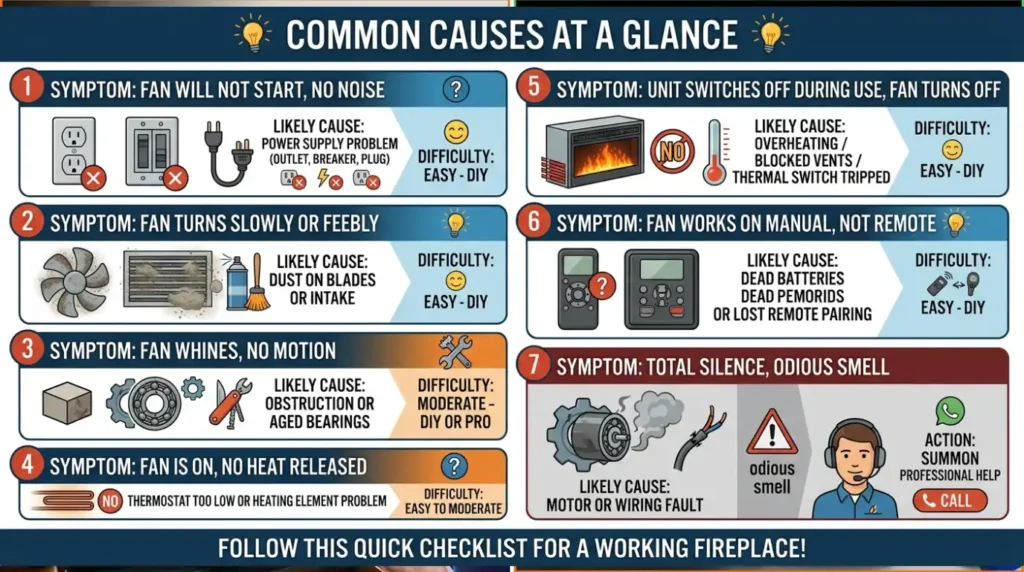
| Symptom(s) | Likely Cause | Difficulty to Fix |
| Fan will not start, unit is not making a noise | Power supply problem (outlet, breaker, plug) | Easy – DIY |
| Fan turns slowly or feebly | Dust on blades or intake | Easy – DIY |
| Fan whines but no motion of blades | Obstruction or aged bearings | Moderate – DIY or Pro |
| Fan is on, no heat is released | Thermostat is too low or heating element problem | Easy to Moderate |
| Unit switches off in the middle of the use, fan turns off | Overheating / blocked vents / thermal switch tripped | Easy – DIY |
| Fan works on manual, not remote | Dead batteries or lost remote pairing | Easy – DIY |
| Total silence, odious smell | Motor or wiring fault | Summon professional help |
How to Fix an Electric Fireplace Fan That Won’t Spin:
An electric fireplace may be a great addition to your home, but when the fan stops rotating, it can be rather frustrating to know how to fix it.
Follow these steps sequentially: All of them can be solved in a matter of several minutes and combined with each other, they will solve the majority of cases of why my electric fireplace fan is not working.
Step 1: Confirm the Unit Is Actually Getting Power
The single most common cause of the fan not spinning is a loose plug or a tripped breaker mainly due to the fact that it is the easiest to ignore.
- Plug the plug fully into the outlet – an incomplete connection will turn on the flame display and turn off the fan.
- To ensure the outlet is live, plug a lamp or phone charger into the outlet.
- Inspect the circuit breaker panel in your home, and reset any GFCI outlet that the fireplace is plugged in to (press the little reset button between the two smaller buttons).
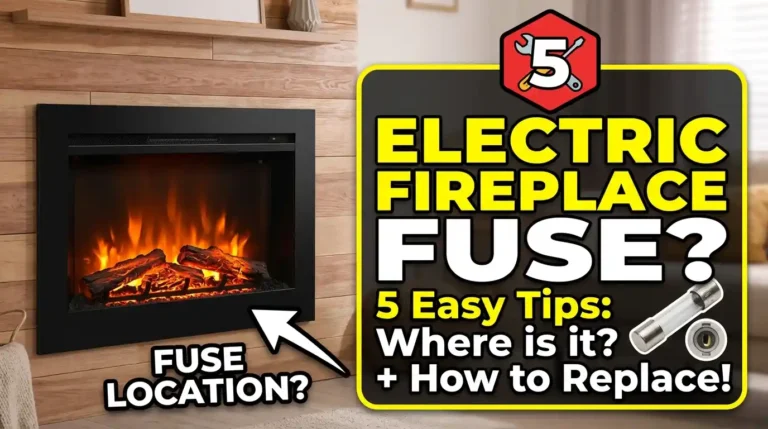
- In the event that the fireplace has its own inline fuse, verify the position and rating of the fuse by referring to your owners manual before making contact with it.
Step 2: Test the Remote and Manual Controls independently.
A lot of owners think that the fan motor is dead when in fact the problem is a setting.
- Change the remote batteries, although they may apparently be okay- weak batteries have just this type of intermittent failure.
- Check the fan with the manual buttons on the unit itself. When the remote fails, but the manual controls are responsive, the motor is good and it is a remote or pairing problem.
- Re-connect the remote as described in the instructions of your model, and ensure that you do not have anything obstructing the view of the receiver.
Step 3: Clean the Vents and Fan Blades:
The silent murderer of blower fans is dust. It induces resistance to the motor, and a sufficient accumulation may prevent turning of the blades altogether.
- Always disconnect the unit and allow it some time to cool.
- Remove the front grille or access panel per your manual.
- Clean the blades, intake vents and exhaust vents with a vacuum with a brush attachment or compressed air in a can.
- Use your hand to spin the blades (unit not plugged) and see how much resistance there is. When they turn at all after cleaning, it was most likely all you.
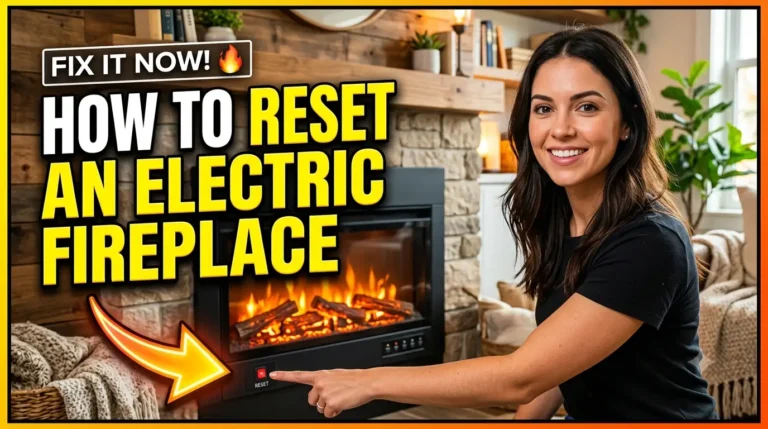
Step 4: Do a Full Power Reset
The easy built-in electronics in most electric fireplaces sometimes require a hard restart, like re-booting a router.
- Turn off the unit in the wall.
- Wait a full 10–15 minutes. This will also provide any tripped thermal safety switch time to reset.
- Reconnect it and run the fan on low and high levels.
Step 5: Check for Blocked or Restricted Vents
When the fan continues to switch off, or fail to start, as the unit is overheating, it is airflow that is the problem.
- Maintain a minimum of 3 feet of clearance at the front of the unit and do not put it directly in front of the curtains or furniture or in an enclosed cabinet without inbuilt ventilation.
- Check that there is nothing that fell down into the top or bottom vent slots.
- When the fireplace is constructed within a mantel or television stand, make sure the enclosure has the vent cutouts as specified by the manufacturer – oversized cabinets are a frequent cause of frequent overheating shutoffs.
Step 6: Inspect for Loose or Damaged Wiring (Only If Comfortable)
A loose internal connector can lead to an intermittent fan, assuming you have no problem doing so, and opening the unit. Unless you are comfortable working with household wiring, you should omit this step and directly refer to a professional.
- Disconnect the unit, open the access panel and look at the wires connected to the fan motor.
- Find any connector that has become loose, or wiring that appears scorched, melted or frayed.
- When all appears to be in place and the fan will still not start, the motor is probably dead.
Fan Spins but Isn’t Blowing Heat
This is another issue than the fan not turning at all, but it is searched nearly as frequently, so it is worth discussing here. In case the air is in motion, but not warm:
- Thermostat is adjustable too low. Turn it up and allow the unit some time to heat.
- The unit is in flame-only mode. Most of the models allow you to use the flame effect without the heater – be sure to check your mode selection on the remote.
- The heating component is faulty, independent of the fan motor. It is not a do-it-yourself repair, but a parts-and-labor repair.
- The intake is closed, and therefore the fan is sucking in very little air to heat.
Fan Hums but Won’t Turn
The distinctive, recognizable pattern of failure is a humming motor with non-moving blades, and it indicates either of two things:
- Physical obstruction – an object (typically a wad of dust, a packaging zip tie, or a small item) is being forced into the blades. Unplug the unit and check.
- Worn motor bearings – after years of use bearings in the inside of the motor may have seized enough so that the motor cannot start the blades moving on its own, although it is still receiving power and attempting to run. This virtually always implies replacement of motor.
When you unplug the unit, turn the blades by hand and the humming goes back, then you are dealing with a bearing or motor problem and not a simple blockage.
DIY Fix vs. Professional Repair
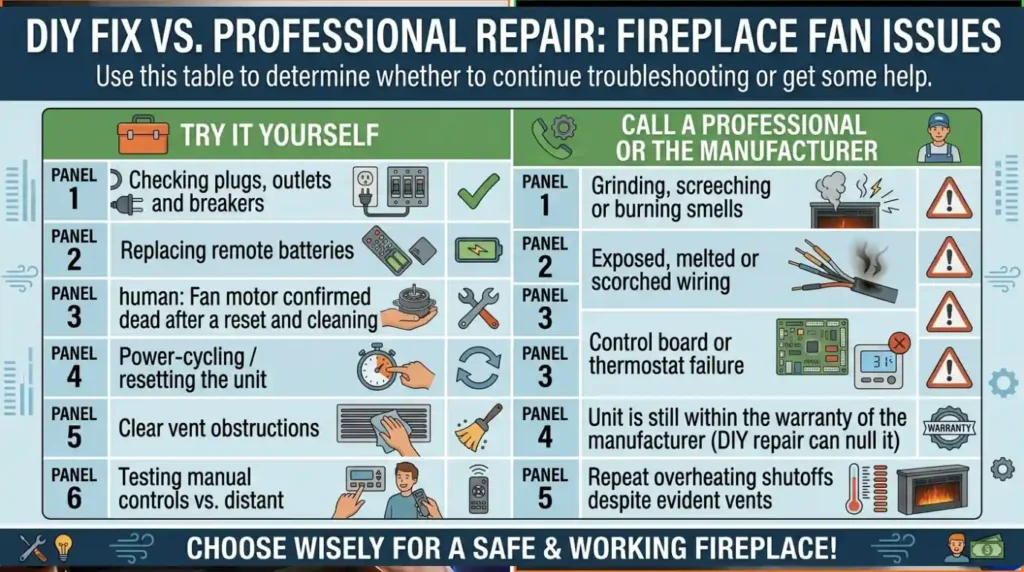
Use this table to determine whether to continue troubleshooting or get some help.
| Try It Yourself | Call a Professional or the Manufacturer |
|---|---|
| Checking plugs, outlets and breakers | Grinding, screeching or burning smells |
| Replacing remote batteries | Exposed, melted or scorched wiring |
| human | Fan motor confirmed dead after a reset and cleaning |
| Power-cycling / resetting the unit | Control board or thermostat failure |
| Clear vent obstructions | Unit is still within the warranty of the manufacturer (DIY repair can null it) |
| Testing manual controls vs. distant | Repeat overheating shutoffs despite evident vents |
One easy guideline: when it comes to a plug, a button, or a vacuum, one can safely DIY. When it comes to internal wiring or replacing a motor, and your unit is under warranty, call support first, self-repair can usually invalidate it.
How Much Does It Cost to Replace a Fan Motor?
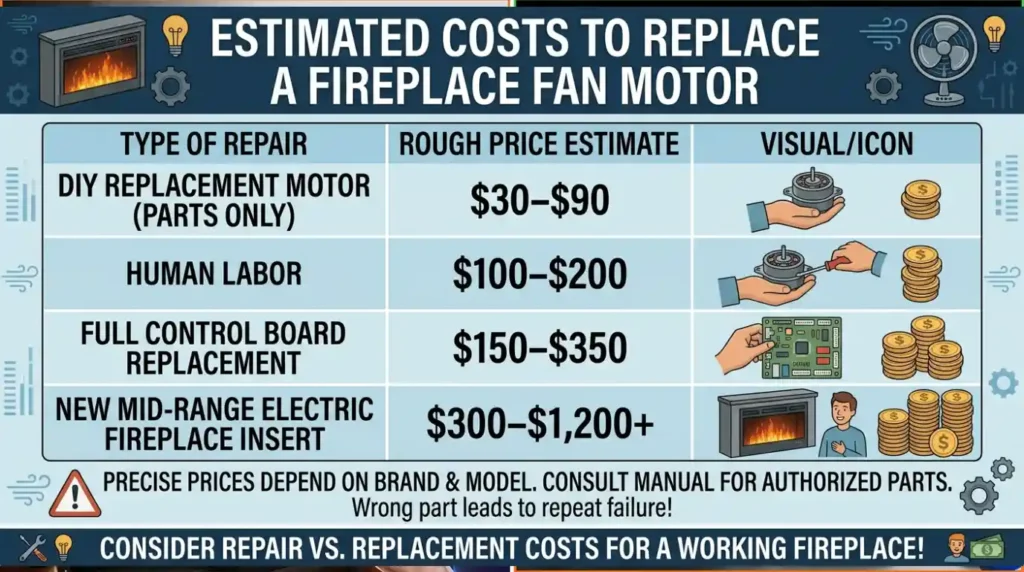
Assuming that troubleshooting reveals that the motor itself has failed, then what to expect is as follows:
| Type of repair | Rough price estimate |
|---|---|
| DIY replacement motor (parts only) | $30–$90 |
| human | $100-$200 |
| Full control board replacement | $150–$350 |
| New mid-range electric fireplace insert | $300–$1,200+ |
Precise prices depend on the brand, and model, so consult your owner manual to see who the manufacturer authorizes to supply parts, before ordering a replacement motor – fit the wrong part and you’ll have a repeat failure.
Preventing Future Fan Problems
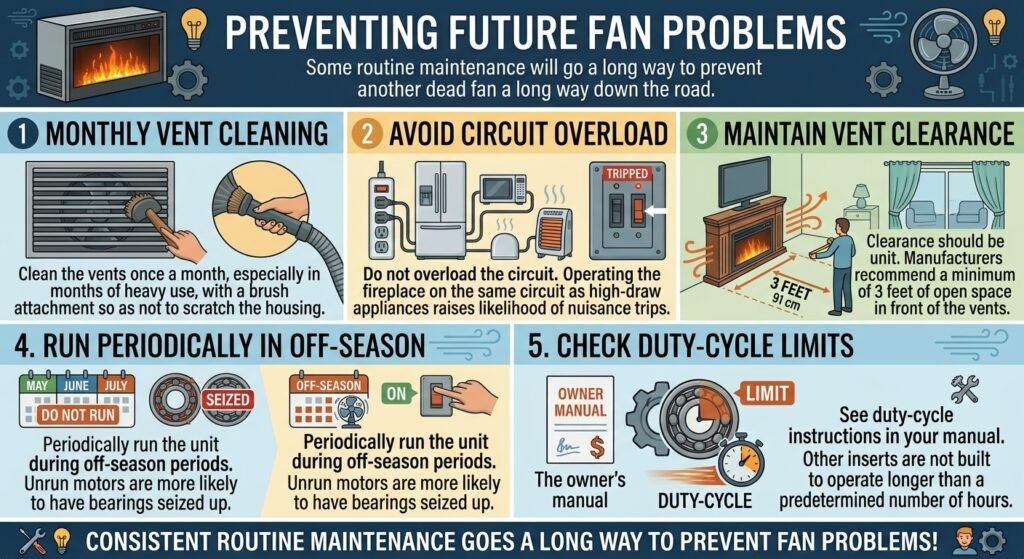
Some routine maintenance will go a long way to prevent another dead fan a long way down the road.
- Clean the vents once a month, especially in months of heavy use, with a brush attachment so as not to scratch the housing.
- Do not overload the circuit. Operating the fireplace powered by the same circuit with a number of other high-draw appliances raises the likelihood of nuisance trips on the breaker.
- Clearance should be maintained around the unit. Manufacturers usually recommend a minimum of 3 feet of open space in front of the vents.
- Periodically run the unit also during off-season periods. The motors that are not run at all during weeks and months are more likely to have their bearings seizing up.
- See the duty-cycle instructions in your manual. Other inserts are not built to operate longer than a predetermined number of hours.
When to Replace the Fireplace Instead of Repairing It
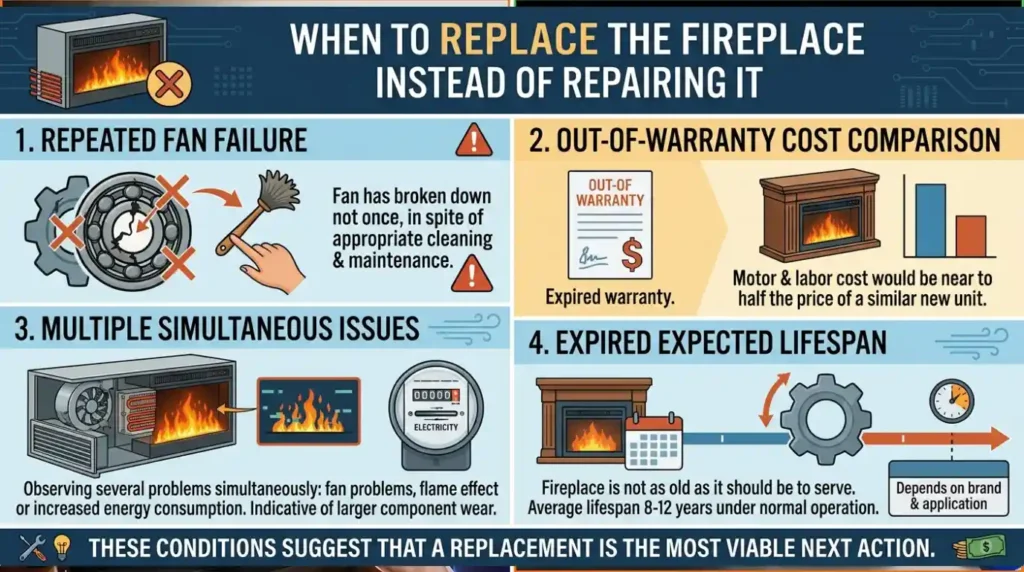
In other cases the next most viable action is to replace the unit instead of repairing it. Consider replacement if:
- The fan has broken down not once in spite of appropriate cleaning and maintenance.
- The unit has expired the warranty, and a motor and labor would cost near to half the price of a similar new unit.
- You are observing several problems simultaneously – fan problems and flame effect glitches or increased energy consumption, which can be indicative of larger component wear.
- The fireplace is not as old as it should be to serve. The majority of electric fireplace inserts are constructed to have a lifespan of about 8-12 years under normal operation, but depends on the brand and the applications.
You May Also Read:
- How Much Energy Does an Electric Fireplace Use? 7 Amazing Facts
- How High Should an Electric Fireplace Be from The Floor
FAQs:
Why won’t my electric fireplace fan turn?
The most prevalent are a power supply problem, dust obstruction of the blades, a faulty thermal safety switch due to overheating, or an aged fan motor. Always remember to check the power source and vents before concluding that the motor has failed.
My electric fireplace is not heating, why is the fan not blowing?
When the fan is running but the air is not hot, be sure the thermostat is adjusted high and the unit is not in a flame-only mode. Should both checks out, then the heating element might require a replacement.
Is it possible to operate an electric fireplace when the fan is not on?
Yes, the flame effect and heater can operate without the blower fan, in most models. With no fan movement, however, there will be minimal heat output, and the unit may be more susceptible to overheating.
How can I tell to know whether my fan motor is burned out?
When the unit is powered up the flame effect is working, but the fan is producing no sound and no airflow – or you can smell something burning, then the motor is most likely dead and requires a replacement.
Why does my electric fireplace fan hum and not rotate?
This normally implies that there is something actually physically blocking the blades or that the bearings of the motor have become worn out so that they can no longer begin to turn themselves though the motor is being fed with power.
How frequently do I need to clean my electric fireplace fan?
A good starting point is once a month or once every one or two months when the fireplace is in regular use, and once a month in case you run the fireplace every day or you keep pets that shed hair.
Is loudness of an electric fireplace fan normal?
It is normal to have a soft hum or whir. Grinding, rattling, screeching, or buzzing is not and indicates, in most cases, that there is a mechanical issue somewhere within the blower assembly.
Why is my fireplace turning off after several minutes?
This is normally the thermal safety switch which guards the unit against overheating usually caused by blocked vents or lack of clearance. Clear the vents, leave it space and allow it to completely reset and then restart.
Key Takeaways
- Try power, remote settings, and vents first and then consider the motor to be broken, this fixes most of them.
- A non-moving hum is likely to indicate a blockage or worn bearings rather than a dead motor.
- Clean vents once a month and maintain 3+ feet of clearance to avoid recurrence of overheating shutoffs.
- Repairs (power, cleaning, resets, etc.) that can be done yourself are not dangerous; wiring, replacing the motor, etc. on a unit that is still under warranty must be done by a professional or by the manufacturer.
- In the case of an older unit, and the fan has failed more than once, consider the cost of repair against just replacing the fireplace.
This is a general troubleshooting guide you should always refer to the owner of your specific model before opening your unit and never open up your unit unless you are unplugged, and never do any inspection or cleaning that is not outlined in the owners manual.