Where Does an Electric Fireplace Have a Fuse? The Ultimate Whereabouts and Replacement Guide.
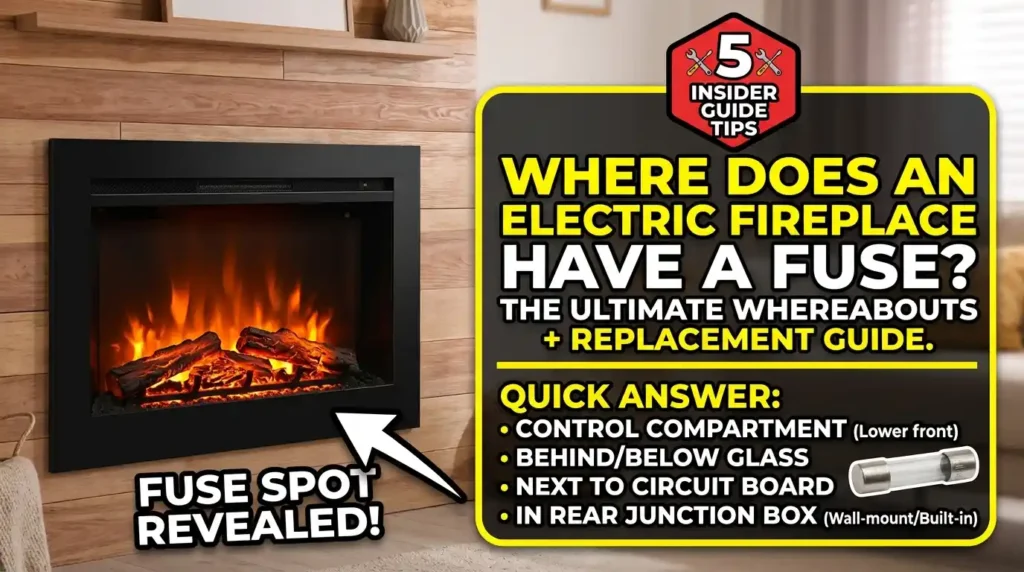
Where Is the Fuse of an Electric Fireplace? Quick Answer: The fuse is usually located in the lower control compartment of most electric fireplaces, just behind or below the glass front, where the power cord is attached to the fireplace. It is typically a little glass or ceramic cylinder, about the size of your pinky finger, clipped to a plastic fuse holder next to the primary circuit board. It is retained within the rear junction box in some wall-mounted and built-in models, which means that you may need to slide the unit out a bit or provide an access panel, which is made of a small metal panel.
Key Takeaways
- The fuse is nearly always located at the lower front compartment, behind the control panel or glass, at the point of entry of the power cord.
- Not all electric fireplaces have a fuse that can be replaced by the user – some have a thermal cutoff or a circuit breaker built into the house instead.
- A fuse that has been blown does not indicate that the flame effect has been turned off, only the heater and even the lights may stop.
- It is important to never leave a unit not unplugged when opening a panel and always to replace a fuse with one of the same amperage and voltage rating.
- In case a new fuse blows immediately, halt that indicates a more serious electrical problem requiring a technician, not another fuse.
What Does the Fuse Actually Do?
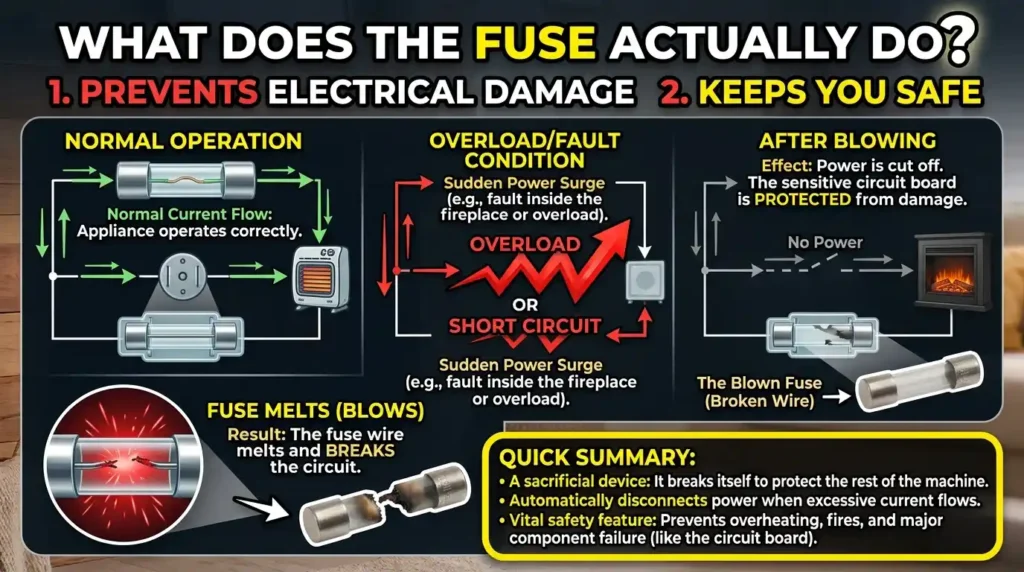
An electric fireplace’s fuse is a one-time safety device. Within a narrow glass or ceramic tube is a fine strand of metal wire, which is rated to carry a certain amount of current. When the circuit requires more power than that rating – due to a power surge, failure of a short in the wiring, or failure of a heater component – the wire in the fuse melts and opens the connection immediately. That break will save the costlier components of your fireplace, such as heating element, the blower motor and the control board, which would otherwise be damaged and potentially catch fire.
Consider it as a part of a sacrifice. It is made to crumble, intentionally, to avoid the need of any other to do so.
Where Is the Fuse Located? A Room-by-Room Answer
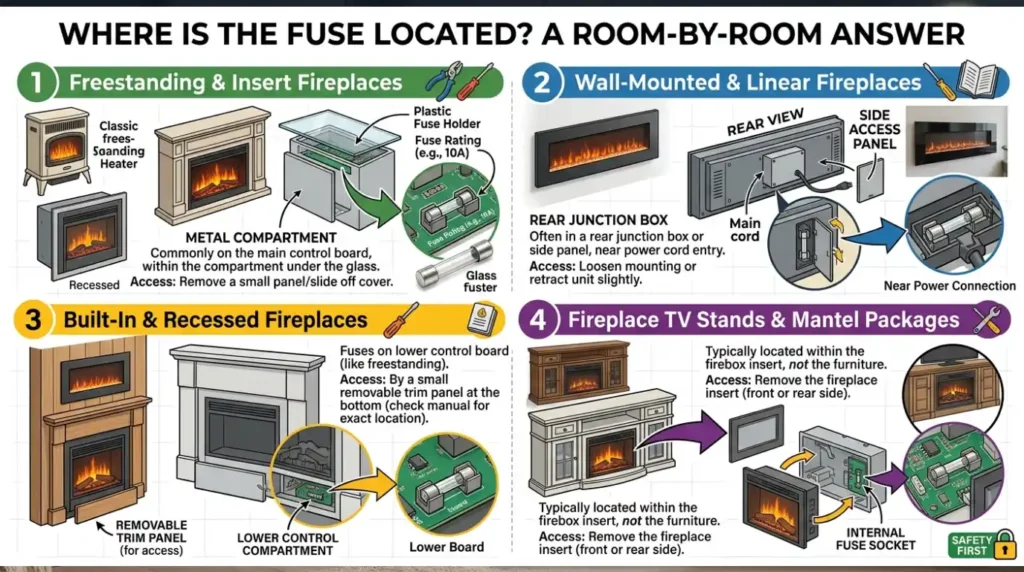
The manufacturers of the electric fireplaces do not adhere to a single layout, and the location can be predicted, yet it is not a total surprise, so the search is reduced in a matter of minutes.
Freestanding and Insert Fireplaces
On standalone devices and drop-in inserts, the fuse is commonly mounted to the main control board, within the metal compartment under the glass viewing surface. To see it, you typically have to remove a small panel screwed on or slide off a metal cover. Find a plastic fuse holder approximately the width of a pen cap that may be directly marked on the circuit board with its fuse rating printed next to it.
Wall-Mounted and Linear Fireplaces
Wall-mounted and linear types will often fit the fuse into a rear junction box or a side access panel, and near where the power cord is connected to the unit. Since these units are mounted directly on a wall, you might have to loosen the mounting bracket a little or retract the unit in a couple of inches to have a clear view of the compartment.
Built-In and Recessed Fireplaces
Installed fuses mounted within a mantel or wall cavity maintain the fuse in the lower control compartment with freestanding ones, still, but access may be by a small removable trim panel at the bottom instead of the primary glass front. Installing a panel varies more by brand than by style of fireplace and so you have to check your installation manual to be sure of where it is placed.
Fireplace TV Stands and Mantel Packages
Combination units – a fireplace insert installed on a TV stand or mantel – the fuse is typically located in the firebox, and not the surrounding furniture. Instead of going to the cabinet frame, remove the insert itself (front or rear side).
Where Is the Fuse of an Electric Fireplace? Electric Fireplace Fuse Location by Brand
Since the term electric fireplace includes dozens of manufacturers, the following is a comparison of the location of the fuse, as per the typical service documentation and manufacturer support instructions. Always check against your particular model manual as one brand can have many other chassis designs.Here is the organized table based on your data:
Electric Fireplace Fuse Locations by Brand
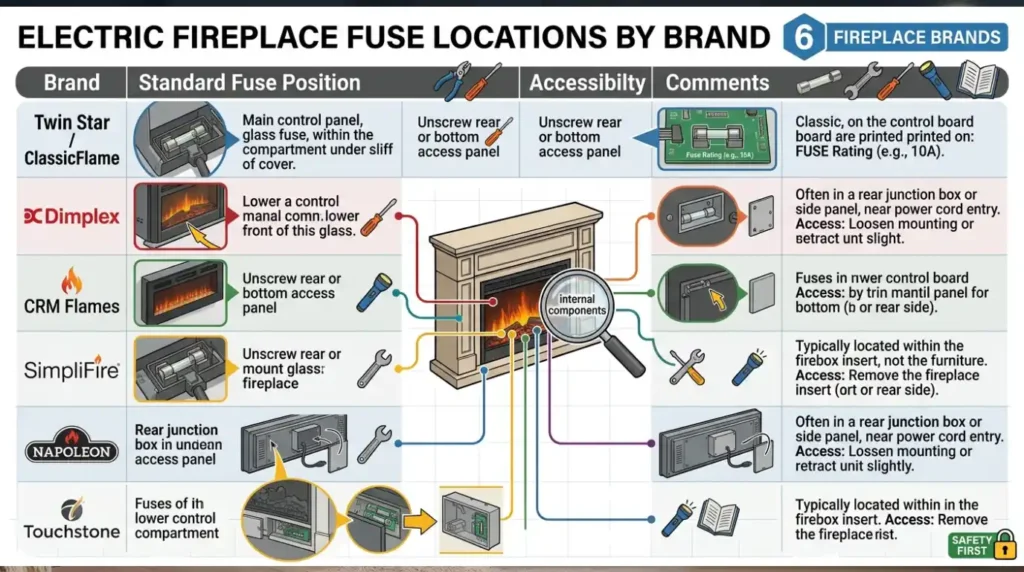
| Brand | Standard Fuse Position | Accessibility | Comments |
| Twin Star / ClassicFlame | Main control panel, lower compartment under the glass | Unscrew rear or bottom access panel | Fuse rating is usually printed on the control board |
| Dimplex | Lower metal compartment under the glass front | Take out front glass or rear panel | Some models have a manual reset button instead of/along with a fuse. |
| CRM Flames | Below compartment, adjacent to power supply board | Slide-off or screwed rear panel | Compact chassis; a flashlight is useful to locate the holder. |
| SimpliFire | Lower compartment under the glass | Screwed access panel | Similar layout on most linear models. |
| Napoleon | Rear junction box or control compartment | Rear access panel | Larger units might have to be tugged out of the wall. |
| Touchstone | Lower control compartment | Bottom or rear panel | Check the manual included; it has a labeled diagram. |
Do All Electric Fireplaces Have a Fuse?
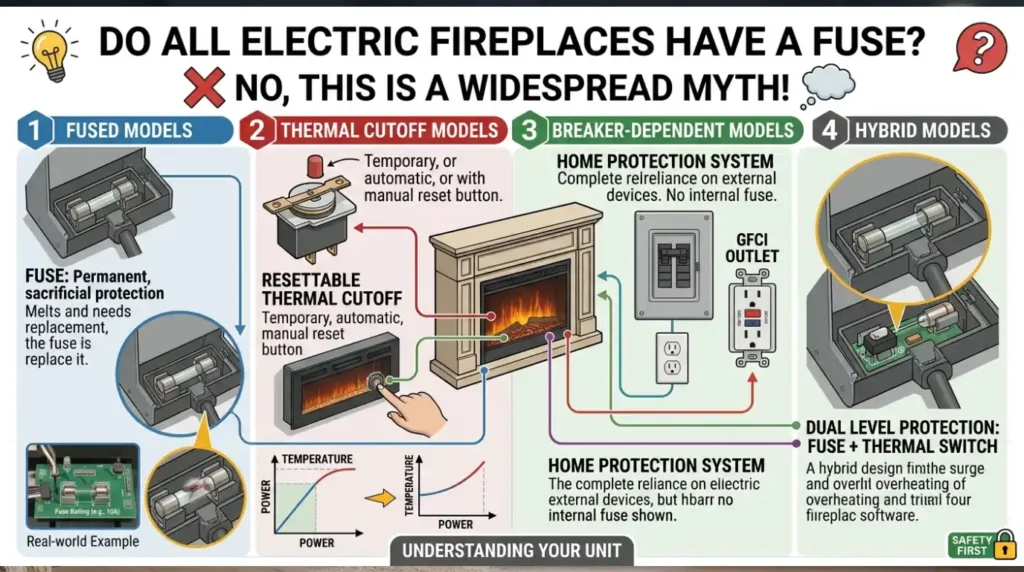
No, this is one of the most widespread myths. Depending on the manufacturer, and the age of the unit:
- Fused models Fused models employ physical, replaceable, fuses that permanently melt when blown and will need to be replaced.
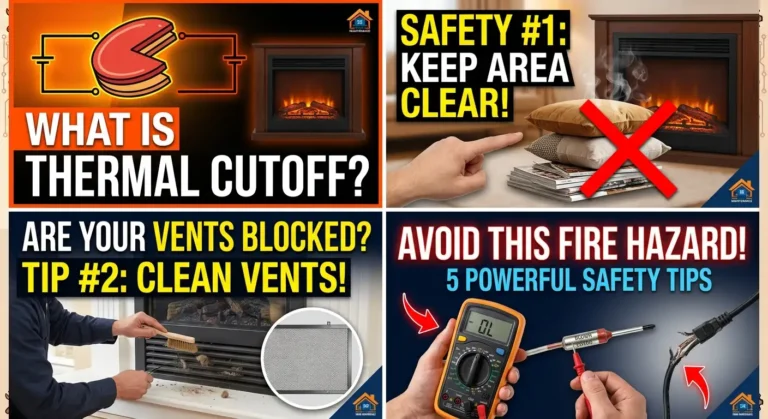
- Thermal cutoff models they use the thermal cutoff models, which use a resettable thermal switch. It switches when the internal temperatures are excessive and automatically turns off as the unit cools down, occasionally with a manual reset button that you press.
- Breaker-dependent models do not contain any internal fuse and depend solely on the circuit breaker of your home, or a special GFCI outlet to provide overcurrent protection.
- Hybrid models use a fuse to protect against surges and a separate thermal protection against overheating to provide 2 levels of protection.
When you open your fireplace and you find nothing that looks like a fuse, look in your owner manual, before you think that one has gone dead, it may have a thermal reset instead.
How Do You Know Your Electric Fireplace Fuse Isn’t Working?
The symptoms of a blown fuse are relatively uniform and this aids in eliminating or including it before opening up the unit.
Here is the clean, formatted table based on your data:
Electric Fireplace Troubleshooting: Fuse vs. Other Causes
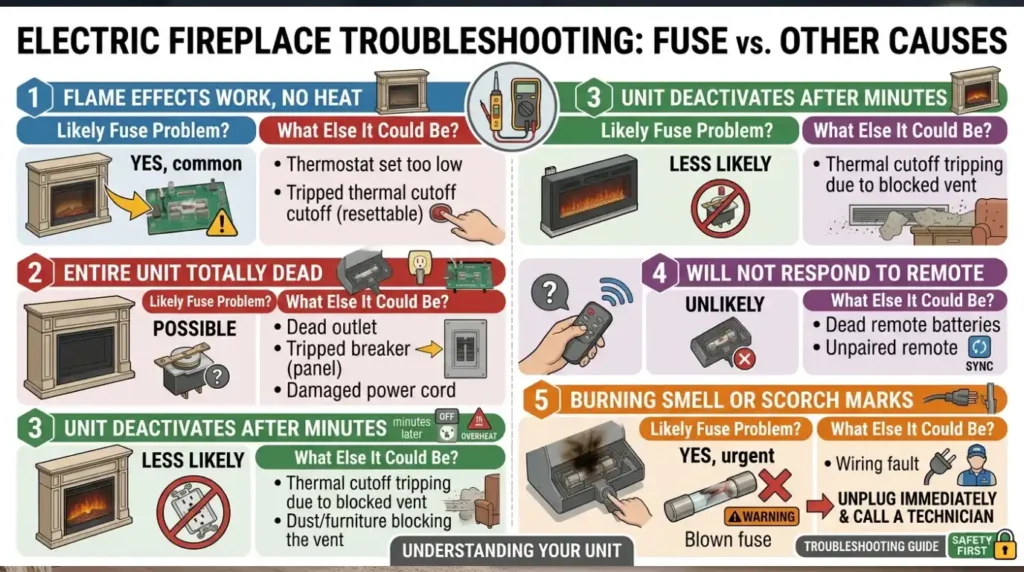
| Symptom | Likely Fuse Problem? | What Else It Could Be? |
| Flame effect works, no heat whatsoever | Yes, common | Thermostat set too low, tripped thermal cutoff. |
| Entire unit totally dead, no lights or flame | Possible | Dead outlet, tripped breaker, damaged power cord. |
| Unit activates, deactivates after a couple of minutes | Less likely | Thermal cutoff tripping due to blocked vent. |
| Unit will not respond to remote control | Unlikely | Dead remote batteries, unpaired remote. |
| Burning smell or visible scorch marks around the panel | Yes, urgent | Wiring fault — unplug immediately and call a technician. |
The most obvious fuse warning sign is a fireplace which is still lit or on fire but no heat, or a unit which will not respond at all on being switched on. When you open the fuse holder and notice a dark, cloudy or visibly broken wire in the glass tube, it is true.
How to Test the Fuse?
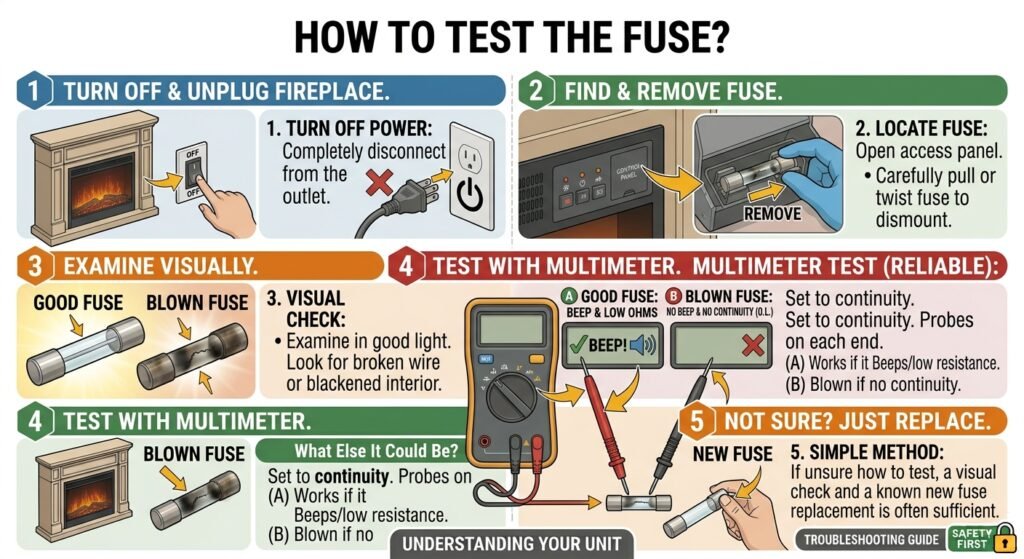
- Turn off the fireplace.
- Find the fuse in its holder, and dismount it, typically by pulling or twisting it out.
- Examine it in good light. A blown fuse will have a blackened, scalded inside or a wire that is evidently broken.
- To have a more reliable check, a multimeter in continuity mode is used. Test a probe on every end of the fuse – a fuse that works beeps or has low resistance, and a blown fuse shows no continuity whatsoever.
- Not sure how to use a multimeter? Visual inspection, with a new replacement fuse, is sufficient to verify the problem most of the time.
How to Replace an Electric Fireplace Fuse: Step-by-Step?
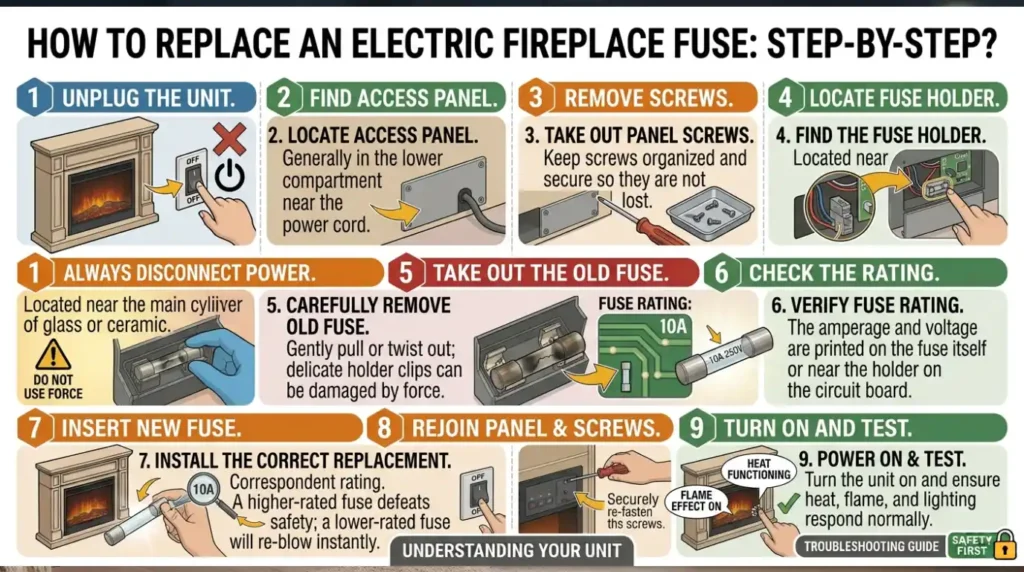
- Unplug the unit. Always remember to never work on a fireplace that is still on power supply.
- Find the access panel. It is generally a screwed metal or plastic cover in the lower compartment, close to the power cord.
- Take the panel screws out. Put them aside in a place you will not lose them.
- Locate fuse holder. It is located almost next to the main control board and typically it carries a small cylinder of glass or ceramic.
- Take out the old fuse. Gently pull or twist it out – do not use force, as the holder clips may be delicate.
- Check the rating. The amperage and voltage are printed either on the fuse itself or next to the holder on the circuit board.
- Insert the appropriate replacement. Correspond to the rating. The purpose of fuses is defeated by a higher-rated fuse, and a lower-rated fuse will reblots instantly.
- Rejoin the panel and screws.
- Turn on and test. Turn the unit on and ensure that there are heat, flame and lighting all respond normally.
Fuse Replacement Quick Reference
Here is the formatted table based on your data:
Fuse Replacement: Time & Tools Required
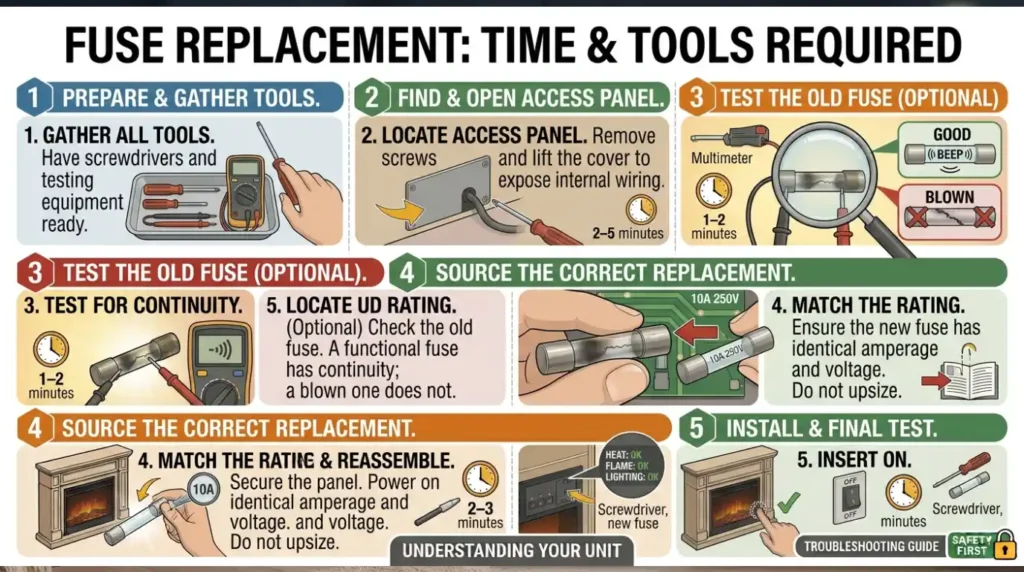
| Task / Step | Time Required | Tools Required |
| Find and open panel | 2–5 minutes | Phillips or flathead screwdriver |
| Test old fuse | 1–2 minutes (optional) | Multimeter |
| Source replacement fuse | Varies | Match rating on manual or old fuse |
| Install and test | 2–3 minutes | Screwdriver |
The majority of fuse replacement, when you have the proper part in hand, takes less than 15 minutes start to finish.
Common Electric Fireplace Fuse Issues and Fixes
- The fuse continues to blow over and over. This nearly always leads to something other than the fuse itself, a faulty heating coil, a short in the wiring, or the unit being on the same overloaded circuit as other high-draw devices. Again, changing the fuse without correcting what the problem was will only blow the next fuse.
- The incorrect fuse size was used. An oversized fuse allows a larger amount of current to pass than the circuit was supposed to be allowed, increasing the chances of fire and resulting in other components being damaged. Never exceed the original rating.
- Corrosion or loose holder. Corroded or bent clips on the holders may result in a fuse not making contact despite being in good condition. Wipe the contacts, ensure the fuse fits.
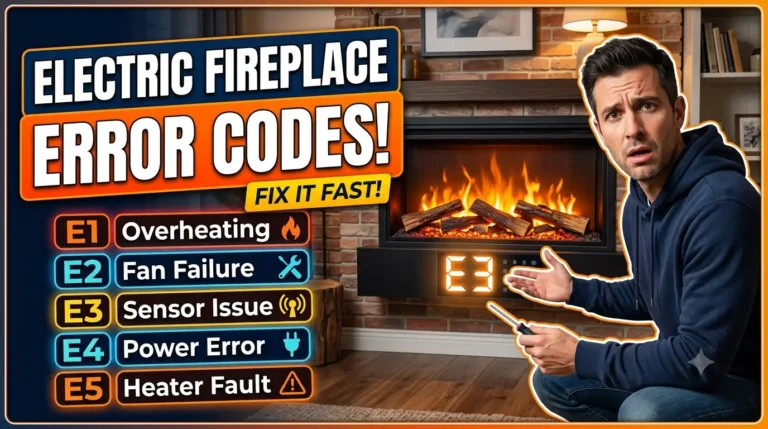
- Incidents of mixing a thermal cutoff with a fuse. Other owners would open their unit thinking that it had a fuse and then realize that it has a small reset button. That is a thermal cutoff and it typically only requires a solid press once the unit has cooled down (20-30 minutes).
- Fuse is okay and the unit still does not work. At this point the problem is in a different part of the circuit – check the outlet, the power cord, the thermostat setting, and the circuit breaker before concluding there is a second fuse problem.
Myth vs. Fact
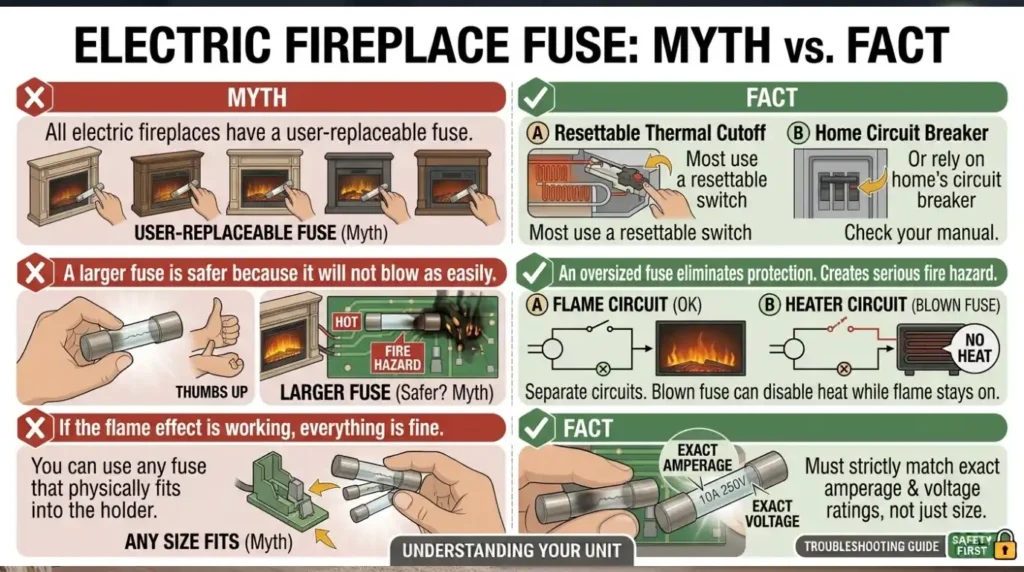
Here is the formatted table based on your data:
| Myth | Fact |
| All electric fireplaces have a user-replaceable fuse. | Most use a thermal cutoff or rely on the home’s circuit breaker instead—check your manual. |
| A larger fuse is safer because it will not blow as easily. | An oversized fuse eliminates the electrical protection and creates a serious fire hazard. |
| If the flame effect is working, everything is fine. | The flame display and the heater often run on separate circuits; a blown fuse can disable heat while the flame display remains on. |
| You can use any fuse that physically fits into the holder. | Fuses must strictly match the exact amperage and voltage ratings, not just the physical size. |
Common Mistakes to Avoid
- Installing a plug in fireplace when it is still plugged in.
- Making an educated guess of the fuse value rather than referring to the manual or the printed label on the old fuse.
- Thinking that a fuse that continues to blow will be fixed with just another replacement.
- Leaving a burning smell or scorch marks, and use the unit anyway.
- Over-tightening or forcing a stuck fuse holder, which may crack the plastic housing.
When to Call a Professional?
Changing a fuse is a relatively easy DIY project that most home owners can handle, but there are some red flags that indicate it is time to put the tool down and call an experienced electrician or fireplace worker:
- The new fuse blows once more instantly or in several uses.
- You see melted plastic, scorch marks or a burning odor around the control board.
- The internal compartment wiring is frayed, or discolored or loose beyond a mere reconnection.
- The unit bypasses the circuit breaker of your home with a good fuse installed.
- You do not like to open electrical parts, whatever the cause.
No harm in seeking the second opinion in this case since fireplace heating elements use really current and a faulty electrical device that reappears is not worth the trouble to troubleshoot repeatedly yourself.
You May Also Read:
FAQs:
Where do you find the fuse in an electric fireplace?
The fuse tends to be found either in the upper control compartment or in the lower control compartment, behind or under the glass front, and close to the power cord entry point of the unit. Others fix it in a rear junction box instead, mounted on the wall or built into the wall.
Are there any electric fireplaces that do not have fuses?
No. Others use a thermal cutoff switch that can be reset, others use only the circuit breaker in the house, and others use a fuse along with a thermal cutoff to provide two levels of protection.
What makes me know that my electric fireplace fuse is blown?
The most prevalent symptom is a unit that continues to exhibit flame effects and light but does not generate heat in any way. This can be easily observed by a visual inspection where a blackened or broken wire is found within the fuse itself.
Is it possible to test a fuse without a multimeter?
Yes, to a degree. The majority of blown fuses are detected by a visual inspection of a scorched or broken wire in the glass tube. Multimeter continuity test is not absolutely necessary but more accurate.
Is it safe to change the fuse myself?
Yes, provided you first disconnect the unit and replace it with an identical fuse, but one with the same amperage and voltage rating. In case the new fuse blows instantly, discontinue and call out a professional.
What are the tools that I will need to replace an electric fireplace fuse?
A Phillips or flathead screwdriver to open the access panel, and a multimeter optionally to check the fuse and pliers to assist in removing a stuck fuse.
My fireplace has flames, but no heat, why?
This is the typical indicator of a shorted fuse as the flame show and heating coil frequently operate on different sections of the circuit. The same can be caused by a tripped thermal cutoff or improper thermostat settings.
My Final Thoughts
One of the simplest issues that can be fixed by an electric fireplace is a blown fuse. Most times it only takes five minutes to do it when you know where to go: the lower control compartment, close to the power cord and behind a small panel screwed in. Fit the replacement fuse precisely, leave the unit unplugged during the work and consider a fuse that blows more than once as an indication to investigate further and not to continue changing components. To be on the safe side, the best place to be sure of the exact location and correct fuse rating of your unit is in the manual of your model and the support line of the manufacturer.