Do you have 240 V Electric Fireplaces? Yes – Here’s How They Deliver Three Times the Heat
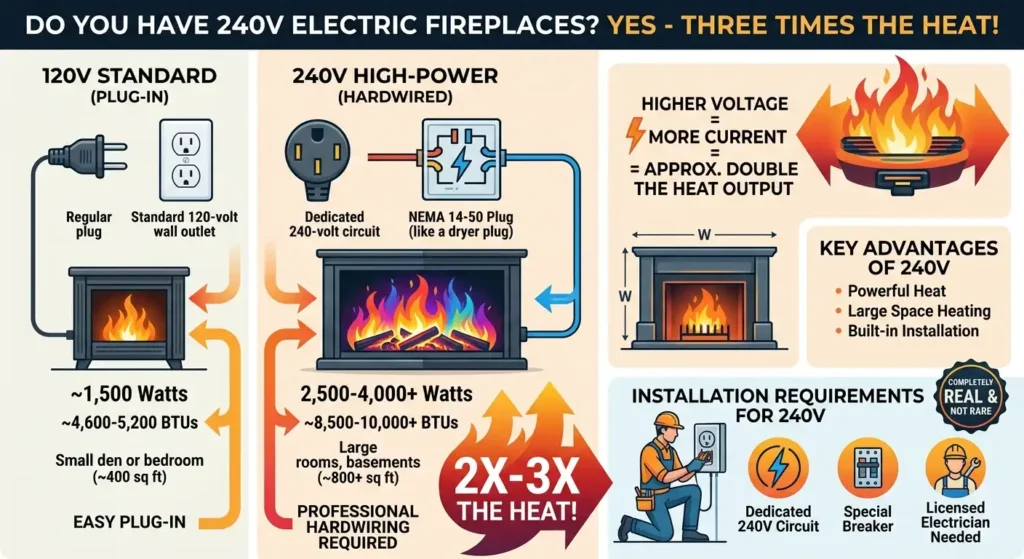
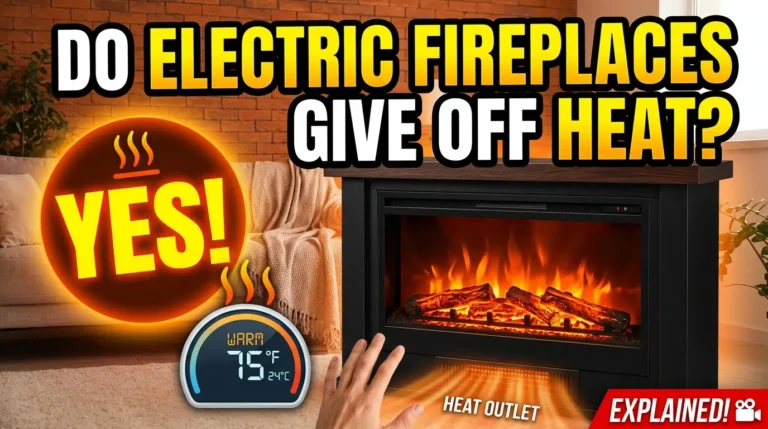
Yes, 240V electric fireplaces are real, and they’re not rare. If you’ve been shopping for an electric fireplace and every unit you find seems to top out around 5,000 BTUs, it’s because you’re looking at standard 120V, plug-in models. Once you switch to a hardwired 240V unit, that ceiling roughly doubles, often reaching 8,500 to 10,000+ BTUs from the same footprint.
That jump matters if you’re trying to heat more than a small den or bedroom. Below, you’ll find exactly how 240V electric fireplaces work, which brands make them, what installing one actually costs, and how to decide whether the extra heat is worth the extra wiring.
Quick answer:
Are There 240V Electric Fireplaces? Powerful Heat Options An electric fireplace that is 240 V operates on a 240-volt circuit in a home (the same type as a dryer or oven) rather than a typical 120-volt wall outlet. Since it can carry a higher current without danger, it will generate approximately twice the heat of a 120 V model, up to 8,90010,000+ BTUs, versus approximately 4,6005,200 BTUs with a plug-in unit. The majority of 240 V units must be hardwired by a licensed electrician into a special circuit.
What Does “240V Electric Fireplace” Actually Mean?
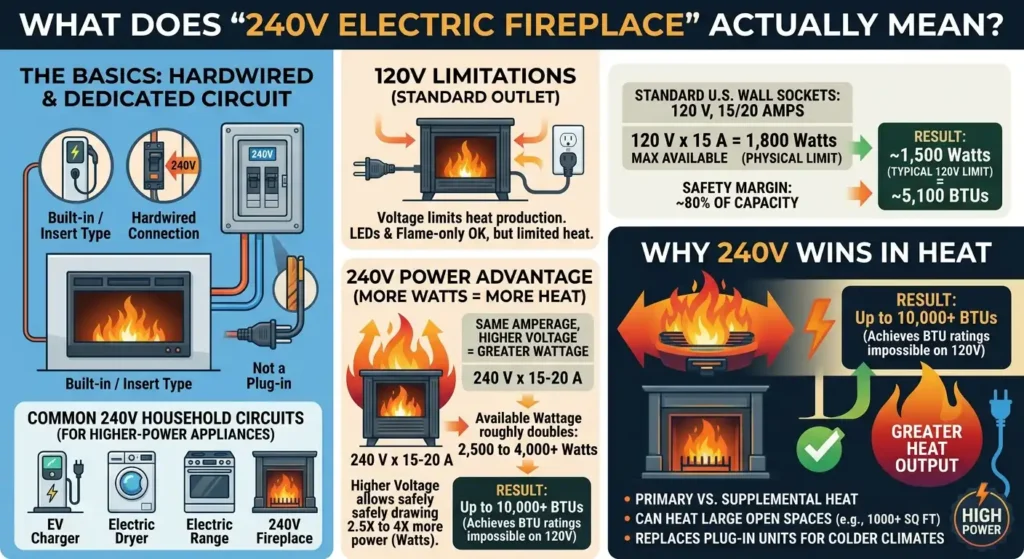
An electric fireplace is a built-in or an insert-type fireplace that is hardwired to a 240-volt household circuit instead of plugged into an electrical outlet. It is the same type of electricity as an electric clothes dryer, a range, or an EV charger.
Electric fireplaces come in regular models with 120 V that is the standard voltage of all wall sockets in the U.S. That will work well with the flame effect and the LED lights, but will limit the amount of the amount of heat the built in heater can produce. In the U.S. residential circuits are usually limited to 15 or 20 amps at 120 V, which is equivalent to about 1,800 watts, and manufacturers keep heaters well below that limit (usually 1,500 watts) so that the unit won’t cause a circuital breaker to trip when it is in any circuit with anything.
A 240 V circuit is different. A 240 V-rated electric fireplace can safely draw 2,500 to 4,000+ watts at the same amperage, and the higher the voltage used, the higher the available wattage, meaning a 240 V-rated electric fireplace can operate on a full 2,500 to 4,000+ watts safely. The greater the number of watts through the heating element the greater amount of heat produced and this is why 240 V units are able to achieve BTU ratings that physically cannot be achieved by a 120 V unit.
120V vs. 240V Electric Fireplaces: Side-by-Side Comparison
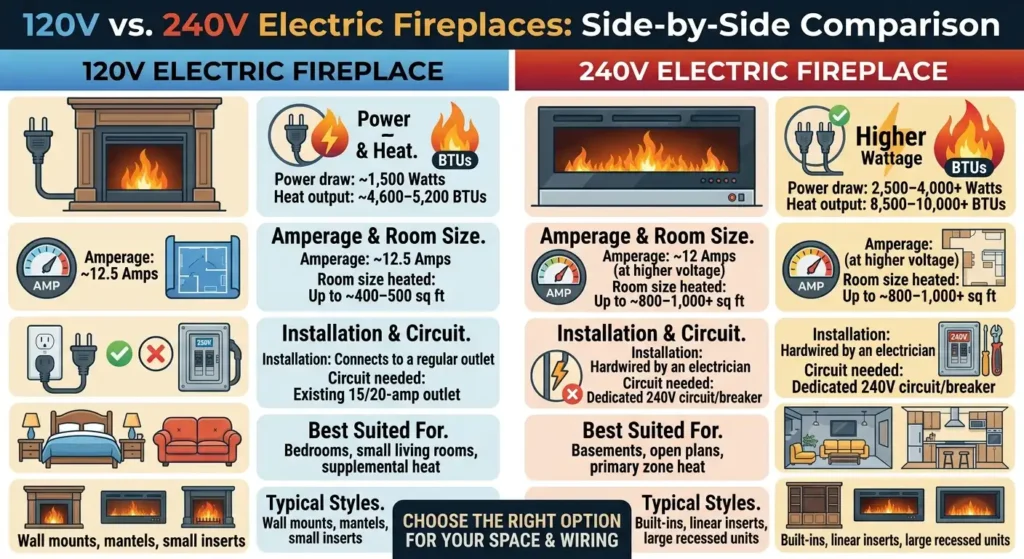
Here is the cleaned and properly aligned table based on your data:
| Feature | 120 V Fireplace | 240 V Fireplace |
| Power draw | ~1,500 watts | 2,500–4,000+ watts |
| Heat output | ~4,600–5,200 BTUs | 8,500–10,000+ BTUs |
| Amperage | ~12.5 amps | ~12 amps (at higher voltage) |
| Room size heated | Up to ~400–500 sq ft | Up to ~800–1,000+ sq ft |
| Installation | Connects to a regular outlet | Hardwired by an electrician |
| Circuit needed | Existing 15/20-amp outlet | Dedicated 240V circuit/breaker |
| Best suited for | Bedrooms, small living rooms, supplemental heat | Basements, open plans, primary zone heat |
| Typical styles | Wall mounts, mantels, small inserts | Built-ins, linear inserts, large recessed units |
The trend is similar among the manufacturers: the voltage doubled approximately doubles the wattage and consequently the BTU output but does not nearly double the amperage current across the circuit. That is all the charm of a 240 V unit. It provides powerfully greater heat without having to use a heavier-gauge wire than an average large appliance circuit already occupies.
How a 240V Electric Fireplace Actually Produces More Heat
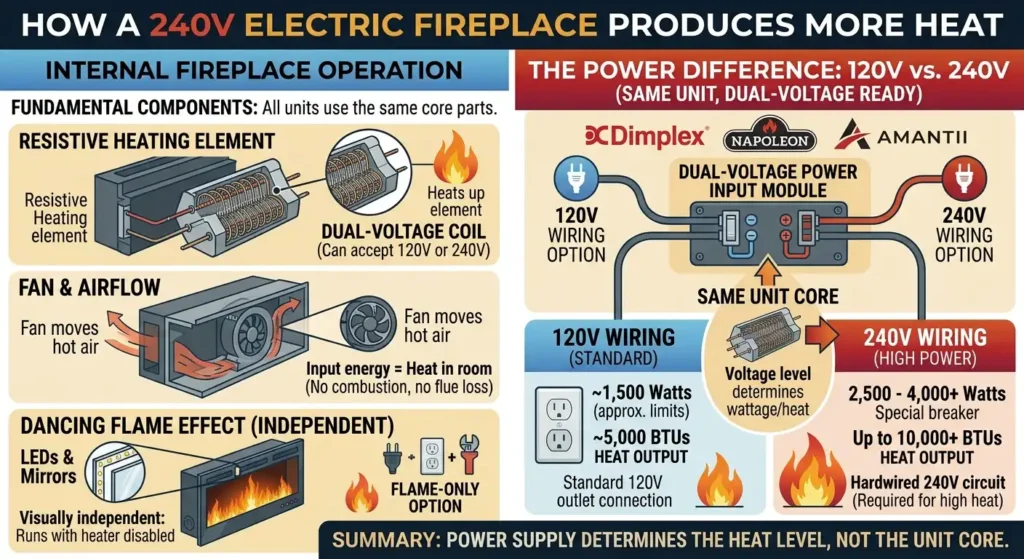
All electric fireplaces operate in a similar fundamental manner: the electricity is conducted through a resistive heating element (like the coil in a toaster or space heater), the heating element warms up, and a fan moves that hot air into the room. Combustion is eliminated; there is no flue and no fuel to burn so all the energy that is inputted is heat in the room. The dancing flame is an independent LED or mirror-based visual effect and can typically run with the heater disabled.
The only difference between a 120 V and a 240 V version of the same fireplace is the amount of electrical power that makes it to the heating element. Many built-in and insert models such as those of Dimplex, Napoleon, and Amanti are constructed as dual voltage, i.e. the same unit can be wired either 120 V (to provide about 5,000 BTUs) or 240 V (to provide up to 10,000 BTUs), depending on how an electrician wires it. The parts of the fireplace core remain the same, just the voltage to the heater changes.
How Many BTUs Do You Actually Need? Room Size Chart
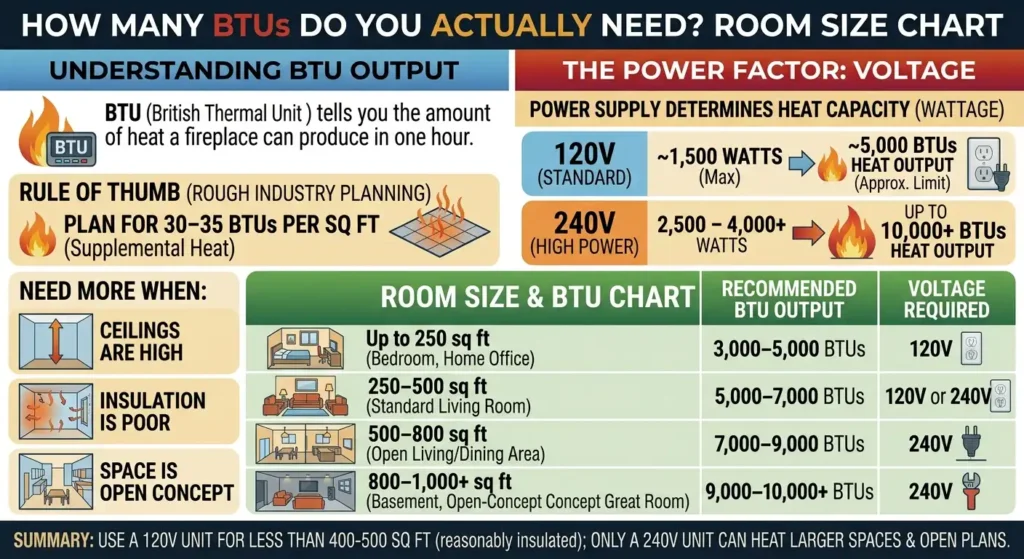
The output of BTU (British Thermal Unit) will tell you the amount of heat that a fireplace is capable of producing in one hour. The rule of thumb in planning in a rough industry is to plan on about 30 to 35 BTUs per square foot of space that you will want to heat in a supplemental source, or more when ceilings are high, insulation is poor, or the space is an open concept.
| Room Size | Recommended BTU Output | Voltage Required |
|---|---|---|
| Up to 250 sq ft (bedroom, home office) | 3,000–5,000 BTUs | 120V |
| 250–500 sq ft (standard living room) | 5,000–7,000 BTUs | 120V or 240V |
| 500–800 sq ft (open living/dining area) | 7,000–9,000 BTUs | 240V |
| 800–1,000+ sq ft (basement, open-concept great room) | 9,000–10,000+ BTUs | 240V |
With a target space of less than 400-500 square feet, and reasonably well insulated, you can probably get away with a 120 V unit, and save the money of an electrician. When you are heating a bigger open floor plan, a completed basement, or a room with large ceilings and large windows, only a 240 V unit is capable of providing you with a truly useful level of supplemental heat an electric fireplace provides.
Installing a 240V Electric Fireplace: What’s Actually Involved
Most homes cannot do the installation since a 240 V fireplace requires a separate circuit than a typical outlet. The overall process is as follows:
- Panel assessment. An electrician determines the availability of empty spaces and slots in your breaker panel to install a new 240 V, double-pole breaker.
- Circuit run. New wiring (usually 10 or 12 AWG, depending on the amp draw of the unit) is installed between the panel and the location of the fireplace.
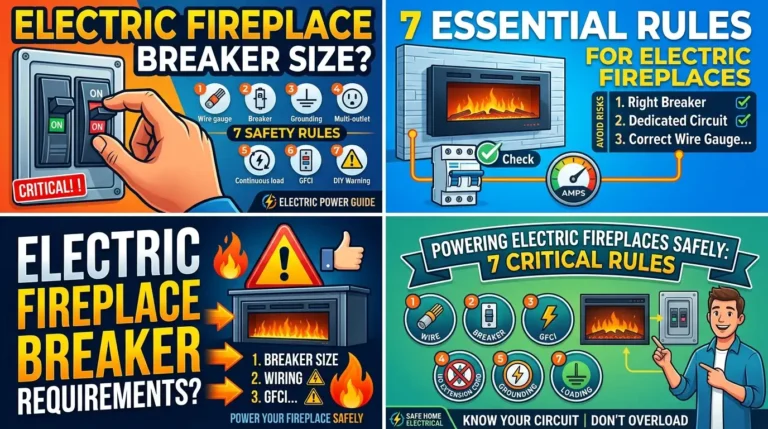
- Dedicated breaker installation. To the panel, a 2030 amp, 240 V breaker is installed that is exclusively dedicated to the fireplace, not to be shared with other appliances.
- Hardwire connection. The electricians wire the fireplace directly to the circuit (no outlet plug involved), and according to the wiring diagram of the manufacturer.
- Permit and inspection (where necessary). An electrical permit and inspection of new circuit work is required in many municipalities, and should be done by your electrician.
- Framing and finishing. In built-in or recessed types, carpentry (framing, drywall, trim, or mantel surround) often occurs prior to or subsequent to the electrical connection.
Installation Cost Breakdown
| Cost Component | Range Typical |
|---|---|
| New dedicated 240V circuit (materials + labor) | $250–$900 |
| Electrician hourly rate | $50–$150/hour |
| Hardwiring labor (1–3 hours typical) | $150–$450 |
| Permit fees (if required) | $50–$85 |
| Framing/drywall/trim for built-ins | $200–$1,000+ |
| Total for a hardwired 240V install | $600–$2,000+, depending on distance from the panel and finish work |
Prices increase when your electric panel is full (you can add a sub panel at an extra $600-1200) or when the place of the fireplace is distant to the breaker panel because longer wiring will require more man hours. Never agree to anything without a written quote and make sure that the electrician is licensed and holding any necessary permit; otherwise, this may lead to issues later, once you sell the house or have to make an insurance claim.
Dual-Voltage Models: Getting the Best of Both Worlds
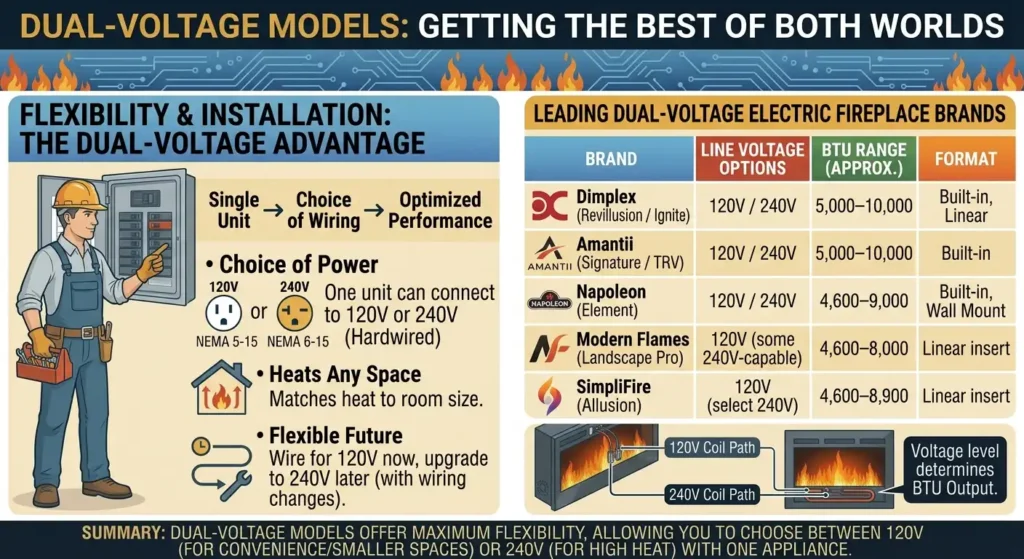
A good deal of the built-in and linear electric fireplaces currently available in the market are designed as dual-voltage, and therefore you would not be restricted to one or the other at the time of purchase. That generally works out as shown in the table below.
| Brand | Line Voltage Options | BTU Range Approx. | Format |
|---|---|---|---|
| Dimplex Revillusion / Ignite | 120V / 240V | 5,000–10,000 | Built-in, linear |
| Amantii Signature / TRV | 120V / 240V | 5,000–10,000 | Built-in |
| Napoleon Element | 120V / 240V | 4,600–9,000 | Built-in, wall mount |
| Modern Flames Landscape Pro | 120V (some 240V-capable) | 4,600–8,000 | Linear insert |
| SimpliFire Allusion | 120V (select 240V) | 4,600–8,900 | Linear insert |
The exact model is always specified in the spec sheet, as not all size/trim levels in a series will be 240 V; some smaller units in a series are only 120 V. When flexibility is important to you (you may move or you are not even sure you will get an electrician out there in the near future), a dual-voltage fireplace allows you to work with a regular outlet and convert to 240 V heat in the future without having to replace the fireplace.
Pros and Cons of a 240V Electric Fireplace
| Pros | Cons |
|---|---|
| Increases the heat production of a 120 V unit by up to 2 times | Installing is only allowed to be done by a licensed electrician. |
| Can genuinely heat larger, open-concept rooms | Added upfront cost for wiring and permits |
| Still zero emission, no venting or chimney | Not portable after hardwiring installed |
| Included with better integrated designs, often | Oversized to small or well-insulated rooms, often |
| Most models can be operated with the flame off and the heat on | Retrofitting an older panel may add to the cost |
240V Electric Fireplace vs. Gas vs. Wood
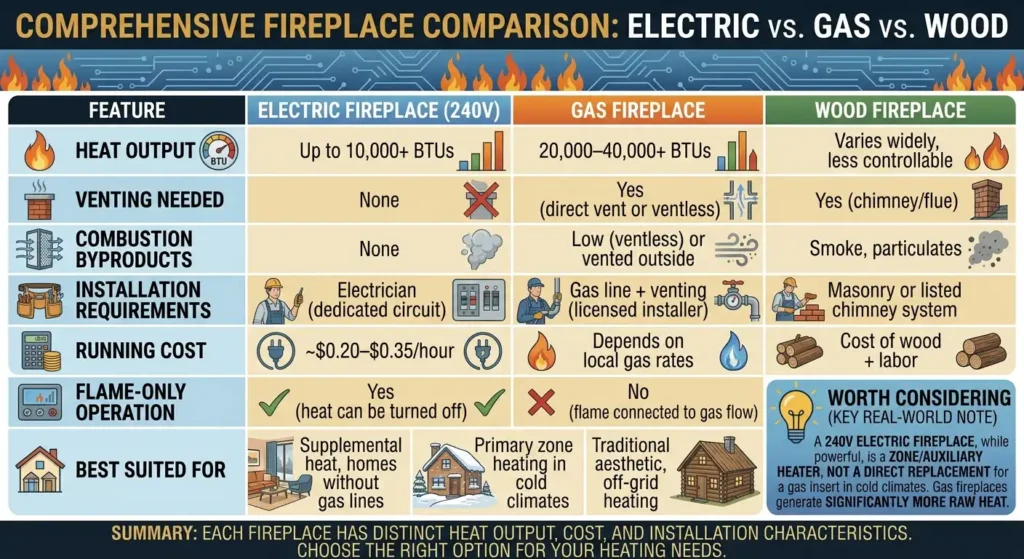
| Feature | Electric Fireplace (240 V) | Gas Fireplace | Wood Fireplace |
| Heat output | Up to 10,000+ BTUs | 20,000–40,000+ BTUs | Varies widely, less controllable |
| Venting needed | None | Yes (direct vent or ventless) | Yes (chimney/flue) |
| Combustion byproducts | None | Low (ventless) or vented outside | Smoke, particulates |
| Installation requirements | Electrician (dedicated circuit) | Gas line + venting (licensed installer) | Masonry or listed chimney system |
| Running cost | ~$0.20–$0.35/hour | Depends on local gas rates | Cost of wood + labor |
| Flame-only operation | Yes (heat can be turned off) | No (flame connected to gas flow) | No (flame connected to burning wood) |
| Best suited for | Supplemental heat, homes without gas lines | Primary zone heating in cold climates | Traditional aesthetic, off-grid heating |
Worth considering even in the upper range a 240 V electric fireplace will radiate significantly less raw heat than a gas fireplace. It is a powerful auxiliary or zone-heater, not a substitute to your hearth or a gas insert in an area with a real cold climate.
Common Mistakes to Avoid
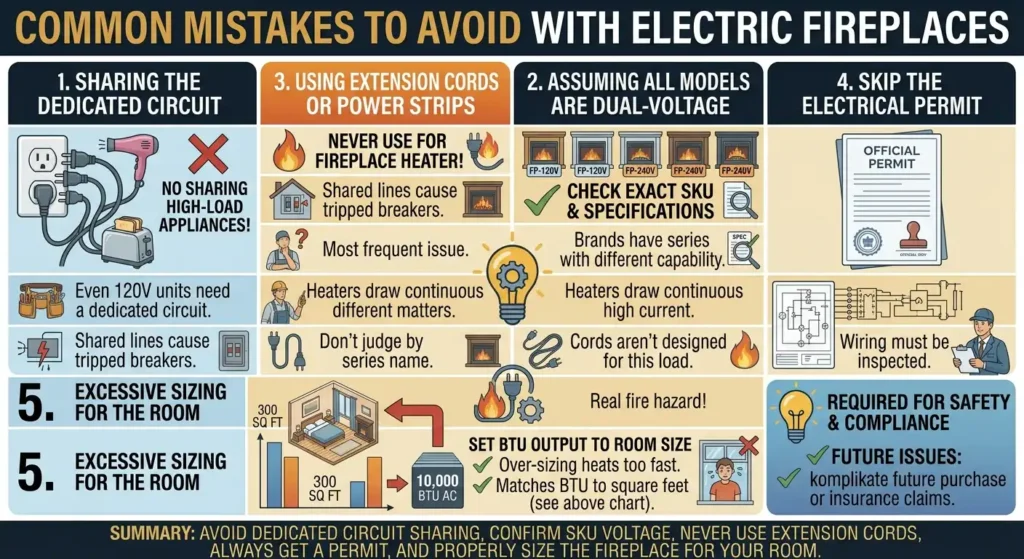
- Leaving the dedicated circuit. Even some 120 V units are supposed to be on their own circuit; sharing it with other high-current appliances (hair dryers, vacuums, space heaters) is the most frequent source of tripped breakers.
- Suppose it is all 240 V in a product line. Check the exact size and SKU rather than the brand name because the voltage capability may not be exactly the same across a series.
- Electric fireplace heaters can require continuous, high current; an extension cord or power strip is not designed to carry that amount of current and is a real fire hazard.
- Leaving out the permit Inviting a purchase or insurance claim in future, even when the wiring is found to be correctly installed, may be complicated by the fact that the permit was left out.
- Excessive sizing to a small room. A 10,000-BTU air conditioner in a 300-square-foot bedroom will heat the room too fast; set the BTU production to square feet on the above chart.
Is a 240V Electric Fireplace Right for You? Quick Checklist
- Your heating room is bigger than 500 square feet, is open-concept, or is not well insulated.
- You desire the fireplace to be a real, primary supplemental heat source not merely ambience.
- You are at ease employing a licensed electrician and spend between $600 and 2,000+ on wiring and finish work.
- You will have space in your electrical panel to add an extra 240 V circuit (or you will add a subpanel)
- You are putting in place an in-built, recessed or linear system instead of a portable, plug-in one.
When you marked most of these boxes, then a 240 V model is probably worth the investment. A 120 V unit will work just as well and cost you a fraction of the price and effort in the event you have a small area or require something you can plug in today.
You May Also Read:
- Can I Safely Install an Electric Fireplace in a Mobile Home?
- Can You Put an Electric Fireplace in a Cabinet? 7 Essential Safety Tips
FAQs:
Are electric fireplaces available that operate on 240 V?
Yes. Most built-in, insert and linear electric fireplaces, such as Dimplex, Napoleon and Amanti, come in either 240 V, or dual-voltage (120 V/240 V) versions with up to 8,900-10,000+ BTUs.
What is the BTU output of an electric fireplace on 240 V?
A majority of 240 V units are designed to produce 8,500 to 10,000+ BTUs, approximately twice the usual 4,600-5,200 BTU output of standard 120 V plug-in units.
Should I hire an electrician to install a 240 V electric fireplace?
Yes, practically in every instance. A 240 V unit has to be hardwired into a special circuit, and this necessitates a licensed electrician and probably an electrical permit in most jurisdictions.
Is the fireplace compatible with either 120 V or 240 V?
Most of these are designed to be dual voltage, i.e. the same unit can be wired with either voltage based on your electrical installation and heating requirements. verify the spec sheet of the model.
What is the cost of wiring an electric fireplace of 240 V?
Your dedicated circuit will cost around $250-900, and the hardwiring will cost around $150-450. All project expenses (including framing or finish work) usually fall in the range of 600-2,000 or more.
What is the area of a 240 V electric fireplace that can be heated?
About 800-1000+ square feet versus approximately 400-500 square feet of a typical 120 V design, but the real-world results vary based on insulation, ceiling height and design.
Is 240 V electric fireplace more unsafe than 120 V?
Not when properly installed. A 240 V circuit has the same electrical code protections (proper breaker sizing, grounding and licensed installer) as any other major appliance circuit, e.g., dryer or range.
Are electric fireplaces that operate on 240 V more expensive to operate?
Running cost is not based on voltage but on the wattage and the local electricity rate. Full heat at 240 V (2,500 -4,000 watts) costs an average of twice as much as a 120 V unit (1,500 watts) per hour, as it is only consuming more power to generate more heat.
Is it possible to make my current 120 V electric fireplace 240 V?
Only in case the particular model is made to be dual voltage. A 120 V fireplace cannot be rewired safely to 240 V; you would have to replace it with a dual-voltage or 240 V-rated appliances.
What is the difference between 220 V. and 240 V. electric fireplaces?
Practically, nothing; both 220 V and 240 V are used interchangeably in North America, to refer to the same type of high-voltage household circuit. The two terms are usually used interchangeably by manufacturers and retailers of the same product.
Key Takeaways
- 240 V electric fireplaces exist, and are common, and are approximately twice the heat of 120 V models: to 8,50010,000+ BTUs versus 4,6005200 BTUs.
- They have to be hardwired into a special 240 V circuit by a licensed electrician, with an average cost of installation being 600-2000 or more.
- Lots of high-end in-built models (Dimplex, Napoleon, Amantii) come in two voltages, allowing you to use either 120 V or 240 V out of the same product.
- 240 V fireplace when the room is larger than about 500 square feet or in open plan the smaller rooms that are well insulated can be on 120 V.
- Electric fireplaces are always emissions-free and ventless, unlike gas or wood-based fireplaces, regardless of their voltage.