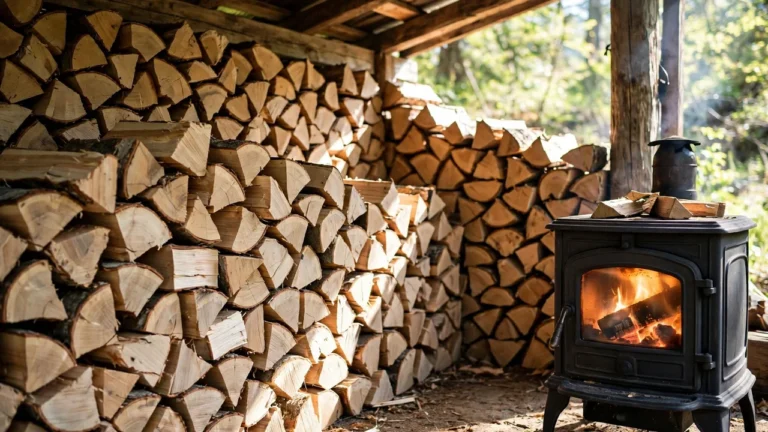
Is Birch a Hardwood? What the Wood Is, How It Burns, and Where It Works Best
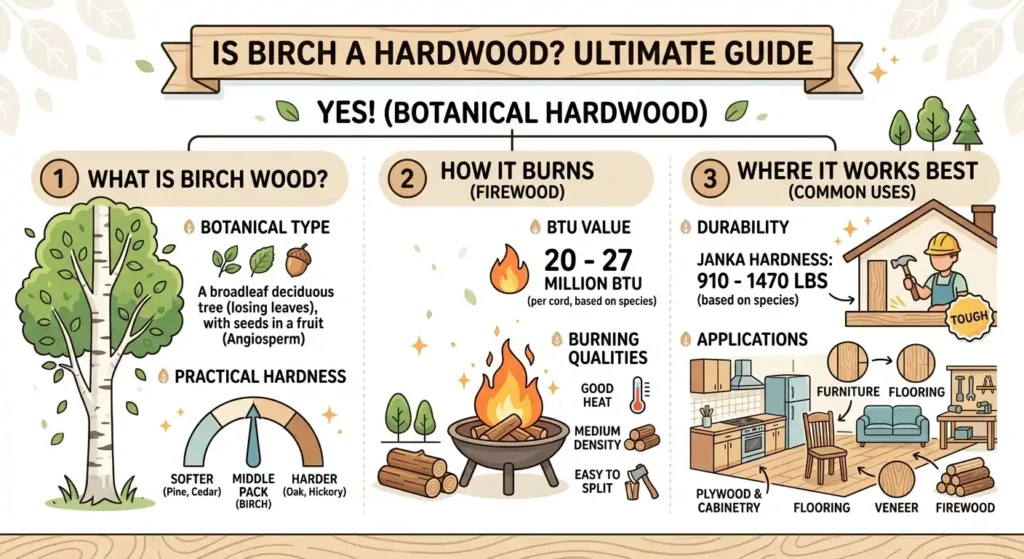
Birch appears everywhere, in the white-barked trees in a backyard, the wood piled next to a cabin, or the plywood in a kitchen cabinet. That spectrum begs a reasonable question: is birch a hardwood or is it a pretender?
The answer to this is yes, birch is a hardwood. But that single word doesn’t tell you much about how it performs. You will find the actual botanical account below, the true BTU figures of burning it, the hardness figures of constructing with it, and a plain idea when to use birch and when to use another wood.
Is Birch a Hardwood? The Quick Answer
Yes. Birch (genus Betula) is a hardwood since it is a tree of the broadleaf, a deciduous tree, and has seeds within a covering or fruit, or an angiosperm, as botanists refer to it. That classification has no bearing on the hardness of the wood physically.
Practically, birch is placed in the center of the hardwood pack. It is sturdier and heavier than pine or cedar, and lighter than oak, hickory, or hard maple. That middle ground is precisely why birch is so versatile in so many applications, both as firewood and furniture, and not the best at any one of the extremes.
Quick facts:
- Botanical type: hardwood (deciduous, broadleaf, angiosperm)
- Janka hardness: about 910 to 1470 lbs per species.
- Firewood BTU: approximately 20-27 million BTU per cord based on species.
- Uses that are common: firewood, flooring, furniture, plywood, cabinetry, veneer.
What Actually Makes a Wood a “Hardwood”
Hardwood vs. Softwood: The Real Definition
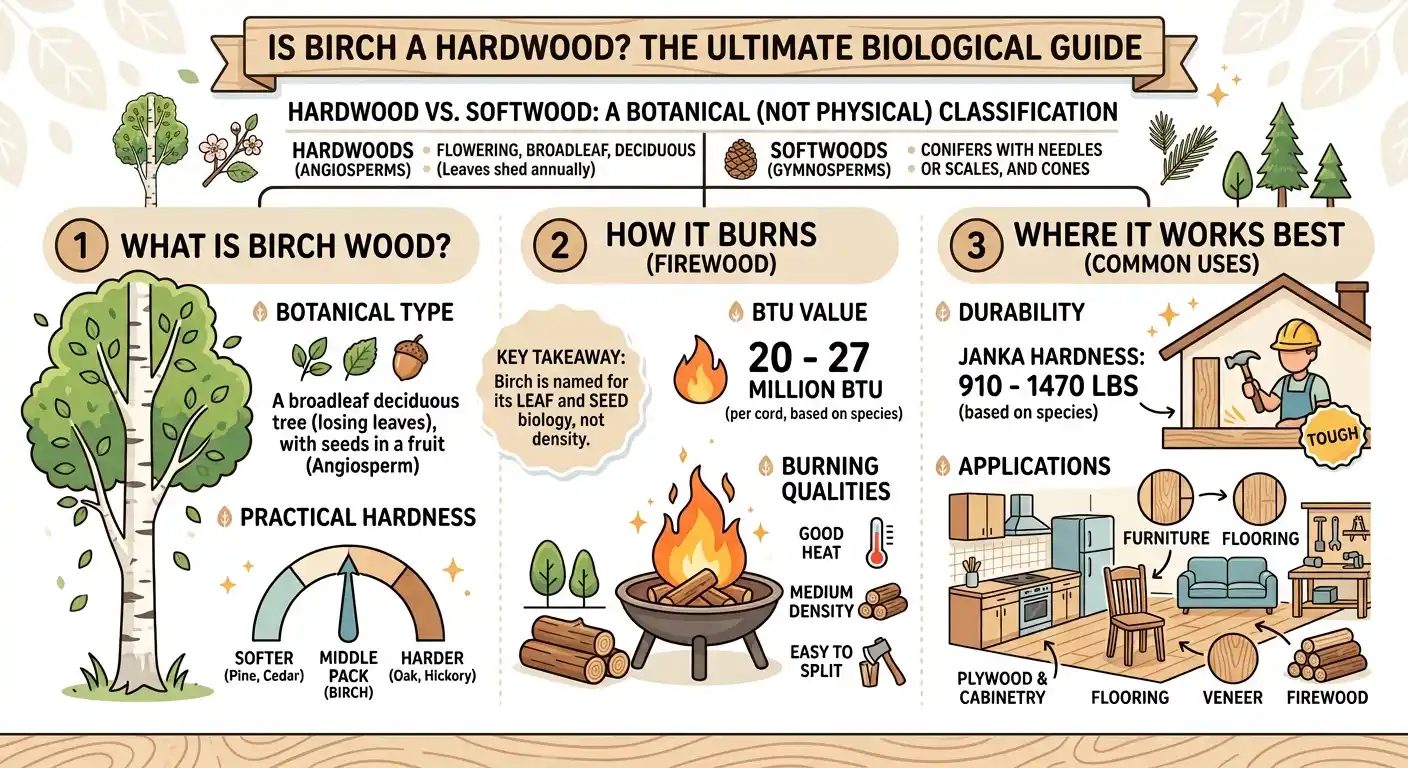
The labels of hardwood and softwood are botanical rather than physical. Foresters and biologists do not sort by density but by the mode of reproduction and growth of trees.
- Hardwoods are angiosperm trees, that is, flowering, broadleaf trees that shed their leaves annually (deciduous). All of oak, maple, walnut, ash, and birch belong to this category.
- Softwoods are produced by gymnosperm trees, or conifers with needles or scale-like leaves and cones. Softwoods are pine, spruce, fir, and cedar.
Since birch is a broadleaf, flowering, deciduous tree in the Betulaceae family, it satisfies all the criteria of hardwood classification, whether it feels like a fingernail.
Why “Hardwood” Doesn’t Always Mean Hard
This is the point of the greatest misunderstanding. Among the hardwoods there are a few really soft woods, and among the softwoods are a few really dense ones.
- Balsa wood is a hardwood technically, but one of the lightest woods in the world.
- Longleaf pine is a softwood that is denser and harder than some of the actual hardwoods.
Birch is in a moderate middle zone. It is harder than balsa or basswood, but is much lighter and easier to work than oak or hickory. That is the subtlety that most of the competing articles omit, and the reason that birch can be too light to certain individuals who think that all hardwoods must be heavy.
Key takeaway: Hardwood is not a claim of density but a claim of the biology of the tree. Birch is so named because of its leaf-bearing and seed-producing form, and its true hardness depending on the species.
Meet the Birch Family: Main Species and Their Differences
“Birch” isn’t one single wood. Betula genus comprises approximately 60 species, although some of them are frequently found in firewood, flooring, and furniture.
- Yellow birch (Betula alleghaniensis): The hardest of all the common commercial birches. Grows in the northeast of the U.S. and eastern Canada. Flooring and furniture popular.
- Sweet birch / black birch (Betula lenta): The hardest and densest of common birch, and smells of wintergreen when cut. Good firewood and a good flooring option.
- Paper birch (Betula papyrifera): It has a white, peeling bark that is bright white. Lighter than yellow or sweet birch, usually used as firewood, pulp, and craft.
- White birch / silver birch (Betula pendula): widespread in Europe and commonly planted as an ornament in North America. Softer wood, mostly used decoratively or as firewood.
- River birch (Betula nigra): Are more heat and flood resistant than other birches, and are commonly used as a decorative tree, not as a lumber source.
Comparison Table: Birch Species at a Glance
| Species | Janka Hardness (lbf) | Typical BTU per Cord | Best Known For |
| Sweet (black) birch | ~1,470 | ~26 to 27 million | Firewood, flooring, furniture |
| Yellow birch | ~1,260 | ~21 million | Flooring, furniture, cabinetry |
| Paper birch | ~910 | ~20 million | Firewood, crafts, pulpwood |
| White (silver) birch | ~850 | ~20 million | Ornamental landscaping, firewood |
Figures are average of species, which are aggregated with wood-industry and firewood-industry sources; different boards or logs may be different depending on the growing conditions and moisture content.
How Hard Is Birch, Really? Janka Rating Explained
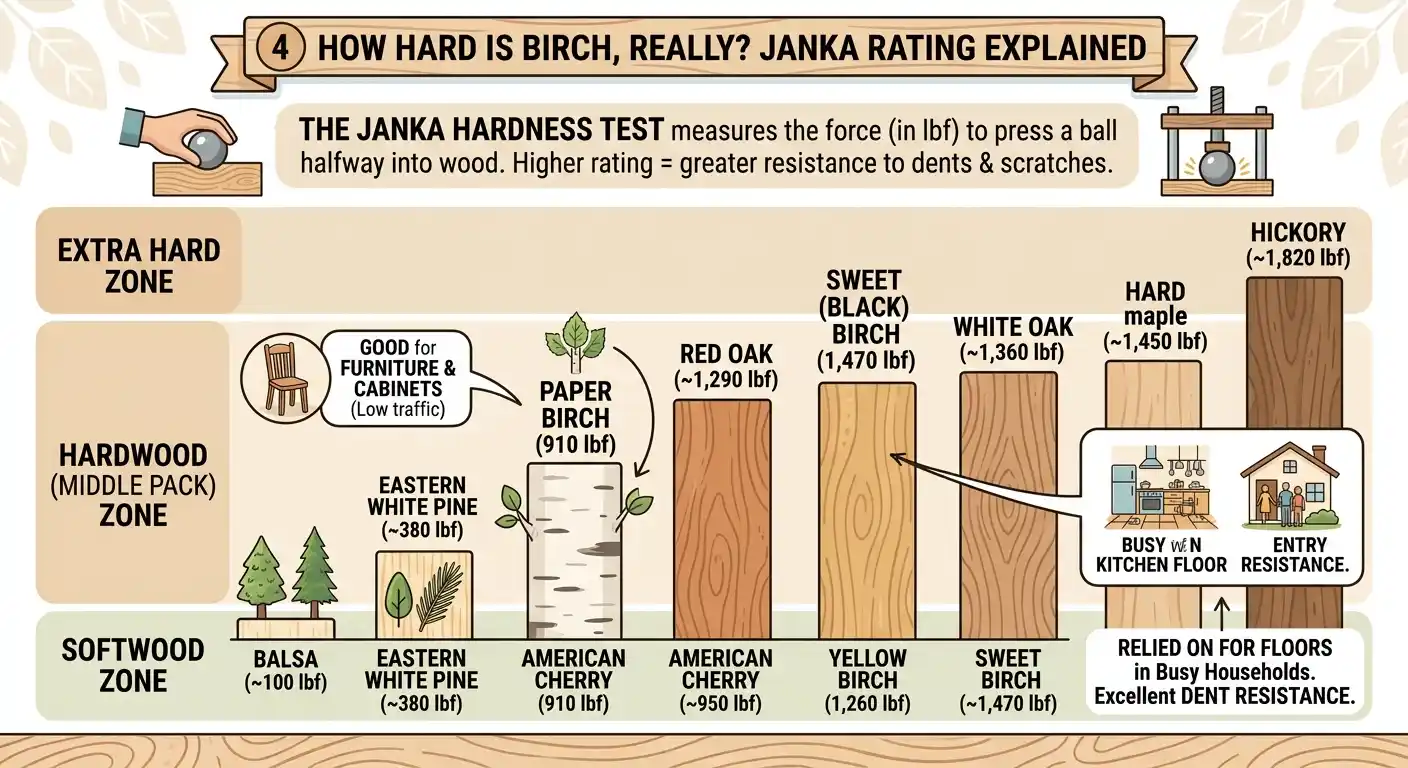
Janka hardness test is used to determine the amount of force required to push a steel ball half way into a wood. The more the better the wood becomes resistant to dents and scratches.
Birch compares with woods people most frequently:
| Wood Species | Janka Rating (lbf) |
| Balsa | ~100 |
| Eastern white pine | ~380 |
| American cherry | ~950 |
| Paper birch | ~910 |
| Yellow birch | ~1,260 |
| Red oak | ~1,290 |
| Hard maple | ~1,450 |
| Sweet (black) birch | ~1,470 |
| White oak | ~1,360 |
| Hickory | ~1,820 |
Yellow and sweet birch are near red oak and hard maple, hence the reason why they are relied upon as flooring in busy households. Paper and white birch are more in proximity with cherry, which is still strong enough to be used in furniture and cabinets, but not in a busy entry.
Is Birch Good Firewood? BTU, Burn Time, and Burn Quality
Yes, birch is good firewood, but there is one caveat: what kind of birch you are burning alters the answer.
Birch Firewood BTU Chart (Compared to Oak, Maple, and Pine)
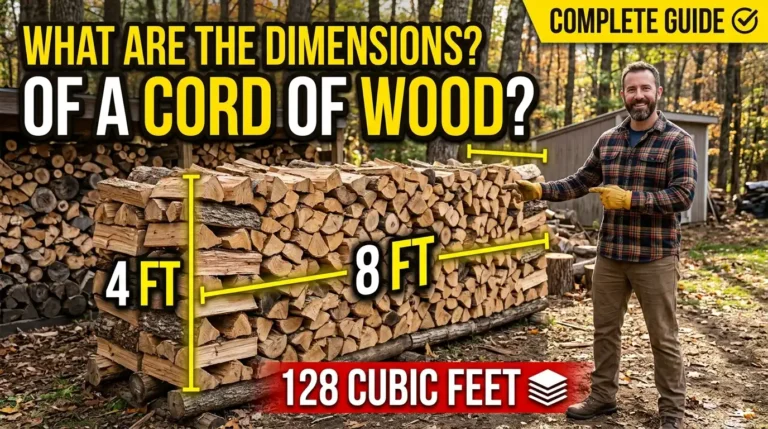
BTU (British Thermal Unit) per cord tells you how much heat a full cord of seasoned wood can produce. A cord measures 4 feet by 4 feet by 8 feet, or 128 cubic feet of stacked wood. If you want the exact stacking dimensions and volume breakdown, it’s worth reviewing before you buy in bulk, since a cord of birch will weigh noticeably less than an equivalent cord of a denser species.
| Firewood | Approx. BTU per Cord (million) |
| Hickory | ~27 |
| Sweet (black) birch | ~26 to 27 |
| Oak (red or white) | ~24 to 25 |
| Ash | ~24 |
| Yellow birch | ~21 |
| Hard maple | ~20 to 24 |
| Paper/white birch | ~20 |
| Pine (softwood) | ~14 to 21 |
The chart above is not as important as two things: species and moisture content. A length of well-seasoned sweet birch can compete with oak. Unseasoned, wet paper birch will generate significantly less usable heat, since energy will be wasted boiling away trapped water, before the wood can combust effectively.
How Birch Actually Burns: Flame, Smoke, and Aroma
Birch is a rapid grower, and in great measure, owing to the natural oils, called betulins, in its bark. Even wet birch bark ignites quickly, and that is why it is valued as a natural fire starter by campers and survivalists.
Birch produces:
- A flaming blaze of fire.
- medium, sweet smell, no strong pine-tar of softwoods.
- When seasoned moderately, a fair share of smoke and ash.
Compared to denser hardwoods like oak or hickory, birch burns a bit faster and doesn’t hold coals quite as long. Many experienced burners use birch to get a fire established quickly, then add a slower-burning hardwood like oak once the fire is going strong; if you’re deciding how much of either to buy, understanding what separates a partial stack from a full one will help you avoid overpaying.
How Long Does Birch Need to Season?
Birch usually requires 6 to 12 months of correct seasoning (divided, piled off the ground and covered only on top) to reduce the green moisture content of about 40 to 50 percent to the 15 to 20 percent range that burns well.
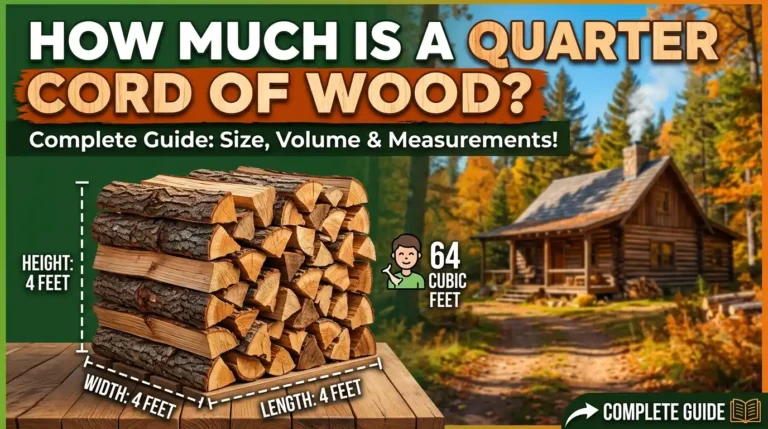
If you’re stacking a full winter’s supply and want to confirm you’re getting what you paid for, this guide to how much wood actually fits in a standard cord is worth a look. Because birch bark is somewhat waterproof, whole rounds can trap moisture underneath the bark even after the wood looks dry, so splitting logs before seasoning is important.
A Word of Caution: Birch Bark and Creosote
The bark of the birch burns quickly and intensively, like a fire-starter, due to the presence of oil. That is an advantage to kindling, but it also implies that a whole firebox of bark-laden, unseasoned birch will burn more smoke and creosote in a chimney than a load of clean-burning, fully seasoned wood.
When you burn birch in a wood stove or a fireplace insert, you should have your chimney inspected at least once a year, and it is common sense with any wood-burning appliance of any species.
Pros and Cons of Burning Birch Firewood
| Pros | Cons |
| Lights easily, even when slightly damp | Burns faster than denser hardwoods like oak |
| Solid heat output, especially sweet birch | Doesn’t hold coals as long overnight |
| Pleasant, mild aroma | Bark can burn very hot and fast if unseasoned |
| Splits easily by hand or with a maul | Some species (paper, white birch) run on the lighter side for BTU |
| Widely available in northern climates | Needs full seasoning to avoid smoke and creosote |
Birch Beyond the Fireplace: Furniture, Flooring, and More
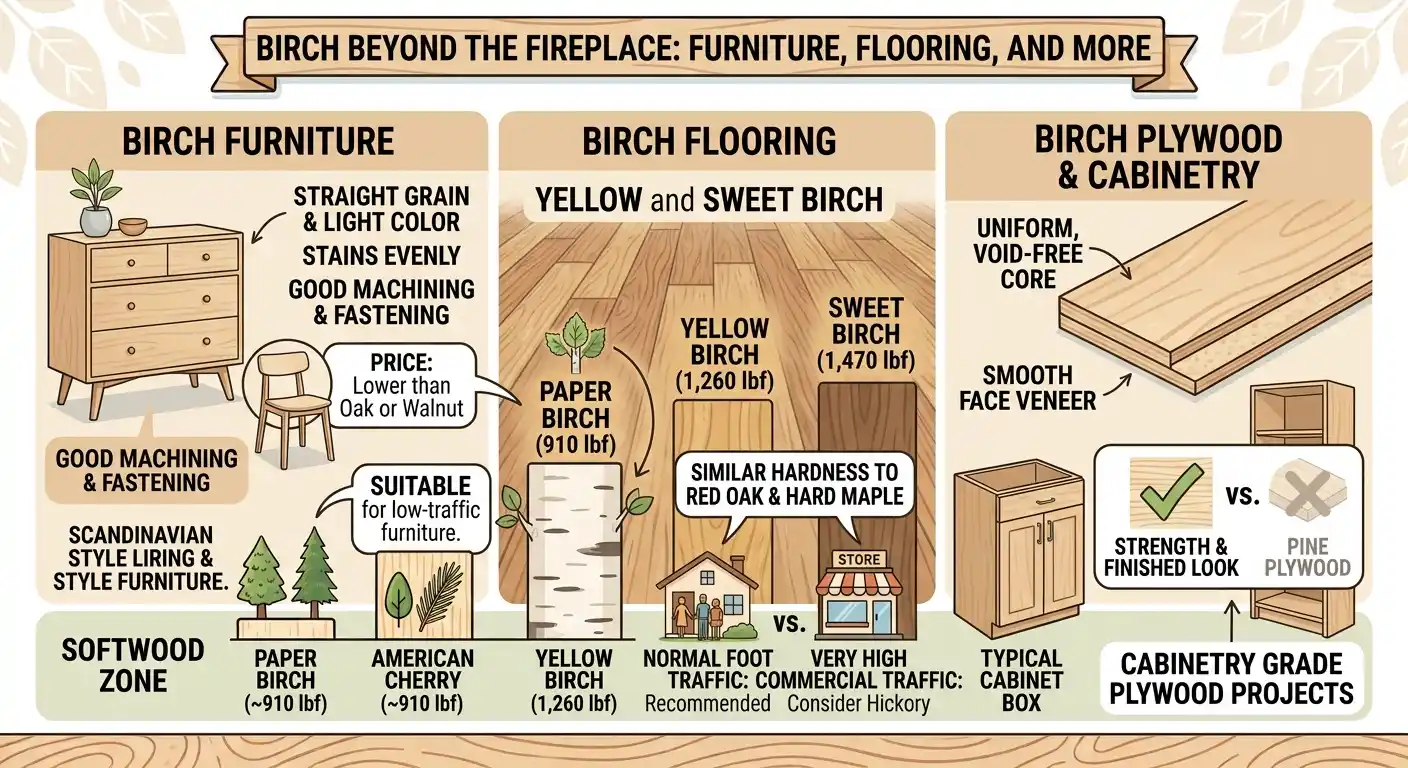
Birch Furniture
The straight grain and light color of Birch make it popular with mid-century modern and Scandinavian-style furniture. It stains evenly, machines, and retains screws and joinery, so it appears frequently in dressers, cabinets, and chairs at a lower price than oak or walnut.
Birch Flooring
Yellow and sweet birch are typical hardwood flooring materials since they have the same Janka rating (1,260 and 1,470, respectively) as red oak and hard maple. Birch flooring is also able to withstand normal foot traffic but very high-traffic commercial areas are inclined to hickory and other hard species.
Birch Plywood and Cabinetry
The Birch plywood is considered to be one of the most admired sheet goods in the woodworking due to its uniform and void-free core and smooth face veneer. It is used as a typical cabinet box, shelving, and furniture grade plywood project, where it is used in preference over pine plywood due to its strength and finished look.
Birch vs. Other Common Hardwoods
If oak keeps coming up as the benchmark, that’s fair; it’s the standard most people measure other firewood against. We break down its BTU output, seasoning time, and burn quality in detail here, which is useful if you’re deciding whether to split your wood pile between the two species.
| Feature | Birch (Yellow/Sweet) | Oak | Maple | Pine (Softwood, for reference) |
| Hardwood/Softwood | Hardwood | Hardwood | Hardwood | Softwood |
| Janka Hardness | 1,260 to 1,470 | 1,290 to 1,360 | 1,450 | 380 to 870 |
| Firewood BTU/cord | 21 to 27 million | 24 to 25 million | 20 to 24 million | 14 to 21 million |
| Grain Pattern | Fine, straight | Open, pronounced | Fine, sometimes figured | Straight, resinous |
| Common Uses | Flooring, furniture, plywood, firewood | Flooring, furniture, barrels | Flooring, cutting boards, cabinetry | Framing, crates, kindling |
| Relative Cost | Moderate | Higher | Moderate to high | Lowest |
Myth vs. Fact: Common Birch Misconceptions
Myth: If it’s called a hardwood, it must be one of the hardest woods available.
Fact: Hardwood is not a hardness rating, it is a botanical classification. Birch is a genuine hardwood which just happens to fall in the middle of the density scale.
Myth: All birch firewood produces the same heat.
Fact: There is a significant difference in BTU output among species. Sweet birch may compete with oak, and paper birch is more in the lower range of maple.
Myth: Birch bark is not safe to burn.
Fact: Birch bark is safe and effective as a fire starter in small amounts. The issue is the burning of big quantities of unseasoned, bark-crowded wood, which might result in the growth of smoke and creosote as time goes by.
How to Choose the Right Birch for Your Project
- To heat a house or cabin: Use sweet (black) birch where you can find it; it is the nearest birch can be to the heat of oak.
- Overnight burn in a wood stove: Combine birch with a denser wood such as oak so that you have the rapid burning of birch and the extended life of the coal of the other wood.
- Flooring: Yellow or sweet birch is durable, similar to red oak, but at a more affordable price more frequently.
- In furniture or cabinetry: Birch of any species is a good choice due to its good machining and staining properties; select by color choice and cost.
- To camp and start a fire: Birch bark, either dry or a little moist, is one of the surest natural fire starters you can get in the forest.
FAQs
Is birch a hardwood or softwood?
Birch is a hardwood. It is a product of a broadleaf, deciduous tree, which classifies it as a hardwood, irrespective of its true density.
Is birch good to burn?
Yes. Birch burns readily, burns with a bright flame and yields moderate to strong heat, particularly sweet (black) birch, which may reach the BTU output of oak.
How much BTU does birch firewood have?
The average BTU content of birch firewood is approximately 20-27 million BTU per cord, depending on the species. Sweet birch is at the high end, near oak, while paper and white birch are nearer to 20 million BTU per cord.
Will birch burn more than oak?
Not quite. Oak tends to burn longer and contain coals more due to its overall density. Birch burns more intensely and is quicker to ignite, so it is not a complete substitute but a good complement to oak.
Is it safe to burn birch bark?
Yes, in moderation. Birch bark is often used as a natural fire starter. The concern is using large amounts of unseasoned wood with a lot of bark as the primary fuel, as this can increase smoke and creosote.
Is birch a good wood for furniture?
Yes. Birch is a popular, cost-effective wood due to its fine, straight grain, light color, and good machining and staining characteristics, which make it a favorite in furniture, cabinetry and plywood.
Should birch be used as a hardwood flooring?
Solid flooring options include yellow and sweet birch, which are rated as hard as red oak. Lighter species such as paper or white birch are less popular in flooring because they can be more easily marked by heavy foot traffic.
What’s the difference between yellow birch and white birch?
Yellow birch is more dense, harder, and has light reddish-brown heartwood, which makes it suitable for flooring and furniture. White or silver birch is softer and paler, and is more frequently used as decorative material and general firewood.
Is it possible to combine birch with other firewood in a wood stove?
Yes. The fast ignition of birch can be complemented by a heavier hardwood such as oak, which can replace it after the fire is started and retain heat longer.
Does birch smoke a lot when burned?
When properly seasoned, birch produces moderate smoke, like other hardwoods. Unseasoned or heavily barked birch is much smokier and should not be used in wood stoves or fireplaces.
Final Thoughts
Birch gets its hardwood status in the same manner as oak and maple do: by its biology, not its size. It is a broadleaf, deciduous tree and that is all that decides the classification issue.
It is all after that that makes birch really useful. It is thick enough to stand on its own in a wood stove, tough enough to support daily foot traffic as a floor, and malleable enough to be made into decades-long furniture. It will not burn hickory or dent oak, but on the majority of daily tasks, a weekend campfire to a complete kitchen cabinet, birch provides a reliable, economical middle-ground that is difficult to surpass.
When selecting firewood, you want to select sweet or yellow birch as the best heat producer, have it seasoned, and mix it with a more dense hardwood to have longer burns overnight. When constructing or purchasing furniture or flooring, you can get the hardwood quality of birch at a lower cost than oak or walnut.