How Much Does a Quart Wood Core Weight? A Species-by-Species Weight Guide

A cord of wood is between 2,000 and 5,200 pounds. Such a wide span, and it boils down to two things, what type of wood it is and how much water remains inside it.
When you are purchasing firewood, or loading it in your own truck, or you are just wondering what is going to be in your driveway, the specific number is more important than a generalized answer like a cord is heavy. The actual breakdown, species by species, green versus dry, here you know what you are actually dealing with.
Quart Wood Core Weight: Quick Facts
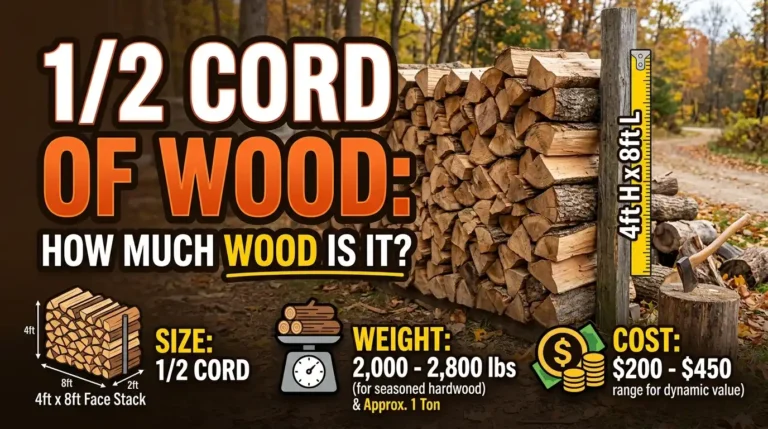
A full cord measures 4 feet by 4 feet by 8 feet, or 128 cubic feet of stacked wood. Dry hardwood cords typically weigh 2,500 to 4,400 pounds. Green hardwood cords typically weigh 3,500 to 5,200 pounds. Softwood cords like pine typically weigh 2,000 to 3,500 pounds. Water can make up 800 to 1,500 pounds of a green cord’s total weight.
The Quick Answer: Cord of Wood Weight at a Glance
The average weight of a cord of wood is 2,000 to 5,200 pounds, depending on the species and its dryness. At the heavy end are dense hardwoods such as white oak and hickory, which can weigh in excess of 4,000 pounds after seasoning. Pine and cedar, which are softwoods, are at the light end, and can be less than 2,500 pounds when well dried.
| Wood Type | Weight Range (lbs per cord) |
|---|---|
| Dry hardwood (oak, hickory, ash) | 2,800 to 4,400 |
| Green hardwood (unseasoned) | 3,500 to 5,200 |
| Softwood, dry (pine, cedar, spruce) | 2,000 to 3,000 |
| Softwood, green | 2,800 to 3,500 |
These are realistic ranges constructed using published species-weight data and supplier scale data. Take any one number you find on the Internet as an estimate, not a promise, since your real cord will vary with the particular species, the length of time it has been in service, and the manner in which it has been packed.
What Exactly Is a Cord of Wood?
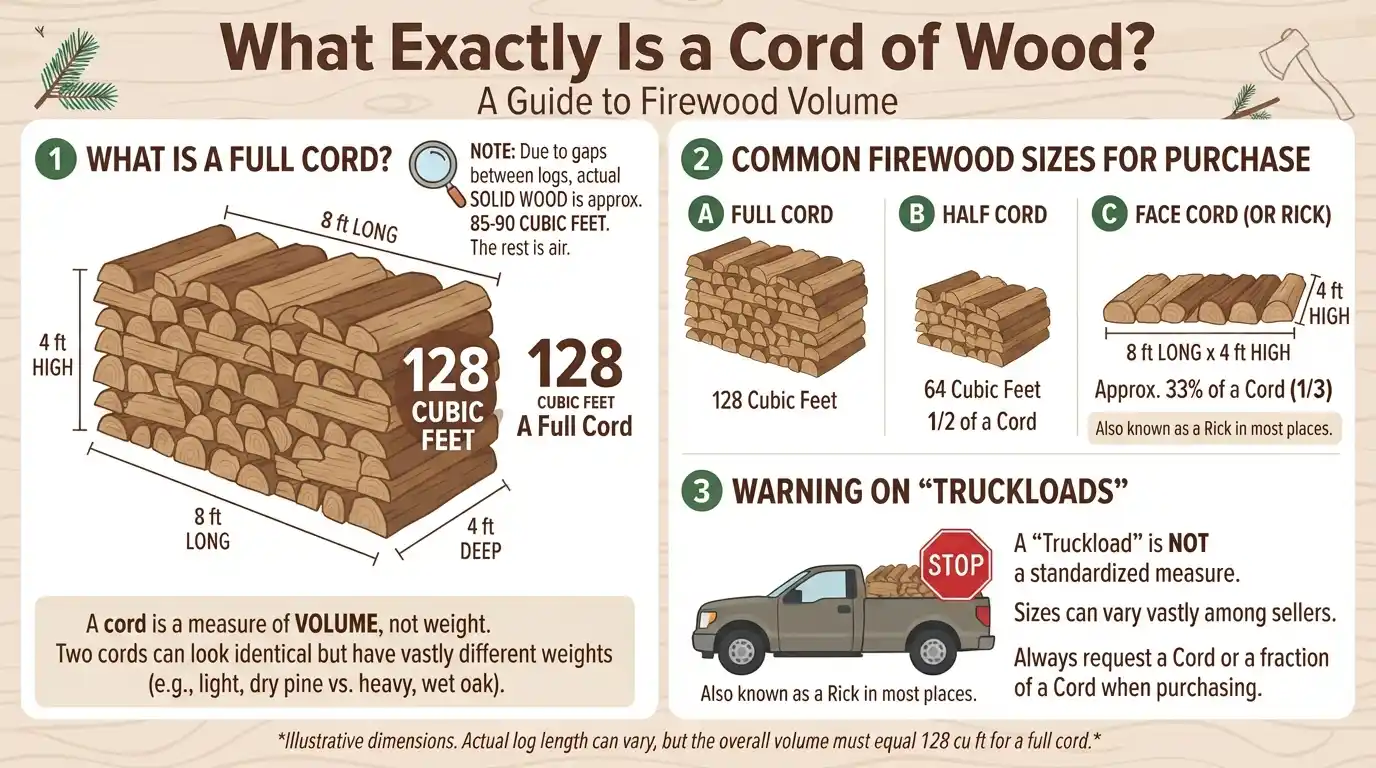
A cord is not a measure of weight, but of volume. It is a pile of wood 4 feet high, 4 feet deep, 8 feet long, or 128 cubic feet of space. Since the logs are circular and are piled one on top of the other with spaces in between, the solid wood in the cord is often only 85 to 90 cubic feet and the rest is air.
This difference is important since two cords may appear the same size, but have vastly different weights. A cord is always 128 cubic feet, and the 128 cubic feet may be filled with light, dry pine, or heavy, wet oak. The volume does not vary. The weight does. If you want to see exactly how those measurements are laid out, it helps to picture the stack itself before worrying about weight.
Sizes of wood that you will come across when making purchases:
- A row of wood, 4 feet by 8 feet, at the length of the pieces cut, is called a face cord (or a rick in most places). It is about a third of a cord.
- A half cord is 64 cubic feet, or half of 128 cubic feet.
- A truckload is not a standardized measure and can have vast differences among sellers, and instead request the cord or a fraction of a cord.
Why Cord Weight Varies So Much
Wood Species and Density
Each species of wood has its density which is in pounds per cubic foot when dry. Dense hardwoods such as oak, hickory and hard maple stuff more solid wood fiber in the same volume, and thus weigh more and also burn longer and hotter. Lighter ones such as pine, cedar and cottonwood contain more open cell structure and thus a cord of them weighs less and burns quicker.
This is the only reason why a cord of wood has no single weight. The same 128 cubic feet is occupied by a cord of white oak and a cord of white pine, but the oak may be almost twice the weight.
Moisture Content: Green vs. Seasoned vs. Kiln Dried
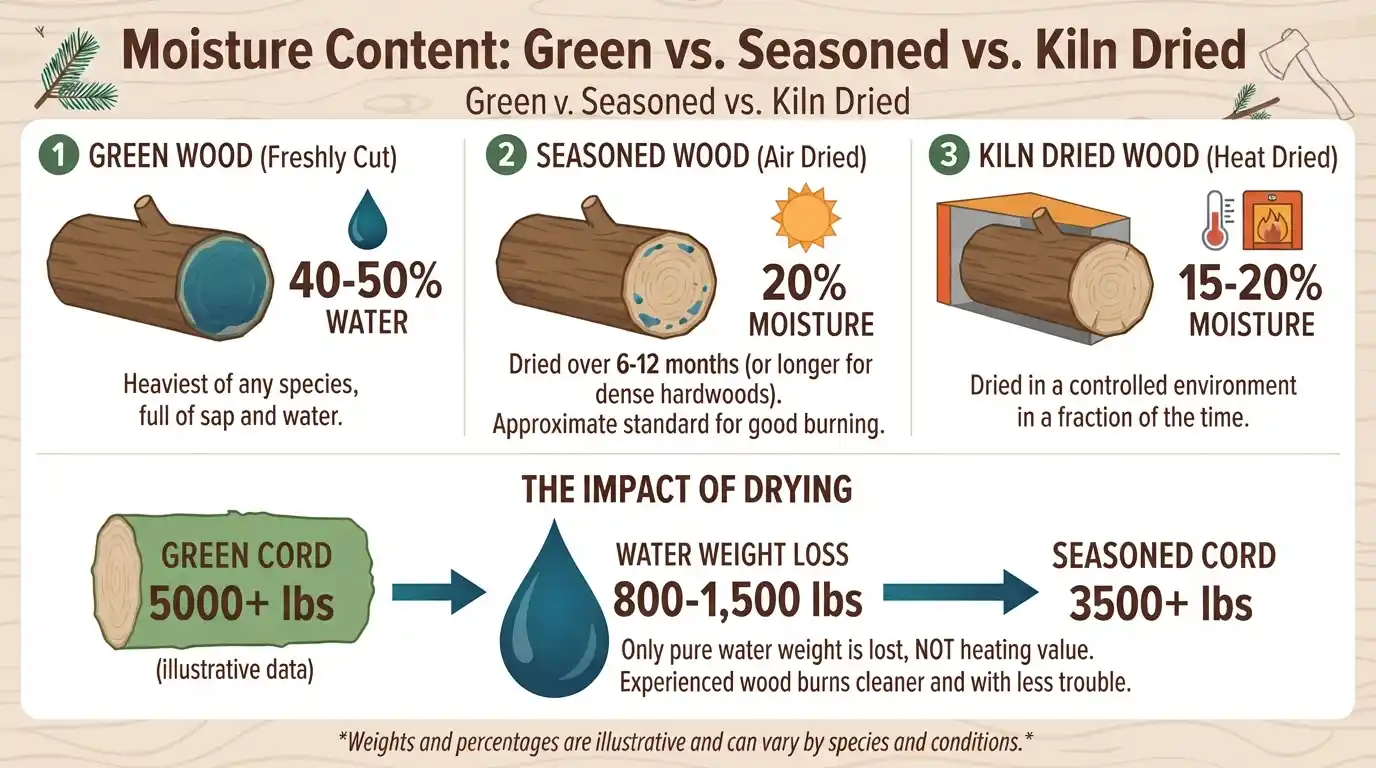
Freshly cut, or “green,” wood can be 40 to 50 percent water by weight. When the wood dries that water comes out of the cells and evaporates, and the wood becomes significantly lighter without losing any of its heating value.
Three stages of moisture you will encounter:
- Green wood is freshly cut, still full of sap and water, and the heaviest of any species.
- Old wood has been allowed to dry in the air over 6 to 12 months (even longer with dense hardwoods) and is usually at 20 percent moisture, the approximate standard of good burning.
- Heat-dried wood has been dried in a controlled kiln, usually to 15 to 20 percent moisture content, in a fraction of the time it takes to dry by air.
Evaporating a cord of green hardwood to dry to seasoned can lose 800 to 1,500 pounds of pure water weight. No lost weight is fuel. It is only water that the wood does not need to burn off before it can give useful heat and that is why experienced wood burns with less trouble and gives cleaner burn than green wood.
How the Tree Died and When It Was Cut
Even two cords of the same species will not weigh the same due to other factors other than species and length of season.
- Standing dead trees (killed by disease, drought, or insects such as the emerald ash borer) have already lost much of their internal moisture before they are ever cut, and thus can weigh significantly less than a healthy tree cut on the same day.
- Winter-cut wood is a little lighter than wood cut in the growing season, as trees do not have active water movement in the dormant season.
- Storage conditions and storage time are important. Wood cut and stacked in the open months away loses moisture, and wood left bare in wet weather may gain some.
Cord Weight by Species: Full Comparison Chart
Here are some practical weight ranges by species, in order of weight, when dry. The numbers are based on published forestry weight tables and data on firewood suppliers, and are intended as a good planning range, but not an actual weight of a single cord, as individual logs are different.
| Species | Green (lbs/cord) | Seasoned/Dry (lbs/cord) | Category |
|---|---|---|---|
| White Oak | ~5,200 | 4,200 to 4,400 | Hardwood, heaviest |
| Hickory | ~5,000 | 4,000 to 4,200 | Hardwood, top heat output |
| Sugar Maple (hard) | ~4,700 | 3,900 to 4,000 | Hardwood |
| Red Oak | ~4,800 | 3,800 to 4,000 | Hardwood |
| Yellow Birch | ~4,700 | 3,700 to 3,900 | Hardwood |
| White Ash | ~4,200 | 3,400 to 3,600 | Hardwood, dries fast |
| Cherry | 3,800 to 4,000 | 3,000 to 3,200 | Hardwood, lighter |
| Silver Maple / Boxelder | ~4,200 | 2,900 to 3,100 | Hardwood, softer |
| Cottonwood | ~4,200 | 2,900 to 3,100 | Hardwood, light |
| Douglas Fir | ~3,600 | 2,700 to 2,900 | Softwood, dense for a softwood |
| White Pine | ~3,700 | 2,200 to 2,500 | Softwood |
| Balsam Fir / Spruce | ~3,500 | 2,000 to 2,200 | Softwood, lightest |
Interpretation of this table: these are not laboratory values, but more general pound-per-cord values. The real weight varies depending on how the particular logs were grown, cut, split and stored. The numbers above are based on state forestry weight-to-cord conversion tables; species with no formal published number are estimated using the same density relationships as the tables.
Important lesson: the densest common firewoods (white oak, hickory, hard maple) can be nearly twice the weight of the lightest common softwoods (spruce, fir) despite both having completely dried. If oak keeps showing up at the top of your list, it’s worth reading what makes it such a dependable long-burning fuel before you commit to a full cord.
Maple owners often ask a similar question about their own wood, and the honest answer on how it performs is worth a look too. Birch sits in an interesting middle ground, and there’s some nuance to whether it truly qualifies as a hardwood that’s worth understanding before you compare its weight to oak.
Green Wood vs. Seasoned Wood: Side-by-Side Weight Comparison
| Comparison Point | Green Wood | Seasoned Wood |
|---|---|---|
| Moisture content | 40 to 50 percent | Around 20 percent |
| Typical weight per cord (hardwood) | 4,000 to 5,200 lbs | 2,800 to 4,400 lbs |
| Ease of lighting | Difficult, smokes heavily | Lights readily |
| Heat output | Lower, energy wasted boiling off water | Higher, more efficient |
| Recommended use | Not recommended for burning | Ready to burn |
Fast response: green wood is heavier than seasoned wood, in some cases, 1000 pounds or more per cord, but this is water, not additional fuel. A cord of green wood weighing more, will not produce more heat than a cord of the same species of properly seasoned wood weighing less. It tends to provide you with less, as the energy is used to evaporate water rather than to heat your area.
Face Cord, Half Cord, and Rick Weights
When you are purchasing less than a full cord, the weight reduces in the same proportion.
| Cord Size | Fraction of Full Cord | Approx. Weight (seasoned hardwood) |
|---|---|---|
| Full cord | 1 (128 cu ft) | 2,800 to 4,400 lbs |
| Half cord | 1/2 | 1,400 to 2,200 lbs |
| Face cord / rick | 1/3 (typical) | 900 to 1,500 lbs |
The size of a face cord will vary with the length to which the logs were cut, and you must always be sure that you have the length your seller claimed to you, or you will have a face cord that is not a full third of a full cord.
Since sellers use these terms inconsistently, it’s worth reading a full breakdown of how the two sizes actually compare before you agree on a price. Some regions call this same quantity a rick, with its own pricing quirks worth knowing.
How Much Does a Cord of Wood Weigh in Your Truck?
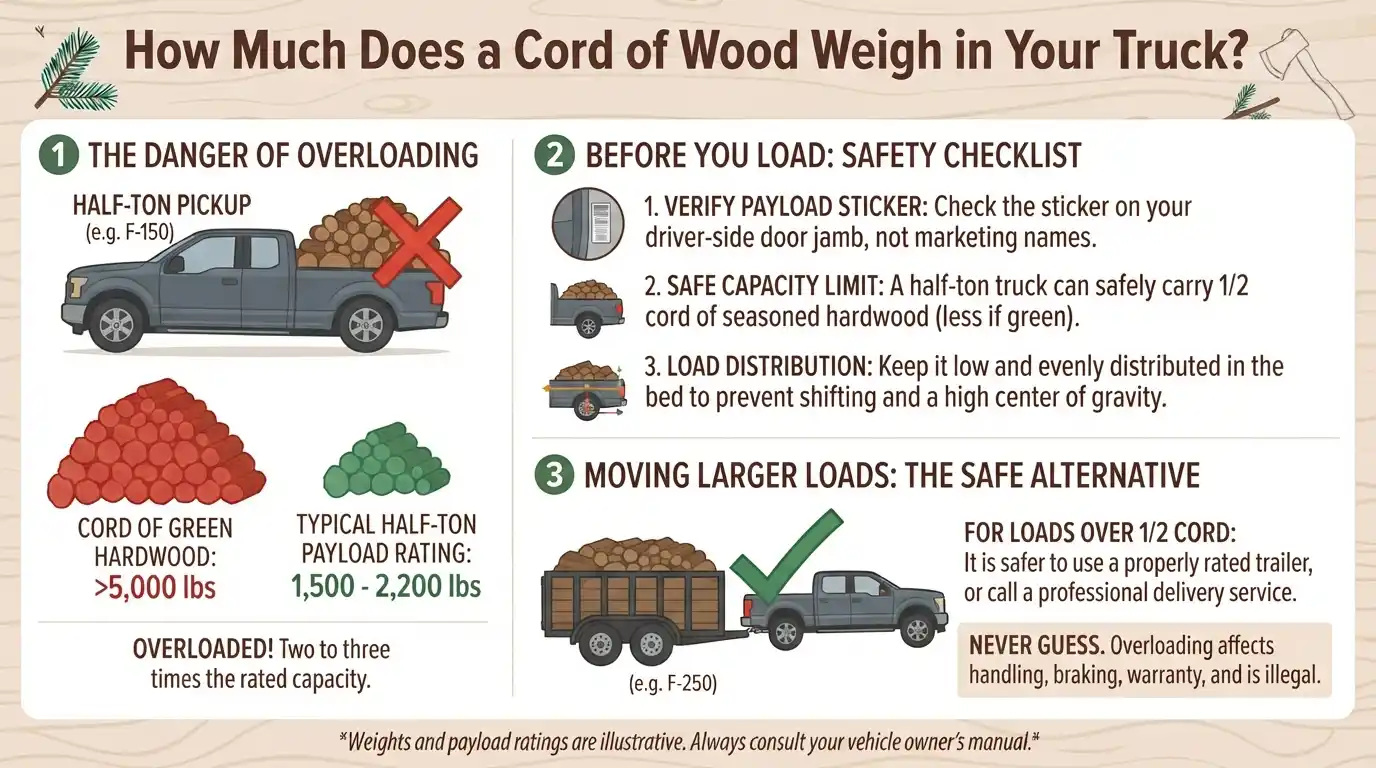
Here the weight of the cord ceases to be a trifle and begins to count in safety. A cord of green hardwood may weigh more than 5,000 pounds. The payload rating of most half-ton pickup trucks (an F-150 or Silverado 1500, say) is about 1500-2200 pounds, or two or three times the amount that the truck is actually rated to carry.
Prior to loading a truck with firewood:
- Verify your actual payload rating on the sticker on the inside door jamb of the driver, not the overall half-ton marketing name.
- Suppose that a half-ton pickup can safely carry a half cord of seasoned hardwood at a time, less with green wood.
- Evenly distribute the load and maintain it low in the bed to prevent shifting weight and increased center of gravity.
- Never guess. A loaded truck is difficult to drive, its brakes are less efficient, and it may cancel your warranty or break the weight laws in your area.
When you are moving over a half cord at a time, or a load rated on a trailer, or a delivery service, it is safer to call a trailer rated to the load.
Cord Weight vs. Heat Output: Does Heavier Mean Better Firewood?
Not automatically. An extra heavy cord of properly seasoned hardwood normally does imply more accessible heat, since the density and BTU output are co-located. But more green wood makes no difference, it only burns more water, and water does not burn. Before the wood can give us usable heat, it must boil off, and this reduces efficiency and causes more smoke and creosote deposits.
The rule of thumb: only compare cord weights between wood of the same moisture level. A cord of 4,000 pounds of seasoned oak will give a better performance than a cord of 4,000 pounds of green ash, though they are equal in weight, because a much greater part of the weight of the oak is actual burnable wood fiber and not water.
How to Estimate Cord Weight Yourself
You do not have to have a scale to get a reasonable estimate. Follow these steps:
- Identify the species. Find its average density or refer to the comparison chart above.
- Test the level of moisture. An inexpensive moisture meter (less than 20 dollars) provides a precise reading within seconds by inserting two pins into a divided face.
- Be sure that you have a real cord. Measure the stack: 4 feet high by 4 feet deep by 8 feet long. Less than that is a cord-length, and the weight decreases in proportion.
- Use the species weight range. Multiply the weight range per cord by your fraction of a cord.
- Adjust for moisture. When the wood has above 20 percent moisture on the meter, lean towards the high side of the weight range; below 20 percent lean toward the low side.
Common Mistakes People Make About Cord Weight
- All cords are assumed to have the same weight. A cord is not a fixed weight, but a fixed volume. The number is dramatically different with species and moisture.
- Purchasing on a weight basis rather than volume. Legitimate firewood dealers do not charge by the pound, but rather by the cord (or fraction of one). When firewood is quoted by the ton, it is a warning sign, as it gives an incentive to wetter and less desirable wood.
- Filling a truck by its appearance rather than the sticker on the payload. Even a half full bed may already be up to the weight limit when the wood is green oak.
- Mistaking a face cord and full cord. A face cord is about a third the volume and weight of a full cord; it is best always to indicate what kind of cord the seller refers to.
- To be heavier is to be better firewood. That can only be true when comparing wood at the same moisture level as discussed above.
FAQs
What is the weight of a cord of wood in pounds?
A cord of wood usually contains 2,000 to 5,200 pounds of wood, based on the type of wood and its dryness. Experienced hardwood cords are typically 2,800-4,400 pounds.
How much does a cord of oak weigh?
A cord of oak, when green, weighs about 4,800 to 5,200 pounds; and when seasoned or dried in the kiln, 3,800 to 4,400 pounds, and is one of the heaviest common firewoods.
What is the weight of a cord of pine?
A cord of pine is about 3,500 to 3,700 pounds green, and 2,200 to 2,500 pounds dry, thus being one of the lightest common firewoods.
Does green wood weigh more than seasoned wood?
Yes. The weight of green wood may be 800 to 1500 pounds per cord greater than the weight of the same wood after it is seasoned since the extra weight is water that is exiting the wood as it dries.
What is the weight of a face cord of wood?
A face cord, which is about a third of a full cord, weighs about 900 to 1500 pounds of seasoned hardwood, by species.
What is the weight of half cord of wood?
A half cord of hardwood, seasoned, weighs between 1,400 and 2,200 pounds, and the weight of a half cord of any species is proportionate to the weight of the full cord.
Will a pickup truck be able to carry a full cord of wood?
Not generally safely in a single journey. A full cord has a weight capacity of more than 5,000 pounds green, and most half-ton pickups have a weight capacity of 1,500-2,200 pounds. Before loading, check the door-jamb sticker of your truck.
Which is the heaviest firewood?
Common firewoods such as white oak and hickory are the heaviest and a seasoned cord can be more than 4,000 pounds.
Which is the lightest firewood?
Lightest of the softwoods are spruce, balsam fir and white pine, and a seasoned cord may weigh between 2,000 and 2,500 pounds.
Why is firewood sold by the cord instead of by weight?
The volume acts as a selling point of firewood since weight is untrustworthy and deceptive. The heavier cord is usually merely wetter and lower-grade wood, and weight-based pricing would give the worst firewood the highest value.
What is the average length of time a cord of wood takes to season?
The majority of hardwoods require 6-12 months of proper stacking and ventilation to dry to approximately 20 percent moisture. Thick woods such as oak may require up to a year or more.
Will the weight of a cord of wood be affected by splitting it smaller?
No. Splitting does not alter the total weight of the wood itself, but only the surface area and speed of drying. A cord of split oak and a cord of unsplit oak logs of the same species and moisture level weigh about the same.
What can I do to test the moisture content of firewood?
A simple moisture meter which can be purchased at a price of less than 20 dollars provides a fast and fairly accurate reading when the pins are tapped into a freshly split piece of the wood.
Final Thoughts
A wood cord does not possess a single weight and that is natural. What you are actually weighing is a mixture of species density and moisture content, and either can cause the number to change by over a thousand pounds.
The best thing you can do, either when you are buying firewood, or when you are hauling it, is to cease to ask how much a cord weighs, and begin to ask how much a cord of this kind, at this degree of moisture, weighs. There is a dependable answer to that question, and now you have the chart to answer it.
When loading a truck, never assume that the payload sticker is full before the bed becomes full. When purchasing firewood, keep in mind that the heavier it is, the better it isn’t necessarily, dry hardwood is better than heavy, wet wood every time it is actually burned.