How Do Oil-Filled Heaters Work? A Complete Heating Guide With Practical Tips
An oil-filled heater looks simple from the outside, but inside it is running a small, continuous convection cycle that most people never think about. This guide breaks down how the heating element, the sealed oil, and the room’s air all work together, plus practical tips for choosing and using one.
What Is an Oil-Filled Heater
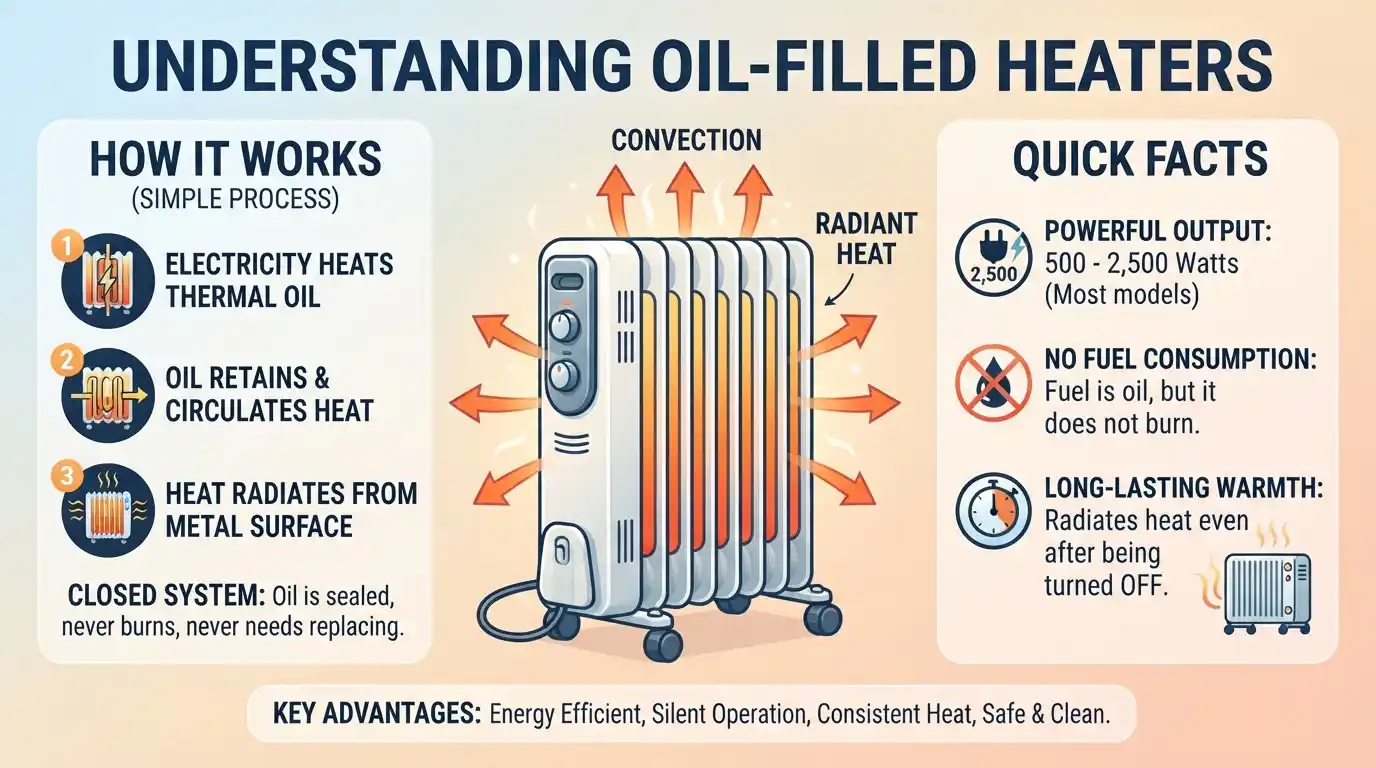
An oil-filled heater, also known as an oil-filled radiator or oil column heater, is a freestanding electric heater, which uses a closed container of thermal oil to store and release heat. Rather than forcing hot air into the room like a fan heater, it heats a room primarily by convection and a lesser amount of radiant heat in its metal surface.
Quick facts
- The fuel within is not oil. It does not burn and does not require replacement in the normal usage.
- The majority of the models are between 500 and 2,500 watts.
- Even after the unit has been turned off, heat still radiates due to the oil that retains heat even after the electrical element has been disconnected.
How Do Oil-Filled Heaters Work, Step by Step
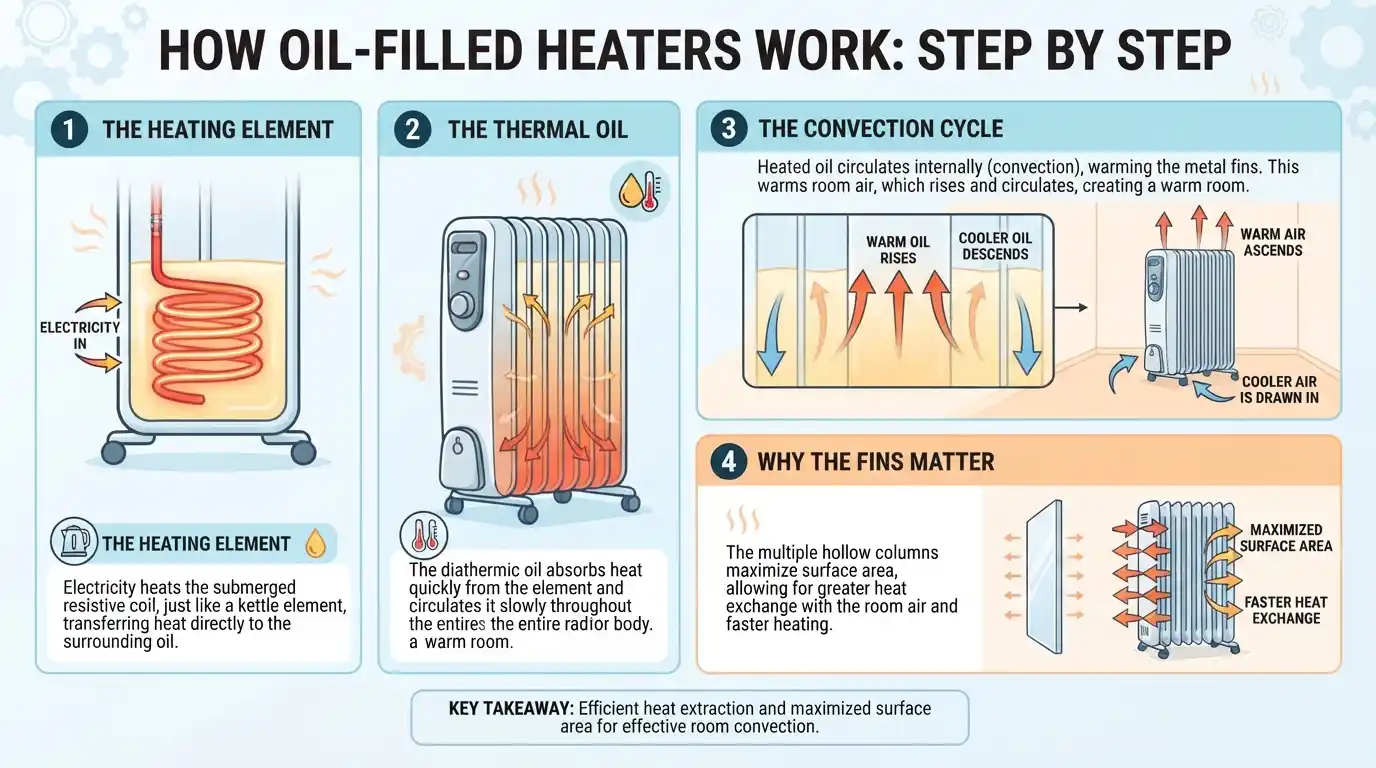
On the simplest level, an oil-filled heater functions in the same manner as an electric kettle, except that the heat does not leave the appliance, but rather boils the water so you can pour it out.
The Heating Element
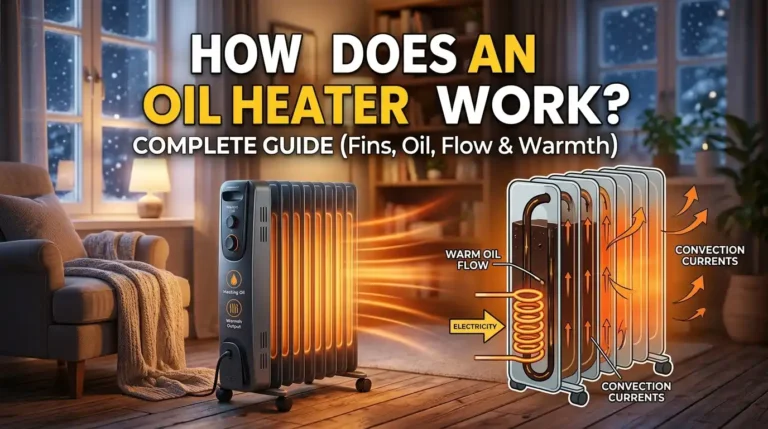
The bottom of the heater has a coil of resistive metal wire, completely immersed in the oil. Electricity passes through this coil when you turn on the heater. The wire does not allow the current to pass through it, so it heats up, just like a toaster element or kettle element.
This is because the heat is transferred directly to the surrounding oil instead of the air and this is the reason why the outer casing requires a few minutes to heat up.
The Thermal Oil
The reservoir is filled with a diathermic (heat-conducting) fluid, usually a mineral oil or a manufacturer-specific engineered fluid. This oil is closed in at the factory and should not be topped up or changed by the user. It has a simple job to do, take the heat out of the element as fast as it can, and then give it out in a slow and even manner over the entire surface of the radiator.
The Convection Cycle
The closer the oil to the element gets, the less dense it becomes and it rises. The cooler oil drops down to replace it at the element, is then heated, and then ascends once more. This continuous cycle is known as a convection cycle and that which causes the even distribution of heat throughout the entire body of the heater as opposed to having a hot spot at the bottom.
This principle is then repeated outside the heater. Air that comes in contact with the warm metal surface warms up, becomes lighter and ascends to the ceiling. The warmer air closer to the floor is forced out by colder air, which is then warmed and the process repeats until the entire room is more evenly heated.
Why the Fins or Columns Matter
The majority of oil-filled heaters are constructed using more than one hollow column or fin instead of a single flat panel. This design is simply to maximize the surface area. The greater the surface area exposed to room air, the greater the amount of heat exchanged in one minute, and thus a finned construction would heat a room quicker than a plain one of the same wattage would.
Key takeaway: The shape of an oil-filled heater, the columns, the base, is all geared towards a single aim: to extract the heat out of the oil and into the room as effectively as possible through convection.
Why Oil-Filled Heaters Stay Warm After You Turn Them Off
It is one of the most commonly asked questions regarding this appliance, and it frequently is confused with a fault. It is not one. Since the oil has been absorbing heat throughout the period the element has been running, it contains a lot of stored thermal energy, like a hot water bottle.
When the element is switched off, the stored heat does not disappear immediately. It continues to emit through the metal surface as long as between 10 minutes up to more than an hour depending on the size of the unit and the room temperature.
This warm-up is really a pure efficiency benefit. An oil heater with a thermostat can switch its element off sooner than a similar fan or ceramic heater, since the stored heat will keep the room comfortable during the interruption, saving overall electricity consumption over time.
Do Oil-Filled Heaters Need Refilling
No. The oil is contained in the unit throughout its working life, and is not used, burnt or spent like fuel. It is never advisable to open, refill or top up an oil-filled heater by yourself. The manufacturers intentionally leave a space at the top of the reservoir allowing oil to expand safely as it warms.
The opening of the unit seals that and poses a real safety risk. When a unit is leaking or not heating properly, the next best thing to do is to call the manufacturer or a professional repair person and not to attempt a DIY repair.
Are Oil-Filled Heaters Energy Efficient
Almost all electric resistance heaters, including those with oil, turn almost 100 percent of the electricity used into heat. The same thing is true of fan heaters, convectors and oil radiators. The real benefit of oil-filled heaters is in their ability to retain heat: since the oil continues to give off heat when the element is off, an oil-filled heater can consume less overall electricity during a heating cycle than one with no thermal mass, even though it may have the same wattage rating on the box.
The running cost remains dependent on your local electricity rate and the amount of wattage you operate the unit at and therefore, you can check your own energy bill or the current price per kilowatt-hour of your provider to determine an accurate cost. The general rule of thumb is to multiply the wattage of the heater by the number of hours it is on, then divide by 1,000 to obtain kilowatt-hours and then multiply by the rate of electricity. For a full breakdown by wattage, see how much electricity an oil-filled radiator uses and whether oil heaters are actually economical to run day to day.
Oil-Filled Heaters vs Other Heater Types
If you want the mechanics behind every row in this table, see how a space heater works and which type of space heater fits your room.
| Heater type | Heat style | Warm-up speed | Noise | Best for |
|---|---|---|---|---|
| Oil-filled radiator | Convection, slow release | Slow | Silent | Bedrooms, offices, overnight use, unattended rooms |
| Convector heater | Convection, no thermal mass | Fast | Silent | Rooms needing quick, even heat without residual warmth |
| Fan heater | Forced convection | Very fast | Noticeable fan noise | Small spaces needing instant heat |
| Infrared or ceramic heater | Radiant, direct | Instant | Usually low | Spot heating one person or area quickly |
Oil-Filled vs Convector Heaters
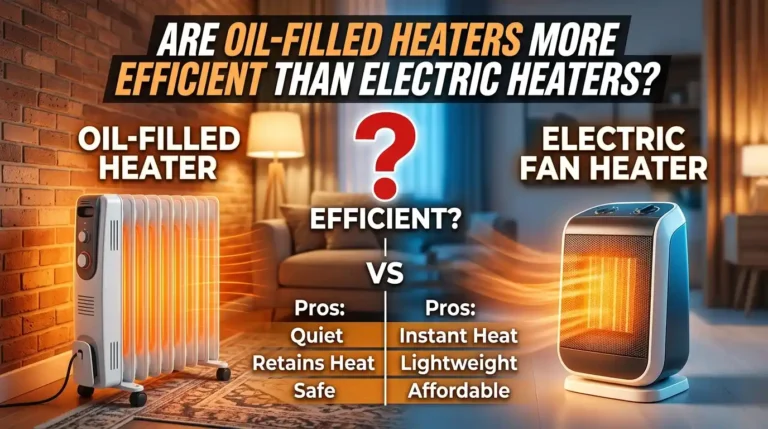
They both operate on convection, and consume approximately the same amount of electricity to generate the same amount of heat, but a convector has virtually no thermal mass, and therefore it ceases to produce heat as soon as it is turned off. A heater is filled with oil and continues to radiate heat later and this is suitable in rooms where you prefer the temperature to remain constant with less on-off switches.
Oil-Filled vs Fan Heaters
Fan heaters blow air over a hot element, thus they heat a room more quickly, but cool nearly instantly when turned off. They are also noisier, as they are powered by a motor. Oil heaters are less noisy and more appropriate in bedrooms or offices, but take longer to warm up.
Oil-Filled vs Infrared and Ceramic Heaters
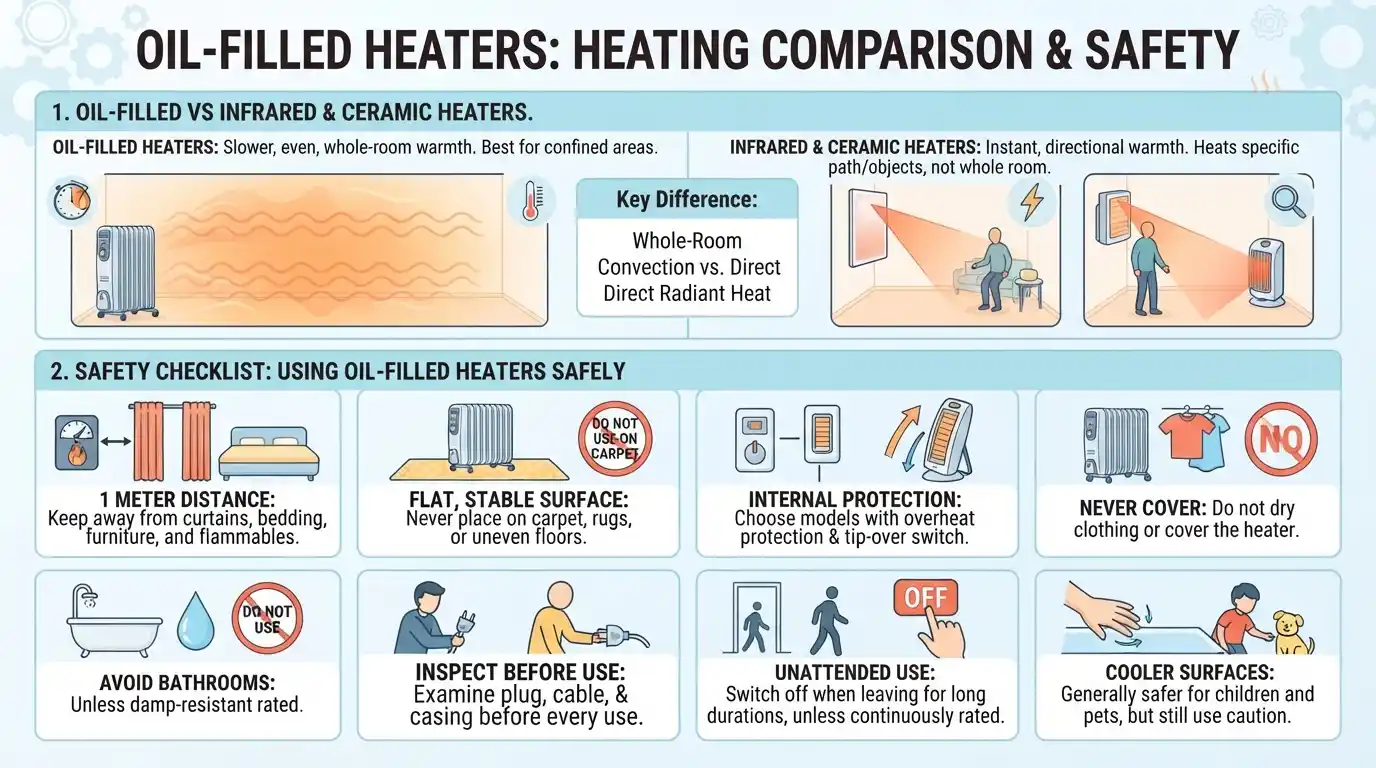
Infrared and ceramic heaters heat items and individuals in their direct line of view instead of the entire air in the room, thus they heat almost instantly but do little to those not in their direct path. Oil-filled heaters are slower, but warm the air in the entire room more evenly, which is better when spending more time in a confined area.
Are Oil-Filled Heaters Safe
Oil-filled heaters are typically thought to be one of the safe types of portable heaters since the heating element is not in direct contact with room air, as in a bar or coil heater. With that said, any electric heater can still be taken care of with sensible precautions.
Safety checklist
- Maintain a minimum distance of one meter between the heater and the curtains, bedding, furniture, and flammable materials.
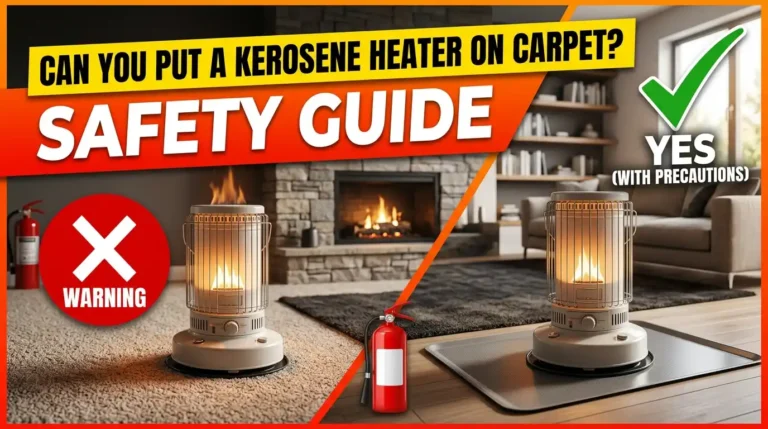
- It must be placed on a flat, stable surface, never on carpet, or rugs, or an uneven floor.
- Use a model that has an internal overheat protection and a tip-over safety switch.
- Never cover the heater or dry clothing on it.
- Do not place it in a bathroom unless the particular one is damp-resistant.
- Before every use, examine the plug, cable and casing.
- When leaving a room unattended over a long duration of time, switch it off, or get a model that is rated to be continuously used.
Most of the modern oil-filled heaters are designed with surfaces that are cool enough to touch momentarily and with automatic turn-off when the unit is tipped or overheats and this is why they are usually suggested in bedrooms and rooms with children or pets, as long as the simple precautions mentioned above are observed.
How to Choose the Right Oil-Filled Heater for Your Room
Start with match wattage to room size, and then adjust to ceiling height, insulation, and climate.
| Room size (approx.) | Suggested wattage |
|---|---|
| Small room, up to 10 m² | 500 to 1,000W |
| Medium room, 10 to 20 m² | 1,000 to 1,500W |
| Large room, 20 to 30 m² | 1,500 to 2,000W |
| Open-plan or poorly insulated space, 30 m² plus | 2,000 to 2,500W or a larger unit |
- Other items to look at prior to purchase.
- An inbuilt adjustable thermostat, to ensure that the heater does not run continuously but turns on and off.
- A programmable timer, which can be used to heat the room before you get up or home.
- Castor wheels, in case you want to take it in and out of the rooms.
- An IP rating that can be used in the space, should you wish to use it in any location with any amount of humidity.
How to Use an Oil-Filled Heater for Best Results
- Turn on the heater early, as it will take longer to heat fully than a fan heater.
- Adjust the thermostat to the lowest comfortable temperature instead of the maximum because the unit will turn on and off to maintain the temperature, which is more efficient than operating at full power at all times.
- Shut the room with close doors and windows to prevent heat loss and allow the convection cycle to function effectively.
- Place furniture at a minimum distance to the heater to allow free flow of warm air around.
- Keep it out of the way of drafty doors or windows so it is not struggling with a continual heat loss.
Common Oil-Filled Heater Problems and Fixes
- Heater will not start: verify the plug, socket and any tip-over or safety switch, which will not operate until the unit is lying flat.
- Heater is on and remains cold: this normally indicates a faulty internal component, which cannot be repaired by the user, therefore call the manufacturer.
- Hot spots and cold spots along the columns: normal to a minor extent through the convection cycle, but a consistently cold area could be a sign of an air pocket inside the building, or a defect, again to be dealt with by the manufacturer.
- Heater switches on and off quite often: sometimes only the thermostat that is functioning properly at a low temperature, but a broken thermostat can also do it.
- Smell during initial use: when a new unit is used, a faint odor of the protective coating burning away is normal and usually goes away after the first brief use in a well-ventilated room. It is not normal to have a strong or persistent smell after that and it should be unplugged.
FAQs
What is an oil filled heater?
An oil-filled heater is an electrical heater which consists of a closed container of thermal oil and an internal heating coil to warm a room primarily by convection.
How does an oil heater work?
The unit contains oil which is heated by an electric element. The heated oil is pumped up through a cycle of convection, which heats up the metal casing, and the casing heats the air in the adjacent room.
Are oil filled heaters to be filled with oil?
No. The oil is enclosed within the heater at the factory. During normal usage, it does not require topping up.
Why does my oil heater keep on being warm even after I have switched it off?
As the element was running, the oil has taken up some heat and it will give off some of this stored heat over a period of time. This is natural and is in fact one of the reasons why oil heaters can be effective.
Can oil-filled heaters be left overnight?
Some are intended to be used long or overnight, and may have additional features such as overheat protection and tip-over switches, but always consult the instructions that come with that particular model and observe the general safety advice regarding heaters.
Are heaters that use oil energy efficient?
Similar to most electric resistance heaters, they transform almost all of their electricity to heat. Their thermal mass can make the element not need to turn on as frequently, potentially saving on the cost of running it compared to having no thermal mass.
What is the time taken by an oil-filled heater to warm a room?
Oil heaters come in different sizes depending on the amount of wattage and the room size, but most oil heaters take longer to achieve full temperature than fan heaters, and it can take 15 to 30 minutes or more to perceptibly warm a typical room.
Is it possible to use an oil-filled heater in a bathroom?
When the particular model has an IP rating that could be used in damp environments. Always examine the specifications of the manufacturer prior to using any electric heater in a bathroom.
Which oil-filled heater should I buy to heat my room?
As a rough rule of thumb, 500 to 1000W is appropriate in a small room, 1000 to 1500W is appropriate in a medium room, and 1500 to 2500W is appropriate in a large or insulated room.
Is an oil-filled heater better than a fan heater?
Neither is necessarily superior. Fan heaters warm an area more quickly, but are noisier and cool immediately upon turning off. Heaters that use oil are quieter and hold more heat longer but require more time to heat.
Why is my heater with oil not heating?
This normally indicates a failure in an internal component that cannot be fixed at home. Call the manufacturer, or a qualified technician.
Is it possible to have an oil-filled heater igniting?
All electric heaters have some fire risk when used improperly, but oil-filled heaters are thought to be less risky than exposed-element heaters since the heating coil is completely immersed in oil and not exposed to air. Risk is minimized by following typical clearance and placement guidelines.
Are oil filled heaters energy consuming?
They consume electricity depending on their wattage and their running duration as any other electric heater. A thermostat instead of operating on full blast at all times keeps the consumption low.
Final Thoughts
A simple piece of engineering is an oil-filled heater when you see how the parts fit together. An electric element is submerged in a sealed reservoir of oil, which heats the oil which in turn heats the room air by a convection cycle within the unit, and the hot casing then heats the air in the room in a similar manner. The residual warmth following the switch-off is not faulty, and the sealed oil never requires refilling.
An oil-filled heater is a quiet, low-maintenance method of heating a room, with the right amount of wattage and a thermostat adjusted to a reasonable temperature, allowing you to keep a room warm throughout the day.