How Does an Oil Heater Work? A Complete, Step-by-Step Guide
An oil heater heats a room by heating a closed tank of thermal oil using an electric heating element inside it, and dissipating the heat through the metal body by convection and radiation. No oil is burned. The oil does not exit the unit. It is just a heat-storing liquid that assists the heater to warm a room gradually and make it stay warm even when you turn it off.
That’s the short answer. The following is what actually happens within the unit, why it takes a long time to heat up, the cost of running it and how it performs compared to other portable heaters.
What Is an Oil Heater, Exactly?
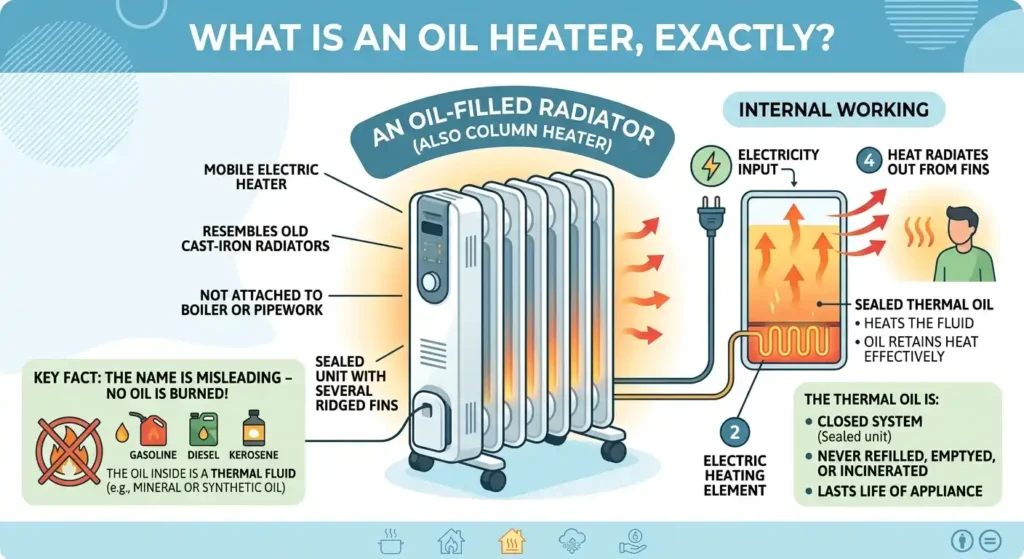
An oil heater (also known as an oil-filled radiator or column heater) is a mobile electric heater that places a sealed container of oil as a heat carrier. It resembles the old cast-iron radiators of central heating systems, with ridged metal columns or fins, except that it is not attached to any boiler or pipework. It has everything it requires in itself.
The Name Is Misleading, No Oil Is Burned
This is the only biggest confusion that people have. The name of oil heater makes one think that it uses fuel, like a kerosene or diesel heater. It doesn’t. Their interior oil is a thermal fluid, typically a mineral or synthetic diathermic oil selected due to its capacity to retain heat effectively and not to breakdown at high temperatures.
It is closed up in the unit throughout the life of the appliance and never filled up, emptied or incinerated. The sole input of energy is electricity.
The Main Parts Inside an Oil Heater
To begin to understand how an oil heater operates, one must know what is really inside the casing.
Heating element. The unit has a coil of resistive metal wire at its base, which is completely immersed in the oil.
Diathermic (thermal) oil. This fills the closed internal chambers, and serves as a heat reservoir, capturing heat off the element and dispersing it into the body of the heater.
Metal columns or metal fins. The ridged surface enhances surface area to allow the heat to be transferred to the surrounding air more efficiently.
Thermostat and controls. These control power to the element to ensure that the room attains and maintains a desired temperature rather than overheats.
Safety switches. The tip-off shutoff and overheat protection automatically switch off the power when the unit is knocked over or the internal temperature is excessive.
How Does an Oil Heater Work? The Step-by-Step Process
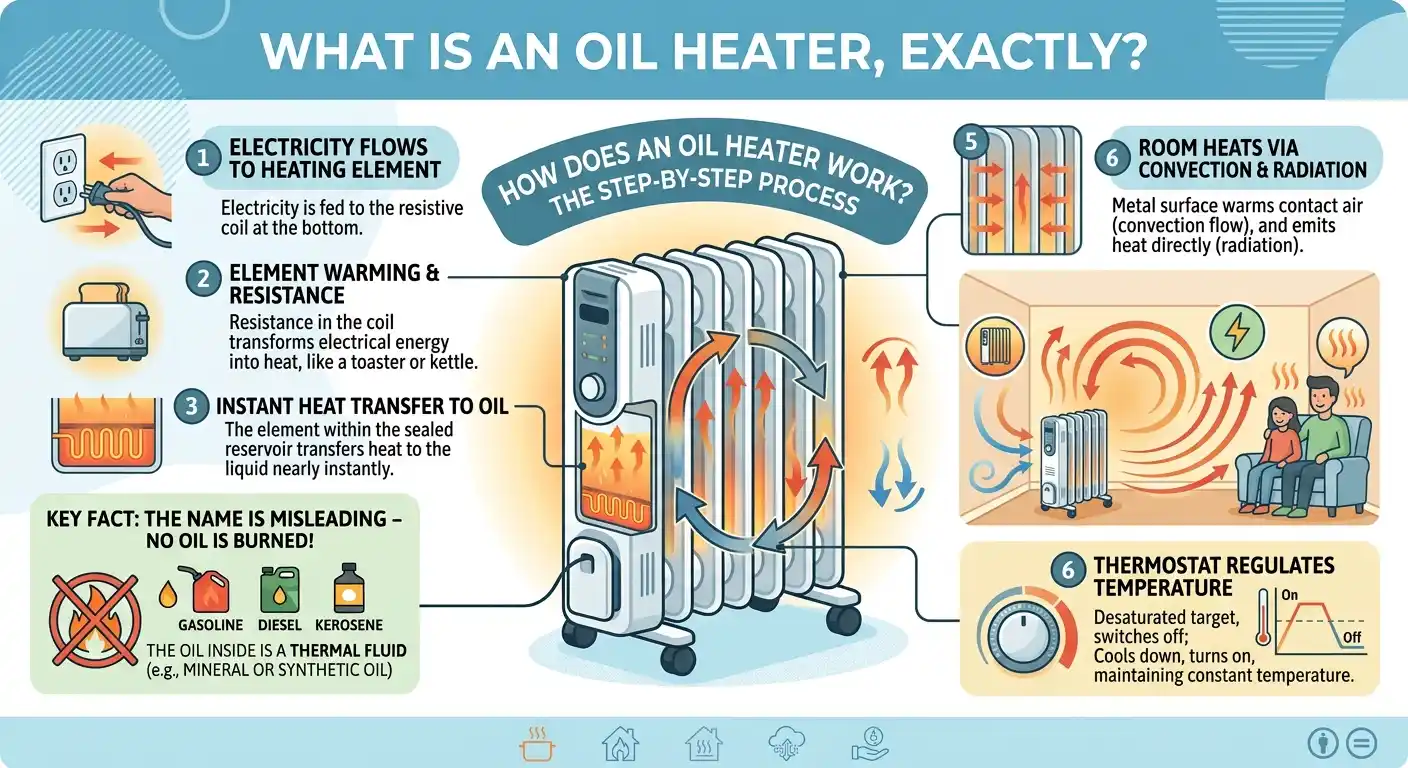
When you plug it in, and turn it on, the following is what happens inside, in order.
- The heating element is fed with electricity. The current passes through the resistive coil at the bottom of the unit.
- The element warms up by means of electrical resistance. When the electrons flow through the thin wire, the resistance directly transforms that electrical energy into heat, which is the same principle of a toaster or electric kettle element.
- The heat is transferred to the oil around. The fact that the element is within the sealed oil reservoir means that the heat is transferred to the liquid nearly instantly.
- Convection of oil starts. The closest oil to the element heats the first, expands a little, and rises. The denser oil is cooler and sinks to the bottom to replace it around the coil. This forms a circulation loop that distributes heat uniformly in the internal chambers of the unit.
- The metal casing is conductive to heat. Hot oil flows through the columns or fins, thereby transferring heat to the metal walls, which are its containment.
- The room heats up by convection and radiation. The metal surface warms the air that comes into direct contact with it, causing it to ascend and draw a cooler air mass behind it, forming a mild convectional flow throughout the room. Meanwhile, the warm metal surface emits heat, and this is why you can sense warmth even when you are a few feet away without air passing through.
- The thermostat switches the element on and off. As soon as the room attains the desired temperature, the thermostat switches off the element. When the room cools down, it turns on again to maintain the temperature constant instead of increasing continuously.
Why Oil Heaters Stay Warm After You Turn Them Off
This is among the most helpful, and most requested of, features of an oil heater, and it all boils down to thermal mass. Oil is also an excellent thermal storage medium and therefore, once the fluid in it is hot, it retains a lot of thermal energy even when the element is switched off.
The warm oil continues to circulate and give off heat to the room via the metal casing when you turn off the heater, or when the thermostat switches off, sometimes 30 to 60 minutes, depending on the size of the unit and how hot the room was. This is referred to as thermal inertia, and it is why oil heaters seem to continue to work even when the power light is off.
Rapid conclusion: The oil does not produce heat by itself. It retains heat generated by the electric component and emits it gradually, which even out temperature changes and minimizes the frequency of the component returning to the on position.
How Long Does an Oil Heater Take to Warm a Room?
Since the unit must warm the oil before it can warm the room, oil heaters take longer to turn on compared to the fan and ceramic heaters. Most of the models require about 10 to 15 minutes before you can actually feel the room temperature change as opposed to the 30 to 60 seconds with a fan heater or a ceramic heater.
This is a deliberate tradeoff. The loss of speed at the beginning is compensated by a more consistent, even heat and reduced temperature drop when the unit is turned off.
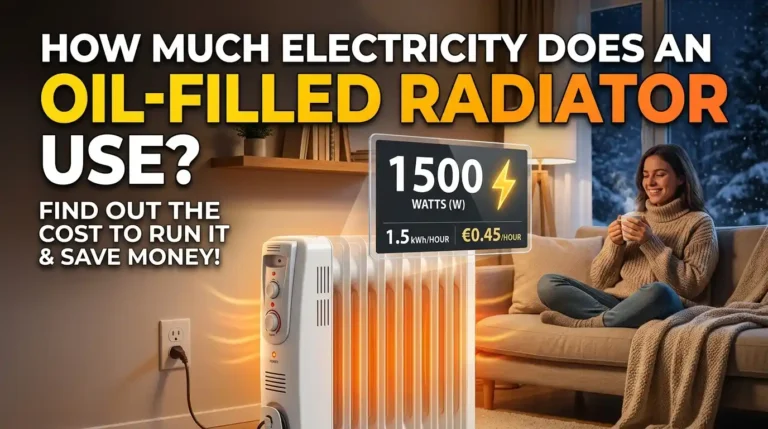
How Much Electricity Does an Oil Heater Use?
Electric resistance heaters, oil, ceramic, or fan are all the same in terms of efficiency in converting electricity into heat at the same wattage. An oil heater with a power of 1,500 watts and a fan heater with a power of 1,500 watts consume the same amount of electricity per hour of active heating.
The distinction lies in usage pattern, not raw efficiency: since the oil keeps the room warm and requires the element to be cycled more frequently once the room is warm, an oil heater may actually consume less electricity, overall, in a long heating cycle, even though its efficiency per watt is the same as any other resistive heater.
Cost Per Hour Breakdown
| Heater Wattage | Approx. Cost Per Hour (at $0.15/kWh) | Approx. Cost Per Hour (at $0.20/kWh) |
| 500W | $0.075 | $0.10 |
| 900W | $0.135 | $0.18 |
| 1,200W | $0.18 | $0.24 |
| 1,500W | $0.225 | $0.30 |
Prices of electricity differ greatly depending on the country and supplier, so use these as an example and find out your local utility rate to get the correct price.
Lesson learned: The running cost is mainly determined by the wattage and the duration that the element is actively consuming power, rather than the fact that it is an oil heater.
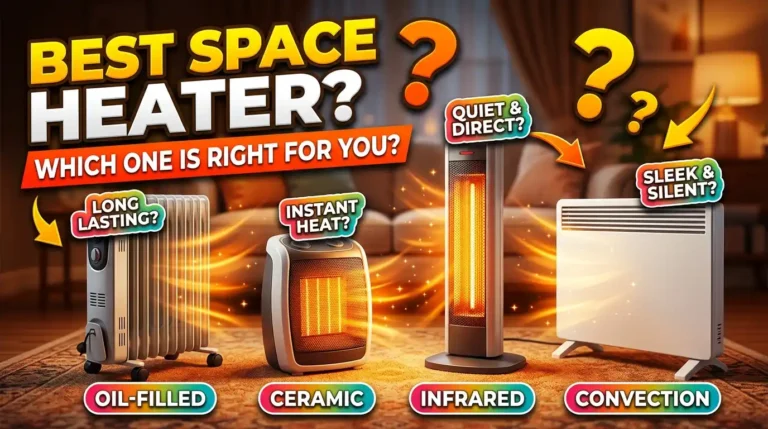
Oil Heater vs. Ceramic Heater vs. Fan Heater
| Feature | Oil Heater | Ceramic Heater | Fan Heater |
| Warm-up time | Slow (10–15 min) | Fast (30–60 sec) | Fast (30–60 sec) |
| Heat after power off | Yes, 30–60 min | Minimal | None |
| Noise level | Silent | Low hum (if fan-assisted) | Noticeable fan noise |
| Best for | Long sessions, bedrooms, overnight use | Quick spot heating, small rooms | Instant short bursts of heat |
| Air drying effect | Minimal | Moderate | Moderate |
| Portability | Heavier, on wheels | Lightweight, compact | Lightweight, compact |
| Surface temperature | Warm but touchable-ish | Can get hot | Vents get hot |
Summary: Select an oil heater when you need constant, noiseless, long-term heating in a bedroom, office, or living room. Use a ceramic or fan heater when you must feel the heat in a minute and you will not be using it hours at a time.
Are Oil Heaters safe?
The oil heaters are often regarded as one of the less dangerous forms of portable electric heater, in large part due to the fact that the outer casing does not get as hot as an open coil or a ceramic plate, and no combustion occurs whatsoever.
Built-In Safety Features
- Tip-off shutoff: Automatically shuts power off when the unit is knocked over.
- Overheat control: Turns off the element when the internal temperature exceeds a safe limit.
- Sealed oil chamber: The oil does not leak out, and thus there is no risk of leaking and spillage during normal use.
- No open flame or burning: Eliminates a whole type of fire hazard with fuel-burning heaters.
Safety Tips for Using One
- Have at least 3 feet of space between curtains, bedding, and furniture.
- When you can, plug directly into a wall outlet and not an extension cord.
- Do not leave a heater on in a room with pets or small children.
- Put it on a level, stable, inflammable surface.
- Do not cover or wrap up the unit or clothing.
If you’re weighing an oil heater against a fuel-burning option, it’s worth reading up on proper propane heater safety practices before deciding, since the risks and precautions are quite different from an electric unit.
Oil Heater Maintenance and Lifespan
The benefit of oil heaters is that they require minimal maintenance. Since the oil reservoir is permanently closed, there is nothing to refill, top up or replace in normal conditions.
Basic upkeep is limited to:
- Cleaning the dust off the fins every now and then to allow easy transfer of heat.
- Inspecting the power cord to confirm its wear or damage each heating season.
- Keeping the unit in an upright position in a dry place during the off-season.
A well-constructed oil heater will last more than ten years with normal usage. The life expectancy is greatly dependent on the treatment of the coil. Maintaining the internal component in its intended operating temperature band, and not subjecting it to frequent rapid on-off cycling, without cooldown, will contribute to the longevity of the unit.
Best Rooms and Situations for an Oil Heater
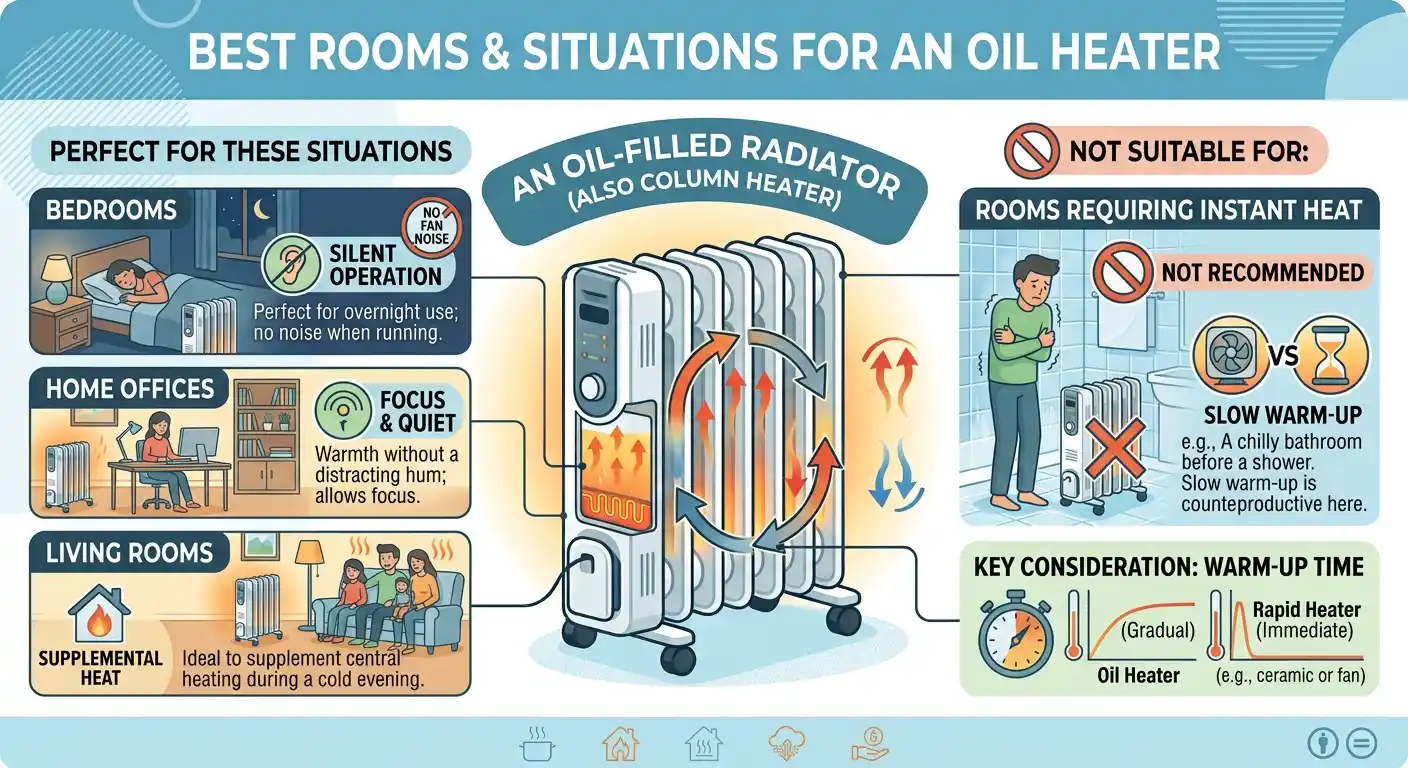
- Bedrooms: It has a silent operation and does not produce any noise when the fan is on, which makes it perfect to be used overnight.
- Home offices: Warmth of the background without the distracting hum.
- Living rooms: Suitable to supplement central heating during a cold evening.
- Not suitable: Rooms where you need to be heated at once, such as a chilly bathroom before a shower, because the slow warm-up will be counterproductive there.
Myth vs. Fact
| Myth | Fact |
| Oil heaters burn oil like a kerosene heater. | No combustion occurs. The oil is a sealed heat-storage fluid, and electricity is the only fuel used. |
| Oil heaters use more electricity than other heaters. | At the same wattage, all resistance heaters use the same electricity per hour of operation. |
| The oil needs to be refilled or replaced. | The oil is sealed for the appliance’s lifetime and isn’t designed to be topped up. |
| Oil heaters are unsafe to run overnight. | Their lower surface temperature and lack of exposed flame make them one of the safer overnight options when basic precautions are followed. |
Common Mistakes to Avoid
- Waiting too long to warm up and shutting the unit before it has time to warm the oil.
- Positioning it too near the furniture, curtains, or bedding.
- Operating a small-wattage unit in a room bigger than the unit.
- Leaving dust accumulation on the fins, thereby decreasing heat transfer with time.
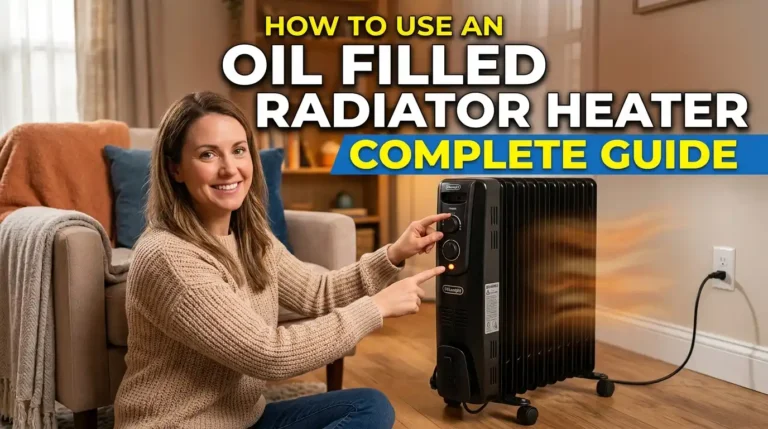
Once you understand how the unit heats a room, the next step is knowing how to run it well. This complete guide to settings, safety, and savings walks through thermostat settings and practical ways to cut your running costs.
FAQs
What is an oil heater and how does it work?
An oil heater is a small electric heater that heats a closed container of thermal oil with a heating element inside, and emits this heat into the room via metal fins by convection and radiation. There is no burning of oil; the only source of energy is electricity.
Is an oil heater burning oil?
No. The thermal fluid within is an oil-filled closed container, which is only used to store and transfer heat. It does not ignite, burn or require replacement when used normally.
Why is it that an oil heater takes so long to warm up?
The unit must then warm the oil reservoir, so that the heat can be passed to the room, and that is generally 10 to 15 minutes, compared to fan or ceramic heaters that directly heat air.
Why does an oil heater stay warm after it’s switched off?
Oil is a good thermal mass and when heated it will still be emitting stored heat into the room even after the element has turned off in 30 to 60 minutes.
Can oil heaters be left unattended over night?
Most models have tip-off and overheat protection that enables them to be used overnight, however, it is always advisable to consult the instructions of the manufacturer and ensure that flammable objects are kept away.
Are oil heaters energy consuming?
They consume the same amount of electricity per hour as any other resistance heater of the same wattage. They can be efficient to run long sessions since they retain heat and cycle off.
What is the cost per hour to operate an oil heater?
A 1,500-watt oil heater at a standard home rate would cost about 0.22-0.30 per hour, but again, it would depend on your local electricity rate.
Is an oil heater better than a ceramic heater?
It is based on your requirement. Oil heaters are ideal in long, continuous heating in bedrooms or offices, whereas ceramic heaters are ideal in short bursts of heat in small areas.
Is it possible to have an oil heater fire?
It will not happen with typical use since there is no open flame or combustion, but any electric heater can be a fire hazard when placed too near flammable substances or when a damaged cord is used.
Do I need to add or change the oil in an oil heater?
No. The oil is enclosed in the unit throughout its lifespan and does not require the user to refill or replace the oil.
What is the average life of oil heaters?
Normal care means that a well-built unit can last more than a decade, in large part due to the sealed design having few moving or wearable parts.
Will an oil heater warm a entire room evenly?
Yes, its convection and radiant heat is quite evenly distributed over a small to medium room, but very large or drafty rooms might require a higher-wattage unit or other heat source.
Is an oil heater good for a baby’s or child’s room?
It is a popular choice in nurseries due to its absence of exposed hot coils and lack of noise, but must still be kept out of reach and out of bedding, and adult supervision is required when in use.
Final Thoughts
Patience is the greatest strength of an oil heater. It does not heat a room immediately, but when it does it keeps it there and continues to provide heat even after you turn it off. There is no burning, no filling up, and the clockwork within, an electric element that warms a closed reservoir of oil which circulates through convection, is simple when you can view it step by step.
A fan or a ceramic heater will beat it off, providing you want fast, short bursts of heat. An oil heater is one of the more reliable choices you can make, should you wish to have quiet, steady, less maintenance, warmer in a bedroom, office, or living room over a longer period.