How to Use an Oil Filled Radiator Heater: The Complete Guide to Settings, Safety, and Savings
Is it cheaper to leave an oil filled radiator on low all day, or better to blast it and switch it off? Most people never get a straight answer, and end up guessing with the dials. Here’s exactly how to use one properly, based on how these heaters actually work.
What Is an Oil Filled Radiator Heater (and How Does It Work)?
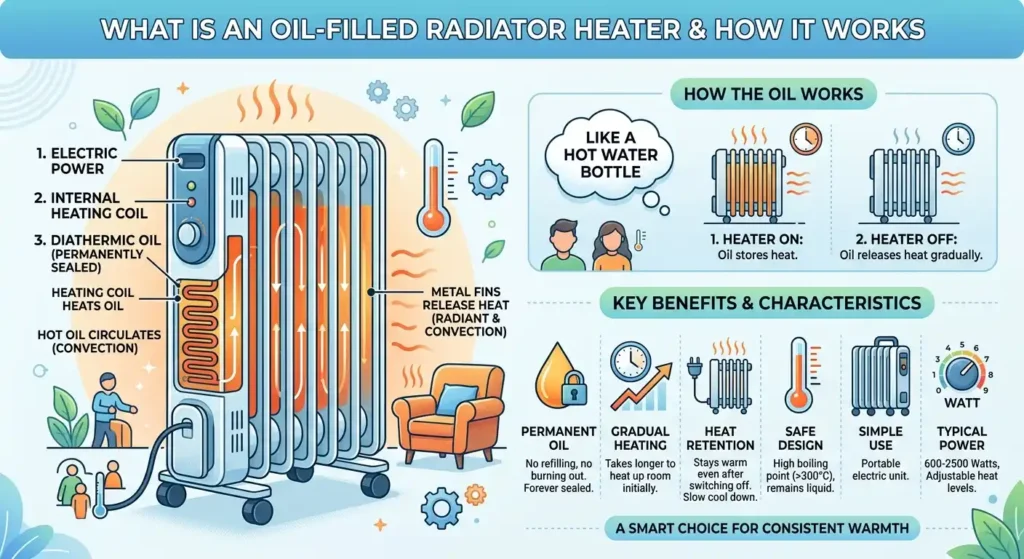
An oil filled radiator heater is a portable electric radiator heater that heats a closed container of diathermic oil (a refined mineral oil, not the fuel oil in your car) by heating an internal heating coil. The hot oil passes through the metal columns and the metal fins get the heat into the room via a combination of convection and radiant heat.
The oil does not require any replacement and does not burn out. It is closed in the unit permanently, hence the name of these heaters, oil filled, not oil burning. The work of the oil is merely to retain the heat and to give it out gradually, like a hot water-bottle which remains warm long after the kettle has been turned off.
The whole idea of this type of heater is that it releases slowly. That is why an oil radiator will keep a room warm even when it is switched off, and why it does not feel the same as a fan heater which becomes cold as soon as you switch it off.
Quick facts:
- Typical household oil radiators have a power of 600-2500 watts, and 3 adjustable heat levels.
- The oil within is never to be filled up and is forever sealed.
- An average unit has an internal boiling point that is far over 300 C, and thus the oil remains a liquid and safe when in use.
- Oil radiators take longer to heat compared to fan or ceramic heaters but retain heat longer when the room is heated. Pre-Installation: Before You Turn It On Checklist.
Before You Turn It On: Setup and First-Use Checklist
- Before plugging it in, attach the wheels or feet. These are detached on most units and the heater should be mounted on the floor with the feet or castors upright.
- Put it on a hard and flat and stable surface. Do not run it on a bed, soft rug or uneven floor.
- Maintain a minimum of 3 feet (approximately 1 meter) of clearance on all sides of curtains, furniture, bedding, and other items that may burn. This is not a mere suggestion of a manufacturer but rather a direct recommendation of the U.S. Consumer Product Safety Commission.
- Simply insert it into a wall. Never use an extension cord or power strip. They are not rated to the amount of current a heater uses and it is one of the major causes of house fires related to heaters.
- Leave it standing a couple of minutes before turning on, particularly when it has just been unboxed or transported, so that any oil can settle completely into the columns.
- Inspect the cord and plug prior to each use. Do not operate when the cord appears warm, frayed or damaged in any manner.
Understanding the Controls
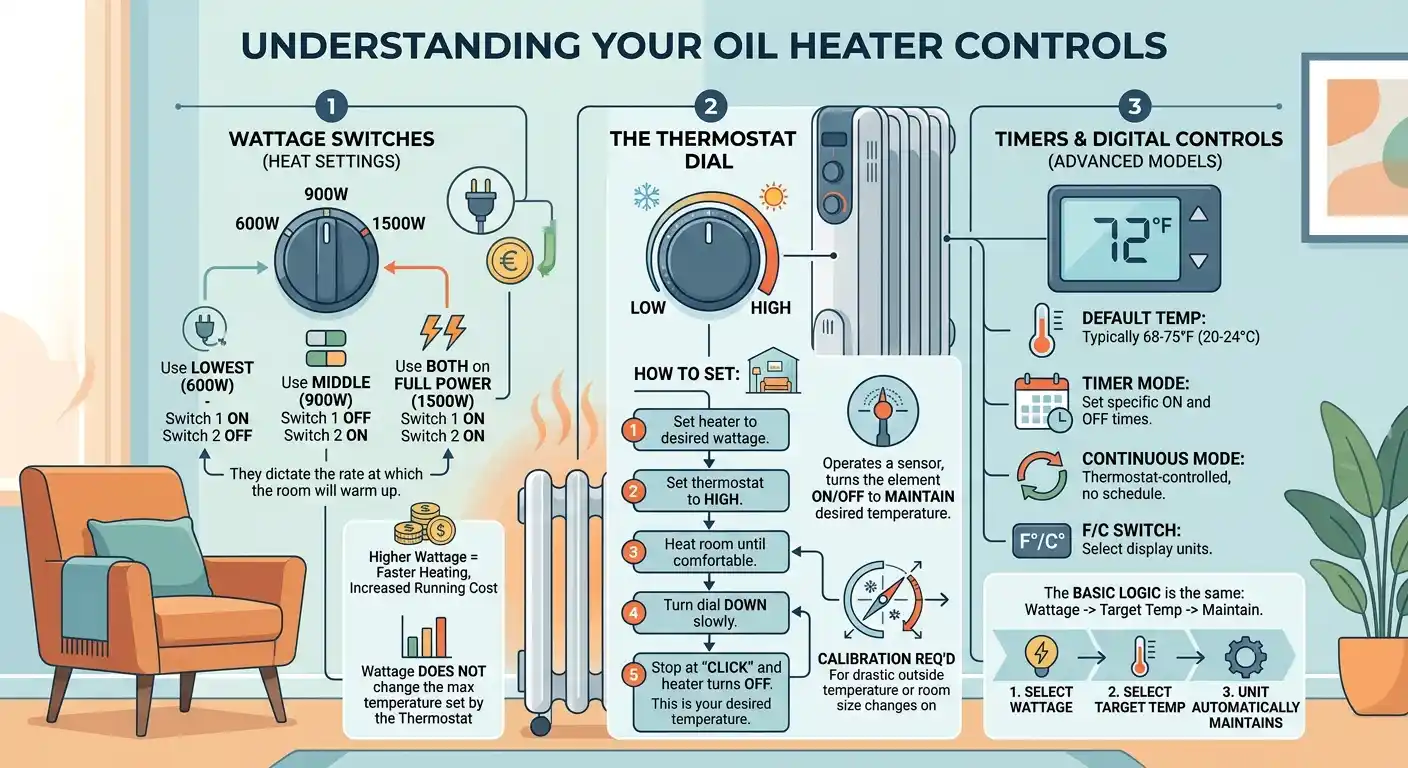
The majority of the confusion with these heaters is reduced to two dials which are similar but perform entirely different tasks.
Wattage Switches (Heat Settings)
These are usually labeled with numbers like 600W, 900W, and 1500W (or 800W, 1200W, and 2000W on larger units). They regulate the amount of power that the heating element consumes which dictates the rate at which the room will warm up.
It is here that people get confused, on most three-setting heaters the two lower numbers will be equal to the highest one. The reason is that the settings are actually only two heating elements that can be turned on or off. Use the lowest heat on switch one, the middle heat on switch two and both on full power.
An increase in wattage also implies increased heating and an increase in the hourly running cost. It does not imply a higher temperature of the ceiling when the thermostat is contented, as the thermostat determines when to turn off power, irrespective of the wattage level chosen.
The Thermostat Dial
This dial is not used to regulate heat production. It operates a temperature sensor that turns the heating element on and off to maintain a desired room temperature. The dial, which is not numbered, but has a range between low and high or 1 and 5, is not a fault, but it is normal.
The most effective method of setting it: Set the thermostat to the full blast and run the heater at the desired wattage until the room is comfortable. Next gradually rotate the dial to the downward position until you hear a gentle clicking noise and the heater is turned off. That clicking is where the thermostat is set to your present room temperature, and leaving it there allows the heater to automatically turn on and off to keep it at that temperature.
Do this once per room, per season. When the temperature outside changes drastically or you change the size of the room the heater is in, you will have to recalibrate.
Timers and Digital Controls
Later and more expensive models include a digital display, a programmable timer and occasionally a Fahrenheit or Celsius switch. On these:
- The default temperature is typically 68-75 F (20-24 C) default.
- Timer mode allows you to set on and off time rather than have it running all the time.
- Continuous mode maintains the heater and thermostat-controlled without a schedule.
- The basic logic of digital units remains the same: choose a wattage or power level, then choose a target temperature, and the unit switches the element on and off to maintain it.
How to Use an Oil Filled Radiator Heater Step by Step
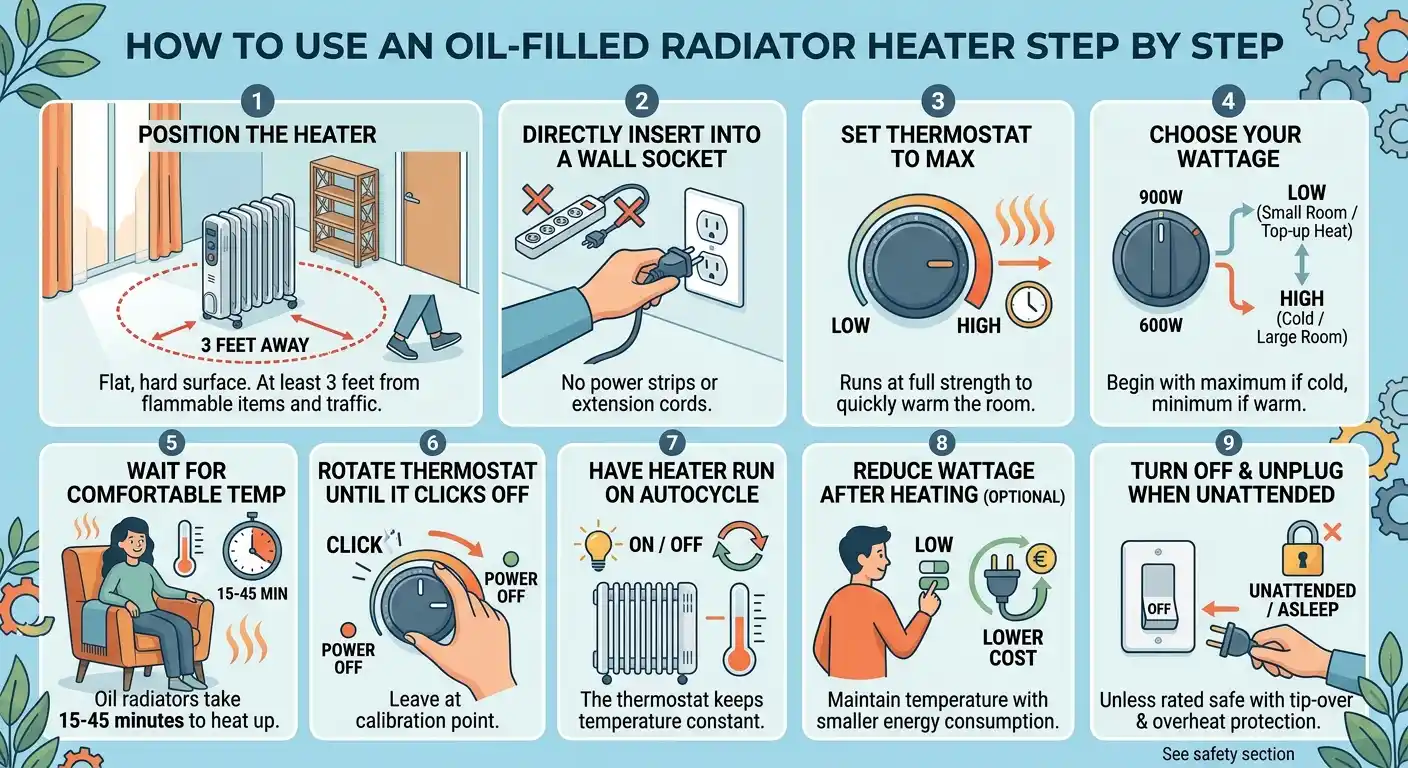
- Position the heater. Place it on a flat, hard surface at least 3 feet away from anything flammable and foot traffic and doorways.
- Directly insert it into a wall socket. No power strips, no extension cords.
- Set the thermostat to its maximum. This lets the heater run at full strength while you get the room to temperature.
- Choose your wattage. Begin with the maximum setting when the room is cold or large or with the minimum setting when the room is small or when it needs only a bit of top-up heat.
- Wait until the room is at a comfortable temperature. This may require 15 to 45 minutes depending on the size of the room and the initial temperature because oil radiators do not heat up immediately.
- Rotate the thermostat dial until it clicks off. This is your calibration point. Leave it there.
- Have the heater run on autocycle. The thermostat will keep the temperature constant by switching on and off the indicator light. This is not an abnormal cycling.
- Reduce the wattage after the room is heated, as you wish, to keep the temperature with a smaller amount of energy consumption, as the thermostat, but not the wattage switch, is doing the continuing work at this stage.
- When leaving the room, unattended long periods or going to sleep, turn it off and unplug unless the model is rated and sold as safe to be used unattended overnight with tip-over and overheat protection (see the safety section below).
Best Settings for Different Rooms and Situations
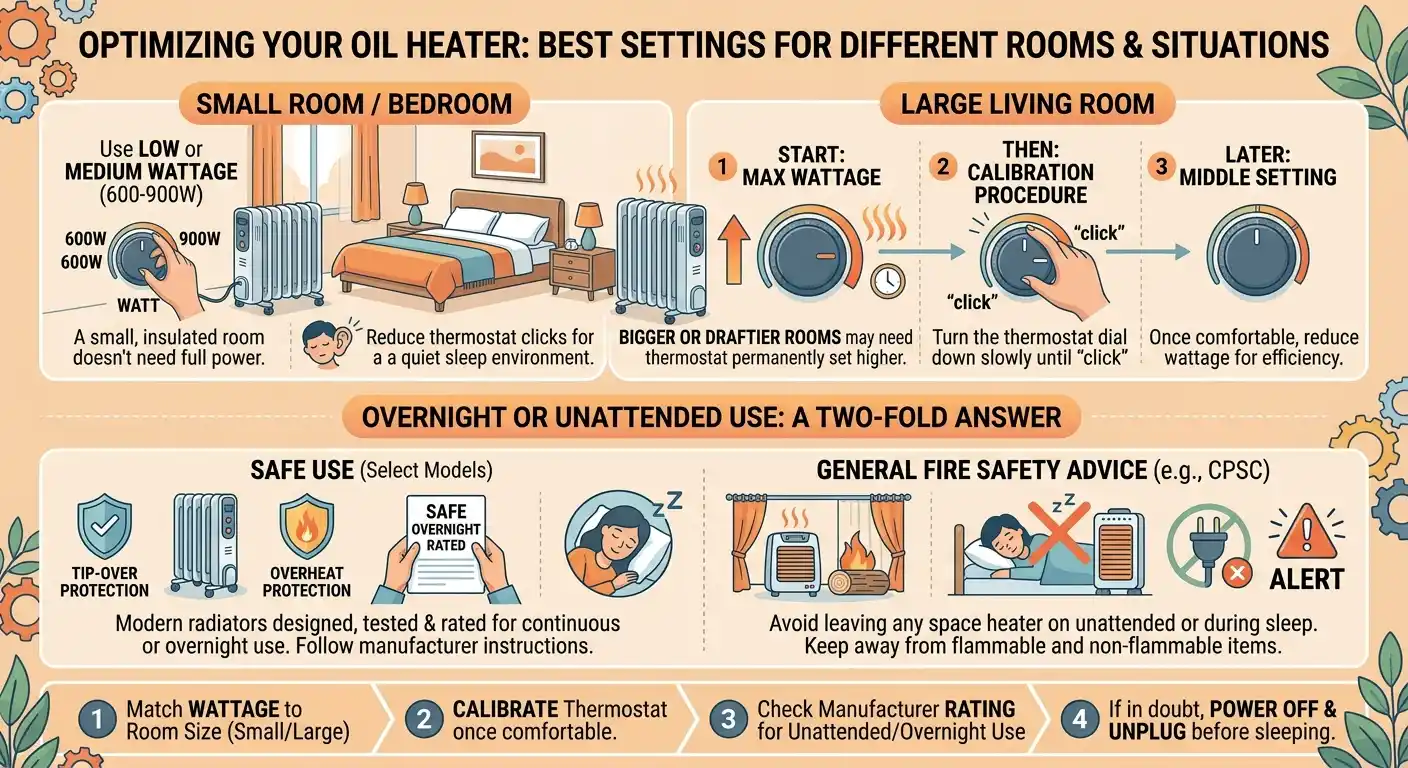
Small Room or Bedroom
Use the lowest or medium wattage (usually 600 to 900W). A small room with good insulation does not require full power and a more relaxed environment will ensure you do not hear the thermostat clicking as much as you can afford to sleep.
Large Living Room
Begin with the maximum wattage to get the room heated as fast as possible, and then proceed with the calibration procedure above and reduce to a middle setting when it is comfortable. Bigger or draftier rooms might require the thermostat to be permanently left nearer to its higher setting.
Overnight or Unattended Use
This is the question that people are most likely to seek and the truthful answer is two-fold.
There are also modern oil filled radiators that are specially designed, tested and sold to run safely continuously or overnight with automatic tip-off shutoff and overheat protection features. In case the manual of your model clearly says that it is rated to do so then it is logical to act as per the instructions of the manufacturer.
That being said, the CPSC provides general fire safety tips that include not leaving a space heater on unattended or during sleep and to keep it away both flammable and not flammable no matter what the safety capabilities of the model are. When you are not sure of the category of your heater, the best bet is to switch it off and unplug it before you leave the room permanently or go to sleep.
Quick Comparison: Heat Setting vs. Thermostat Dial
| Control | What It Actually Does | When to Adjust It |
| Wattage switch (600W/900W/1500W) | Sets how much power the element draws, controlling how fast the room heats | Set high to warm the room quickly, lower it once comfortable |
| Thermostat dial | Sets the target room temperature the heater will maintain | Set once per room using the “click” method, rarely touch it again |
| Timer (if fitted) | Schedules on/off times automatically | Use for predictable routines, like warming a room before you wake up |
How Much Does It Cost to Run an Oil Filled Radiator?
The running cost is determined by three factors: the wattage level at which you operate it, the number of hours it operates, and the price of electricity per kilowatt-hour (kWh). Since the thermostat switches the element on and off instead of keeping it on at full power once the room is heated, the actual use is typically much less than the maximum wattage in a full day.
Worked example: A 1.5 kW (1500W) heater operating at full power one hour consumes 1.5 kWh. That would be about 0.26 per hour at full and continuous load at an average U.S. residential rate of about 0.17 per kWh (rates are highly state-specific and country-specific, so look up the rate of your own utility to get a precise number). Practically speaking, when the thermostat is adjusted and running, a heater seldom requires full power during a full hour at a time, so actual expenses are usually less than this maximum amount.
In order to minimize the running expenses:
- Adjust the thermostat correctly rather than relying on guesswork, which means that the heater is not overheating the room and wasting energy.
- Turn on the minimum amount of wattage that will warm the space, and not necessarily leave it on high.
- Keep the door of the room you are heating closed to prevent the warm air entering unused areas.
- Heat a room only when in use by using a timer.
Oil Filled Radiator vs. Other Heaters
| Feature | Oil Filled Radiator | Ceramic/Fan Heater | Infrared Heater |
| Heat-up speed | Slow (15 to 45 min) | Fast (near instant) | Fast, but only where it’s pointed |
| Heat retention after switch-off | High, stays warm for a while | Low, cools almost immediately | Low |
| Noise | Silent (no fan) | Fan noise on most models | Silent |
| Best for | Heating a room over time, bedrooms, offices | Quick spot heating | Directly warming a person or small area |
| Surface temperature | Warm to hot metal casing | Can get very hot on grille | Very hot at the emitter |
| Typical running cost pattern | Cycles on/off once warm, can be efficient over time | Draws steady power while on | Draws steady power while on |
Oil radiators are slower, but more consistent. They are bad when you want a room warm within two minutes, and good when you want background heat that is steady and quiet and lasts hours.
If you’re weighing an electric option against a fuel-burning alternative, it’s worth reading up on running a gas-fueled unit properly before you decide, since propane heaters come with a different set of setup and ventilation rules.
Safety Rules You Shouldn’t Skip
The U.S. Consumer Product Safety Commission estimates that 1,100-1700 fires are caused each year in the United States by portable electric heaters, and that space heaters in general contribute a significant portion of home heating fire fatality, according to the National Fire Protection Association. With a couple of rules that are always followed, almost all of that risk is eliminated.
- maintain a minimum clearance of 3 feet between curtains, furniture, bedding, paper and flammable items.
- Do not use an extension cord or power strip. Directly plug into the wall.
- Do not put a heater on a rug, carpet, bed, or unsteady surface.
- Do not leave it running when you are asleep unless the manufacturer specifically rates the model to be used in that way.
- Always keep the heater uncovered, not even with clothes or blankets to dry them.
- Purchase a model that has been registered by an established testing lab (UL, ETL, or CSA in North America; similar indications elsewhere), and is known to have passed tip-over and overheat tests.
- periodically compare the model to your country product recall database.
- Check and install smoke detectors in any room that you often heat using a portable unit.
Common Mistakes to Avoid
- Turning the thermostat to the highest and leaving it. This heats the room unnecessarily, consumes energy and does not run the calibration step that renders the heater effective.
- Final room temperature is controlled by assuming wattage switch. It just regulates the heating rate; the thermostat regulates the desired temperature.
- Operating it on carpet or an uneven floor. This poses a fire risk and a stability hazard.
- Not hearing the clicking sound. The clicking of the thermostat on and off is not a malfunction, but a normal functioning.
- Extension cord due to poor location of the outlet. Adjust the position of the heater or change outlet instead.
- Expecting instant heat. Oil radiators are the incorrect device when you require a room to be heated within five minutes; it is what a fan or a ceramic heater should do.
Troubleshooting: My Oil Radiator Isn’t Working Right
The heater won’t turn on at all.
Test the outlet using another device. Then ensure that the thermostat is not too low because the unit will not run until the thermostat setting is lower than the current room temperature.
It’s on, but the room isn’t warming up.
Ensure that you are on a higher wattage, ensure that the thermostat is not close to minimum and ensure that the doors and windows of the room are closed.
It cycles on and off very frequently.
This typically implies that the thermostat is set near the existing room temperature which is normal, particularly in a tiny or well-insulated room. In case it appears too high, you can turn the thermostat down a notch and re-calibrate.
It’s making a ticking, clicking, or gurgling noise.
It is normal to click with the thermostat relay. The gurgling of the oil during heating in the columns is also normal in most cases. The heater should not be unplugged and checked or changed, a loud rattling, buzzing, or burning smell is not.
It fell over and closed down.
The tip-over safety switch at work. Place the unit on a firm surface and stand it up again; most units will start working again when they are in the upright position, but always check first.
Maintenance and Care
- Unplug and allow the unit to cool then clean.
- Clean the outside using a wet cloth; do not wet the vents or control panel.
- When out of use keep it erect in a dry place, and the cord should be loosely coiled and not tightly wound round hot fins.
- Do not ever open the sealed housing or refill the oil. These heaters are lifetime sealed and opening the casing will damage them and invalidate the warranty.
- Periodically check the cord and plug for wear, especially at the point where the cord meets the unit.
Myth vs. Fact
| Myth | Fact |
| “Leaving it on the highest wattage keeps the room warmer.” | Wattage only affects heating speed. The thermostat, not the wattage switch, decides the final maintained temperature. |
| “The clicking sound means it’s broken.” | It’s the thermostat cycling the element on and off, which is normal operation. |
| “Oil filled radiators need the oil topped up over time.” | The oil is sealed for the life of the unit and is never meant to be refilled or replaced. |
| “It’s always cheaper to leave it on low all day than turn it off and on.” | It depends on insulation, room size, and how long the room sits empty; there’s no universal answer, and a timer is usually the more reliable way to control cost. |
FAQs
What’s the correct way to set the thermostat on an oil filled radiator?
Set it to the maximum, allow the room to heat up, then gradually reduce the setting until you hear a click and the heater shuts off. That is your tuned-up scale of that room.
Should I leave an oil filled radiator on all day in order to save money?
Not necessarily. It will depend on your insulation and the frequency of use of the room. In the case of most homes, it consumes less energy to heat the room when it is used and a timer is used where possible than to run it all the time.
Can an oil filled radiator be left overnight?
When the particular model is produced and is listed as being able to be left unattended or overnight, and tip-over and overheat protection is verified in its manual. The general fire safety advice is to switch off portable heaters when sleeping unless the model specifically allows it.
Why does my oil radiator take so long to heat the room?
Radiators that use oil heat slowly since they heat a pool of oil and the heat is then distributed to the air. This is natural and it generally takes 15 to 45 minutes based on the room size and the initial temperature.
What is the meaning of the wattage values such as 600W, 900W and 1500W?
They are individual heating units that can be turned on or off, and they regulate the amount of power that the heater consumes and the rate at which it warms the room. They do not determine the final temperature.
Can I use an oil filled radiator with an extension cord?
No. It is advised by manufacturers and safety agencies such as CPSC to plug heaters directly into a wall outlet, as extension cords and power strips are not designed to handle the current that these devices require.
What is the minimum distance between furniture and an oil filled radiator?
Keep at least 3 feet (about 1 meter) of clearance on all sides from furniture, curtains, bedding, and anything flammable.
Is an oil filled radiator better than a fan heater?
It is based on what you want to achieve. Fan heaters are quicker to heat a room but cool immediately when turned off. Oil radiators take longer to heat, but retain it longer and operate quietly.
What is the clicking sound of my heater?
That’s the thermostat’s relay switching the heating element on and off to maintain your set temperature. It’s normal and expected.
Is it possible to place clothes or a blanket on the heater to dry them?
No. It is a fire hazard to cover any portion of the heater, even temporarily, and may also cause the overheat cutoff.
Are oil filled radiators to be refilled with oil or replaced?
No. The unit permanently seals the oil and is not meant to be topped up, emptied or serviced by the user.
What is the recommended size of a room to place an oil filled radiator?
This depends on the wattage and insulation, but as a crude rule of thumb, a 1500W unit is usually appropriate to small or medium sized rooms, with bigger or drafty rooms possibly requiring a higher-wattage unit or additional heating.
Why has my heater just turned off?
The tip-off switch was probably caused by the fact that the unit is not flat, or the overheat alarm was activated. Before starting it again, make sure it is standing upright on a stable surface and that there are no blocked vents.
Is it normal for the heater’s metal casing to get very hot?
Yes, the fins and casing are supposed to be warm to hot when it is running and that is how they give heat to the room. This is precisely the reason why it is important to clear off flammable materials, as well as children and pets.
Would an oil filled radiator work in a bathroom?
See the manual of your particular model. Risk of electric shock means many portable electric heaters are not rated to operate in high-humidity or wet-zone unless it is specifically stated that they are.
Final Thoughts
A radiator heater that uses oil will pay off a small initial investment with a long period of silent, consistent, low maintenance heat. The two dials which at first sight appear bewildering, wattage and thermostat, actually perform two very different and very simple functions when you get to know them, one determining how quickly you heat the room, the other how warm you keep it.
One time of the year, calibrate the thermostat using the click method, select a reasonable wattage to use in the room, obey the simple clearance and cord rules, and the heater will do the rest on its own.