How Efficient Are Oil-Filled Electric Heaters? The Energy Guide to Real Running Costs
You turn on a heater that fills with oil, experience the warm feeling and then the anxiety sets in. Is this object steadily creeping up your bill?
It is a just question, and there are two sides to the answer. Electric heaters that are filled with oil are highly effective in converting electricity to heat. They are cheap to operate, but it is up to you how you utilize them, the size of your room and the amount you pay in power.
This guide provides you with the figures and a straight forward method of calculating your own cost.
How Efficient Are Oil-Filled Electric Heaters?
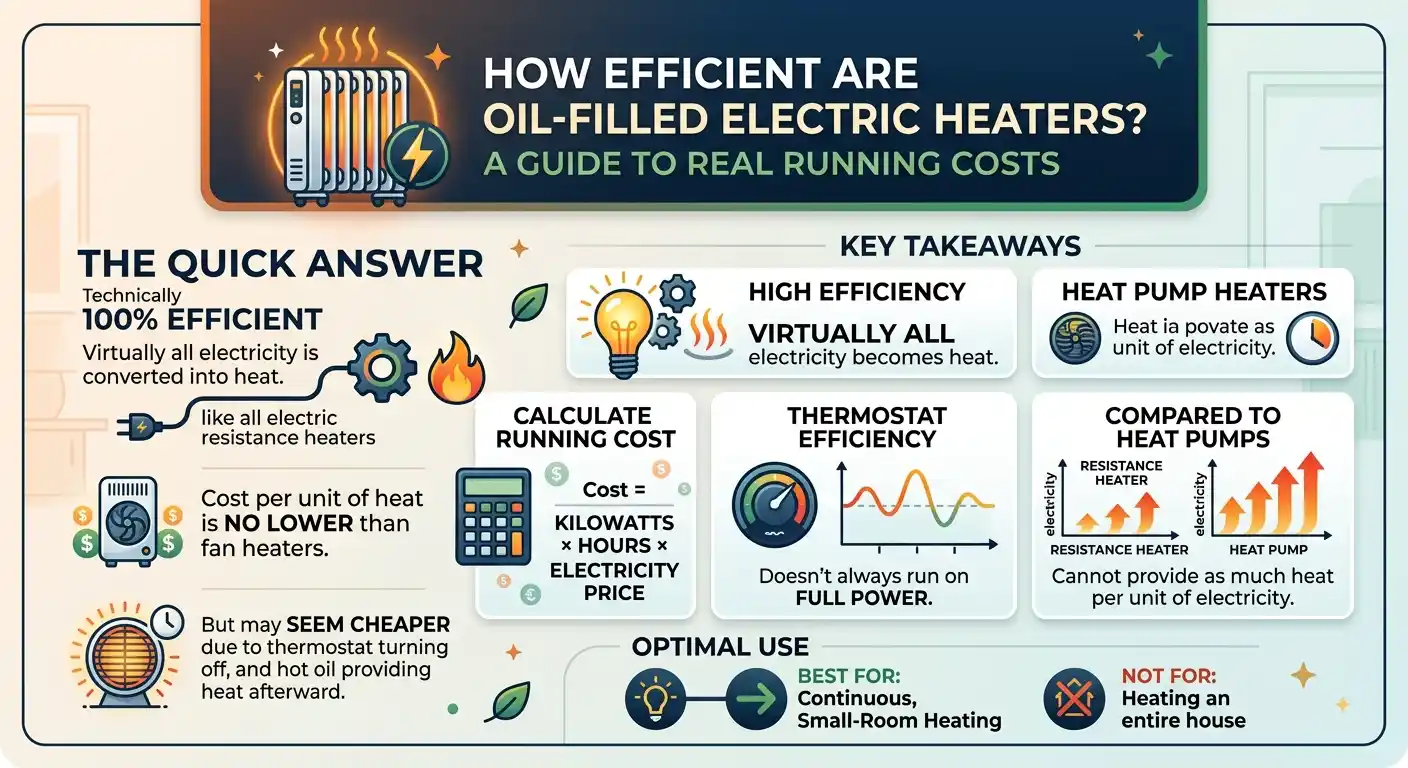
Oil-filled electric heaters are technically 100% efficient, which is to say that virtually all of the electricity they consume is converted to heat in your room. But so are all other electric resistance heaters. The cost per unit of heat of an oil-filled radiator is no lower than that of a fan heater.
It still may seem cheaper since its thermostat turns off and the hot oil continues to give out warmth later on.
Key takeaways
- Virtually all electricity is heat, hence efficiency is high.
- Running cost = kilowatts, times hours, times your electricity price.
- The thermostat implies that the heater does not often run on full power.
- No resistance heater can provide as much heat as a heat pump on a unit of electricity.
- Optimal is continuous, small-room heating, not heating an entire house.
What “Efficient” Really Means for a Heater
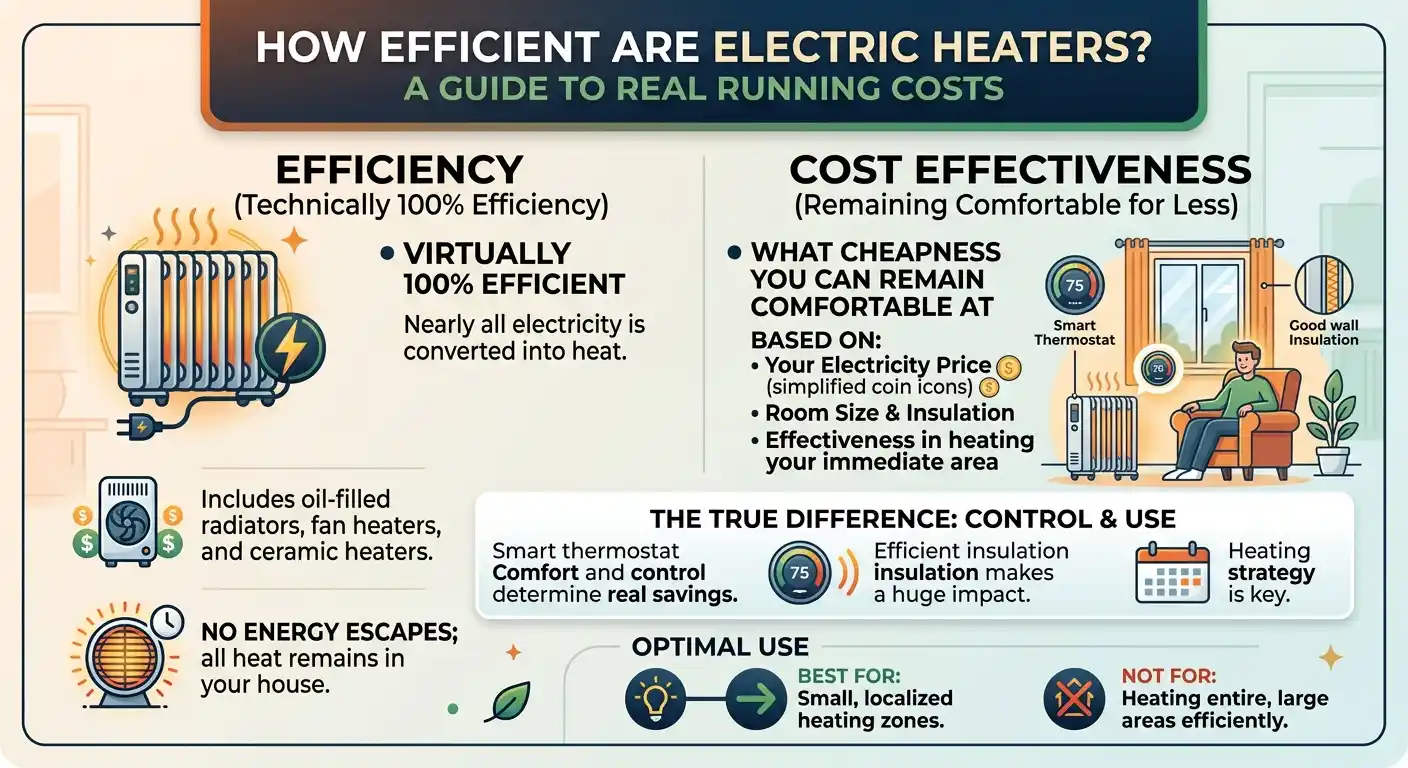
Efficiency is the extent to which the energy you pay is converted into the desired thing. In the case of a heater, that is heat.
Electric resistance heaters such as oil-filled radiators, fan heaters, ceramic heaters and infrared panels all use nearly 100% of the electricity used to heat them. Nothing escapes as there is no exhaust and no fuel burned. The heat remains in your house. If you want to go deeper on the engineering side, this science-backed look at oil-filled heater energy performance covers it well.
That brings to a point that most articles do not cover. Cost effectiveness and efficiency are not the same.
- Efficiency: what proportion of power is heat. Heaters that are filled with oil have a score of approximately 100.
- Cost effectiveness: the cheapness with which you remain comfortable. This is based on your electricity bill, your room, your insulation and the effectiveness of your heater to provide warmth in the area where you are seated.
Since all plug-in electric heaters are roughly equally efficient, comfort, control and your use of them are the true differences.
How an Oil-Filled Heater Works
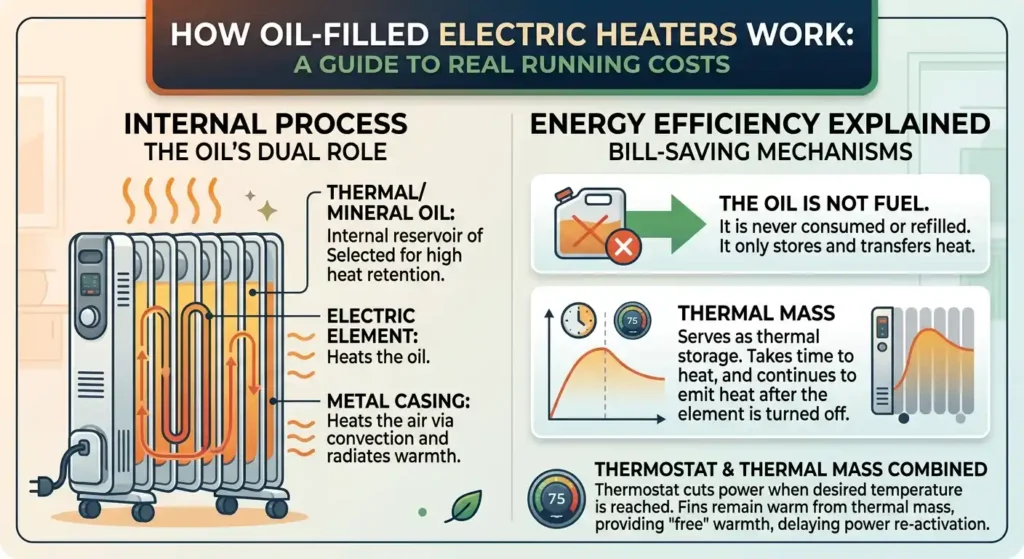
Within the metal fins is a reservoir of oil, normally a thermal or mineral oil, selected due to its ability to retain heat. The oil is heated by an electric element and the metal casing is heated by the oil. The casing then warms the air surrounding it through convection, and it also radiates a bit. For a fuller walkthrough of the inner workings, see this practical explanation of how these radiators produce and hold heat.
Two particulars are important to your bill:
- The oil is not fuel. It is never incinerated or wasted and it does not require filling. It is merely a storage and transfer of heat.
- The oil serves as a thermal storage. It takes time to heat, and it continues to emit heat even after the element is turned off. This is referred to as thermal mass.
Once the room is heated to your desired temperature, the thermostat will eliminate power to the element. The fins remain warm a bit and hence the room continues to get the warmth without attracting additional electricity. Then the element switches back on with a drop in temperature.
How Much Electricity Do Oil-Filled Heaters Use?
The majority of oil-filled heaters have various power levels, typically between 500 and 2,500 watts depending on the model and location. The standard household outlet and circuit limit about 1,500 watts on the use of portable heaters in the United States. Higher wattages are more prevalent in the UK and other 230 volt areas.
The Simple Cost Formula
Use this to estimate any heater:
Watts ÷ 1,000 = kilowatts (kW)
kW × hours used = kilowatt-hours (kWh)
kWh × your electricity price = cost
Check your latest electricity bill for your price per kWh. It is highly dependent on country, state and provider, and you should use your own number, not an overall average. If you would like a second set of worked numbers, this real-world cost breakdown for oil-filled radiators is a handy companion.
Real Example With a Thermostat
You have a 1,500 watt heater that you leave on in a bedroom and the cost of electricity is 17 cents per kilowatt hour. This is a representative rate, and replace yours.
- At full power all the time: 1.5 kW × 8 hours = 12 kWh, which costs about $2.04.
- When the thermostat leaves it on half of the time: 6 kWh, and that would cost approximately $1.02.
More than 30 half-duty nights, or about 30 dollars. The half duty number is an approximation, as the actual share will be determined by room size, insulation and outside temperature. The heater can turn off much more frequently in a small, well-sealed room. It can run nearly all the time in a cold, drafty room.
Cost Table by Wattage
The cost per hour at full power, at the same illustrative rate of 17 cents per kWh:
| Heater power | kWh per hour | Cost per hour at full power |
|---|---|---|
| 500 W | 0.5 | about $0.09 |
| 800 W | 0.8 | about $0.14 |
| 1,000 W | 1.0 | $0.17 |
| 1,500 W | 1.5 | about $0.26 |
| 2,000 W | 2.0 | $0.34 |
| 2,500 W | 2.5 | about $0.43 |
Multiply by the share of time the element is actually on to get a realistic figure. Readers who want to see how the bill changes by wattage can also read this guide to whether oil heaters are expensive to run.
Visual hint to designer: A simple bar chart of hourly cost at each wattage, and a second light bar of cost at half duty cycle.
Oil-Filled Heaters vs Other Heater Types
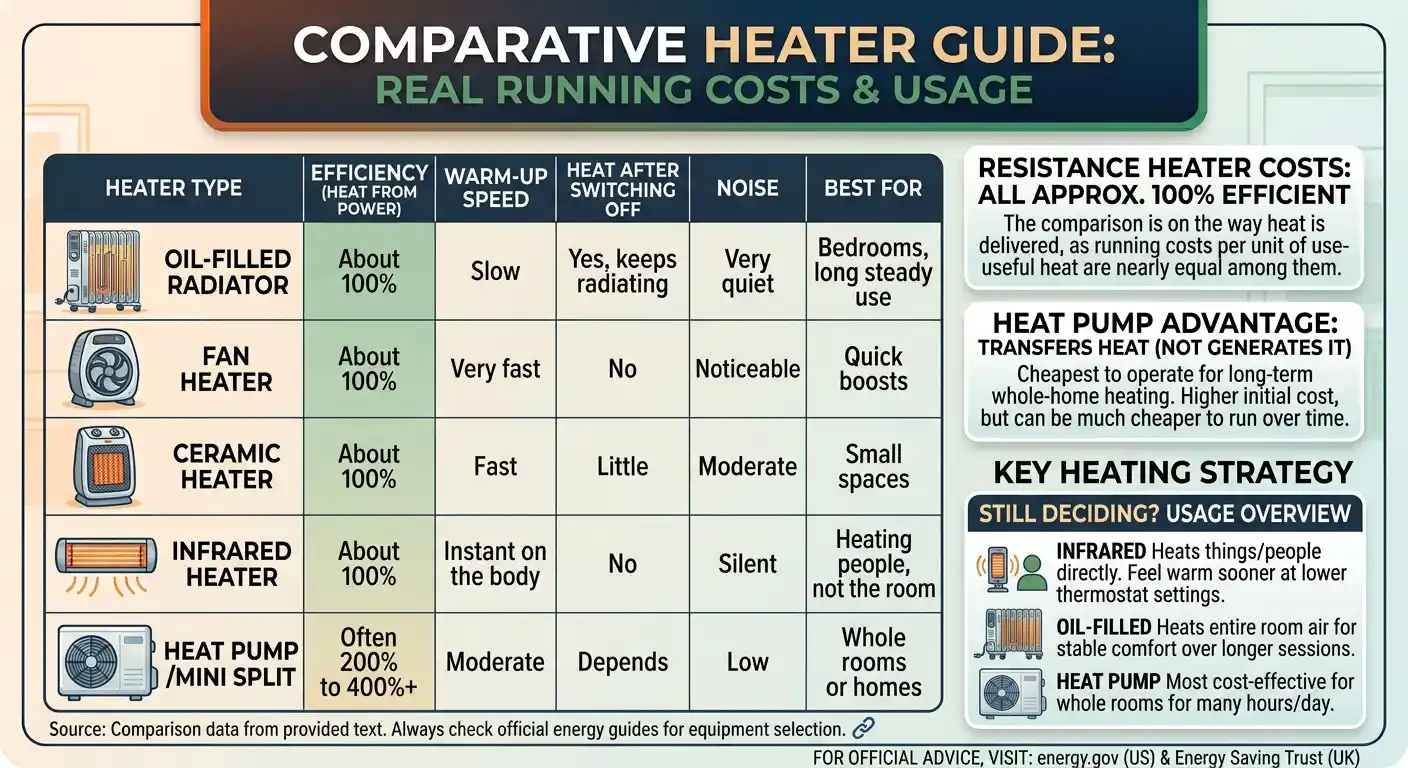
The comparison is on the way the heat is delivered since all electric resistance heaters are approximately equally efficient.
| Heater type | Efficiency (heat from power) | Warm-up speed | Heat after switching off | Noise | Best for |
|---|---|---|---|---|---|
| Oil-filled radiator | About 100% | Slow | Yes, keeps radiating | Very quiet | Bedrooms, long steady use |
| Fan heater | About 100% | Very fast | No | Noticeable | Quick boosts |
| Ceramic heater | About 100% | Fast | Little | Moderate | Small spaces |
| Infrared heater | About 100% | Instant on the body | No | Silent | Heating people, not the room |
| Heat pump or mini split | Often 200% to 400% or more | Moderate | Depends | Low | Whole rooms or homes |
Some things to keep in mind:
- Compared to infrared: Infrared heats things and people directly, therefore you can feel warm sooner at a lower thermostat setting. A heating system is an oil-filled heater that heats the air and maintains the entire room at a comfortable temperature. Neither is a winner in efficiency. It is concerning what you desire to warm.
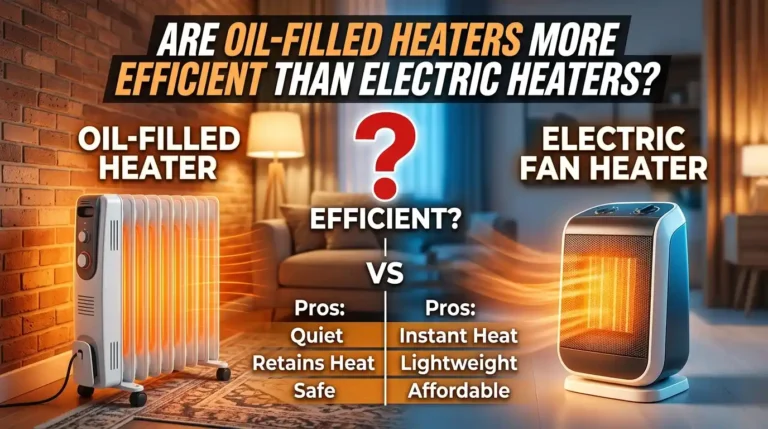
- Versus fan heaters: A fan heater is a rapid heat source that will cease as soon as it is turned off. An oil-filled heater is more stable in longer sessions. You can see what the other side of that comparison costs in this hourly, daily and monthly fan heater cost guide.
- Compared to heat pumps: A heat pump does not generate heat, but transfers it, thus it can provide multiple units of heat to every unit of electricity. When you heat a room many hours a day a heat pump would tend to be much cheaper to operate, but more expensive to purchase and install.
Still deciding between styles? This comparison of the main portable heater categories can help you match a type to your room.
To get official advice on selecting heating equipment, visit the US Department of Energy at energy.gov, which discusses the use of space heaters and heat pumps. UK readers can check the Energy Saving Trust.
Pros and Cons
| Pros | Cons |
|---|---|
| Nearly 100% efficient at making heat | Slow to warm a cold room |
| Thermostat cuts power once the room is warm | Not cheaper per unit of heat than other electric heaters |
| Keeps radiating heat after the element switches off | Heavy compared with fan heaters |
| Quiet, no fan noise | Poor for heating a large or open space |
| No fuel to refill and no fumes | Surface can be hot enough to burn skin |
| Does not dry the air or blow dust around as much as fan heaters | Costs more to run than a heat pump |
How to Size an Oil-Filled Heater
The usual rule of thumb is approximately 10 watts per square foot of floor area of a room with typical ceiling and average insulation. That would be a 12 by 12 foot room or 150 square feet, which would be appropriate to a 1,500 watt heater. This is a general guideline. More may be required by poor insulation, high ceilings or large windows, and less may be required by a well-insulated room.
Having an oversized heater is not necessarily a bad thing due to the thermostat, but a heater that is too small will run flat and still will not be able to run.
How to Cut Your Running Costs
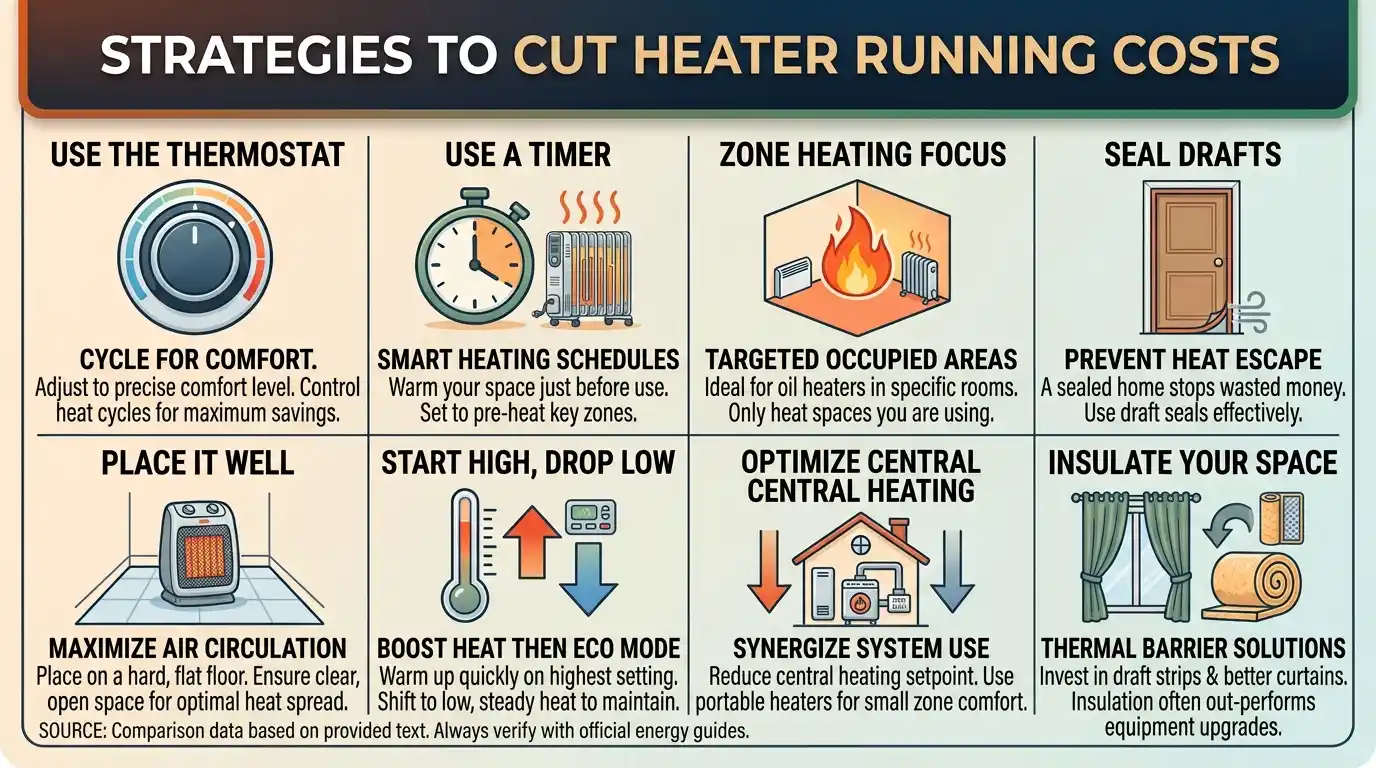
- Use the thermostat. Adjust the temperature to a comfortable level and have the unit run in a cycle rather than running at full blast.
- Use a timer. You can warm the room up early and leave the accumulated heat to take you away.
- Turn on a room, not the house. Heaters that use oil are effective as zone heating in the room you are in.
- Seal the door and drafts. Leakages are wasted money.
- Place it well. Place it on a hard, flat floor with an open area around it. Do not hide it under furniture or curtains.
- Start on high, then drop. Warm up on the highest setting and use a lower setting to maintain.
- Turn down your central heating (when you have it on). According to the US Department of Energy, zone heating can only save money in the event that you turn down the main heating system.
- Insulate where possible. Draught strips and heavier curtains can frequently be more economical than a heater upgrade.
Common Mistakes
- Leaving the heater on the highest level and not using a thermostat throughout the day.
- Operating it in an open window/door room.
- Heating a large open plan area that it was not originally designed to heat.
- Being oil-filled is to assume low energy. Never forget to check the wattage.
- Drying clothes by covering it, a fire hazard, and prevents air circulation.
- Plugging an extension cord (long or damaged) into a wall outlet rather than directly.
Safety Notes
Heat oil-filled heaters are said to be safer than open element heaters since there is no glowing element, although not risk free. The casing becomes hot and children and pets should be kept away and no cloth should be thrown over the casing. When purchasing, seek tip-off protection and overheat protection.
Insert it directly into a wall socket instead of using a power strip or slim extension cord and read the instructions that come with it. Up-to-date space heater safety advice is available in the US Consumer Product Safety Commission and your local fire authority.
FAQs
Are oil-filled heaters 100% efficient?
Yes, in the sense that nearly all the electricity they use becomes heat in the room. So do other electric resistance heaters. Heat pumps are able to overcome 100% since they do not generate heat but transfer it.
Are oil-filled heaters consuming a lot of electricity?
When the element is on, they draw as much as their wattage claims to draw. A 1,500 watt model has a power consumption of 1.5 kWh/h at full power, but the thermostat allows it to be operated at full power only a few hours per day.
Do oil-filled heaters cost less to operate compared to fan heaters?
No. Per unit of heat the cost is equal. They have the ability to be more cost effective as they turn off and continue to release heat.
What is the cost of operating an oil-filled heater at night?
Divide the kilowatts of wattage by the hours and multiply by your price per kilowatt hour and then you have to factor in the cycling of the thermostat. An example is a 1,500 watt heater with a cost of 17 cents per kilowatt-hour which costs approximately 1 dollar in 8 hours when it is operating half the time. Get your own rate to get the right number.
Is it safe to leave an oil-filled heater on overnight?
A lot of people do and models with a thermostat, tip-over switch and overheat protection are made to be used over a long period of time. Nevertheless, do as the manufacturer suggests and keep it empty of bedding and curtains and do not use extension cords.
Are oil-filled heaters to be refilled?
No. The oil is contained within and not used up. A leak implies that the unit is to be repaired or replaced.
What is the time of an oil-filled heater to heat a room?
Typically 15-30 minutes to detect warmness, in a big or cold room, it takes longer. Times differ depending on the model and room.
Why does my heater, which uses oil, turn on and off?
That is the thermostat which turns the element on and off to maintain your desired temperature. It is normal and is the way the heater conserves energy.
Do oil-filled heaters outperform infrared heaters?
Neither is more efficient. Oil-filled heaters are appropriate to provide constant warmth to an entire room. Infrared heaters are better suited to warming people directly.
What is the size of the oil-filled heater that I require?
The typical guideline is approximately 10 watts per square foot and therefore a room of 150 square feet would accommodate approximately 1,500 watts. Compensate for insulation and ceiling height.
Is an oil-filled heater less expensive than central heating?
Not often, particularly where gas or some other fuel is cheaper per unit of heat than electricity. It can help you save money by heating a single room and switching off the central heating in other rooms.
How can you heat a room using electricity at the lowest cost?
A heat pump is typically the lowest-cost electric choice to operate, since it provides more heat per unit of electricity than any resistance heater.
Do oil-filled heaters dry the air?
They do not dry the air, but can make air seem drier as it warms. They are also likely to be milder than fan heaters since they do not force air around.
Is it possible to dry clothes with an oil-filled heater?
It is not recommended. Sealing the heater prevents air circulation and poses a fire hazard. Instead, use a drying rack that is at a safe distance.
Final Thoughts
In the simplest sense, oil-filled electric heaters are efficient: almost any unit of electricity you pay for is converted into heat. They are not magic money savers, however. They are priced the same amount of heat per unit as any other plug-in electric heater, and a heat pump will outperform them on operating cost should you be able to use one.
In what they excel is comfort. They are silent, stable and tolerant, and their thermostat and stored heat allow them to consume less power than indicated on their label. Adjust to the room size, thermostat and timer, no drafts, and heat only the area you occupy. Do so, and an oil-filled heater is among the most agreeable and reliable methods of heating a small room.
Second step: Take your recent electricity bill, identify your price per kilowatt-hour and the wattage of your heater and compute the cost formula above. You will have your real number in a minute or less.