How Long Does a Propane Tank Last on a Patio Heater? Real Burn Times, the Simple Math, and Ways to Stretch a Tank
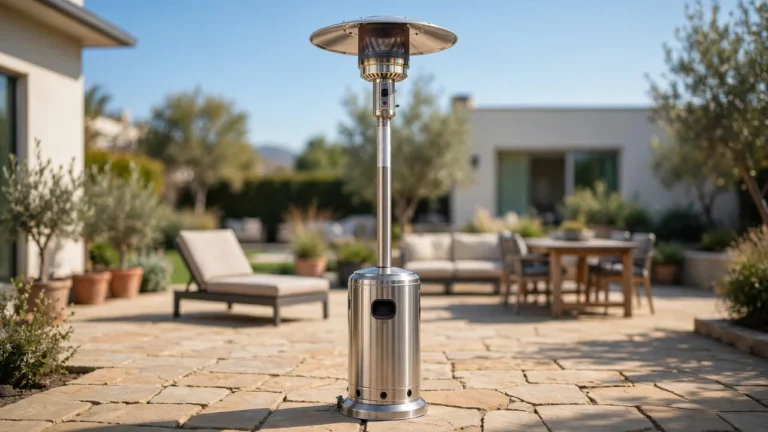
If you are planning a backyard evening around a propane patio heater, one question decides how the night ends: how long does a propane tank last on a patio heater? Nobody wants the flame dying halfway through dinner while guests are still on the patio. Here is the short answer. A full 20-pound tank holds about 430,000 BTUs of energy. A common full-size patio heater burns 40,000 BTUs per hour on high, so one tank gives you roughly 8 to 10 hours of real-world heat. That covers three or four typical evenings. A tabletop model sips fuel at around 10,000 BTUs per hour and can run 40 hours or more on the same tank.
By the end of this guide, you will know how to work out your own heater’s exact burn time with one quick division, how to check how full your tank really is (exchange tanks often hold less than the label suggests), and how to make a single tank cover more evenings. You will also get the safety basics that come with any gas appliance. Plan on five minutes of reading, a beginner skill level, and one simple formula.
Gas safety note: Propane patio heaters are outdoor appliances. Never run one indoors, in a garage, or inside a tent. Burning propane produces carbon monoxide, an odorless gas that can kill. Keep the tank upright and outdoors, and check connections for leaks with soapy water before each season. If anything smells wrong or you feel unsure, shut the valve and call a licensed propane technician.
- Find your heater’s BTU rating on the spec plate
- Weigh your tank to learn how full it really is
- Calculate how long a propane tank lasts on your patio heater
- Turn the dial down to stretch one tank further
- Spot the signs your tank is nearly empty
- Handle propane the safe way every time
Find your heater’s BTU rating on the spec plate
The whole calculation starts with one number: how many BTUs your heater burns per hour. Look for the metal spec plate on the heater’s base or pole, or check the manual. Full-size freestanding patio heaters usually list 40,000 to 50,000 BTU/hr on high. Tabletop and mushroom-style models often run 10,000 to 15,000 BTU/hr. Write down both the high and low settings if the plate lists a range — you will use the low number later to see how much fuel a gentler setting saves. If you are still shopping, our guide on how to choose a patio heater breaks down BTU ratings by patio size.
Weigh your tank to learn how full it really is
A “20-pound tank” does not always hold 20 pounds of propane. A refill station fills your own cylinder close to the full 20 lb (about 430,000 BTU). Exchange cages, on the other hand, often hand you a tank with only 15 lb inside — roughly 322,500 BTU, which shaves about a quarter off your burn time. That difference is the most common reason a “full” tank seems to empty fast. To find out what you actually have, read the tare weight stamped “TW” on the tank collar, weigh the tank on a bathroom scale, and subtract. The difference is your remaining propane in pounds. No scale? Pour warm water down the side of the tank — the metal feels cool where liquid propane sits and warm above it.
Calculate how long a propane tank lasts on your patio heater
Here is the one formula you need: tank BTUs ÷ heater BTU/hr = hours. A true full 20-lb fill holds about 430,000 BTU (20 lb × roughly 21,500 BTU per pound). Divide that by your heater’s rating. A 40,000 BTU heater gives about 10.75 hours on paper, and 8 to 10 hours in real backyard conditions, since wind and efficiency losses trim the theoretical number. If your tank came from an exchange cage with 15 lb, use 322,500 BTU instead — that same 40,000 BTU heater then runs about 7 to 8 hours.
| Heater output (BTU/hr) | Burn time on a full 20-lb tank | Typical heater type |
|---|---|---|
| 50,000 | ~8.5 hours | Large commercial-style tower |
| 40,000 | ~10–11 hours (8–10 real-world) | Standard freestanding patio heater |
| 30,000 | ~14 hours | Mid-size freestanding heater |
| 20,000 | ~21.5 hours | 40,000 BTU heater on medium |
| 15,000 | ~28.5 hours | Small radiant / wall-mount style |
| 10,000 | ~43 hours | Tabletop patio heater |
Based on ~430,000 BTU in a true 20-lb fill. Wind, cold, and burner efficiency trim 10–20% off these numbers in practice.
Turn the dial down to stretch one tank further
Cutting the heat setting roughly in half nearly doubles your runtime. A 40,000 BTU heater dropped to medium (around 20,000 BTU/hr) stretches a full tank from about 10 hours to about 20. On mild evenings, low is plenty — radiant heat warms people, not air, so a lower setting still feels cozy within a few feet. Wind is the other fuel thief: a breeze forces the burner to work harder for the same warmth. Parking the heater in a sheltered corner or behind a windbreak screen measurably cuts consumption. Curious how your setup compares to a fire pit? See how long a propane tank lasts on a fire pit — a different appliance with its own burn-time math.
Spot the signs your tank is nearly empty
About two hours before the end, most heaters give you a warning: the flame shrinks, the glow dims, or the burner sputters on breezy nights. A white frost ring creeping up the tank wall is another classic sign — it means liquid propane is boiling off fast and the metal is getting cold. Cold weather adds a twist: propane must vaporize before it burns, and on a frigid night a nearly-empty tank can starve the heater even with fuel still inside. If output fades on a cold night, move the tank out of the wind, let it warm up, or swap in a fuller cylinder.
Handle propane the safe way every time
Before the first lighting of the season, brush soapy water over every connection — the hose fitting, the regulator, the valve. Bubbles mean a leak: shut the valve and do not use the heater until the fitting is fixed. Keep the tank upright at all times, outdoors, with at least 3 feet of clearance from walls, furniture, and anything flammable. Never store a spare cylinder indoors, in a basement, or in a hot car. And the rule that matters most: propane heaters stay outside, always. Our post on whether you can use a patio heater indoors explains why no room in the house is safe for one.
| If This Happens | Try This |
|---|---|
| Heater sputters or the flame shrinks on a cold night | The tank can’t vaporize propane fast enough. Move it out of the wind, let it warm up, or swap in a fuller tank. At around 20°F a full 20-lb tank reliably feeds only about 45,000 BTU/hr. |
| Frost or ice forms on the tank | Normal when demand is high and the air is cold. Turn the setting down a notch, or swap tanks and let the frosted one thaw. |
| Flame dies halfway through the evening | The tank is likely down to its last couple of pounds. Weigh it to confirm, and keep a spare cylinder on hand for gatherings. |
| Rotten-egg smell or hissing at a connection | Shut the tank valve immediately, move everyone away, and do not create sparks or flip switches. Call your gas supplier or the fire department. |
- Read the BTU/hr rating off the spec plate (40,000–50,000 typical full-size).
- Weigh the tank, subtract the TW tare weight — that’s your real pounds of propane.
- Divide: 430,000 ÷ BTU rating (or 322,500 for a 15-lb exchange tank).
- Expect 8–10 real-world hours on high for a 40,000 BTU heater; ~40+ for a 10,000 BTU tabletop.
- Run on medium to roughly double runtime; shelter the heater from wind.
- Leak-check with soapy water, keep the tank upright and outdoors, never use indoors.
You now know exactly how long a propane tank lasts on a patio heater — and how to work it out for any heater, any tank, and any setting with one quick division. Most owners are surprised twice: first by how fast high burns through a tank, then by how far a tank goes on medium. Weigh your tanks, keep a spare for party nights, and respect the gas. For the full setup walkthrough, read how to use a patio heater next.