Are Oil-Filled Heaters More Efficient Than Electric Heaters?
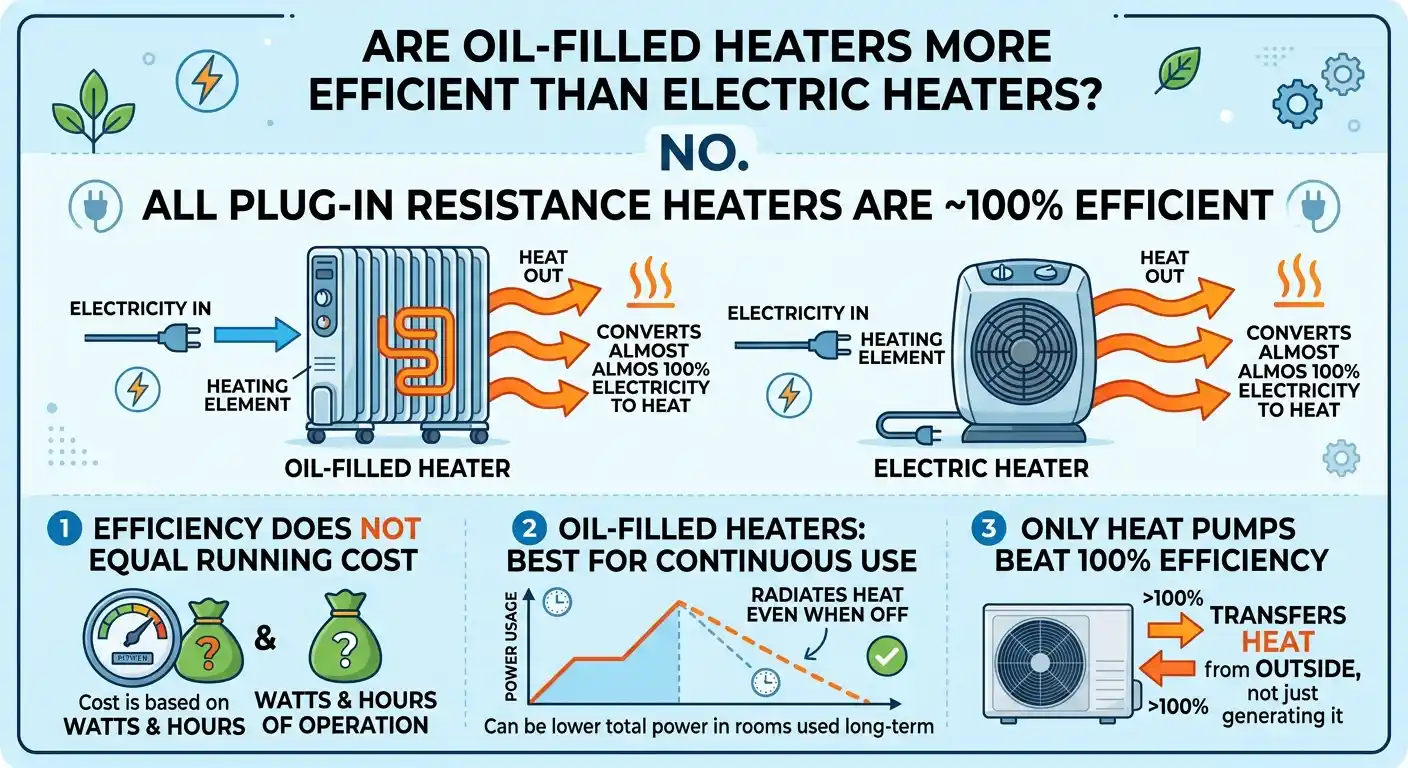
The brief answer: no. An electric heater is an oil-filled heater. It turns almost 100% of the electricity it uses into heat, and so does every other plug-in resistance heater. The only place that oil-filled models can triumph is the methods of delivering that heat, its duration, and its impact on your bill.
Key takeaways
- All the oil-filled, fan, ceramic, and convector heaters are approximately 100% efficient in converting power to heat.
- Efficiency does not equate to running cost. The cost is based on the number of watts and hours of operation.
- Oil-filled heaters can be less total powered in rooms that are used continuously and long-term, since they turn off and continue to radiate.
- The only common that beats 100 is heat pumps.
What Does “Efficient” Actually Mean for a Heater?
Efficiency is the proportion of the electricity you pay that is transformed into heat. In the case of plug-in resistance heaters, it is almost everything. The unused energy has no other place to go thus it is warmth in your room.
One kilowatt-hour (kWh) of electricity produces about 3,412 BTU of heat, whatever the heater looks like. Any kind of 1,500-watt heater provides you with approximately 5,100 BTU per hour at full blast.
When people are inquiring about which heater is more efficient, what they are asking is which one is cheaper to maintain a room at a comfortable temperature. That is based on the behaviour of the heater, rather than its conversion rate.
How Each Type of Electric Heater Works
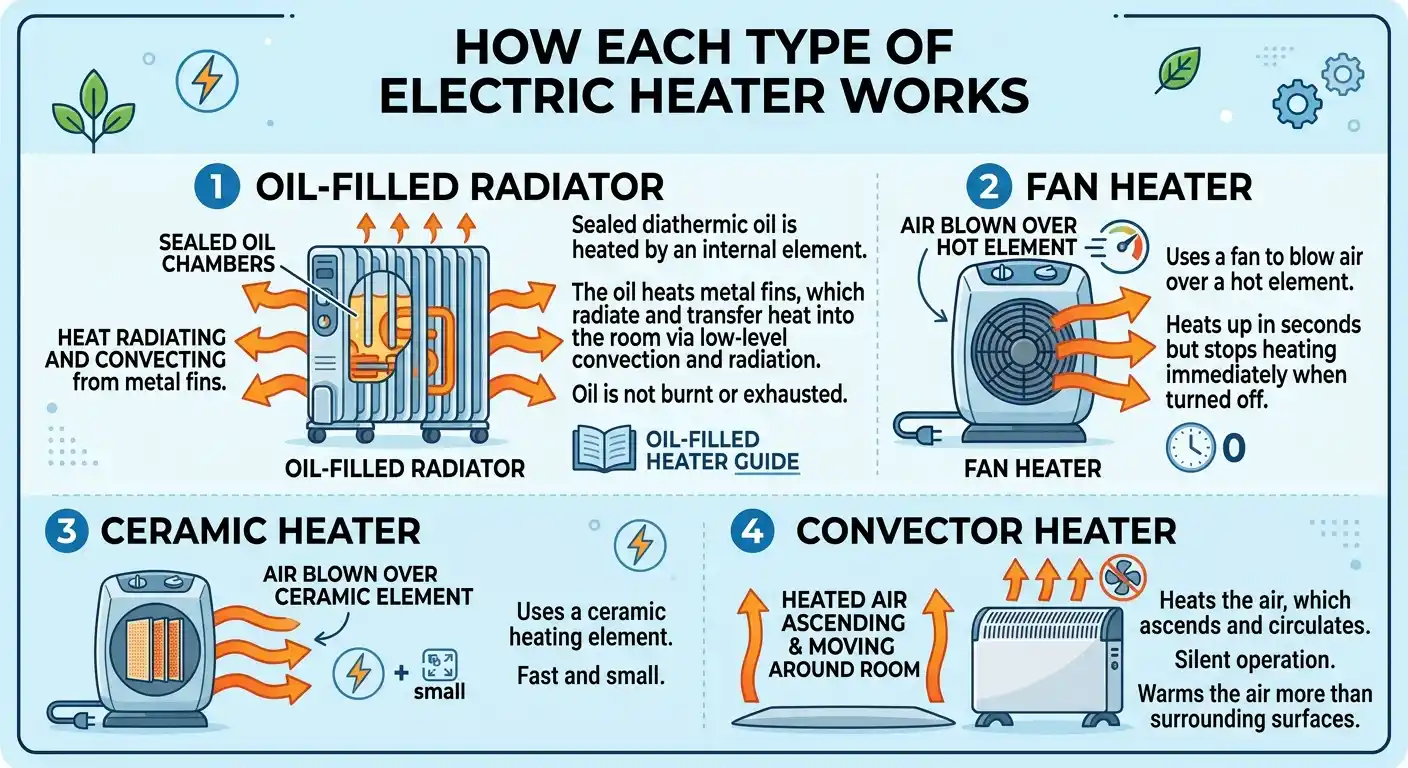
Oil-filled radiators are sealed diathermic oils that are heated through an internal element. The oil heats the metal fins and the fins radiate and transfer heat into the room through low-level convection and radiation. The oil is not burnt or exhausted. To have a more in-depth examination, check out our oil-filled heater guide.
Fan heaters are used to blow air over a hot element. They heat up within a few seconds but cease to heat once you turn them off.
Ceramic heaters are similar to fan heaters except that they have a ceramic heating element. They are fast and small.
Convector heaters heat the air that ascends and moves around in the room. They do not make noise, but warm the air more than the surfaces.
Oil-Filled vs Electric Heaters: Quick Comparison
| Feature | Oil-filled radiator | Fan or ceramic heater | Convector heater |
|---|---|---|---|
| Energy conversion | About 100% | About 100% | About 100% |
| Warm-up time | Slow (10 to 20 minutes) | Seconds | Fast to moderate |
| Keeps heating after switch off | Yes, for a while | No | Very little |
| Noise | Near silent | Fan noise | Quiet |
| Best for | Steady heat in bedrooms and offices | Fast boosts | Medium rooms |
| Air feel | Gentle, less dry | Can feel dry | Moderate |
Are Oil-Filled Heaters Cheaper to Run?
They may be, but not due to increased efficiency. It can be attributed to three things.
- Thermal mass. The hot oil and metal store heat thus the element switches off as the fins continue to heat the room.
- Thermostat control. The heater only heats the room to a certain extent so that it stays warm.
- Steady heat. You would rather leave it on a lower setting than turn on a fan heater and turn it off.
A fan heater that runs on full blast in a drafty room does not turn off, so you pay per watt. The lowest cost heater is the one that maintains your desired temperature and consumes the least total kWh.
Real Cost Per Hour
The following is the math at a sample rate of 0.17 per kWh. You will have a different rate, and look at your bill. The U.S. Energy Information Administration releases the average rates of residences by state.
| Heater setting | Watts | Cost per hour at full draw |
|---|---|---|
| Low | 600 W | about $0.10 |
| Medium | 900 W | about $0.15 |
| High | 1,500 W | about $0.26 |
It is a mere formula: watts/1,000 times hours times your rate.
Example: a 1,500 W oil-filled heater that is used 8 hours per day, and is powered approximately half of the time due to the thermostat, consumes 6 kWh/day. Over 30 days that is 180 kWh, or about $30.60. A 1,500 watt fan heater operating 24 hours a day would consume 12 kWh/day, approximately 61 a month.
These are examples, not exact measurements, as actual use is determined by the size of the room, the insulation, and the thermostat setting. or more cost numbers, read how much electricity an oil-filled radiator uses and how much a fan heater uses.
When an Oil-Filled Heater Is the Better Choice
- Bedrooms and home offices where you desire consistent, warm, and quiet.
- Rooms that you heat up several hours at a time.
- Anyone who is sensitive to dry air or fan noise.
- Well insulated spaces, as the heat does not escape.
When a Different Electric Heater Wins
- Short bursts: a fan or a ceramic heater will heat you up within a few seconds. You are wasting your time waiting 15 minutes to have an oil heater warm up.
- Small personal spaces: a desk heater or infrared panel is used to heat you directly.
- Bathrooms and garages: quick, short-term heat is better in these.
If you are still choosing, our guide to the best type of space heater breaks down the options. You can also see which space heaters use the least electricity.
The Heater That Really Is More Efficient: Heat Pumps
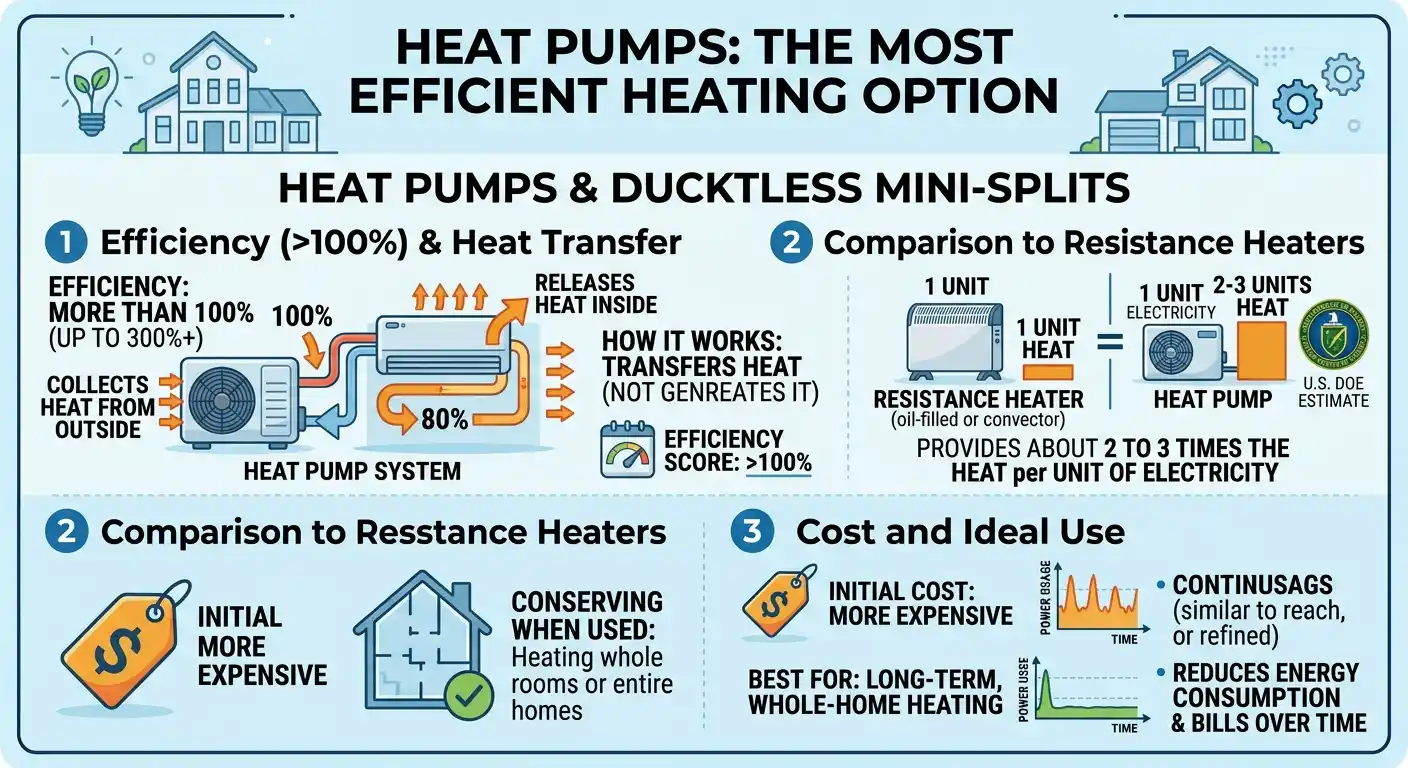
A heat pump or ductless mini-split would give you efficiency of more than 100%. It does not generate heat using electricity but transfers the heat outside to inside.
According to the U.S. Department of Energy, heat pumps have the ability to provide about two to three times the amount of heat generated per unit of electricity than a resistance heating system, depending on the model and the temperature outside.
They are more expensive initially but conserve the most when used in heating whole rooms or entire homes.
Common Mistakes That Waste Money
- Turning on a heater in a big, uninsulated room with the heater on high.
- Turning on the thermostat to the maximum setting when it was possible to do the work.
- Leaving doors and windows open
- Selecting a heater that is either too small or too big in the room.
- Disregarding drafts, which are more expensive than any heater setting.
How to Get the Most From an Oil-Filled Heater
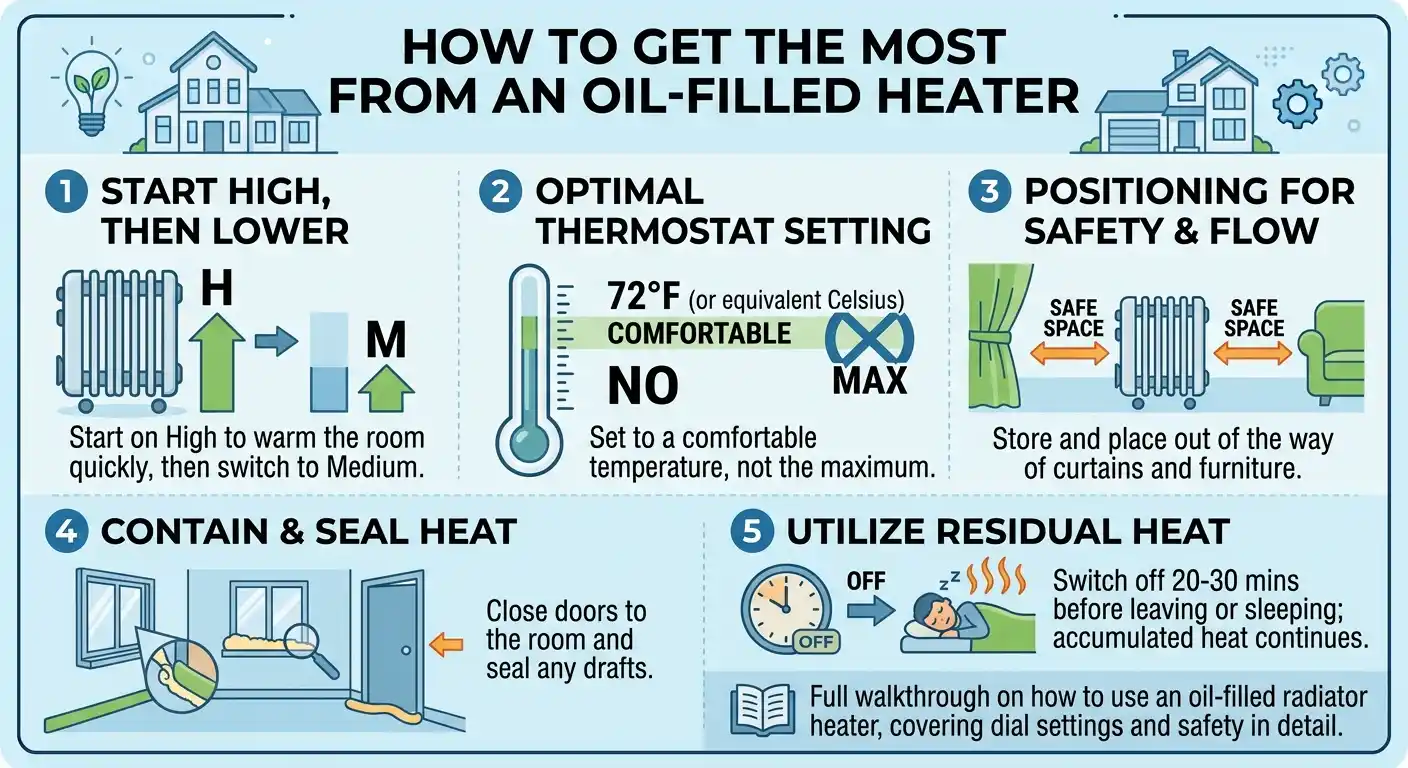
- Begin with a high level to heat the room, then lower to medium level.
- Set the thermostat to a comfortable temperature, not the maximum.
- Store it out of the way of curtains and furniture.
- Close the door and seal drafts.
- Switch it off 20-30 minutes before you leave or sleep and allow the accumulated heat to continue.
Our full walkthrough on how to use an oil-filled radiator heater covers dial settings and safety in more detail.
Safety Notes
The heaters that use oil do not have open glowing elements, which is comforting to many individuals. Nevertheless, they do get hot. Do not use an extension cord or power strip, but plug them directly into a wall outlet and make sure they are not in contact with anything flammable. Both the National Fire Protection Association (NFPA) and the U.S.
Consumer Product Safety Commission caution that space heaters are the primary cause of home heating fires, and to find a model with tip-over and overheat protection and a known safety listing like UL.
Which One Should You Choose?
- Select an oil-filled heater when you desire quiet, long-lasting, continuous heat in one room.
- Select a heater with fan or ceramic when you require quick heat temporarily.
- Select a convector when you desire a warm room in medium size, and when you can afford to wait a few minutes.
- Select a heat pump when you heat a large area most of the winter and when the lowest running cost is desired.
FAQs
Do oil-filled heaters work better than electric heaters?
No. They are also electric heaters and turn approximately 100 percent of power into heat, just like fan, ceramic and convector heaters.
Do oil heaters cost less to operate than fan heaters?
Frequently, long term. They also recycle with the thermostat and continue to radiate heat, thus can attract less total power in a stable room.
What is the price of an oil-filled heater per hour?
A 1,500 W model costs about $0.26 per hour at $0.17 per kWh on full power. Low settings are cheaper. Divide watts by 1,000, by rate.
Are oil-filled heaters consumptive of electricity?
When the element is on they consume as much as their wattage indicates. With a 1,500 W unit, 1.5 kWh per hour is the amount of power consumed at full load, but the thermostat decreases the real usage.
Can an oil-filled heater be used in a bedroom?
Yes. It is silent and imparts soft warmth. Use thermostat and safe location.
Will oil-filled heaters keep warm when you turn them off?
Yes, the oil and metal are hot and continue to give it off awhile, but the room will cool as it cools.
Why does it take so long to warm up oil heaters?
They have to heat the oil and metal fins first. Allow approximately 10-20 minutes.
Which type of electric heater is cheapest to run?
The price of all resistance heaters is the same per kWh of heat. The most affordable is the one that fits your room and habits, or a heat pump to use on a regular basis.
Which is more efficient ceramic or oil-filled heaters?
No. Both are approximately 100% efficient. Ceramic heaters are quicker to warm, oil-filled heaters are slow to cool.
Is it possible to leave an oil-filled heater on overnight?
Lots have safety features, but consult your manual. Do not use extension cords and maintain space around it.
Which is superior, an oil-filled or a convector heater?
It depends. Oil-filled retains longer heat whereas the convectors heat the air at a higher rate.
What heater is more efficient than an oil-filled heater?
A heat pump since it does not generate heat, but rather transfers it, provides more heat per kWh.
Does a thermostat conserve money on an oil-filled heater?
Yes. It prevents the element to run when the room has reached your desired temperature.
Final Thoughts
Oil-filled heaters are not more efficient than other electric heaters but it is usually the wiser choice when you need constant and quiet heat. The actual savings are achieved by adjusting the heater to fit your room, thermostat and preventing drafts. When you want a fast heat, take a fan or ceramic one. Heat pump: In case you warm the same room throughout the winter.
Next step: take a measurement of your room, look at your electricity rate and select a heater wattage that fits. Then follow our oil-filled radiator guide to set it up safely.