How to Use a Kerosene Heater: A Safe, Step-by-Step Guide for First-Time and Seasoned Users
A kerosene heater can get you through a power outage or put the chill off a cold garage, but only when you install it and operate it properly. One step in the wrong direction, such as not priming the wick or closing the room too tightly, and you have a smoky burn or an actual safety hazard. This manual takes you through the whole procedure, starting with your initial fill-up, all the way to shutdown, with safety tips provided by the U.S. Consumer Product Safety Commission (CPSC) and the manufacturer instructions that come with most of the units.
Lesson learned: Only water-clear 1-K kerosene should be used, the wick must be primed before initial use, a door or window should be left open to allow fresh air, and a hot heater should never be refueled.
What Is a Kerosene Heater and How Does It Work?
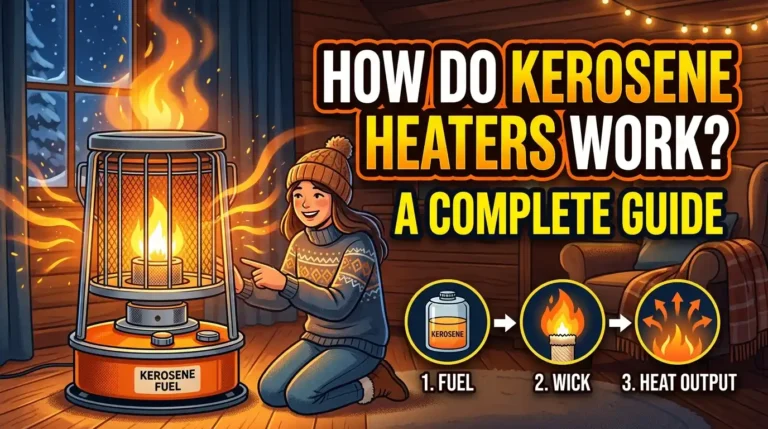
A kerosene heater burns kerosene fuel in the form of liquid which rises up a woven wick through capillary action. The resulting flame at the top of the wick heats a metal burner unit that is used to either radiate heat into the room or in convection models, to draw room air through the heater to heat a larger area.
The heat itself does not need any electricity, which is why these units are frequently used during power outages, although most of them have a battery-powered igniter to begin the flame.If you want a deeper look at the combustion process itself, we break down the full mechanics of wick-fed heating in this guide.
Radiant vs. Convection Kerosene Heaters
These two styles differ in their work, and that varies where you are to place them.
| Feature | Radiant Heater | Convection Heater |
|---|---|---|
| Heat pattern | Directional, heats what’s in front of it | 360 degrees, heats the whole room |
| Best for | Small rooms, spot heating, garages | Larger rooms, whole-space heating |
| Typical shape | Flat-backed, boxy | Cylindrical tower |
| Placement | Against a wall, facing open space | Center of the room, away from walls |
When your competitor research or the manual refers to your unit as a radiant model, then make sure that you keep it a few feet away in its heat path of anything that can burn. When it is a type of tower which is a convection type, leave it open on all sides so that air can move freely within the unit.
Before You Light It: Setup and Safety Checklist
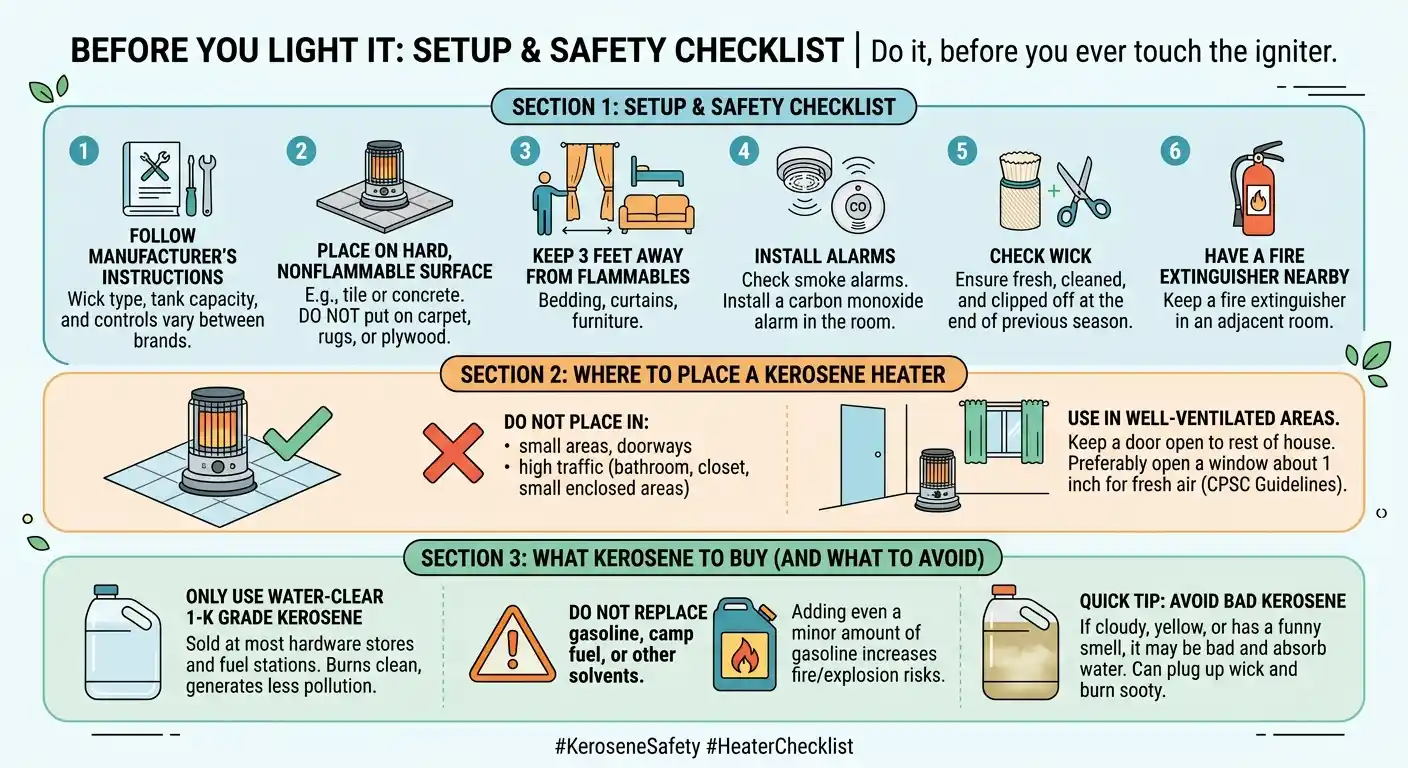
Do it, before you ever touch the igniter.
- Follow the instructions of your manufacturer. Wick type, tank capacity, and controls vary between brands.
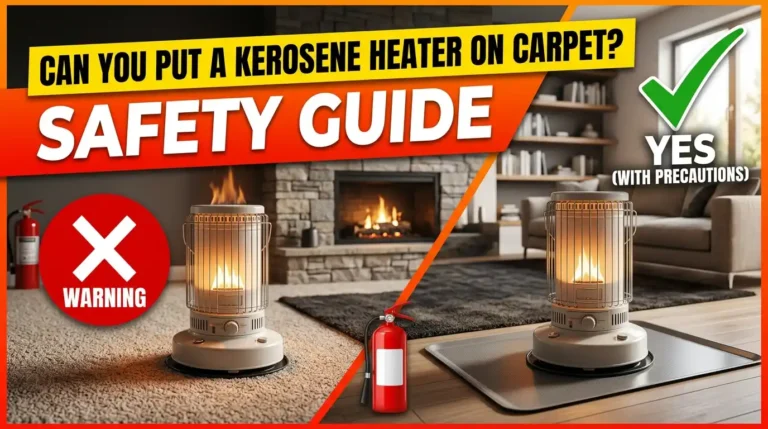
- Place the heater on a hard, nonflammable, and flat surface, e.g., tile or concrete. Do not put it on carpet, rugs or plywood.
- Keep it at least three feet away bedding, curtains, furniture and other flammable items.
- Check your smoke alarms and install a carbon monoxide alarm in the room in case you do not have one.
- Check that the wick is fresh or that it was cleaned and clipped off at the end of the previous season.
- Keep a fire extinguisher with the adjacent room.
Where to Place a Kerosene Heater
Place the heater on a hard, flat surface that does not have foot traffic, doorways, or bumps by pets or kids. Do not put it in a bathroom, bedroom closet or any other small, enclosed area. Since these heaters require air to burn efficiently and to prevent the accumulation of pollutants, they must only be operated in a room that has a door open to the rest of the house and preferably a window that is open about an inch to allow fresh outside air to enter the room, as recommended by CPSC guidelines.
What Kerosene to Buy (and What to Avoid)
Only use water-clear 1-K grade kerosene, sold at most hardware stores and fuel stations. This is the standard that CPSC suggests since it burns clean and generates less pollution as compared to lower grades. Do not replace gasoline, camp fuel, or other solvents. A minor amount of gasoline added to kerosene significantly increases the chances of fire or explosion.
Quick tip: Kerosene which has become cloudy, yellow, or has a funny smell has probably absorbed water or gone bad and should not be used. It may plug up the wick and burn sooty.
How to Use a Kerosene Heater: Step-by-Step Instructions
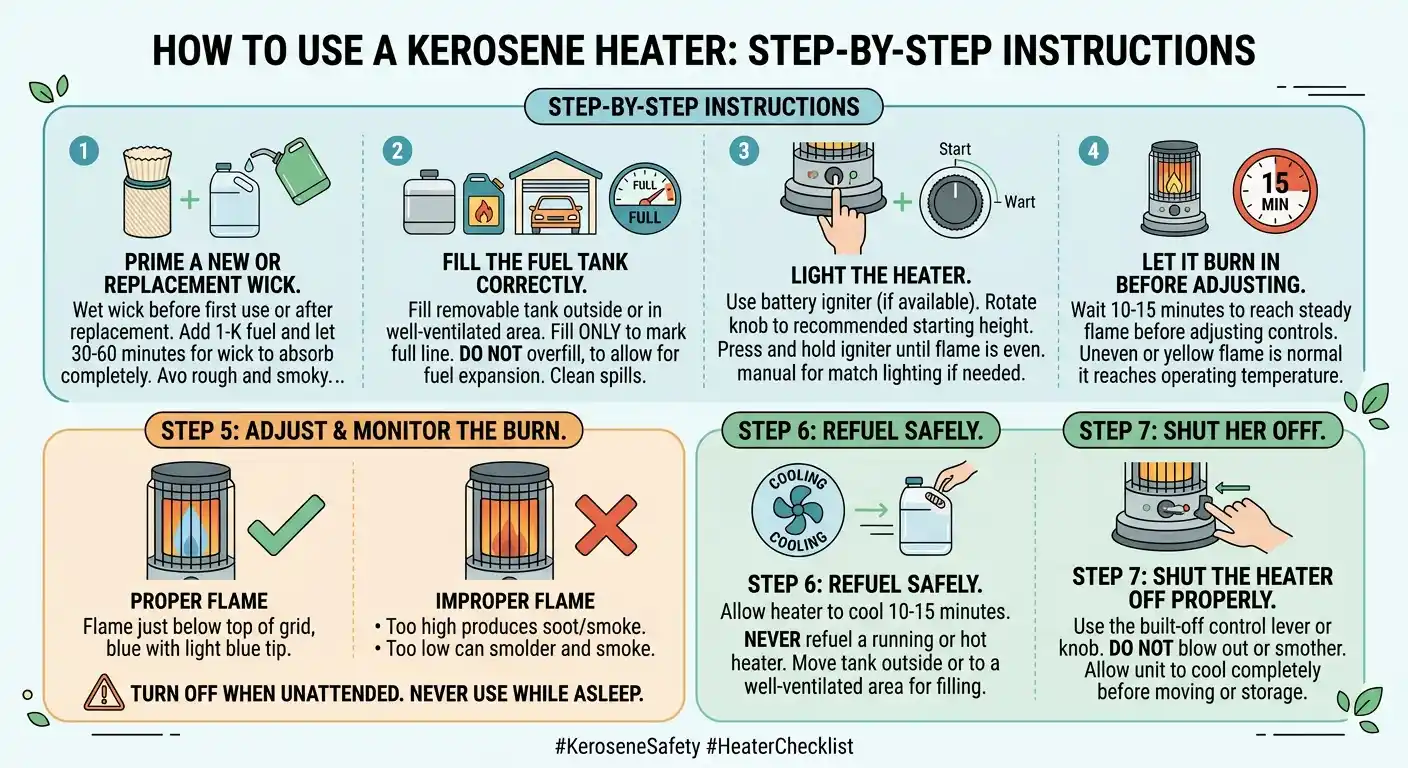
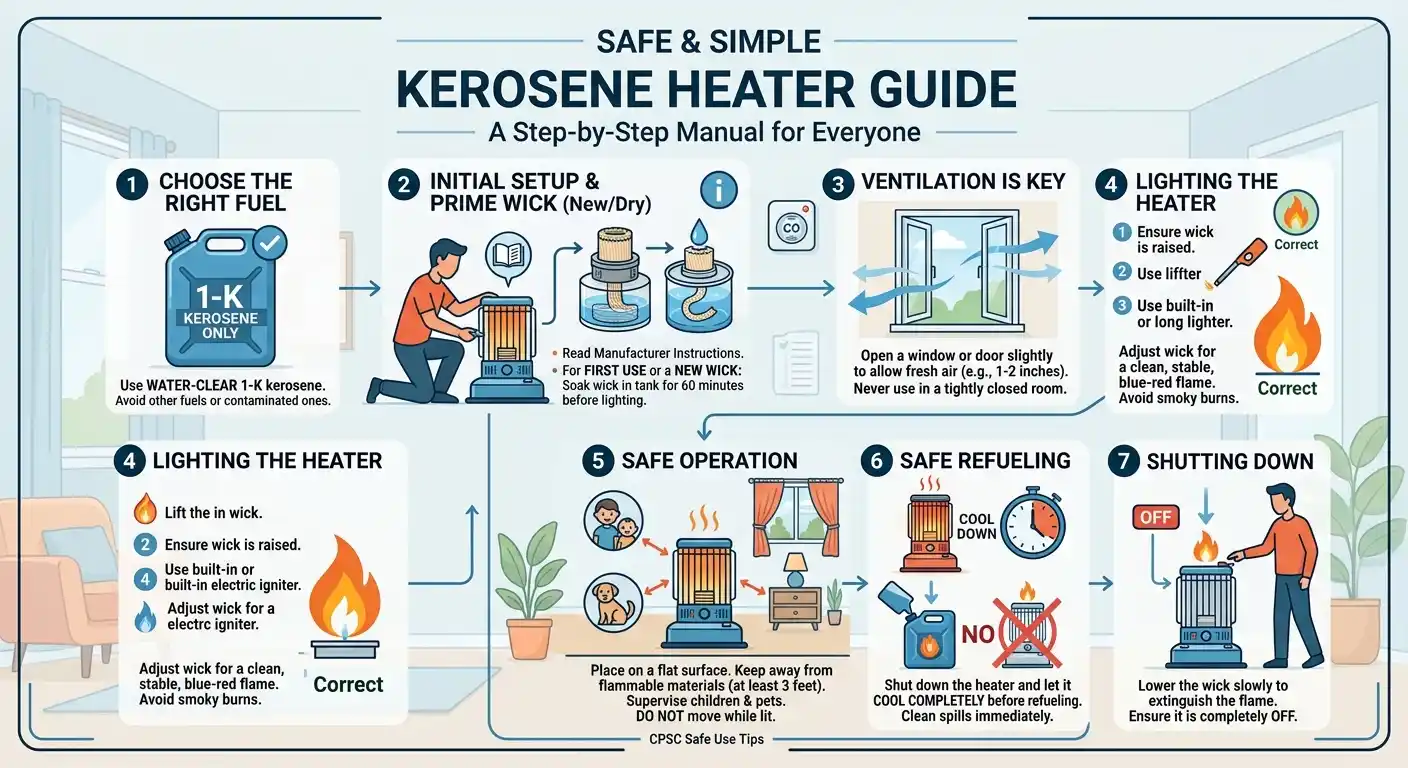
Step 1: Prime a New or Replacement Wick
When you are using a heater the first time, or have just changed the wick, wet it first. Add 1-K kerosene to the tank, and allow the heater to rest approximately 30-60 minutes to allow the wick to absorb fuel completely. When a dry wick is lit, it will start roughly and smoky, and may reduce the wick life. This is advised in most manuals particularly with a brand new wick; a few minutes wait before lighting is the norm after that.
Step 2: Fill the Fuel Tank Correctly
Fill the removable tank outside or in a well-ventilated garage, but not near an open flame. Use a kerosene only fuel can with an appropriate spout and fill to the marked full line but not beyond. Overfilling does not allow the fuel to expand as it heats up and this may overflow when the heater is turned on. Clean up any spills as soon as possible and allow the tank to rest a few minutes before replacing it in the heater to allow any surface fuel to dissipate.
Step 3: Light the Heater
The majority of contemporary units are lit by a push-button battery igniter. Rotate the wick knob to the recommended starting height (refer to your manual, typically indicated), press the igniter and hold it until the flame establishes evenly around the wick. Unless your model takes a match, however, light it at the side opening as indicated in the manual, but never on top of the wick.
Step 4: Let It Burn In Before Adjusting the Flame
Allow the heater 10-15 minutes to reach a steady flame before handling the controls. The flame can be uneven or a bit yellow, this is normal as the wick and burner attain operating temperature.
Step 5: Adjust the Flame and Monitor the Burn
When it is steadily burning, trim the wick to the point where the flame is just below the top of the burner grid, and is blue in color with a light blue tip. An excessively high flame produces smoke and soot, whereas an excessively low flame can smolder, as well as produce smoke. Always turn off the heater when unattended and never leave it on when you are asleep.
Step 6: Refuel Safely
Allow the heater to cool down, preferably turn it off at least 10 to 15 minutes before refueling. Do not put fuel in a running or hot heater. To refill the tank, move it out or to a well-ventilated place, using the same fill-line rule as previously.
Step 7: Shut the Heater Off Properly
Turn off the flame using the inbuilt shut-off control (usually a lever or knob) of the heater. Do not blow it out or smother it as this may leave unburned fuel vapour in the burner. Allow the unit to cool completely and then move it or store it.
Kerosene Heater Safety Rules You Can’t Skip
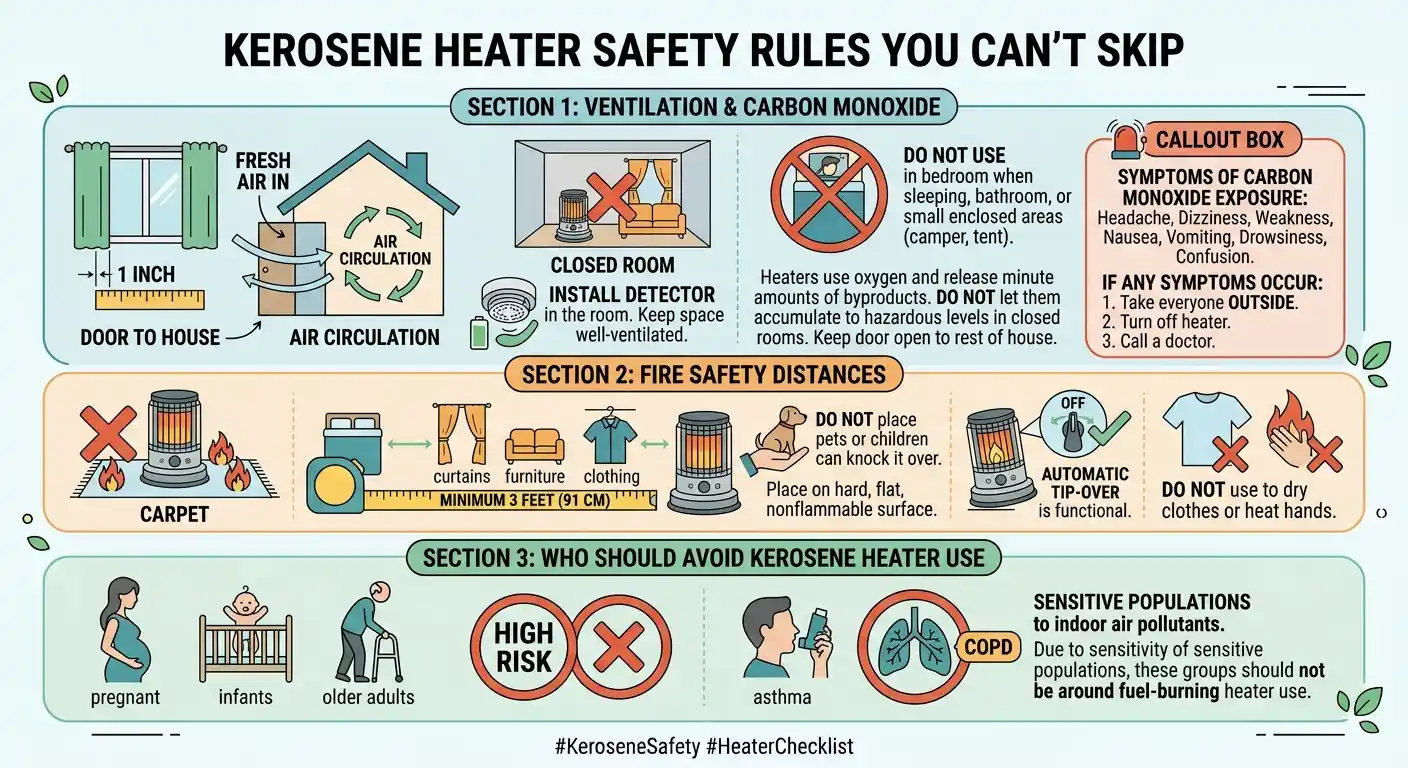
Ventilation and Carbon Monoxide
Kerosene heaters use fuel and burn the oxygen in the room, releasing minute amounts of carbon monoxide, carbon dioxide, nitrogen dioxide, and sulfur dioxide as typical byproducts of the combustion process. They can remain at low levels in a well-ventilated space, and can accumulate to hazardous levels in a closed-up room.
The essence of the safety rule of CPSC is to leave the heater on in a room with the door open to the rest of the house, and to open a window about an inch wide, particularly in a newer, airtight house. Install a carbon monoxide detector and do not use a kerosene heater in a bedroom when sleeping or in any small, enclosed area such as a bathroom, camper, or tent.
Callout box – Symptoms of carbon monoxide exposure: Headache, dizziness, weakness, nausea, vomiting, drowsiness and confusion. When any person in the house acquires these symptoms when a heater is on, take everyone outside, turn off the heater and call a doctor.
Fire Safety Distances
- Maintain a minimum of three feet of space between bedding, curtains, furniture and clothing.
- Do not put it on carpet or flammable liquids or where pets or children can knock it over.
- Make sure your model has an automatic tip-off shut-off; this has been a necessary safety measure on kerosene heaters since time immemorial, and it puts out the fire should the unit tip over.
- Do not use the heater to dry clothes or heat hands with cloth coverings on it.
Who Should Avoid Kerosene Heater Use
Due to the sensitivity of sensitive populations to indoor air pollutants caused by any fuel-burning heater, pregnant women, infants, older adults, and people with asthma, COPD, or other respiratory or cardiovascular diseases should exercise additional care and ventilation, or avoid unvented kerosene heaters altogether, according to fire safety and insurance industry recommendations.
How Long Does a Kerosene Heater Run on One Tank?
The burn time varies with the size of the tank and the height at which you run the flame so any figure is only an approximation and not a guarantee of your particular model. Numerous typical portable units with 1 to 1.9 gallon tanks will operate approximately 12 to 24 hours on a full tank at a moderate flame rate; larger units or those operated at full capacity will use fuel at a higher rate.
The burn-time rating of your particular model is listed in the owner manual of your owner, as the manufacturer lists the burn-time rating depending on the size of their tank and the amount of heat they generate.
Common Mistakes First-Time Users Make
- Not soaking the wick before use, resulting in a smoky uneven fire.
- Fill past the marked line on the fuel tank.
- Fueling when the heater remains hot.
- Operating the heater in an enclosed bedroom overnight.
- Burning anything but 1-K kerosene, such as old fuel remaining over last season.
- Placing the heater on carpet or too close to furniture
- Do not cut or substitute an old, burnt wick.
Troubleshooting: Kerosene Heater Won’t Light, Smokes, or Smells
| Problem | Likely Cause | Fix |
|---|---|---|
| Heater won’t light | Dead igniter battery, dry wick, empty tank | Replace batteries, prime the wick, check fuel level |
| Flame is smoky or has a strong odor | Wick set too high, wrong fuel grade, old or dirty fuel | Lower wick to correct height, switch to fresh 1-K kerosene |
| Flame burns unevenly | Wick worn or charred, wick not seated correctly | Trim or replace the wick per manual instructions |
| Heater shuts off on its own | Tip-over sensor triggered, or oxygen depletion sensor activated due to low ventilation | Set heater upright on level ground, crack a window and door for fresh air |
| Soot building up on burner | Flame set too high or fuel is low-quality | Lower the flame slightly, use fresh water-clear 1-K kerosene |
When a problem still exists after attempting these fixes, then discontinue using the heater and call the manufacturer or an experienced repair person instead of further troubleshooting on your own.
Maintenance and Off-Season Storage
- Drain the tank, or empty the remaining fuel, prior to long-term storage.
- Wipe the wick according to the instructions in your manual and change it when it is charred, hardened, or older than one or two seasons.
- Wipe down the burner unit and check for rust or damage.
- Keep leftover kerosene in a labeled, approved container, not in living spaces, not in the direct sunlight, and not in the vicinity of any source of heat.
- Kerosene doesn’t store indefinitely. More than a year old, or appears cloudy or discolored, fuel must be used elsewhere (see local regulations) but not burned in your heater.
Kerosene Heater vs. Other Portable Heaters
| Feature | Kerosene Heater | Electric Space Heater | Propane Heater |
|---|---|---|---|
| Works without power | Yes | No | Yes |
| Fuel cost | Moderate | Depends on electricity rate | Moderate to higher |
| Ventilation needed | Yes | No | Yes |
| Best use case | Power outages, garages, workshops | Everyday indoor supplemental heat | Outdoor or well-ventilated spaces |
| Setup effort | Higher (fueling, wick care) | Low (plug in) | Moderate (tank swaps) |
If your power outage plans include more than one fuel type, it’s worth knowing what proper setup and ventilation look like for a propane unit as well, since the safety habits carry over. For everyday indoor warmth once the power is back on, many households pair a kerosene heater with a plug-in radiator that runs on heated oil for quieter, unattended heating.
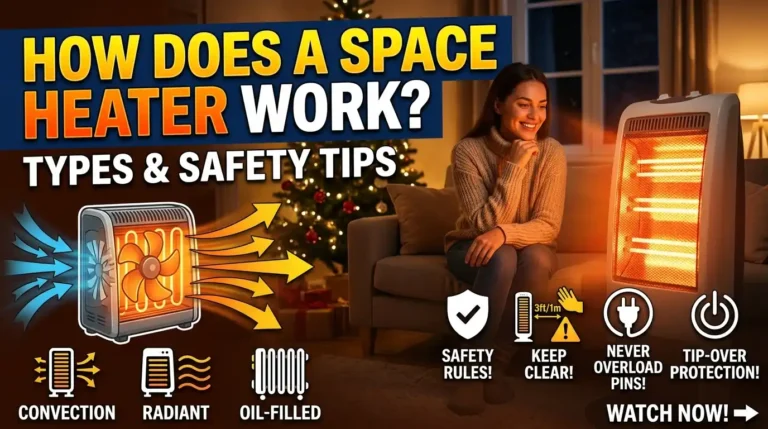
Curious how the electric option on that table actually generates heat, or what it might add to your bill? Here’s a plain-language explainer on how those coil-based units function, and here’s a real-world cost breakdown for oil-filled radiators if you’re weighing a fuel-free backup for the rest of the season.
FAQs
Is it safe to use a kerosene heater indoors?
Yes, with a unit that is meant to be used indoors, you only need 1-K kerosene and you must keep the room open with a window open and the door open. Kerosene heaters are not designed to be used in rooms that are unventilated.
What is the procedure to light a kerosene heater?
Add 1-K kerosene to the tank, allow a new wick to soak between 30 and 60 minutes, then light it with the igniter or a match as indicated in your manual, allowing the flame to stabilize between 10 and 15 minutes before making any adjustments.
Are you able to sleep with a kerosene heater on?
No. Kerosene heaters must be turned off prior to bedtime, as no one is watching the flame or air quality at bedtime.
How frequently do you refuel a kerosene heater?
It varies with the size of the tank and the intensity of the flame, yet most portable models require filling up about once a week to 24 hours of operation. Always ensure that the heater is cooled before refueling.
Why does my kerosene heater have a smell when I turn it on?
When lighting or extinguishing a brief slight odor is normal. The persistent odor is normally a sign of a high wick, stale fuel, or inappropriate grade of kerosene.
Which type of kerosene can I use?
Water-clear 1-K grade kerosene. Never use dyed or lower grade kerosene and never use gasoline or other fuels in its place.
Is it possible to use a kerosene heater in a garage?
Most individuals do it in workshops, but the same ventilation and clearance principles are applicable: ensure that the area is well-ventilated, the heater is not in contact with flammable substances and fuel storage, and the heater is not used in a garage that is fully sealed.
How to act in case my kerosene heater overturns?
A majority of the units constructed up to the present safety standards have an automatic shut-off where the flame is extinguished in case it tips. Nevertheless, place it on its feet as soon as possible, allow it to cool, verify the presence of fuel spills, and examine it in terms of damages prior to its reuse.
What do I do to tell when my wick needs to be replaced?
Symptoms include a hard, charred, uneven wick, which is difficult to light, or smoky flame despite adjustment.
Is it natural that the flame should appear uneven when it is first lit?
Yes, it is normal to have a slightly lumpy or yellow fire during the first few minutes. It will come to rest in a stable blue flame with light tips in 10 to 15 minutes.
Final Thoughts
Kerosene heater is a truly useful device in times of power failure, garages, and other areas that require heat, but it does not pay off immediately. Prime the wick before that initial burn, burn only 1-K kerosene, provide the room with air and never leave it running when you sleep. After going through the steps once you have, it becomes a routine to light and run it safely.
When you are not certain about the controls or fuel capacity of a particular model, then your owner manual is the last word as each brand has different details.