Can You Convert a Propane Patio Heater to Natural Gas?
⚠️ Safety First: Read This Before You Touch Anything Gas-Related
Carbon monoxide (CO) is a colorless, odorless gas that can build up when fuel burns without enough fresh air, and it can make people very ill without warning. Put a working CO alarm on every level of your home and near sleeping areas, and test each alarm once a month. Replace alarms as the maker directs, and never block vents or disable a CO alarm.
If you smell gas, act fast and do not try to find the source: do not touch light switches, flames, or appliances. Leave the area at once with all people and pets, and call your gas utility’s emergency line or 911 from outside. Never go back inside to look for a leak, open a gas line, or relight anything after a strong gas smell.
Gas conversion work is for a licensed gas professional only. Never open a gas line, change a gas valve beyond the normal user controls in your appliance manual, bypass a safety device such as a thermocouple or oxygen-depletion sensor, or block a vent. Pets are sensitive to fumes and poor air, and birds are at added risk, so keep pets away from heaters and out of rooms with fumes, and call a vet at once if a pet seems unwell.
Can you convert a propane patio heater to natural gas? The short answer is: sometimes, but only in a narrow set of cases, and only with a manufacturer-approved kit fitted by a licensed gas professional. Most propane patio heaters are built for one fuel only, and a home swap of parts is not a safe shortcut.
Propane and natural gas burn in different ways, and each heater is tuned for its own fuel. The burner opening, the regulator, and the gas pressure all work as a matched set. When any part of that set is wrong, the flame can burn poorly, soot can form, and heat output can drop. That is why the manual, not a guess, decides the path forward.
This guide walks you through the checks you can make as a homeowner, the questions to ask the maker, and what a licensed pro handles on a real conversion. It also covers the cases where buying a natural gas model, or staying with propane, is the smarter call.
⏱ Time: Your checks and calls take under an hour. A pro visit takes as long as the pro quotes for your setup.
🔧 Difficulty: Reader checks are low effort. All gas, venting, and conversion work is pro-only.
👤 Who does what: You check the manual and call the maker. A licensed gas professional does every gas step.
What You Need
- Your heater manual, or the model name and number from the rating plate
- A phone, for calls to the maker and to a licensed gas professional
- A pen and paper, to note the kit name, part number, and pro quote details
- A tape measure, for patio clearances the pro may ask about
- No gas tools. You will not open a gas line or change a gas part in this guide.
At a Glance
- Check your manual and model plate for fuel wording.
- Ask the maker if an approved conversion kit exists for your exact model.
- Book a licensed gas professional for an assessment.
- Compare conversion with buying a natural gas model.
- Clear the patio for the pro visit.
- Learn the safe user controls from the pro.
1. Check Your Manual and Model Plate
Start with the manual that came with your heater, or look it up on the maker site with your exact model number. Find the fuel section and read what it says about propane, natural gas, and conversion. Some manuals state that the heater runs on one fuel only, while others name a conversion kit by part number.
Next, find the rating plate near the base or control area, and note the model number and fuel type. Write down the exact model number, since a kit for a close model may not fit yours.
2. Ask the Maker About an Approved Kit
Call or email the heater maker and ask: does the maker sell an approved conversion kit for your exact model, and may a licensed pro fit it? An approved kit is made for your burner and tested with your heater. A generic part is not the same thing.
Ask what the kit changes, what it costs, and whether fitting it keeps your warranty and safety certification in place. No approved kit means no conversion. For a wider look at how the two fuels differ, see our guide on natural gas vs propane fireplaces.

Propane and natural gas heaters differ in regulator, burner opening, and fuel supply. That is why parts are not swapped on a guess.
3. Book a Licensed Gas Professional
Once you have the maker answer in hand, book a licensed gas professional for an assessment. Tell the pro your model number, what the maker said, and where the heater sits. The pro can confirm if a fixed natural gas line can reach that spot, and whether local rules allow the work.
Do not ask a pro to fit unapproved parts, or hire an unlicensed helper for gas work. Licensed gas work protects your home, your warranty, and your safety certification. Ask for a written quote listing the kit, the line work, and any permits.
4. Compare Conversion With a New Heater
A conversion can make sense when your heater is in good shape, the maker sells an approved kit, and a gas line already runs near the patio. You gain a heater with no tank to refill, but lose portability, since it stays near its gas line.
A new natural gas model may be the better call when your heater is old or has no approved kit. Compare the full pro quote with a new heater price. If neither option fits, staying with propane is sound, and our guide to choosing the right propane heater can help.
5. Clear the Patio for the Pro Visit
Before the visit, clear chairs, toys, and plant pots away from the heater and the path the pro will use. Note where your gas meter sits, and where you would like the heater to stand. Keep pets indoors and away from the work area while the pro is on site.
Leave all gas work to the pro, including any line, valve, and venting changes. Do not open panels, loosen fittings, or test connections yourself. The pro handles the gas side and tells you when the heater is ready for normal use.
6. Learn the Safe Controls From the Pro
When the work is done, ask the pro to walk you through the normal user controls in your manual: how to start and stop the heater, and how to shut it down in wind or bad weather. Ask about clearances, and about keeping leaves and cushions away from the heater.
If you smell gas at any point, follow the gas-smell rule at the top of this guide: leave with people and pets, and call for help from outside. For setup basics, see how to assemble and install a patio heater.
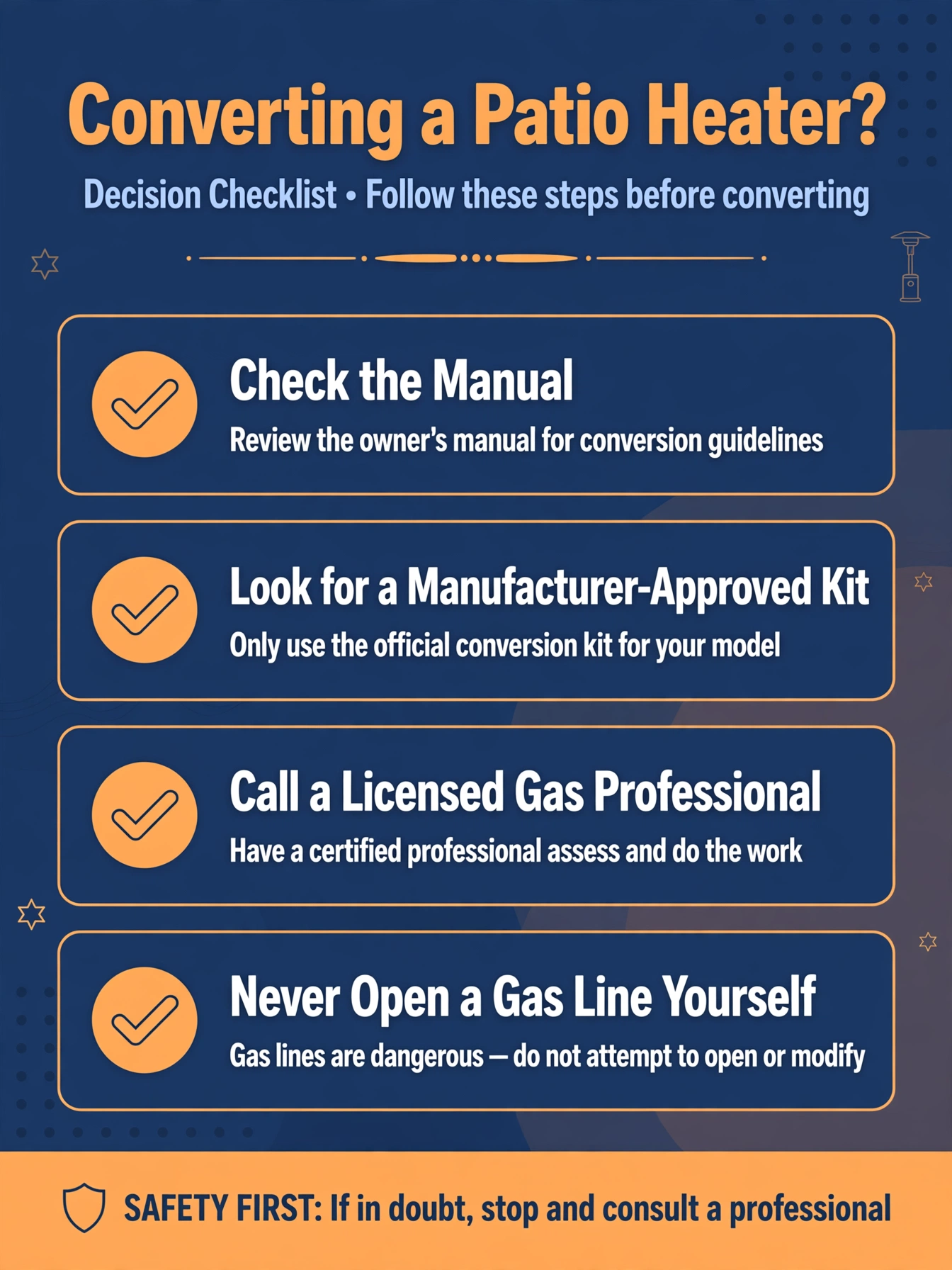
Check the manual, confirm an approved kit, and call a licensed pro. If any step fails, the conversion stops there.
Common Mistakes to Avoid
Swapping parts on a guess. A burner opening or regulator from another model can throw off the flame and void the warranty. Use only a kit the maker names for your exact model.
Treating a patio heater like a grill project. Heaters, lines, and venting rules differ by product, so a fix that worked on one gas item may be unsafe on another. Follow your heater manual and your pro’s advice.
Ignoring the gas-smell rule. A faint smell still means leave and call from outside. Never hunt for the source, open a line, or relight a heater after a strong gas smell.
Blocking vents or moving a heater indoors. Patio heaters need open air and the clearances in the manual. Never run an outdoor heater in a garage, tent, or closed room.
Skipping the CO alarm check. Test alarms monthly, even if the heater sits outside. CO can drift through doors and windows, and an alarm is your early warning.
Frequently Asked Questions
Can you convert any propane patio heater to natural gas?
No. Only models with a manufacturer-approved conversion kit can be converted, and a licensed gas professional must fit the kit. If the maker offers no kit for your model, the heater stays on propane.
Why can’t I convert a propane patio heater myself?
Conversion involves gas pressure, burner parts, and a fixed gas line, and a wrong part can cause a poor flame, soot, or a gas leak. Licensed gas professionals are trained and insured for this work, and their work keeps your warranty and safety certification valid.
Does converting a patio heater void the warranty?
It can, if you use unapproved parts or unlicensed labor. Ask the maker in writing whether the approved kit and a licensed pro install keep your warranty intact before any work starts.
What does a conversion cost?
Costs vary too much to quote here, since they depend on the kit, the length of the gas line run, permits, and local labor rates. Get a written quote from a licensed gas professional for your exact patio before you decide.
Is it better to buy a natural gas patio heater instead?
Often, yes. A factory-built natural gas model avoids kit and warranty questions, and it may cost less overall than a long gas line run plus conversion. Compare the full pro quote with a new heater before you choose.
Quick Reference Card
- Convertible? Only with a manufacturer-approved kit for your exact model.
- Who does the work? A licensed gas professional, always.
- First check: Manual and rating plate for fuel wording.
- Deal-breaker: No approved kit means no conversion.
- Smell gas? Leave with people and pets, call from outside.
- CO alarms: Every level and near sleeping areas, tested monthly.
- Best alternative: A factory-built natural gas model, or stay with propane.
A careful check now can save you a costly mistake later. Start with the manual, ask the maker, and let a licensed pro guide the gas side. Warm patios are worth the wait for a safe setup. If conversion is not on the cards for your model, a new heater or a fresh propane tank still gives you many cozy nights outside.