Keeping Holiday Guests Warm: Portable Heater Safety for Parties
Keeping Holiday Guests Warm: Portable Heater Safety for Parties starts with a clear plan, not with a heater switched on at the last minute. Cold guests crowd close to heat, cords cross walk paths, and decorations move near warm surfaces. A short safety plan stops those small risks from growing during the night.
Holiday parties bring extra people, extra food, and extra movement. Kids run past chairs, pets slip under tables, and guests shift seats to find a warm spot. Heaters that work well for a quiet night need more care when a full house is in motion. The steps in this guide help you place heaters where guests can feel warm and still move with ease.
You will learn how to pick a safe spot, set clear space, handle cords, and check heaters through the party. Each step gives one clear action and a short reason for it. Read the safety notes first, then work through the steps in order.
Safety first: read this before you start.
Use fuel-burning heaters outdoors or in well-vented spaces only. Never use them in a closed room, a garage with the door shut, or any space with no fresh air. Fit working carbon monoxide (CO) detectors where guests will sit and sleep, and know CO signs: headache, dizziness, nausea, and confusion.
If you smell gas, leave the area at once. Call your gas utility or 911 from outside. Do not try to find or fix a leak, and do not switch lights or appliances on or off near the smell.
Never leave a heater running with no adult watching it. Check local rules and burn bans before the party, and follow your heater manual for clearance, fuel, and wind limits.
Time: 45 to 60 minutes to set up and test | Difficulty: Beginner | Best for: Patios, decks, garages with the door open, and large rooms with electric heaters | Check again: Every 30 minutes during the party
What You Need
- Portable heaters with tip-over shut-off and a stable base
- Working CO detectors with fresh batteries, for any space near a fuel heater
- A tape measure for clear space checks
- Cord covers or a clear cord route away from walk paths
- A wind anchor, weights, or a wall bracket where your manual calls for one
- A flashlight for night checks of cords, fuel lines, and heater bases
At a Glance: The 7 Steps
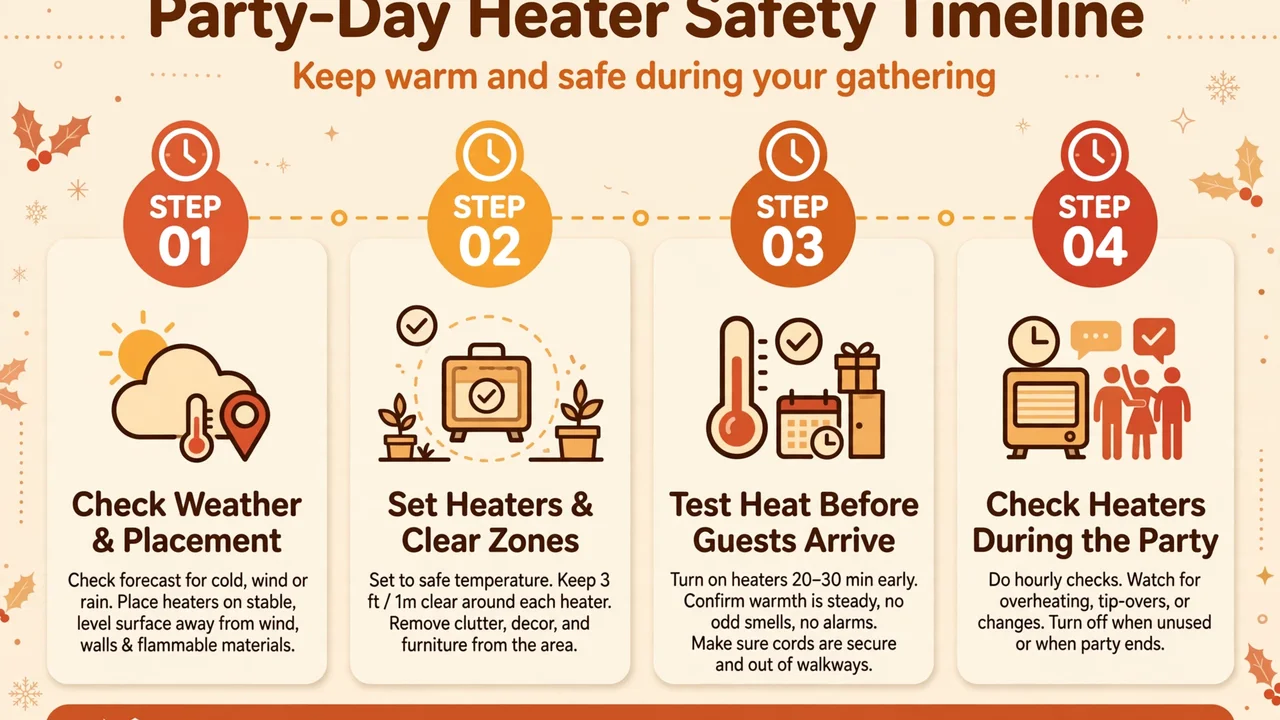
- Pick a safe spot for each heater
- Check the heater before guests arrive
- Set clear space around each heater
- Place heaters away from foot traffic
- Plug in electric heaters the safe way
- Test the heat and adjust before the party
- Check heaters often during the party
Step 1: Pick a Safe Spot for Each Heater
Start with the space, not the heater. Pick a flat, firm spot that will not wobble when guests brush past it. Keep the heater away from low roofs, awnings, dry leaves, and hanging lights. If wind can push the heater, pick a sheltered corner and anchor it as your manual directs.
Fuel heaters belong outside or in a well-vented space. Electric heaters can work in more rooms, but they still need clear air flow and a firm floor. For a full guide to first use, see how to use a patio heater before party day.
Step 2: Check the Heater Before Guests Arrive
Give each heater a slow check two hours before guests arrive. Look for frayed cords, cracked plugs, loose guards, and bent legs. Test the tip-over switch and the shut-off control. If a part looks worn or a control sticks, take that heater out of service for the night.
Check fuel with care. Use only the fuel type your manual names. Fill or swap tanks outside, away from flames, and keep spare fuel upright in a cool, vented spot far from seats. A heater that starts clean and runs steady is far less likely to cause trouble once guests arrive.
Step 3: Set Clear Space Around Each Heater
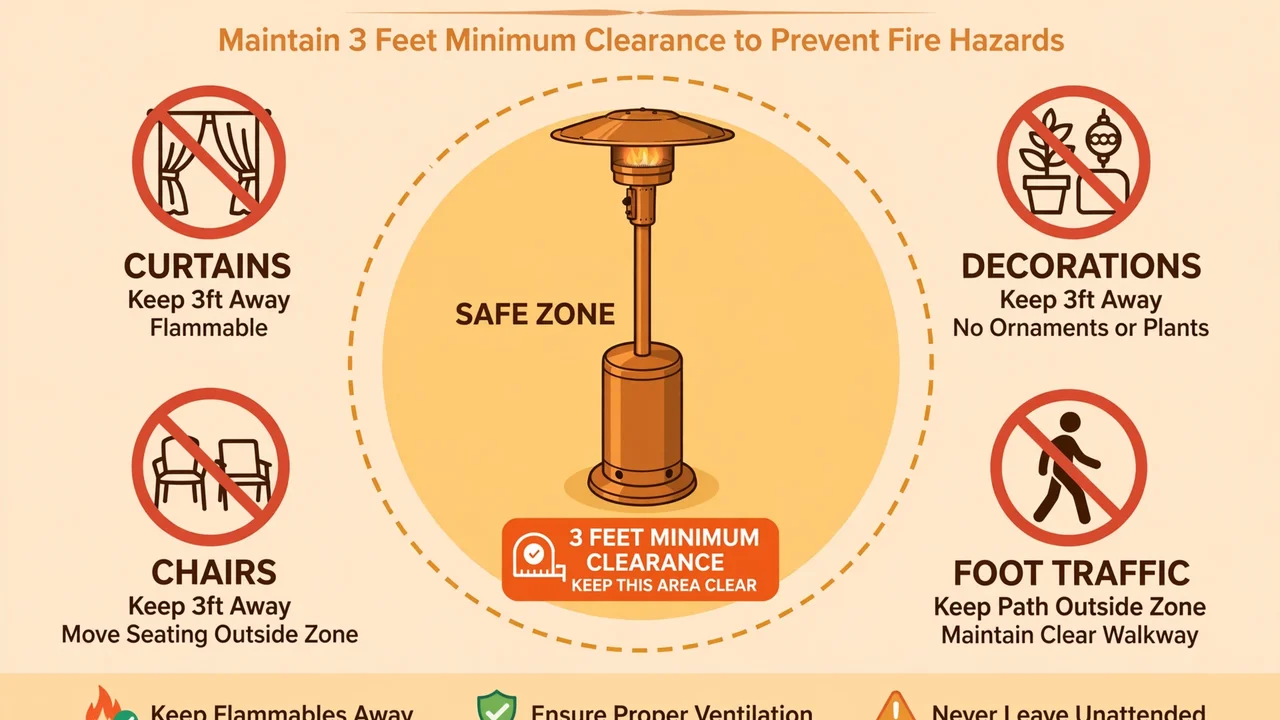
Measure the clear zone with a tape measure. Do not guess it by eye. Move curtains, tablecloths, paper decorations, coats, and gift wrap out of the zone. Guests will pull chairs close as the night cools, so leave room for that shift.
Your manual gives the final clearance for your model, and that number wins over any general guide. Use the table below as a party planning aid, then check it against your manual. For more detail, read our guide to patio heater clearance.
| What to protect | Clear distance to keep | How to do it at a party |
|---|---|---|
| Curtains, tablecloths, and paper decorations | 3 feet from the heater on all sides | Pull tables back, tie curtains away, and hang paper items well clear |
| Chairs guests pull close for warmth | 3 feet from the heater | Mark the zone with a rug edge or a low table so chairs stop short |
| Coats, blankets, and bags | 3 feet from the heater | Set a coat spot in another room, away from heat |
| Kids and pets | Outside the 3-foot zone, with a barrier where you can fit one | Place heaters where kids do not run past, and tell kids the zone is hands-off |
| Walk paths and doorways | Keep the path 3 feet wide and free of heaters and cords | Route guests around heaters, never through the clear zone |
Step 4: Place Heaters Away From Foot Traffic
Put heaters at the edge of a seating group, not in the middle of a walk path. Guests carry hot food and drinks, and a bump in a crowd can tip a light heater. A heater near a wall warms people with less risk than one in open traffic.
Think about the flow of the night. Guests will move from food to seats to the door. Keep each heater out of those lanes. If a heater must sit near a door, move coats so no one crowds it on the way in.
Step 5: Plug In Electric Heaters the Safe Way
Plug each electric heater straight into a wall outlet. Do not use a power strip or an extension cord unless your heater manual states in clear words that it allows one. A long, thin cord can heat up, and a strip can trip or fail under a heater load.
Run cords flat along a wall, not across a walk path. Cover any cord that must cross open floor. One heater per outlet is a safe party rule. To compare fuel and power types, see electric vs propane patio heater options.
Step 6: Test the Heat and Adjust Before the Party
Switch heaters on 30 minutes before guests arrive. Walk the seating area and feel for cold spots and hot spots. Move a chair, shift a heater by a foot, or add a blanket station in a cold corner. Small shifts now save awkward moves once guests sit down.
Count heaters against guests, not floor size alone. Two heaters at opposite ends of a seating group warm a party more evenly than one in the middle. For a large outdoor holiday meal, our guide to how many patio heaters you need for outdoor Thanksgiving dinner shows how to plan the count.
Step 7: Check Heaters Often During the Party
Set a phone timer for every 30 minutes. On each check, look at the clear zone, the cord, the base, and the flame or heat setting. Move chairs, coats, and gifts that have crept close. Check CO detectors too, and act fast if one sounds.
Give one adult the heater job for the night, and tell guests who that person is. That adult watches wind, rain, and fuel, and switches heaters off if wind picks up or a heater wobbles. At the end of the night, switch heaters off, let them cool, and store fuel as your manual directs.
Common Mistakes to Avoid
- Bringing a fuel heater inside for warmth. Fuel heaters need fresh air. If guests feel cold inside, use an electric heater made for indoor use, and check the guide to can you use a patio heater indoors first.
- Running a cord under a rug. A rug traps heat and hides cord damage. Route cords along walls instead.
- Placing a heater where kids run past. Pick a spot outside play lanes, and set a clear hands-off zone.
- Leaving a heater on while you host in another room. If no adult can see the heater, switch it off.
- Skipping the manual clearance. General guides help with planning, but your model manual gives the final distance.
Frequently Asked Questions About Keeping Holiday Guests Warm: Portable Heater Safety for Parties
Can I use a patio heater inside for a party?
No. Do not use a fuel-burning patio heater inside a closed room, a garage with the door shut, or any space with no fresh air. Fuel heaters make carbon monoxide, which you cannot see or smell, and a closed room lets it build up. Use an electric heater made for indoor use instead, and follow its manual for clearance and cord rules.
How far should a heater sit from curtains and decorations?
Keep at least 3 feet of clear space on all sides of the heater, and use a larger distance if your manual calls for one. Move curtains, tablecloths, paper decorations, coats, and gift wrap out of that zone before guests arrive. Re-check the zone every 30 minutes, because chairs and coats move during a party.
Can I plug a space heater into a power strip?
No, unless your heater manual states in clear words that it allows one. Plug the heater straight into a wall outlet, use one heater per outlet, and run the cord flat along a wall away from walk paths. If a cord feels warm, switch the heater off and move it to a wall outlet with no strip or extension cord.
What do I do if I smell gas at a party?
Leave the area at once with your guests, and call your gas utility or 911 from outside. Do not try to find or fix a leak, and do not switch lights or appliances on or off near the smell. Stay outside until a trained responder says it is safe to go back in.
Quick Reference Card
Holiday heater safety at a glance
- Fuel heaters: outside or well-vented spaces only
- Clear space: 3 feet on all sides, or more if your manual says so
- Cords: straight into a wall outlet, one heater per outlet
- Checks: test 30 minutes before guests arrive, re-check every 30 minutes
- Gas smell: leave, call the utility or 911 from outside
- End of night: switch off, let heaters cool, store fuel per the manual
Conclusion
Warm guests and safe heaters go hand in hand. A firm spot, a clear zone, a safe cord route, and checks every 30 minutes cover most party risks. Plan the count and placement before guests arrive, and give one adult the heater job for the night.
When wind rises, a heater wobbles, or a CO detector sounds, act fast and switch the heater off. Guests will recall a warm, calm night far more than a heater that ran a few degrees hotter. Keep the plan in place, and your holiday party can stay warm from the first hello to the last goodbye.