What Size Patio Heater Do I Need? A BTU and Coverage Guide for Your Patio
Stand on your patio in October and you can feel the question in your bones: is my heater big enough, or did I waste money on something that looks warm and isn’t? When you ask what size patio heater do I need, you are really asking two smaller questions — how much heat (BTU) and how far that heat reaches (coverage). This guide walks you through a six-step sizing process you can finish tonight with a tape measure and this page.
Here is the honest truth up front: there is no magic formula that converts patio square footage into BTU the way indoor heating charts do. Wind, outside temperature, and open sides change everything. What you can do is measure your space, match it to real heater output ranges and manufacturer coverage claims, and then correct for your weather. By the end, you will know which heater style and size fits your patio — and which claims to take with a grain of salt.
- Tape measure (25 ft is plenty for most patios)
- Paper and pencil to sketch your patio layout
- The BTU-to-coverage chart in Step 3 below
- Your heater’s manual (for exact clearance numbers)
- A working CO detector near any door from patio to house
Safety note: Propane patio heaters burn fuel, which means they produce carbon monoxide. Never use one indoors, in a garage, or in an enclosed tent or screened room — CO can build up fast with no smell to warn you. Keep a working CO detector near the door between your patio and house, and know the symptoms of CO poisoning: headache, dizziness, nausea. Call emergency services if they appear.
- Measure Your Patio Space
- Pick the Heater Style That Fits the Space
- Match the BTU Rating to the Size You Need
- Shrink the Coverage Claim for Wind and Cold
- Check Clearances Before You Buy
- Plan the Fuel Supply
1. Measure Your Patio Space
Walk out to your patio with the tape measure. Measure the length and width of the area where people actually sit — not the whole yard, the seating zone. A 12 ft by 14 ft seating area is 168 sq ft, and that number is the one that matters.
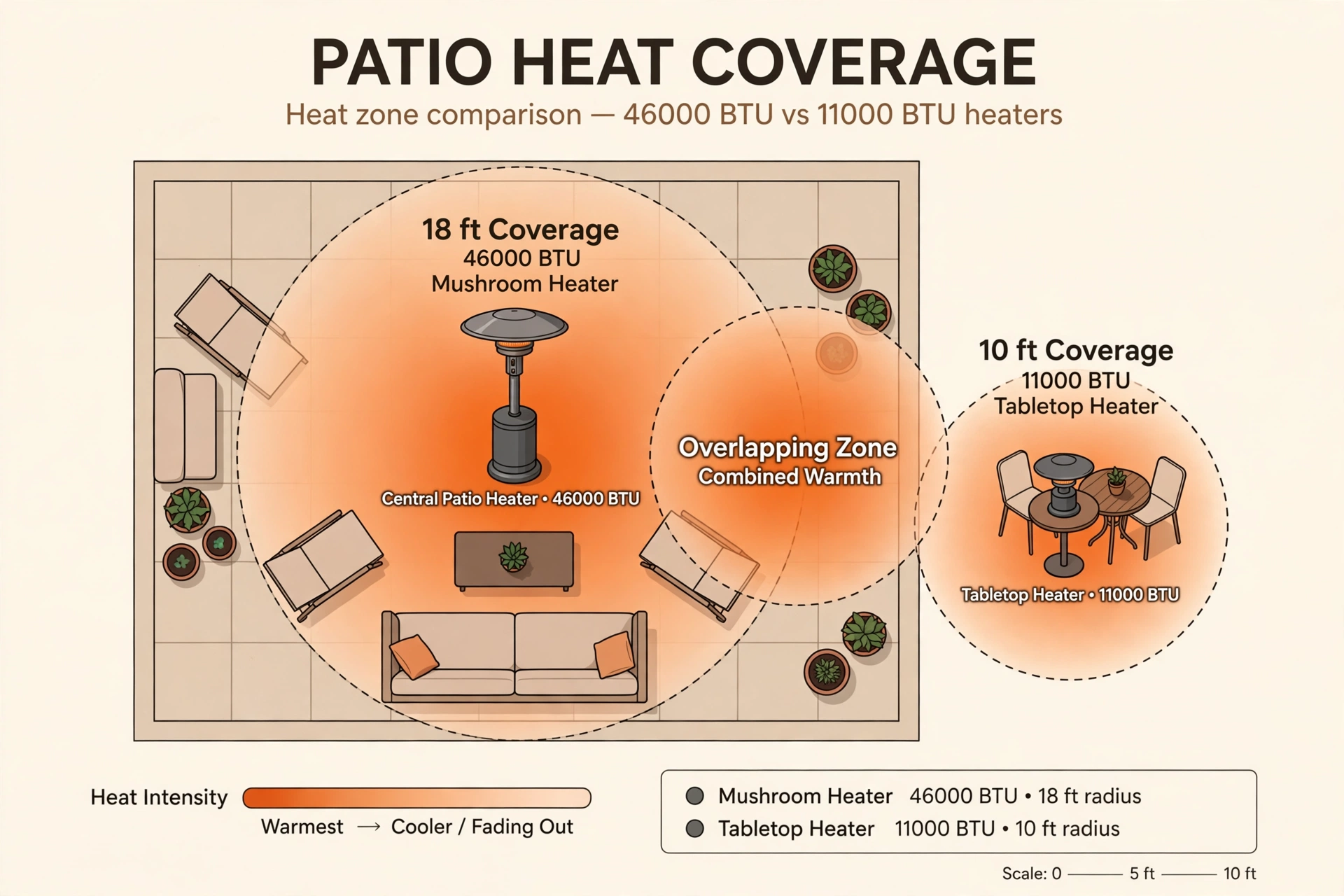
Mark where the heater will stand on your paper sketch. Most freestanding heaters warm a circle around themselves, so note the distance from that spot to the farthest chair. If chairs sit 9 ft or more from the heater’s position, the far seats will feel noticeably cooler than the near ones.
2. Pick the Heater Style That Fits the Space
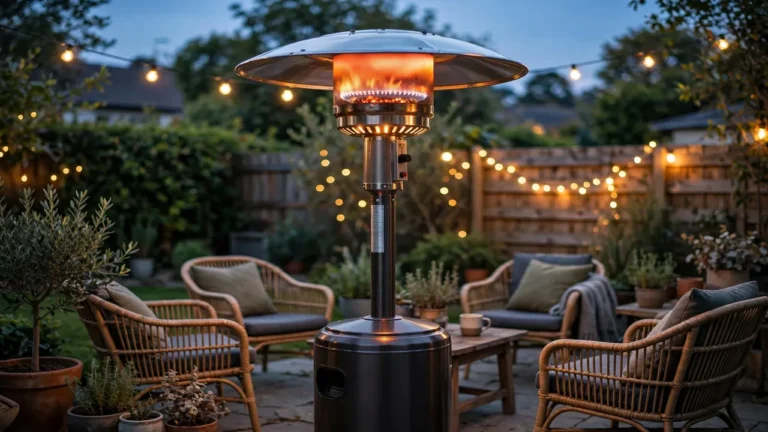
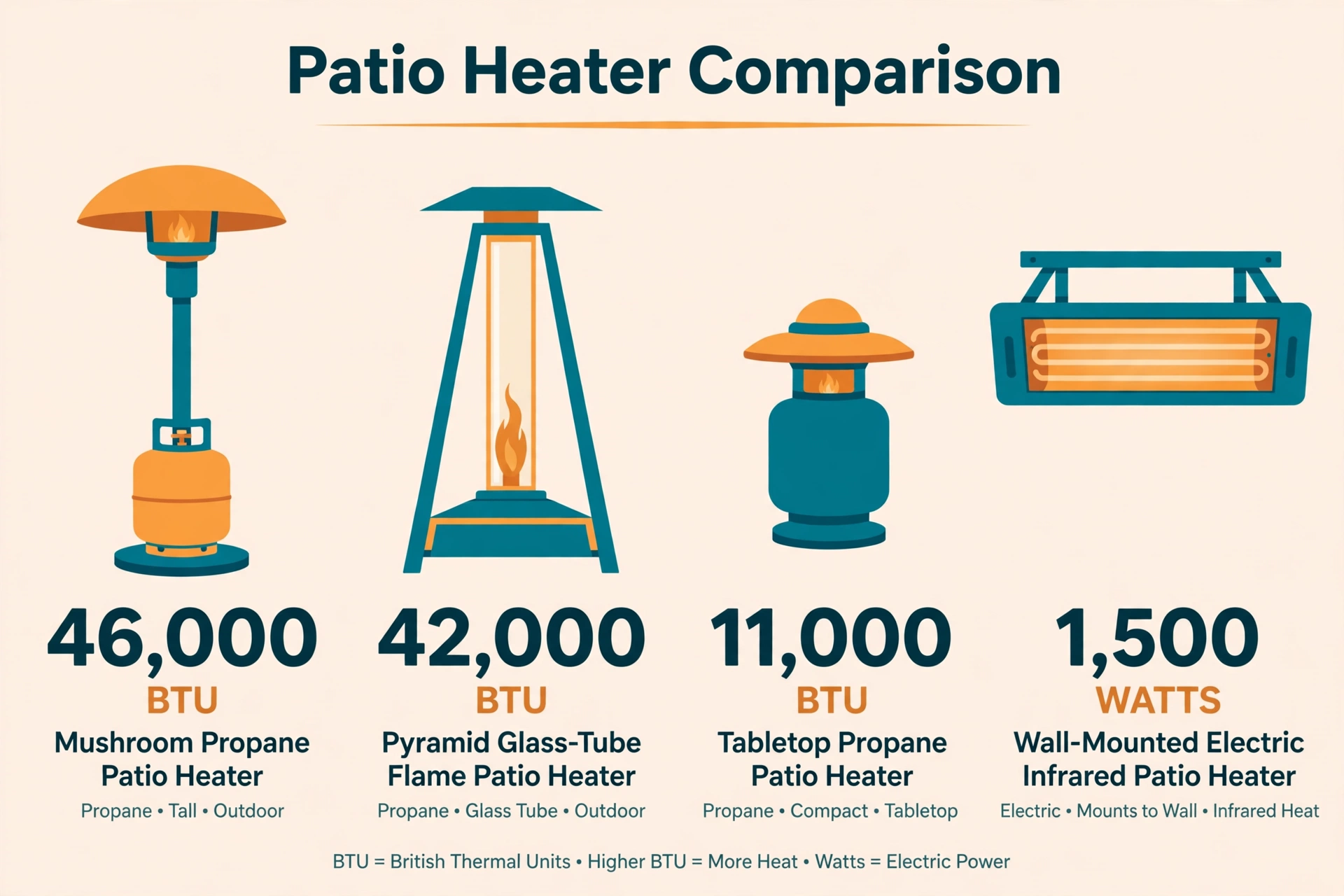
Heater style decides where the heat goes, and that matters more than raw BTU. A tall mushroom-style heater radiates heat downward and outward across a wide circle — the right pick for open patios. A pyramid or flame-tower heater looks dramatic but concentrates warmth in a tighter ring, so it suits smaller decks and dining sets.
Tabletop models (around 11,000 BTU) only warm the people sitting right at the table. Wall- or ceiling-mounted electric infrared units heat the objects in front of them in a narrow cone. If you are still deciding between fuel types, our guide on how to choose a patio heater compares the styles in more detail.
3. Match the BTU Rating to the Size You Need
Now line your space up against real output numbers. Mushroom-style propane heaters most commonly run 40,000 to 46,000 BTU, and manufacturers typically claim about an 18-foot diameter of coverage (a 9-foot radius) for the 46,000 BTU models. A few models claim up to 200–250 sq ft. Treat those claims as calm-evening numbers, not promises.
| Heater Type | Typical BTU | Claimed Coverage | Best For |
|---|---|---|---|
| Mushroom freestanding (propane) | 40,000–46,000 | ~18 ft diameter | Open patios |
| Pyramid / flame tower (propane) | 40,000–42,000 | Tighter ring | Small decks, dining sets |
| Tabletop (propane) | ~11,000 | Table only | Dining tables |
| Wall/ceiling electric infrared | 1,500 watts (~5,100 BTU) | ~8–10 ft zone | Covered seating nooks |
4. Shrink the Coverage Claim for Wind and Cold
This is the step most buyers skip, and it is the one that causes the most disappointment. Wind carries warm air away from a propane heater’s glow, and a breezy night can cut the usable warmth zone well inside the claimed 18 ft circle. Cold matters too: a heater that feels generous at 55°F feels thin at 40°F.
Be honest with yourself about your spot. If your patio sits on a hill, faces the open prairie, or funnels wind between buildings, size up or plan for two smaller heaters instead of one big one. Our electric vs. propane patio heater comparison also notes that wind affects propane models more than directional infrared ones.
5. Check Clearances Before You Buy
A heater you cannot place safely is the wrong size no matter its BTU. Most manuals require roughly 3 ft of clearance from walls, railings, umbrellas, and overhanging branches, plus clear space above the reflector. Measure your intended spot against those numbers — a big heater wedged into a tight corner is a hazard, not a heater.
6. Plan the Fuel Supply
Size affects your wallet, not just your warmth. A 46,000 BTU heater on high burns through a standard 20 lb propane tank in roughly 10 hours, so a big heater that runs most evenings will need frequent tank swaps. If that sounds like a chore, a smaller unit — or an electric model with no tank at all — may fit your habits better.
Running the numbers is worth five minutes. See how long a propane tank lasts on a patio heater and what it costs to run a patio heater so the heater you size for warmth is also one you can afford to feed.
| If This Happens | Try This |
|---|---|
| Near seats are toasty, far seats are cold | Your coverage circle is smaller than your seating zone. Move the heater to the center of the group, or add a second smaller unit instead of replacing the first. |
| Heater was fine last fall, useless this winter | Colder air steals heat faster. Lower your expectations by one “size” in deep winter, and block wind with a patio screen if you can. |
| Wind keeps making the heat vanish | Wind is the #1 coverage killer for propane models. Relocate the heater to a sheltered corner (keeping clearances) or switch the windy side to directional electric infrared. |
| Burning through propane tanks too fast | You sized for the coldest night, not the average one. Run the heater on medium instead of high, or size the next heater to your typical evening temperature. |
Patio Heater Sizing FAQs
Steps:
1. Measure the seating zone (length × width) and the distance to the farthest chair.
2. Pick the style: mushroom for open patios, pyramid for decks, tabletop for tables, electric infrared for covered nooks.
3. Match BTU to space: 40,000–46,000 BTU ≈ 18 ft diameter · ~11,000 BTU = table only · 1,500 W ≈ 8–10 ft zone.
4. Correct for wind and cold — claims assume calm, mild evenings.
5. Verify clearances (~3 ft) and never use indoors.
6. Plan fuel: ~10 hrs per 20 lb tank at 46,000 BTU on high.
You have done the real work now: your patio is measured, your heater style is picked, and the BTU numbers match your space instead of your hopes. The right-size heater is the one you can afford to run on an ordinary Tuesday evening — not the biggest box on the shelf.
Your natural next step is the budget question: once you know what size patio heater you need, check how much it costs to run a patio heater so the size you picked fits your wallet too. Then measure, shop, and enjoy the patio past sunset.