How Much Does It Cost to Run a Patio Heater? Real Propane and Electric Math
You are eyeing your patio heater and wondering the same thing everyone wonders the first time they see the tank gauge drop: how much does it cost to run a patio heater for a normal evening outside? One hour? Four hours? All month? By the end of this guide, you will have your exact per-hour number for both propane and electric heaters — worked out with your own rates, in about five minutes.
The method works because heater running costs are not a mystery. Every heater has a fixed appetite: a wattage on the label for electric models, a BTU rating for gas ones. Multiply that appetite by your local fuel price and you get the answer. Propane costs more per hour but puts out far more heat; electric costs pennies per hour but warms a much smaller area. This article runs both sets of numbers so you can compare fairly.
Plan on five minutes with a calculator. The math is grade-school simple, and each step needs only one number you already have or can look up in a minute. One quick note before we start: this guide uses typical U.S. prices from 2026 sources (a 20 lb propane refill of $15–$20 and a residential electricity rate near $0.18 per kWh). Your numbers will differ — that is fine, because the formulas below let you plug in your own.
Fuel safety: Propane patio heaters are for outdoor use only. Never run one indoors, in a garage, or under an enclosed cover — burning propane makes carbon monoxide, which you cannot see or smell. Install CO detectors in your home and keep at least 3 feet of clearance around any heater.
What You Need
- Your heater’s wattage (electric) or BTU rating (propane) — printed on the label
- Your electricity rate per kWh — on your power bill
- Your last propane refill receipt (or the local refill price)
- A phone calculator
At a Glance
- Check your heater’s wattage or BTU rating
- Pull your real electricity price
- Multiply watts, hours, and rate for the electric cost
- Divide a propane tank’s price by its burn hours
- Price a refill, not an exchange
- Add up one evening’s cost to run a patio heater
Check your heater’s wattage or BTU rating
Electric heaters list their appetite in watts. Plug-in models usually draw 1,500 watts; wall- or ceiling-mounted infrared units often draw 2,000 to 4,000 watts and may need a 240-volt circuit. The number is on the rating label, the box, or the manual.
Propane heaters list theirs in BTU. A standard freestanding tower puts out about 40,000 BTU on high; tabletop and tank-top models are often 10,000 to 15,000 BTU. Write the number down — everything after this depends on it. If you are still deciding between fuel types, our electric vs propane patio heater comparison walks through the trade-offs.
Pull your real electricity price
National averages are handy, but your bill is better. Open your latest electric bill and look for the rate in cents or dollars per kWh. The U.S. residential average in 2026 ran about $0.17–$0.18 per kWh according to EIA data cited by rate calculators.
Use the all-in rate if your bill shows one — some utilities split energy and delivery charges. That single number is all the electric math needs. Skip this step for propane-only owners.
Multiply watts, hours, and rate for the electric cost
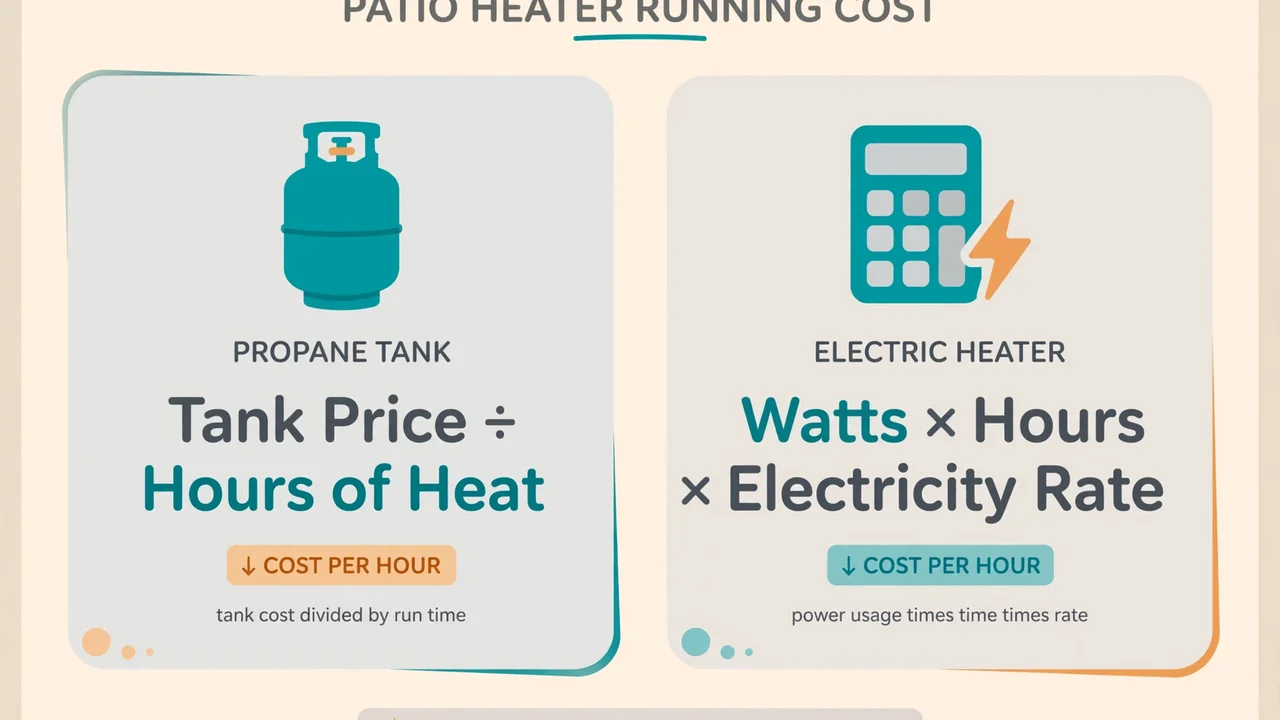
The formula is short: watts ÷ 1,000 × hours × your rate = running cost. A 1,500-watt heater at $0.18 per kWh costs 1.5 × 1 × 0.18 = $0.27 per hour. That is the whole trick.
A 2,000-watt mounted heater costs about $0.36 per hour at the same rate, and a 4,000-watt unit costs about $0.72 per hour. For one four-hour evening: $1.08, $1.44, and $2.88 respectively. A heater with a thermostat cycles on and off, so real cost can land 30 to 50 percent lower than the full-blast figure.
Divide a propane tank’s price by its burn hours
A standard 20 lb propane tank holds roughly 4.5 to 4.7 gallons of fuel (about 430,000 BTU total). A 40,000 BTU tower burns close to half a gallon per hour on high, so one tank gives you about 9 to 10 hours of full-blast heat. Turning the dial down to medium stretches that toward 14 hours or more.
Cost per hour is then tank price ÷ hours it lasted. A $20 refill lasting 10 hours costs $2.00 per hour; a $15 refill lasting 12 hours costs $1.25 per hour. Most owners land in the $1.50–$2.00 per hour range at typical prices. For the full tank-life breakdown, see how long a propane tank lasts on a patio heater.
Price a refill, not an exchange
Where you buy propane changes the hourly cost more than anything else. Refilling your own tank at a propane dealer typically runs $15–$20 for 20 lbs, or about $0.60–$1.00 per pound. A tank-exchange cage charges roughly $1.50–$2.00 per pound — and the exchanged tank often holds only 15 lbs.
Run the numbers and exchanges nearly double the hourly cost: roughly $1.20–$2.00 per hour on a refill versus $2.75–$3.70 per hour on an exchange for a 40,000 BTU tower. When you quote your per-hour cost, use the refill price — it is what a regular user pays once they know the game.
Add up one evening’s cost to run a patio heater
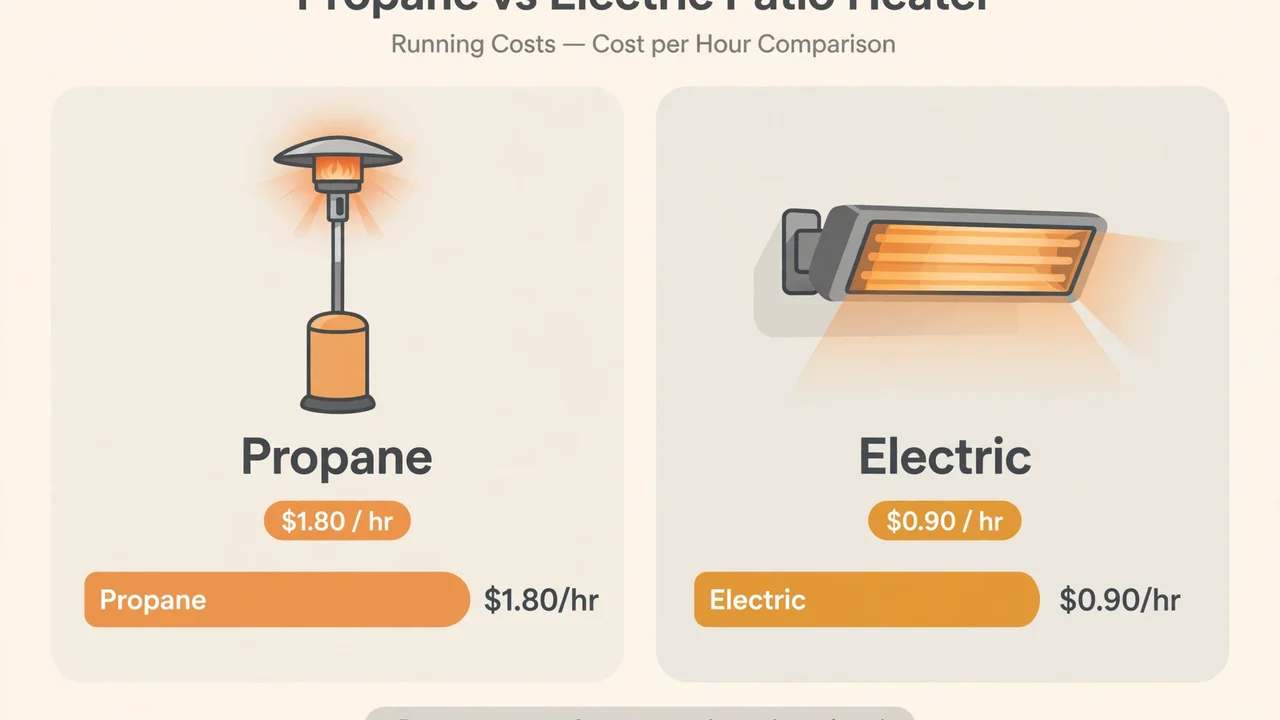
Take a typical four-hour evening and line the two fuels up. Propane at $1.75 per hour costs $7.00. A 1,500-watt electric heater at $0.18 per kWh costs $1.08. The electric number looks tiny — and it is — because the electric heater puts out roughly one-eighth the heat.
Stretch it to a month (four evenings a week): propane lands near $112, the plug-in electric near $17. These are planning figures, not promises. Your rate, heat setting, and weather move them. If you want help picking the right size before you spend, read how to choose a patio heater.
Typical Running Cost at 2026 U.S. Rates
40,000 BTU
~$112 / month
1,500 W
~$17 / month
4,000 W
~$46 / month
Based on a $15–$20 propane refill and $0.18/kWh electricity. Monthly figures assume four 4-hour evenings per week. Plug in your own numbers for an exact answer.
See what moves the bill up or down
The per-hour number is not fixed. It swings with five things, and knowing them keeps you from paying for heat you never felt.
The heat setting
High burns the full rating; medium or low can cut fuel use by a third or more. Most evenings do not need the top setting once people are seated. Try medium first and turn it up only if you feel the chill.
Wind
Wind is the biggest cost driver nobody budgets for. A heater in an open, breezy spot works far harder to warm the same people. Setting it near a wall, fence, or hedge blocks the wind and can let you drop one or two settings lower for the same comfort.
Your local rates
Electricity prices vary widely by state — some households pay half the national average, others double. Propane swings with season and dealer. Both inputs change the answer, which is why the formulas beat any single “official” number.
How many hours it actually runs
Timers, thermostats, and smart plugs cut run time without cutting comfort. An electric heater with a thermostat may draw full power only half the time. For propane, that means walking out and turning it off when the last person heads inside — obvious, and rarely done.
Trim your running cost this weekend
Four moves cover nearly all the savings a regular patio owner can get. None of them cost much.
- Refill instead of exchanging — this one change can cut propane running cost close to in half.
- Run medium instead of high — drop the dial and see if anyone notices; most evenings, nobody does.
- Block the wind — a wall, screen, or hedge behind the seating area keeps heat where people are.
- Heat people, not the patio — infrared and radiant heaters warm objects and bodies, so aim them at seats, not open space.
- Keep the burner clean — a weak, yellow, or sputtering flame burns fuel poorly. Our guide on fixing a patio heater that won’t stay lit covers the simple cleaning steps.
Common mistakes that inflate the bill
- Judging propane by exchange prices. The cage price is the most expensive way to buy fuel. Compare with refill prices and the hourly cost drops sharply.
- Calling electric “cheaper” without comparing heat. A $0.27/hr plug-in heater is cheap per hour — but a 1,500-watt unit cannot warm what a 40,000 BTU tower warms. Compare cost per warm evening, not cost per hour.
- Running full blast in the wind. Wind carries the heat away before it reaches anyone, so you pay for BTUs that never touch a person. Move the heater or block the wind first.
- Leaving it on “for later.” An empty patio does not need heating. Turn propane off at the valve and unplug or switch off electric models when everyone goes inside.
Frequently asked questions
Is it cheaper to run a propane or electric patio heater?
Electric costs less per hour — about $0.27 for a 1,500-watt plug-in versus $1.50–$2.00 for a 40,000 BTU propane tower at typical 2026 U.S. rates. But propane puts out far more heat, so cost per comfortable evening is closer than the hourly figures suggest.
How much does it cost to run a patio heater per hour?
Most owners pay $1.50–$2.00 per hour for propane (with a refilled 20 lb tank) or $0.25–$0.75 per hour for electric, depending on wattage and the local electricity rate. Running on a lower heat setting cuts either number.
How many hours does a 20 lb propane tank last on a patio heater?
About 9–10 hours on a 40,000 BTU tower running on high, because the tank holds roughly 4.5–4.7 gallons and the heater burns close to half a gallon per hour. Medium or low settings stretch it to 12–14 hours.
Do electric patio heaters use a lot of electricity?
A 1,500-watt plug-in heater uses 1.5 kWh per hour — about the same as a hair dryer. A four-hour evening costs a little over a dollar at average rates, so one heater will not wreck your power bill, though larger 4,000-watt mounted units use proportionally more.
Is it expensive to leave a patio heater on all evening?
Propane costs roughly $6–$8 for a four-hour evening at typical refill prices; electric costs about $1–$3 depending on wattage. The expensive habit is leaving it burning with nobody outside — turn it off when the gathering breaks up.
Quick Reference Card
Need: heater wattage or BTU rating · your electricity rate · your propane refill price · calculator
Electric: watts ÷ 1,000 × hours × your $/kWh = cost (1,500W ≈ $0.27/hr at $0.18/kWh)
Propane: tank price ÷ hours it lasted = cost/hr (typical $1.50–$2.00 on a refill)
Cheapest fuel: refill your own tank — exchanges cost nearly twice as much per hour
Biggest lever: run medium, block the wind, and turn it off when nobody is outside
You now know exactly what an evening of heat costs you — how much it costs to run a patio heater is no longer a guess but a number you calculated yourself. Keep the refill receipts and check your bill once, and the math stays honest all season.
Next step: if the numbers surprised you, compare your setup with how to use a patio heater to make sure you are getting every bit of warmth you are paying for. And keep that propane outdoors — the cheap evenings are only worth it when everyone stays safe.