Can You Cook on a Kerosene Heater? What’s Actually Safe to Do
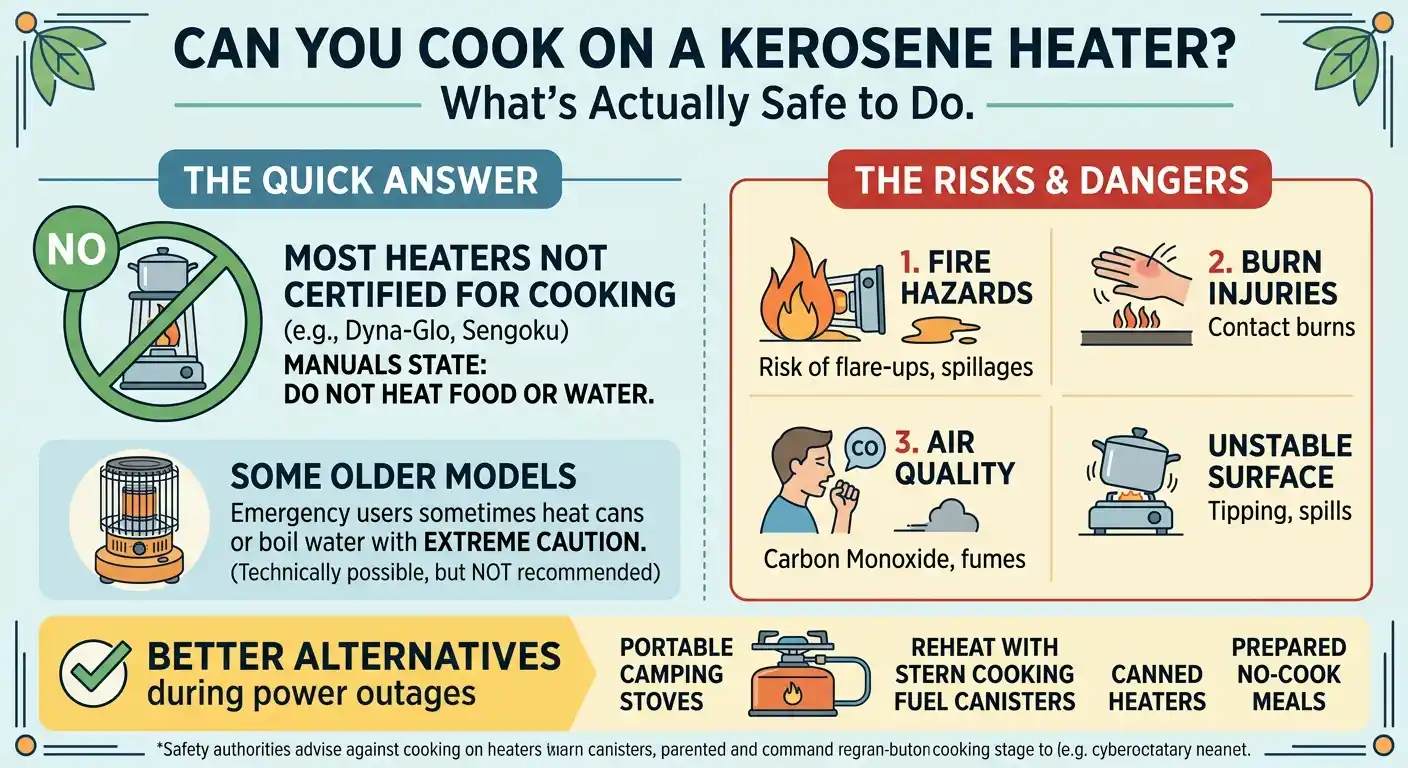
When the power goes off, the house is getting colder and all that is keeping you warm is your kerosene heater, it is only natural to ask yourself whether you can put a pot on top of it as well. Short answer: technically, you can heat some things using some kerosene heaters, but nearly all manufacturers, fire safety organizations, and the U.S. Consumer Product Safety Commission would tell you not to cook full meals on one.
This is why, what the actual risks are, and what should be done instead in case you require hot food during an outage.
Can You Cook on a Kerosene Heater?
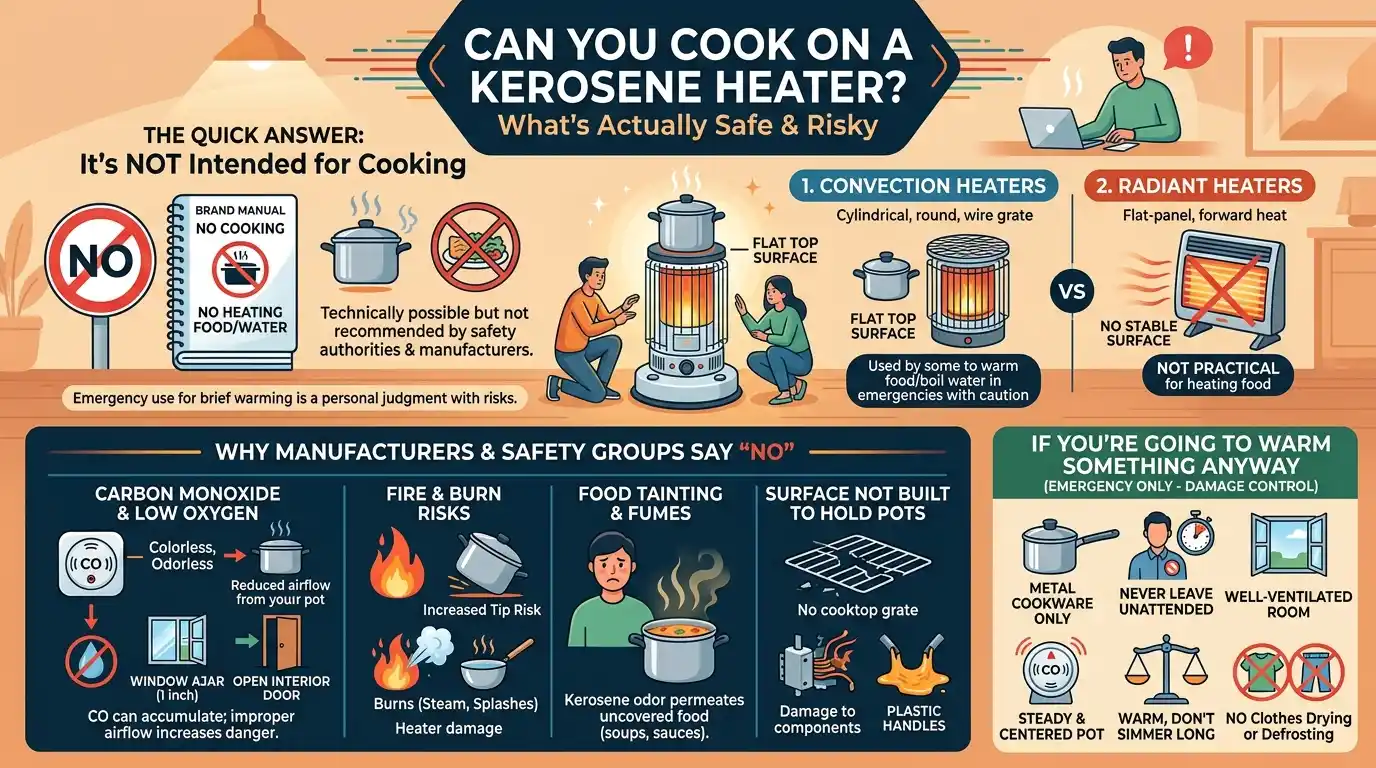
The Quick Answer: The majority of portable kerosene heaters are not intended or certified to cook. The manuals of big brands such as Dyna-Glo and Sengoku specifically state that the heater should not be used to heat food or water. With that said, there are owners of older convection-style kerosene heaters (the round ones with a wire safety grate around the flue) who have used the flat top to heat canned food or boil water in an emergency, with due caution.
It is a judgment call that involves actual fire, burn, and air-quality hazards, and it is not something that any safety authority would suggest.
How a Kerosene Heater Actually Works
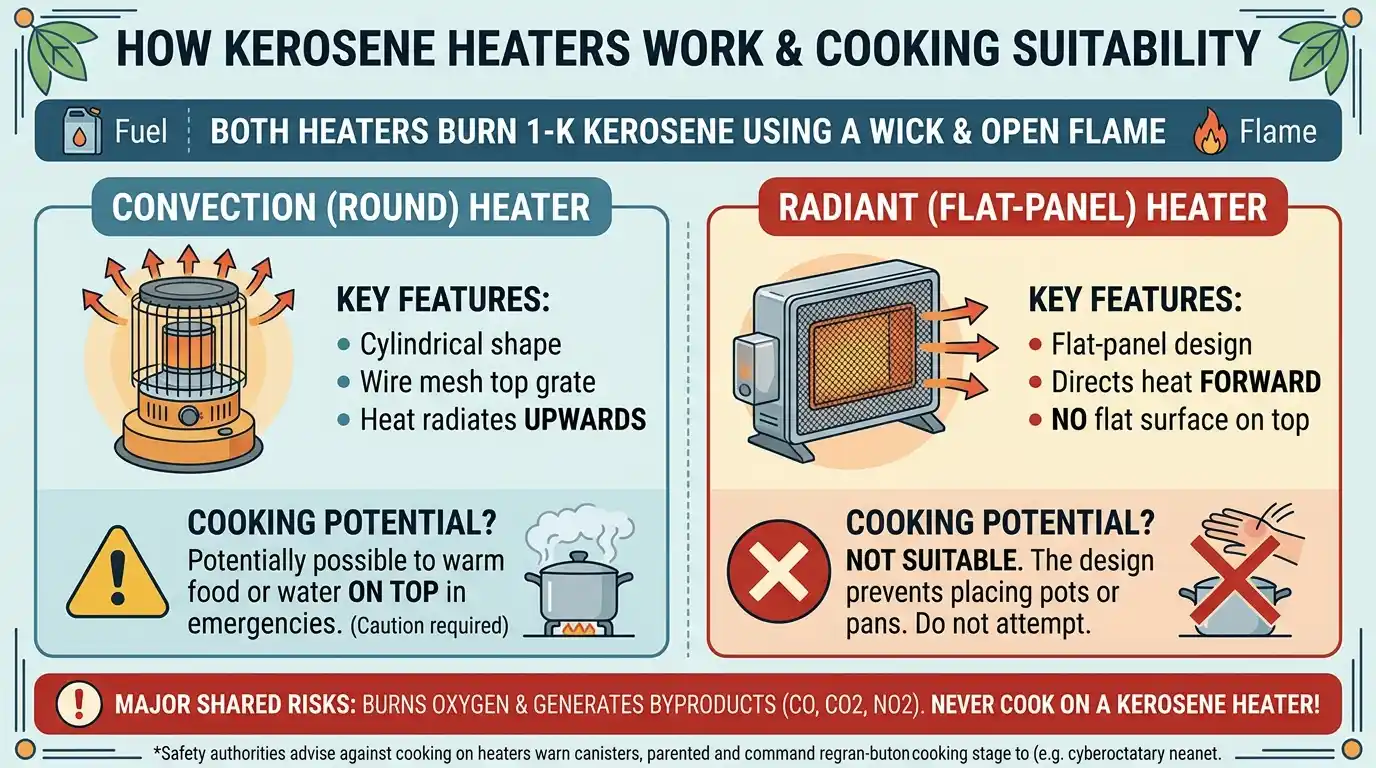
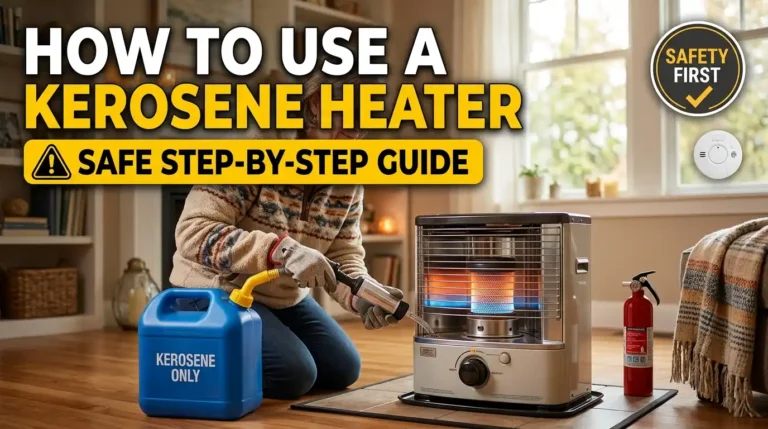
A kerosene heater burns 1-K grade kerosene through a wick, producing an open flame that heats a metal combustion chamber. If you want the full mechanics behind how that combustion process generates heat, this breakdown of kerosene heater components and fuel flow covers it in detail. There are two main types:
- Convection (radiant-from-the-top) heaters: These are cylindrical, and have a wire mesh grate on the top. These are the ones that people occasionally heat food on, as the top is hot enough to boil water.
- Radiant heaters: These are flat-panel type heaters that radiate in the forward direction, much like a reflector. These do not even have a flat surface that can be used to place pots and pans.
Both are based on the principle of burning fuel inside the house, and this is the crux of the matter: any open-flame appliance burns oxygen and generates byproducts of combustion, such as carbon monoxide, carbon dioxide, and nitrogen dioxide.
Why Manufacturers and Safety Groups Say Not to Cook on One
Carbon Monoxide and Reduced Oxygen
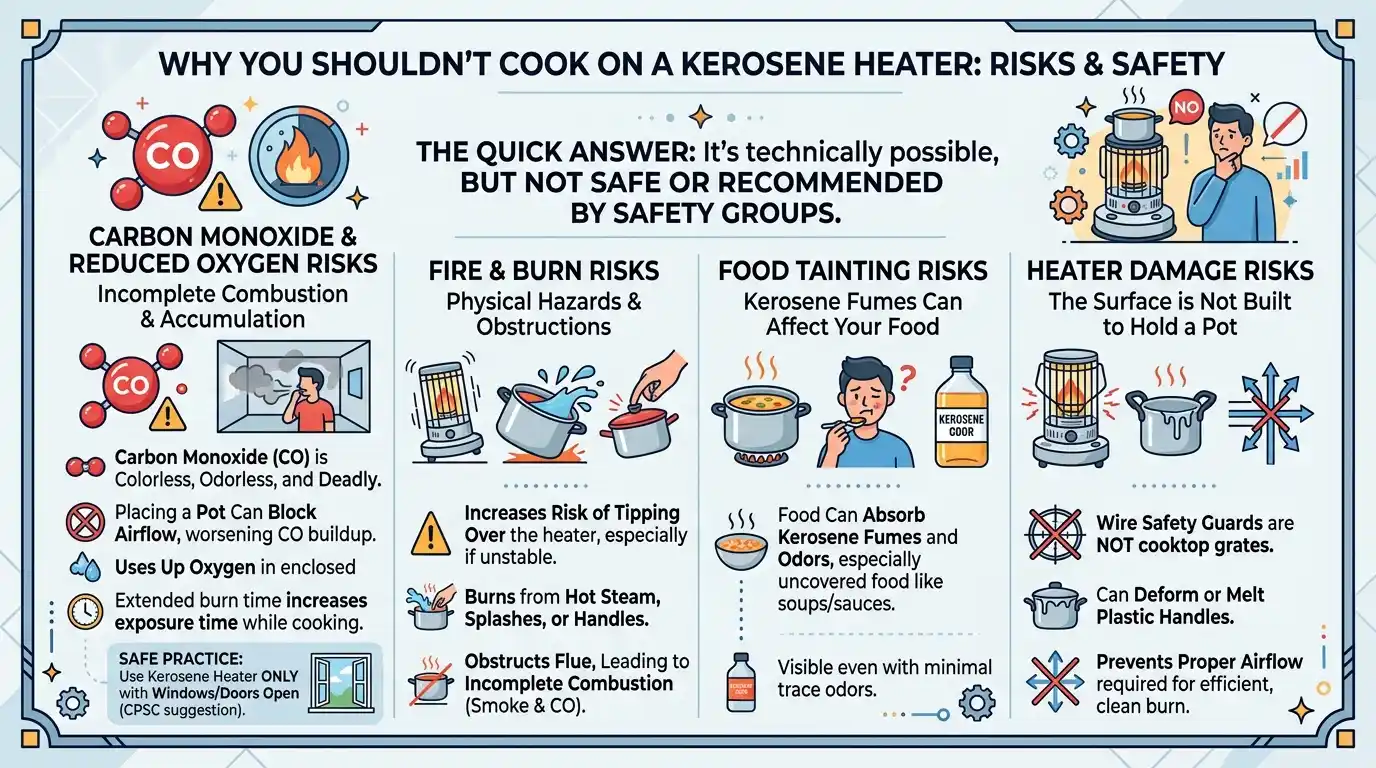
Carbon monoxide (CO) is both colorless and odorless, and that is what makes it hazardous. It is a byproduct of combustion in kerosene heaters and in a small or poorly ventilated room, oxygen levels may decrease and CO may accumulate. To dilute these pollutants, the CPSC suggests operating a kerosene heater with a window ajar about an inch and the door to the rest of the house open.
Ventilation can be exacerbated by extending the burn time of the heater by using it as a stove, or by placing a pot on top which partially blocks airflow around the flue, at the very time you are spending more time in the vicinity, waiting to cook food.
According to federal data monitored by the CPSC, kerosene heaters, and other indoor burning fuel appliances, are always associated with non-fire carbon monoxide poisoning fatalities annually. The figures are lower than those associated with generators or gas appliances, but the danger is real enough that all the leading safety agencies consider it a significant risk, rather than a hypothetical one.
Fire and Burn Risk
An added weight and an added obstruction in the proximity of an open flame would be a pot of water or a can of food resting on a lit heater. It increases the chances of:
- Leaning the heater, particularly on a sloping or soft surface.
- Burns due to contact with steam, splashes, or hot pot handle.
- Suffocating the flue to the point of incomplete combustion, thereby raising the amount of smoke and CO.
Kerosene Fumes Can Taint Your Food
A kerosene heater, even when in good condition, emits a trace of kerosene odor, particularly when it is being lit or when it is being turned off. The odor and the fumes that carry it can permeate food that is lying uncovered on or near the heater, especially soups, sauces, or food with a large amount of surface area exposed to the air.
The Surface Wasn’t Built to Hold a Pot
The kerosene heaters most commonly sold include a wire safety guard around the top to ensure that objects (and hands) do not touch the hot surface or the flue opening. There is no cooktop grate in that guard. Putting cookware on it may cause damage to the guard, prevent airflow that the heater requires to burn without pollution, and in certain instances, melt or deform plastic handles.
What People Actually Do (and Where the Line Is)
Warming vs. Cooking: There’s a Real Difference
The overall consensus of long-time kerosene heater users in online forums and owner groups is quite similar: many will boil a can of soup or heat water to make coffee on the flat cook top of a convection heater in case of an emergency, but few will consider it a cooking device with raw materials or full-course meals.
Warming something that’s already cooked, in a sealed container, for a short time is a very different risk profile than simmering a pot of stew for 45 minutes.
Convection Heaters vs. Radiant Heaters
| Heater Type | Shape | Flat Surface? | Can It Warm Food? |
|---|---|---|---|
| Convection (cylindrical) | Round, wire grate on top | Yes, once the grate is removed or set aside | Some owners warm canned goods or boil water briefly |
| Radiant (flat-panel) | Flat, front-facing heat | No | Not practical; there’s no stable surface |
If You’re Going to Warm Something Anyway, Do This
It is not an advocacy, it is damage control to those who are going to do it anyway. Should you decide to heat food on a kerosene heater of the convection type:
- Cook only with metal cookware having a metal handle. The heat that escapes the flue may melt or warp plastic or resin handles.
- Do not leave it unattended even a minute.
- Maintain the room well-ventilated as you would when using the heater normally: an open interior door and a cracked window.
- Have a working carbon monoxide detector installed in the room and ensure that it is on before you begin.
- Hold the pot steady and in the center and never fill it to the point that it may spill on the flame or wick.
- Warm, don’t simmer for long periods. The longer cookware on top it is, the more it inhibits airflow around the flue.
- Do not use it to dry clothes, to thaw frozen food over an extended period of time, or to replace a real stove.
Kerosene Heater Cooker/Cookstove Products: A Different Category
There are products that are sold as kerosene heater/cooker combination units, designed with a stable cooking surface. Consumers ought to be aware that the CPSC has already recalled at least one such product line due to the specific reason that it was not designed to be used indoors and did not have the automatic shutoff feature that is standard on typical kerosene space heaters.
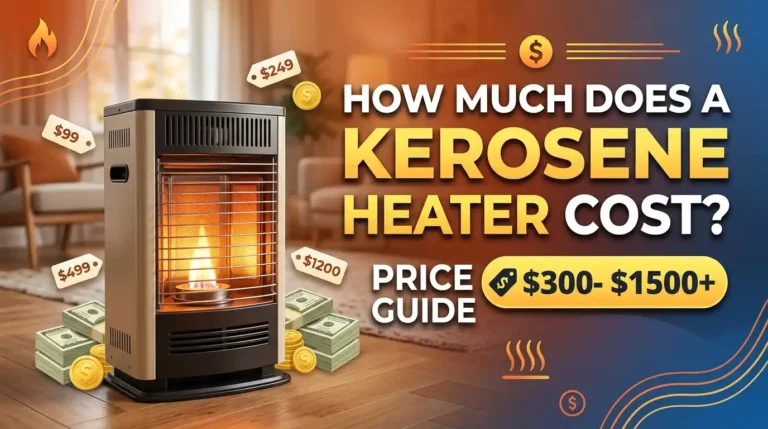
When buying a dual-purpose kerosene cooker, make sure it has a current safety certification (i.e. UL listing) and that the manual specifically authorizes indoor cooking use. Do not think that a product is safe because it is called cooker. And before you buy anything, it’s worth knowing what these units typically run in today’s market, since combo cookers are often priced well above standard heaters.
Safer Ways to Cook During a Power Outage
When you are relying on your kerosene heater as your primary source of warmth and the power goes off, there are less risky ways to literally get a hot meal:
- Outdoor camp stove or grill, used well outside the home, never in a garage or under a covered porch
- Butane or propane one-burner stove, and should only be used in a well-ventilated place not near the heater. If propane is part of your backup plan anyway, this guide to setting one up without the usual hazards is worth reading before winter hits.
- Insulated thermos of food, ready-made hot food prior to the outage.
- Fireplace or wood stove with suitable cooking grate, should your home have one rated.
Kerosene Heater Safety Checklist
For a fuller walkthrough of setup, lighting, and daily operation beyond this checklist, see our complete first-time owner’s guide.
Kerosene Heater Cooking: Pros and Cons Table
| Pros of Warming Food on a Convection Heater | Cons |
|---|---|
| Can heat canned food or water in a true emergency | Not approved by most manufacturers |
| No extra fuel source needed | Increases fire and burn risk |
| Works during a total power outage | Can concentrate CO exposure near where you’re standing |
| Familiar to people who grew up with these heaters | Fumes can affect food taste and quality |
FAQs
Do you have a kerosene heater to cook on?
Not safely, as most manufacturers and fire safety authorities say. Some convection-style heaters can warm already-cooked, sealed food like canned soup for a short time, but this isn’t an approved or recommended use.
Will a kerosene heater be able to boil water?
Certain convection heaters are hot enough at the top to boil water lightly, although manufacturers usually advise against it due to fire, burn, and ventilation hazards.
Is it safe to warm up food on a kerosene heater?
It is risky. Do it anyway, but with metal cookware, keep an eye on it, and ensure that the room is well ventilated and a functioning CO detector is in place.
Do kerosene heaters give off carbon monoxide?
Yes. Any kerosene heater will emit a certain amount of carbon monoxide as a byproduct of fuel burning and this is why ventilation and a CO detector are necessary whenever the heater is in use.
What type of kerosene heater do you have to cook on?
When any of these types are near, it is not a flat-panel radiant heater but an older convection-style (cylindrical) heater with a flat top and a wire grate. Even at that it is warming not cooking.
Is it possible to heat a closed garage or shed with a kerosene heater?
Not until it is really ventilated, with an open window or door, and not in a completely closed space. CO can accumulate to harmful amounts in a closed garage.
What is the maximum amount of time you can safely operate a kerosene heater indoors?
It is not usually recommended to be run unattended or left on overnight by manufacturers. No safe number of hours exists; it depends on the size of the room and the ventilation.
Are kerosene fumes able to enter food that is cooked in the area of the heater?
Yes. The taste of uncovered food in the vicinity of the kerosene odor and fumes, particularly immediately after lighting or extinguishing the unit, can be influenced.
Should I have a carbon monoxide detector when I use the heater infrequently?
Yes. The risk of CO does not depend on the number of times you turn on the heater, but rather ventilation and the size of the room each time the heater is on.
Final Thoughts
A kerosene heater will really come in handy when you have no power in the cold weather, but it was not meant to cook your dinner, just to warm up a room. The truthful response to the question of whether a kerosene heater can be used to cook is that some older convection models can be used to warm already-cooked food in an emergency, but that almost all manufacturers and safety agencies recommend against it due to the risk of fire, burn, and carbon monoxide.
A special outdoor stove or a thermos filled with hot food is a much safer choice in case of an outage. And whatever you do with the heater itself, get it ventilated, have a CO detector in the vicinity, and never leave it unattended.