Why Background Lights no longer work on an Electric Fireplace?
When your electric fireplace continues to heat, but the flame, ember bed, or backdrop lighting is no longer lit, you are not alone in thinking so and you are not alone. It is one of the most frequently reported complaints owners make to repair technicians and manufacturer support phone lines, and in most instances, it can be repaired within less than 20 minutes without calling anyone.
Quick fix: Background lights on an electric fireplace tend to go dead due to a bad LED strip or bulb, a defective LED driver board, a loose internal connection, a tripped setting (flame-only mode, brightness, or demo mode), or, less frequently, a blown fuse on the lighting circuit. Since the majority of units have the heater and the light system wired separately, you can lose the ambience as the heat continues to run well.
The guide will take you through each cause in descending order of likelihood, provides you with a repair table that can be scanned in a few seconds, discusses brand-specific idiosyncrasy of brands such as Dimplex, Simplifire, and Modern Flames, and explains when to cease troubleshooting and seek assistance.
Key Takeaways
- Precheck settings prior to parts. Lights can also be made to look dead when they are simply turned down or turned off by flame-only mode, brightness sliders, night mode, and demo mode.
- Heat working ≠ lights working. The majority of the electric fireplaces operate the lighting system and the heater on different circuits, allowing one to malfunction, and the other to continue functioning as usual.
- LEDs are more reliable than LED drivers. A dark or dim flame effect is usually the driver/inverter board that is losing output, rather than the strip of LEDs.
- Brand issues to trouble shoot order. Dimplex, Simplifire, Modern Flames and Remii have slightly varying control logic and known failure points.
- Certain repairs require an electrician. Breaker trips that keep blowing, scorch marks, or a burning odor are all indicators that it time to quit DIY troubleshooting. The way Electric Fireplace Lighting works.
How Electric Fireplace Lighting Actually Works
- LED strip + rotating or vibrating reflector: LED bars are used to light up a moving mylar or metallic ribbon that reflects and scatters the light to appear like flames.
- LED strip + optical prism/mirror array: Permanently lit LEDs are used to produce motion with no moving components through the use of a faceted plastic or glass plate.
The two designs rely on an LED driver (also known as an inverter or control board) which transforms household AC power into the low-voltage DC current that the LEDs require. The heater, in turn, typically operates directly off line voltage via its own relay. It is that separation that allows your fireplace to blow warm air with no flame or ember lighting – the two systems do not have a point of failure.
Quick-Reference Troubleshooting Table
| Symptom | Likely Cause | What to Check | Fix Difficulty |
| No lights, heat works fine | Flame-only mode is off, or lights disabled in settings | Remote/panel light or flame button | Easy |
| Lights very dim, not fully off | Failing LED driver board | Multimeter reading at LED output | Moderate |
| Lights flicker on and off | Loose internal connector | Wiring harness behind light assembly | Moderate |
| One section dark, rest working | Burnt-out LED segment | Swap light bars between slots if possible | Moderate |
| No lights, no heat, no power at all | Tripped breaker or blown fuse | Breaker panel, power cord, outlet | Easy |
| Lights worked, now nothing after a reset | Firmware/board fault | Full power cycle, 5–10 minute wait | Easy to try, hard to fix |
| Remote won’t turn lights on, buttons do | Dead batteries or lost pairing | Remote battery compartment, pairing steps | Easy |
| Lights cut out only when heater kicks on | Voltage drop from shared circuit | Circuit load, wire gauge | Needs electrician |
7 Reasons Your Electric Fireplace Background Lights Stopped Working
1. The Fireplace Is in Flame-Only or a Restricted Mode
The vast majority of models allow you to turn on the flame and ember lights without heating, but the opposite confusion occurs as well: some users turn on a setting that turns off the lights, but the heating and the fan remain on. The lights may appear off when simply turned all the way down with night mode or sleep mode or a dimmed ambient setting.
What to do: Press all the buttons on the remote and control panel that deal with lights (flame on/off, brightness up/down, color settings, and any “demo” or “showroom” mode). Test: Set brightness to the maximum.
2. Burnt-Out LED Bulbs or a Damaged LED Strip
LEDs have a long life (usually 20,000 to 50,000 hours), but they do wear out, and physical abuse, such as shipping, bumping a hard object, or overheating, can prematurely kill a strip.
What to do: Disconnect the unit, open the front panel as per your manual and physically examine the LED strips to identify dark spots, scorch marks, or obviously broken diodes. When your model has two light bars, change the positions of the light bars; when the dark spot follows the bar, then the bar is bad. In case it remains at the same location, then suspect the driver or wiring.
3. A Failing LED Driver or Inverter Board
It is among the most common causes of dim lights, flickering lights or lights that are not completely off but emit a faint glow. The driver board adjusts the voltage to the LEDs, and the capacitors and transformers degrade over time and heat cycles.
Based on the troubleshooting advice posted by HVAC technicians on consumer question and answer websites, the LED driver or inverter board is usually the more likely source of failure than the LEDs themselves, when LED light bars turn on and remain dim after being reassembled, as the capacitors and connectors in that board age, causing the output to drop even though the strip remains lit.
What to do: When the unit is open and unplugged, check the little circuit board surrounding the lights, looking for bulging capacitors, discoloration, or scorch marks. Assuming you feel at ease with a multimeter, compare the output voltage at the LED connector with the specifications in the model. A misfit tends to prove that the driver requires a replacement – a component that most manufacturers offer as a direct sale.
4. Loose or Corroded Internal Connections
Shipping vibration, rough install, or even the normal thermal contraction and expansion with years of use may loosen connectors. The same applies to corrosion at a solder joint: intermittent or complete loss of lighting.
What to do: Unplug and re-seat all the connector between the light strips and the driver board. Minor oxidation can be removed by applying a shot of electronics-safe contact cleaner on the pins.
5. A Blown Fuse or Tripped Breaker Affecting the Light Circuit
Should your fireplace lose lights and heat and power altogether, this is not the last resort. Other models also operate a dedicated lighting circuit fuse which may blow independently of the heater fuse.
What to do: Check that the outlet is live (use a different device), look at the plug and cord to see if they are damaged and check the internal fuse of the fireplace or the breaker panel in the home. Do not keep resetting a breaker that keeps tripping, it is an indication of a larger electrical issue, not a nuisance trip.
6. Remote or App Pairing Issues (Not an Actual Light Failure)
In some cases the light problem is actually a control problem. When onboard panel buttons switch the lights on successfully, but the remote or app does not, the LEDs were not broken.
What to do: Change remote batteries and verify polarity, verify that there is no child lock on, and re-pair remote or app according to your model manual. Test onboard controls initially – in that case, you have isolated the problem to the remote link, not the lighting system.
7. Installation or Airflow Conditions Triggering a Protective Shutdown
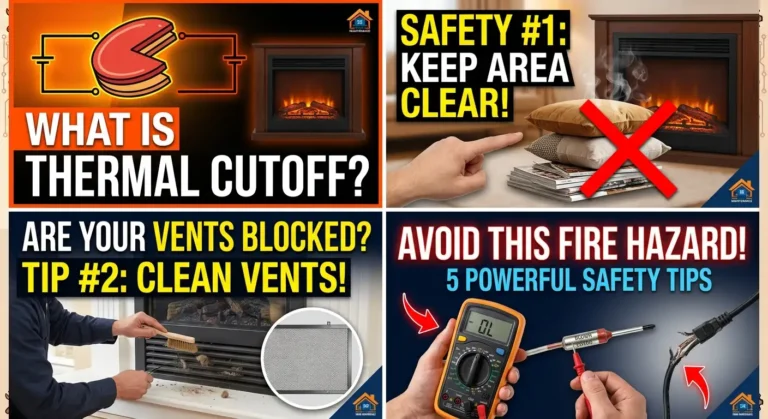
Less frequent, but actual: some models will reduce ambient lighting (or all non-essential functions) in response to a thermal protection measure, although the heater will still operate normally, even when a fireplace is overheating because of blocked vents or tight clearances.
What to do: Make sure that intake and outlet vents are clear and unobstructed, ensure that furniture or trim does not crowd the unit, and allow the unit to cool 15-20 minutes before retesting.
Brand-by-Brand Notes
| Brand | Known Lighting Quirk | First Thing to Check |
| Dimplex | LED driver dimming is a commonly reported issue after several years of use | Multimeter check at LED output; inspect driver board for damage |
| Simplifire | Light assembly access can be less intuitive; connections loosen during panel removal for cleaning | Reseat connectors after any panel removal |
| Modern Flames | Customizable color/brightness settings can be accidentally changed via app | Confirm app settings match physical remote settings |
| Remii | Straightforward wiring, but shipping damage to bulbs is a recurring early-life issue | Inspect bulbs for damage immediately after unboxing/install |
Note: these are usually reported trends of user and technician conversation, rather than official failure-rate figures of the manufacturers – no independent, publicly available failure-rate data exists between brands, so take this as a starting point in troubleshooting, not a guarantee.
Step-by-Step Fix Walkthrough
- Confirm the basics. Is the unit completely plugged in? Is the outlet live? Is the breaker on?
- Rule out settings. Adjust cycle flame mode, brightness, color and any lock or demo setting both with the remote and the onboard panel.
- Try the remote on its own. Check pairing, swap batteries and test the onboard buttons to isolate a remote issue to a real light failure.
- Turn on and off the unit. Turn off and turn on after 5-10 minutes. This eliminates numerous temporary control glitches.
- Unscrew the unit and examine visually. Disconnect and allow to cool, inspect burnt bulbs, broken strips, loose or corroded connections.
- Test driver board. Check physical damage; a multimeter is not a bad idea, or write down model/serial numbers to a technician.
- Choose: Home repair or service. In case you have discovered an obviously burnt-out bulb or a driver board with obvious damage, numerous manufacturers offer direct replacements. When the reason is not so clear, it is time to call support. Myth vs. Fact
Myth vs. Fact
| Myth | Fact |
| “If the heat works, the whole electrical system is fine.” | Heat and lighting are usually on separate circuits — one can fail while the other works perfectly. |
| “Dim lights just need a good cleaning.” | Dust rarely dims LEDs meaningfully; a faint glow after reassembly usually points to the driver board, not dirt. |
| “All electric fireplace remotes are interchangeable.” | Remote compatibility is typically model-specific — a universal-looking remote may not pair correctly. |
| “A tripped breaker means the fireplace is broken.” | It often means the circuit is overloaded or undersized, not that the appliance itself has failed. |
Cost Breakdown: DIY vs. Professional Repair
Understanding the likely cost of each path can help you decide how far to take DIY troubleshooting before calling for help.
| Repair Path | Typical Cost Range | Time Investment | Best For |
| Settings adjustment | Free | 5–10 minutes | Lights that appear off but are dimmed or in the wrong mode |
| Battery/remote fix | Under $10 | 5–15 minutes | Remote not responding, onboard panel works fine |
| Bulb or LED strip replacement | Varies by brand and model | 20–45 minutes | Confirmed burnt-out bulb or cracked strip |
| LED driver/inverter board replacement | Varies by brand and model | 30–60 minutes | Dim, flickering, or faintly glowing lights with a healthy strip |
| Professional diagnostic visit | Varies by region and provider | Scheduled visit | Unclear cause, recurring breaker trips, or discomfort with electrical work |
| Electrician-level circuit repair | Varies by region and scope of work | Scheduled visit | Wiring damage, incorrect voltage, or persistent breaker trips |
Precise prices change frequently, so it is always a good idea to verify the current parts prices with your manufacturer of the fireplace or an authorized dealer before you budget a repair. Generally, however, settings fixes and battery swaps are free, bulb and strip swaps the next cheapest DIY solution, and a driver board is typically the most expensive component that most owners will ever need to replace on one of these units – still generally much less expensive than a complete fireplace replacement.
Preventing Future Lighting Failures
Even some basic maintenance can be extremely helpful in ensuring that background lights last many years:
- Keep vents clear. One of the most prevalent indirect causes of premature component failure is blocked airflow, as trapped heat increases wear on the driver board and LED strips.
- Clean the unit on a regular basis. Clean with a vacuum with a brush attachment on the vents and a soft, dry cloth on the light assembly area according to the cleaning instructions in your manual.
- Do not leave the fireplace running. Extensive sustained operation causes cumulative heat-stress to internal electronics compared to normal use patterns.
- Do not play with the remote. Lost remotes will often be the root cause of the calls that say the lights are not responding, and have nothing to do with the fireplace.
- Register your warranty. The driver boards and LED assemblies usually have a warranty period upon purchase and the model and serial number kept on record would facilitate any future support request.
- Do not circumvent safety. When a unit goes off lighting or heat as a response to a thermal protection, take that as a signal to check clearances and airflow instead of a nuisance to work around. Decision Tree: What to try first.
Decision Tree: What to Try First
- Is there any power at all (does the unit respond to anything)? No → Check the outlet, cord, and breaker before anything else. Yes → Move to step 2.
- Does the onboard control panel turn the lights on? No → Suspect the light assembly itself (bulbs, strip, driver, or internal wiring). Yes → Move to step 3.
- Does the remote or app also turn the lights on? No → The issue is likely the remote/app pairing, not the lighting hardware. Yes → Lights should be working; recheck brightness and mode settings.
- Are the lights dim rather than fully off? Yes → Suspect the LED driver board first, the LED strip second. No (fully off) → Suspect a burnt-out bulb, blown fuse, or loose connector.
When to Call a Professional
Stop troubleshooting and contact a qualified technician or your manufacturer’s support line if you notice any of the following:
- The breaker trips repeatedly, even after resetting
- You see scorch marks, melted plastic, or smell burning
- Wiring looks frayed, pinched, or exposed
- The unit was installed on incorrect voltage for its rating
- A driver board replacement didn’t resolve dim or flickering lights
- You’re not comfortable opening electrical components
Attempting deeper electrical repairs yourself can void your warranty and, more importantly, create a real safety hazard. A five-minute call is worth it compared to a fire risk.
You May Also Read:
FAQs:
Why are the background lights of my electric fireplace not working, but the heat is?
The majority of electric fireplaces connect the heater and the lighting system together, and thus a failure in one of them (a strip of burnt LEDs, a faulty driver board, a loose connector, etc.) does not impact the other.
Is it possible to install background lights on an electric fireplace by myself?
Yes, in many cases. Adjusting settings, re-fitting connectors, changing bulbs and replacing a driver board are all easy with simple tools. Professionals should be engaged in deeper wiring or consistent problems with the breakers.
Are there any special tools required to repair lights in electric fireplaces?
Typically only a screwdriver to remove the panel. You can use a multimeter, which is optional when you are testing a suspected driver board.
What can I do to determine whether it is the bulb or the driver board that is the source of the problem?
Interchange light bars positions (assuming your model permits it). When the dark area comes after the bulb, the bulb must be replaced. Provided it remains, the driver board or wiring at that point is suspect.
Why do my flame lights not go off, but are very faint?
A dim light with less brightness is usually an indicator of a bad LED driver or inverter board and not the LED strip itself – the board is not delivering full voltage although the LEDs are technically being fed.
Is it normal that an electric fireplace could operate without heat?
Yes. Almost all of the contemporary electric fireplaces allow you to operate the flame and ember effect without the heater, which is precisely why lights and heat can appear to operate independently.
Will the lights stop working when the vent is blocked?
Indirectly, yes. Other models activate a protective shutdown of non-essential functions such as lighting in case the unit is overheating because of obstructed airflow.
Why does the remote switch on the heat and not the lights?
This is usually a settings or matching problem as opposed to a hardware malfunction. Check the onboard control panel – when it lights up, then troubleshoot the remote itself.
How much does it cost to replace an LED driver board?
Prices are dependent on brand and model and prices fluctuate with time so always verify the current price with your fireplace manufacturer or with an authorized parts retailer instead of using a set price.
Is it advisable to turn off my electric fireplace and then open the panel?
Always. Always ensure that you do not work on internal parts when the unit is still plugged in even when it may seem to be off at the switch.
Is it possible that dust can make background lights to fail?
The accumulation of dust will more likely result in overheating or airflow problems than will directly dim LEDs, though it is still a good practice to clean them regularly in the long term.
Will re-setting my electric fireplace correct the lights?
Sometimes. Many temporary control glitches can be cleared by a full power cycle (unplug 5-10 minutes, then restart), but a burned-out bulb or a damaged driver board cannot be fixed.
Are the light assembly of all brands of electric fireplaces the same?
No. Dimplex, Simplifire, Modern Flames, and Remii have their own light assemblies and control logic, so consult the manual of your particular model not generic instructions.
What’s the average lifespan of electric fireplace LED lights?
LEDs are generally specified to last tens of thousands of hours of operation, although in practice the lifespan of any given LED is strongly dependent on heat exposure and the quality of the unit, and thus the documentation of a particular model will specify the number of hours it is rated to last.
Is flickering flame light a fire hazard?
Flickering alone is typically a loose connection or a failed driver and not a fire hazard, but any flickering combined with a burning odor or scalding visible should be considered an emergency – disconnect the unit.
My Final Thought:
Having background lights go off on an electric fireplace is nearly never indicative that the entire device is failing to work it tends to be one of a few, specific, fixable problems: a setting, a bulb, a loose connection, or a driver board. Checks are listed in sequence, beginning with the free ones (settings and connections) and then proceed to parts. When you hit a wall, or when you see something that smells or looks like it might be an electrical hazard, then that is your signal to call in a professional instead of continuing with your troubleshooting.