Do Electric Fireplaces Have Battery Backup? What Works in a Power Outage
Do electric fireplaces have battery backup? Most models do not. Your fireplace stops the moment house power stops, and the flame effect goes dark along with the heat. A small battery in some models keeps the remote or the clock alive, but it cannot run the heater.
This guide shows what battery backup can and cannot do for an electric fireplace. You will see how long a portable power station runs heat or flame-only mode, how to check your own model for a battery, and what to grab when the lights go out. All runtime numbers below come from plain wattage math using figures from your fireplace label, so you can size backup power for your own model.
Safety note: read this first
Plug your electric fireplace into a wall outlet on its own circuit. Never run a heater from a power strip, an extension cord, or a UPS that is not rated for the load. A heater that draws more power than its backup source can supply is a fire risk. Hardwired work belongs to a licensed electrician. This guide is general information, not a substitute for your fireplace manual or local electrical code.
Key takeaways
- Most electric fireplaces have no battery backup for heat or flame. When house power fails, they go dark.
- A small battery in some models powers only the remote, the clock, or saved settings. It never runs the heater.
- A 1,000Wh portable power station runs a 1,500-watt heater for about 30 to 40 minutes, but it can run flame-only mode for a full day or more.
- A computer UPS is a poor fit for a heater. It is built for low-watt electronics, not a 1,500-watt heating element.
- Match any backup source to your fireplace wattage on its label, and check that the source output rating covers it.
READ TIME
About 9 minutes
DIFFICULTY
Low
BACKUP COST
$0 to $1,500+ (estimates, 2026)
What you need for outage prep
- Your fireplace manual and the wattage from the rating label
- A flashlight or battery lantern
- A portable power station, if you plan to run flame-only mode
- Spare batteries for the remote (AA, AAA, or coin cell, per your manual)
- A surge protector rated for the fireplace load, if your manual allows one
- Warm blankets and a charged phone, for a long outage
The Short Answer: Most Electric Fireplaces Have No Battery Backup
No, most electric fireplaces do not have battery backup. They plug into a wall outlet and draw all their power from your home wiring. When the power goes out, the heating element stops and the flame effect stops with it. Nothing inside a standard plug-in model keeps it running.
That surprises many owners. A gas fireplace can often run without power, because the gas burner needs no electricity to make flame. An electric fireplace is different. Both its heat and its flame picture come from electricity, so a dead outlet means a dead fireplace. Our guide to whether a gas fireplace can run without electricity shows the contrast in full.
What “battery backup” means for an electric fireplace
People use the phrase “battery backup” for two very different things. The first is a small built-in battery that keeps settings, the clock, or the remote receiver alive while the unit sits unplugged. The second is a separate backup power source, like a portable power station, that feeds the fireplace during an outage. Only the second kind can keep the flame or the heat going.
Most product pages never promise the second kind. If a listing says “battery operated remote,” it means the remote takes batteries. It does not mean the fireplace runs on battery power. Read the spec sheet with that split in mind before you buy.
The small battery some models do have
Some electric fireplaces ship with a coin-cell battery on the control board or a battery in the remote. That battery holds your timer settings or lets the remote talk to the unit. It draws a tiny amount of power, often under one watt, and it lasts months or years.
That battery cannot power a heating element. A heater needs 750 to 1,500 watts. A coin cell or a pair of AA batteries holds a fraction of one watt-hour. The gap is so large that no small built-in battery could ever bridge it. Think of it as a memory keeper, not a power source.
Why a Heater Battery Is Rare
Heat takes a lot of power. A typical plug-in electric fireplace draws 1,500 watts on high heat and 750 watts on low heat. The flame effect alone, with the heater switched off, draws far less, often 20 to 60 watts. Check your own model, because figures vary by brand and size.
A battery that could run a 1,500-watt heater for hours would need to be large, heavy, and costly. It would weigh as much as a car battery or more, and it would add hundreds of dollars to the price of the fireplace. Makers leave that battery out and let owners who want backup buy a separate power station instead.
How much power each mode draws (typical plug-in model)
Flame effect only: 20 to 60 watts
Low heat: 750 watts
High heat: 1,500 watts
Wattage varies by model. Use the rating label on your own fireplace for exact figures.
Flame-only mode is the reason a portable power station can still be useful. The flame effect needs only a few dozen watts, so a mid-size station can keep the glow going for a day or more. Heat is the costly part. That split shapes every backup plan in this guide.
How Long Would a Battery Last? Do the Math
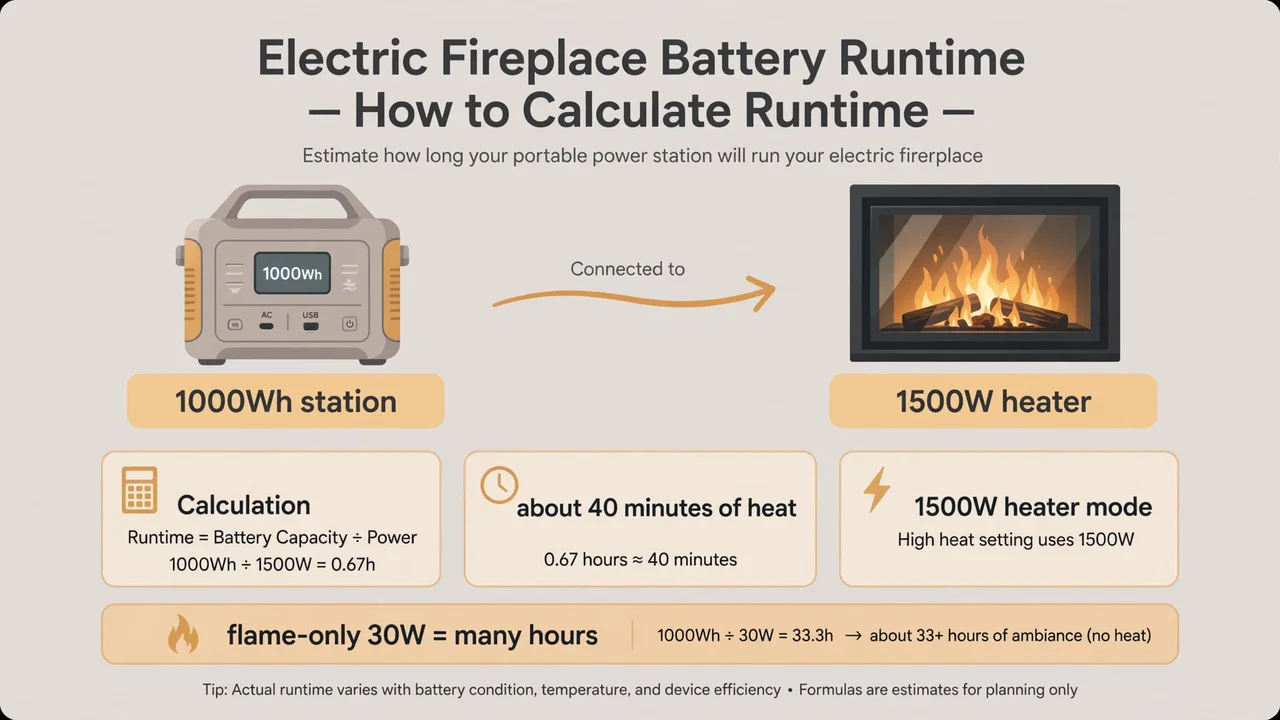
You can work out runtime with one formula. Divide the power station capacity in watt-hours by the fireplace draw in watts, then multiply by 0.85 to allow for inverter loss. The result is a fair estimate of run time in hours.
Runtime in hours = station watt-hours ÷ fireplace watts × 0.85
Worked example: a 1,000Wh station feeding a 1,500-watt heater. Divide 1,000 by 1,500 to get 0.67 hours, then multiply by 0.85. The answer is about 0.57 hours, or roughly 34 minutes. The same station feeding flame-only mode at 30 watts gives 1,000 ÷ 30 × 0.85, which is about 28 hours.
Runtime table: three station sizes, three modes
The table below uses the same formula for three common station sizes. All times are estimates. Real run time shifts with battery age, room temperature, and the exact watt draw of your model.
| Power station size | High heat (1,500W) | Low heat (750W) | Flame only (30W) |
|---|---|---|---|
| 500Wh | About 17 minutes | About 34 minutes | About 14 hours |
| 1,000Wh | About 34 minutes | About 68 minutes | About 28 hours |
| 2,000Wh | About 68 minutes | About 2 hours 16 minutes | About 57 hours |
The pattern is clear. Even a large station gives you little more than an hour of full heat. Flame-only mode is a different story. That is why most owners who buy backup power use it for light and mood, not for heating the room.
Read the label on your fireplace before you buy backup power
Find the rating label on the back or side of your unit. It lists watts, volts, and amps. A model rated at 1,440 watts draws a bit less than a 1,500-watt model, so your run time will run a bit longer. A 240-volt model may draw more, so check the label rather than guessing. Our guide to 240-volt electric fireplaces covers high-voltage models in more detail.
Also note the flame-only draw if your manual lists it. Some manuals give a separate figure for the flame effect with the heater off. That number is the one that matters for long flame-only run times.
Check for a Battery in Your Model
Five quick checks tell you what your fireplace already has. Set aside ten minutes and keep the manual nearby.
Step 1: Read the manual section on power and batteries
Search the manual for the words “battery,” “backup,” and “power failure.” The manual states plainly whether the unit holds settings through an outage. It also lists the remote battery type and the heater wattage. If you lost the paper manual, the maker website usually hosts a PDF under your model number.
Step 2: Open the remote battery cover
Slide the cover off the back of the remote and note the battery size. Most remotes take AA or AAA cells. Replace weak cells now, while the power is on, so the remote works when you need it. Keep a spare set in the drawer beside the fireplace.
Step 3: Look for a coin-cell slot on the control panel
Some wall-mounted and insert models hide a small coin-cell battery behind the control panel or near the power cord inlet. Your manual shows its spot if one exists. That cell keeps the clock and timer alive. It does not run the flame or the heat.
Step 4: Test what stays alive when you unplug the unit
Set a timer, then unplug the fireplace for one minute and plug it back in. Did the clock keep time? Did the timer setting survive? If both reset, your model has no memory battery at all. Write down what you found, so you are not surprised during a real outage.
Pro tip: photo the rating label
Take a phone photo of the rating label and the model number plate. Save it in a note with the heater watts and the remote battery size. That photo saves a trip behind the unit when you shop for a power station later.
Step 5: Write down your heater wattage and flame-only wattage
Copy both numbers onto a card taped inside a nearby cabinet. When you shop for backup power, those two numbers decide everything. A station must beat the heater watts on its continuous output rating, not only on its peak rating.
Pick Backup Power That Fits Your Fireplace
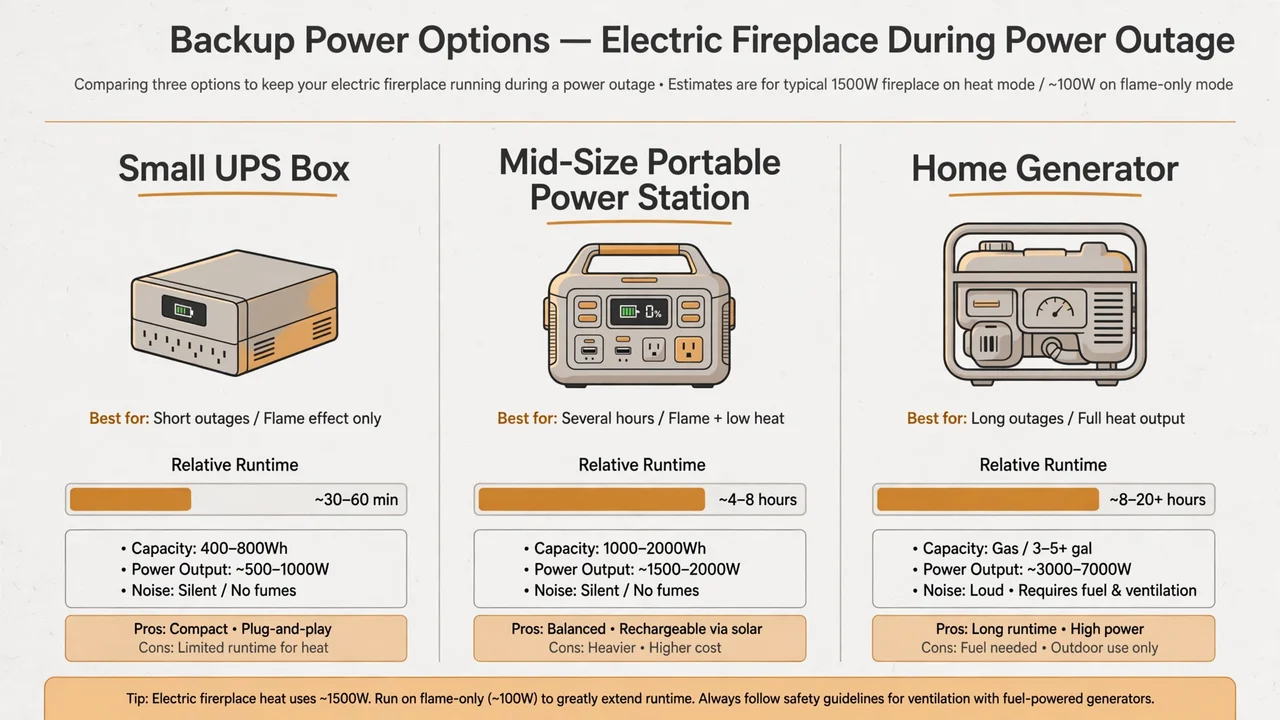
Four options cover most homes. Each one suits a different goal, and each one carries a different cost. Prices below are rough estimates for 2026, based on common retail ranges, and they vary by brand and capacity.
| Backup option | What it can run | Heat run time (1,500W) | Cost estimate (2026) |
|---|---|---|---|
| Computer UPS | Flame only, for minutes | Minutes, or overload shutdown | $100 to $300 |
| Portable power station | Flame only for hours, heat for under an hour | About 30 to 70 minutes | $500 to $1,500 |
| Portable generator | Heat and flame, while fuel lasts | Hours, with fuel on hand | $500 to $1,500+ |
| Whole-home battery | Whole circuits, including heat | Hours, based on capacity | $8,000+ |
Why a computer UPS is a poor fit for a heater
A UPS is built to keep a computer alive for a few minutes during a short outage. Most home UPS units are rated at 600 to 1,500 VA, and their batteries hold only a few hundred watt-hours. Plug a 1,500-watt heater into one and it will overload, beep, and shut down, or drain in minutes.
A UPS can still serve one narrow role. It can keep the flame effect glowing for a short while if the draw stays low. Even then, check the UPS watt rating first. If the flame draw is 30 watts and the UPS is rated for 300 watts or more, it will cope. Never assume it will cope without checking.
Match the power station to the heater
Read the continuous output watts on the power station, not the peak watts. A station rated for 1,800 continuous watts can feed a 1,500-watt heater. A station rated for 1,000 continuous watts cannot, even if its peak rating reads higher. Look for a pure sine wave inverter, which suits motor and heater loads better than a modified sine wave unit.
Also check the station outlets. The fireplace plug must fit a standard AC outlet on the station. Keep the station close to the fireplace and keep its vents clear, so it can shed heat while it works. For circuit and wiring questions, see our guide to electric fireplace breaker requirements and the electric fireplace code requirements.
Heads up: three hard rules
Never plug a heater into a power strip or a light-duty extension cord. Never run a portable generator indoors, in a garage, or near an open window, because exhaust fumes can kill. Never plug a power station into a wall outlet and the fireplace into the same station in a loop. If any of these steps feels unclear, call a licensed electrician before you try it.
What a generator changes
A generator is the only portable option that can heat a room for hours. It burns fuel to make power, so run time depends on the fuel tank and the load. A generator also needs fresh air and a safe spot outside, far from windows and doors. It is loud, it needs fuel storage, and it needs regular upkeep.
For many owners, the honest answer is to heat with something else during an outage and use the power station for light and the flame glow. That plan costs less and carries fewer risks than running a heater off a generator all night.
What to Do When the Power Goes Out
An outage is stressful, and a dark fireplace adds to it. A short plan keeps you calm and keeps the unit safe when power returns.
Step 1: Switch the fireplace off
Turn the fireplace off at its own controls before you do anything else. A heater that restarts on its own when power returns can surprise you. Switching it off also protects the control board from a surge when the grid comes back.
Step 2: Unplug the fireplace from the wall
Pull the plug from the outlet. Power can return in a surge, and a direct plug-in leaves the unit exposed to it. Leave the plug out until the lights in the rest of the house stay steady for several minutes.
Step 3: Set up light and warmth from other sources
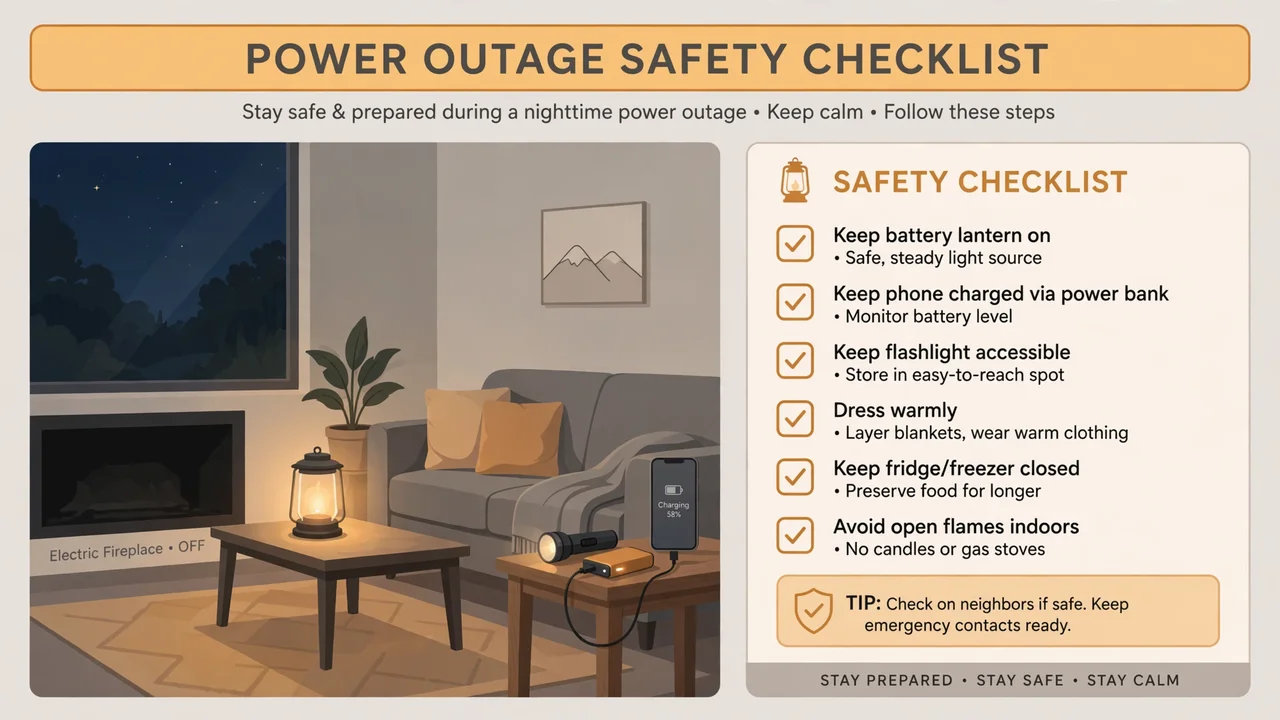
Put a battery lantern in the room and layer on warm clothes and blankets. If you have a portable power station, use it to charge phones and run a lamp first. Heat from the station is a luxury. Light and phone charging come first. If the fireplace will not turn on after power returns, our guide to why an electric fireplace is not turning on walks through the checks.
Step 4: Run flame-only mode from the power station, if you want the glow
Plug the fireplace into the station only after the station is on and stable. Switch the heater off and turn on the flame effect alone. Watch the station display for the first minute. If the draw stays near the flame-only figure from your manual, you can leave it running. If the draw jumps higher, switch it off and check your settings.
Step 5: Plug back into the wall when power is steady
Wait until the house power holds steady for several minutes. Unplug from the station, plug back into the wall outlet, and switch the fireplace on. Check that heat and flame both respond. If anything smells hot or the unit trips the breaker, switch it off and call a licensed electrician.
Common Mistakes to Avoid
Four mistakes owners make with fireplace backup power
1. Buying a station by watt-hours alone. Capacity tells you how long it runs. Continuous output watts tell you whether it can run the heater at all. Check both numbers.
2. Trusting a computer UPS with a heater. A UPS is built for computers and routers. A 1,500-watt heater will overload most home UPS units in seconds.
3. Running the heater on an extension cord. Long, thin cords heat up under a heavy load. Plug the fireplace into a wall outlet, or into a station outlet rated for the load, and nothing in between.
4. Expecting heat all night from a battery. Even a large station gives about an hour of full heat. Plan for flame-only mode and blankets, and save the battery for light and phones.
One more habit pays off. Test your backup setup once, on a calm evening, before you need it. Plug the fireplace into the station, run flame-only mode for ten minutes, and watch the draw. A short test beats a cold surprise in a storm.
What Does a Battery Backup Cost?
Cost depends on what you want the battery to do. A small UPS for flame-only mode costs about $100 to $300 as an estimate for 2026. A mid-size portable power station in the 1,000Wh range costs about $500 to $1,000 as an estimate for 2026, while larger 2,000Wh units run about $1,000 to $1,500 or more. A portable generator sits in a similar range, plus fuel and upkeep.
A whole-home battery is a different scale of spending, often $8,000 or more installed as an estimate for 2026. It backs up whole circuits, not one fireplace. If you are weighing that spend, compare it with the running cost of the fireplace itself first. Our guide to how much an electric fireplace costs puts purchase and running costs side by side.
Before you spend, ask what an outage really costs you. If you want the glow and a charged phone, a mid-size station covers it. If you want real heat through a long outage, a generator or a gas heat source is the honest match. No battery in the common price range heats a room all night.
Frequently Asked Questions
Do electric fireplaces work during a power outage?
No, not on their own. A standard electric fireplace needs house power for both heat and flame. It will work during an outage only if you plug it into a backup source that can cover its watt draw, such as a portable power station or a generator.
Can I plug my electric fireplace into a UPS?
Only for flame-only mode, and only if the UPS watt rating covers the draw. Most home UPS units cannot handle a 1,500-watt heater and will overload or shut down. Check the UPS rating first, and never plug a heater into a UPS that is not rated for the load.
How long will a 1,000Wh power station run an electric fireplace?
About 34 minutes on high heat at 1,500 watts, about 68 minutes on low heat at 750 watts, and about 28 hours in flame-only mode at 30 watts. Those figures allow about 15 percent for inverter loss, so real times vary a little by model.
Can a power station run the flame effect only?
Yes. The flame effect draws only 20 to 60 watts on most models, so a 1,000Wh station can keep it glowing for about a day or more. Switch the heater off first, then check the station display to confirm the low draw.
Do I need an electrician to add battery backup?
Not for a plug-in power station, which needs no wiring work. You do need a licensed electrician for any hardwired battery, a transfer switch, or a new dedicated circuit. If you are unsure which kind your plan needs, ask an electrician before you buy.
Will a power station damage my electric fireplace?
It should not, if the station output is a pure sine wave and its continuous watt rating covers the fireplace draw. A station that is too small can shut down under load or deliver unstable power. Match the ratings and follow both manuals.
Quick reference card
You need: manual, rating-label photo, flashlight, remote batteries, power station if you want flame-only mode.
Remember: most models have no built-in battery backup. Heat needs 750 to 1,500 watts. Flame only needs 20 to 60 watts.
Math: hours = station watt-hours ÷ fireplace watts × 0.85.
Outage plan: switch off, unplug, light the room, run flame-only mode from the station if you want the glow.
Safety: no power strips, no extension cords for heaters, no generator indoors, electrician for hardwired work.
Conclusion
Do electric fireplaces have battery backup? As a rule, no. The small battery in some models keeps settings alive, but it never runs the heater or the flame. Real backup comes from a separate source, and the math decides what that source can do.
A portable power station is the best fit for most owners. It keeps the flame glowing for a day or more and gives you a short burst of heat if you need it. Size it from the watts on your label, test it once on a calm evening, and keep the safety rules in mind. For more on safe use, read our electric fireplace safety tips before your next outage.