Firewood Sizes Explained: What Length Should You Buy for Your Firebox?
You ordered a load of firewood, and half the pieces stick out past the stove door. Or the pieces slide around in a firebox that is twice as deep as they are long, and the fire burns down before it gives off much heat. Firewood sizes explained in plain terms can stop both problems before you spend a cent. This guide shows you how to measure your firebox, pick the length that fits, and order with confidence.
By the end, you will know your target length in inches, what to ask your supplier, and how to cut down any pieces that arrive too long. The whole measuring job takes about 20 minutes, and it works for open fireplaces, wood stoves, fire pits, and outdoor fireplaces alike. You will also see a length chart that matches each standard cut to the firebox it fits, plus a way to test a delivery before you pay for it.
Safety note: cutting and burning firewood carry real risks. Wear eye and ear protection, gloves, and sturdy boots when you cut wood, and follow the manual that came with your saw. Never burn treated, painted, or stained wood, plywood, or household trash, because the fumes are toxic. Check local burn rules and burn bans before you light a fire, and keep working smoke and carbon monoxide alarms in your home.
What You Need
- Tape measure
- Pencil and paper
- Work gloves
- Chalk or marker
- Sawbuck or sturdy sawhorse
- Chainsaw or bow saw (only if cutting)
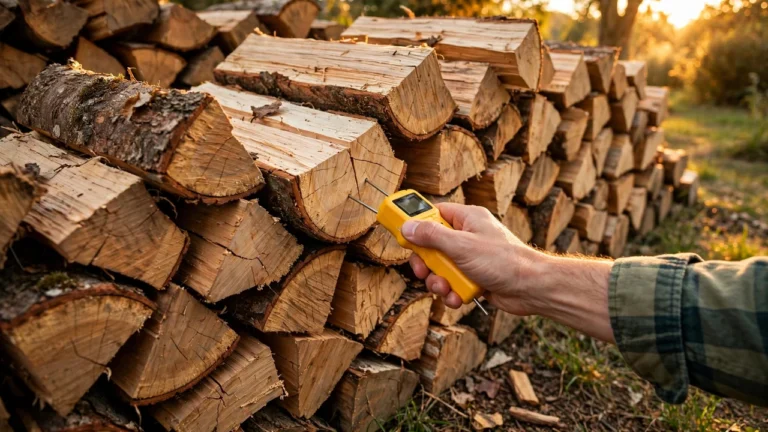
- Moisture meter (optional, for checking dryness)
- Stacking rack or dry storage spot
At a Glance
- Measure the depth of your firebox.
- Subtract 3 inches from that measurement.
- Compare standard lengths with your appliance.
- Pick one length for the whole order.
- Test a few pieces before you pay for a delivery.
- Cut long pieces down with a chainsaw or hand saw.
- Stack each length in its own row.
Firewood Sizes Explained: What Length Fits Your Firebox?
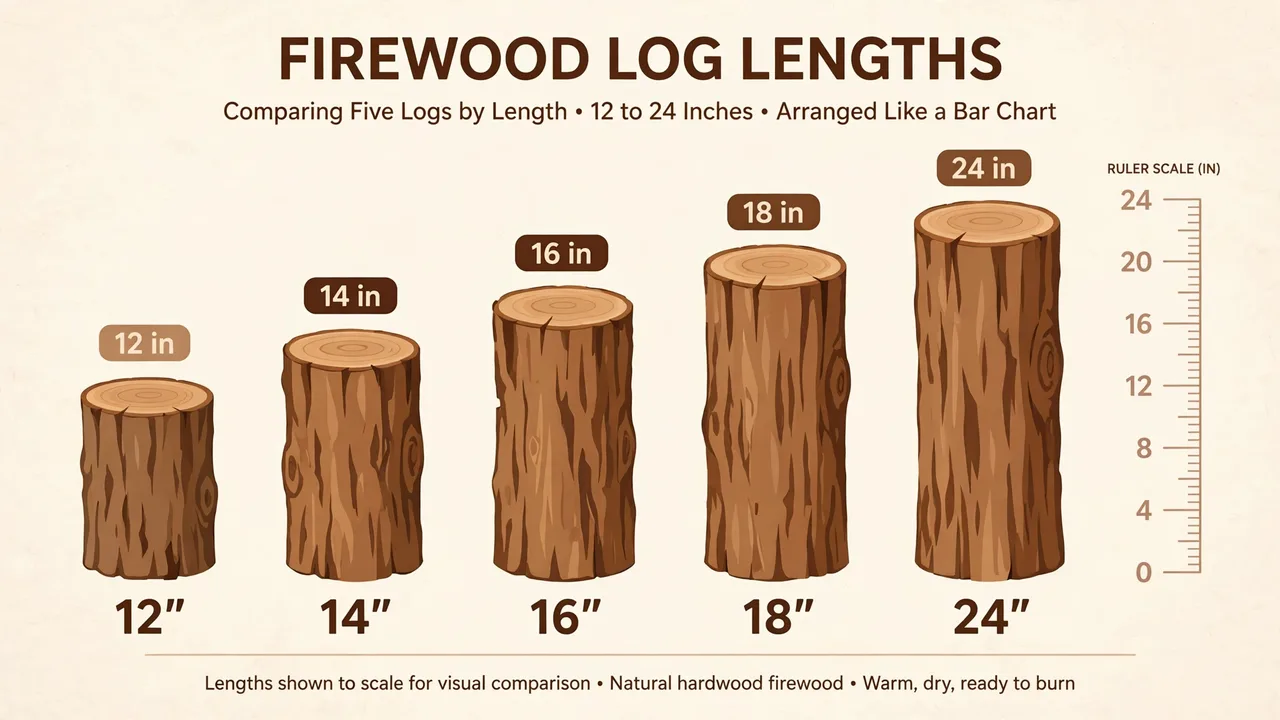
Suppliers cut firewood in a small set of standard lengths. The five you will see most often are 12 inches, 14 inches, 16 inches, 18 inches, and 24 inches. Of these, 16 inches is the most common cut sold by suppliers, because it fits the widest range of stoves and fireplaces.
The table below matches each standard length to the firebox depth it fits. The fit column uses the 3 inch clearance rule from Step 2, so a piece needs a firebox at least 3 inches deeper than the piece itself. Use it to narrow your choice before you read the steps.
| Piece length | Fits fireboxes | Best for | Notes |
|---|---|---|---|
| 12 inches | 15 inches and deeper | Small stoves, fire pits, chimineas | Shortest common cut |
| 14 inches | 17 inches and deeper | Compact wood stoves | Good middle ground for small stoves |
| 16 inches | 19 inches and deeper | Most wood stoves and fireplaces | Most common cut sold by suppliers |
| 18 inches | 21 inches and deeper | Larger fireplaces and stoves | Check door width too |
| 24 inches | 27 inches and deeper | Large open fireplaces | Too long for most stoves |
Firebox fit is worked out from the 3 inch clearance rule in Step 2. Lengths shown are standard cuts offered by most suppliers.
One warning before you order: length is only half the question. The wood also needs to be dry. Learn what seasoned firewood is and how to tell if firewood is seasoned before you pay, because wet wood of the perfect length still smokes, hisses, and coats your chimney with creosote.
Measure the Depth of Your Firebox
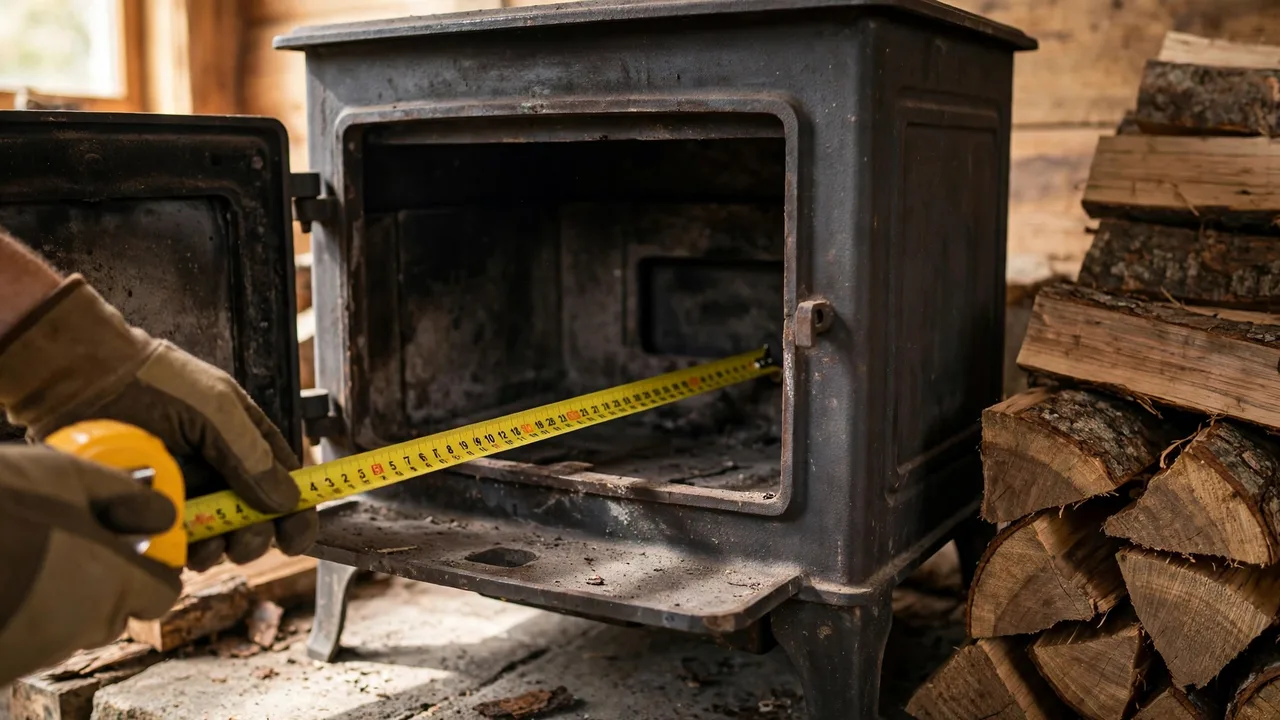
Open the stove or fireplace door and run a tape measure from the back wall of the firebox to the inside edge of the front opening. Write the number down in inches, and measure twice so a slip of the tape does not send you home with the wrong length.
A firebox that measures 21 inches deep takes a very different load than one that measures 15 inches deep. If you heat with more than one appliance, measure each one and write each number on its own line. The smallest firebox sets the limit for any load you plan to share between them.
Subtract 3 Inches From That Measurement
Take your firebox depth and subtract 3 inches. That gap leaves room for air to move around the ends of the pieces, lets the door close without pressing on the wood, and keeps hot ends away from the glass or the front frame.
A 21 inch firebox gives you a target of 18 inches. A 19 inch firebox gives you 16 inches. A 15 inch firebox gives you 12 inches. Circle your target number, because every later step works from it.
Compare Standard Lengths With Your Appliance
Suppliers cut firewood in a small set of standard lengths, so your target will land near one of them. A 12 inch piece suits small stoves and fire pits. A 14 inch piece suits compact stoves.
A 16 inch piece is the most common cut and fits most stoves and fireplaces. An 18 inch piece suits larger fireplaces, and a 24 inch piece suits big open fireplaces with deep fireboxes.
Pick the standard length at or below your target number, never above it. If your target is 17 inches, order 16 inch wood rather than 18 inch wood, because a piece that is one inch too long is a piece you have to cut.
Pro Tip: Cut a scrap stick to your target length and keep it by the woodpile. Hold any new piece against the stick, and you can check a whole load in minutes without pulling out the tape measure each time.
Pick One Length for the Whole Order
Tell your supplier one length and ask for every piece cut to it. Mixed lengths stack badly, and short pieces buried under long ones are hard to reach when you need them. One length also lets you check the load fast, because every piece should match the same mark on your tape.
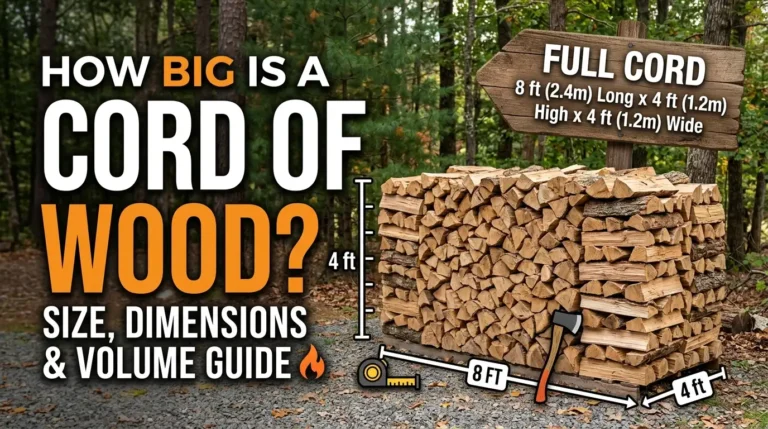
If you buy by the face cord, remember the row is 8 feet long and 4 feet high, and its depth equals your piece length. Read our guide to what a face cord of wood is before you agree on a price, so you know exactly how much wood your money buys at your chosen length.
Test a Few Pieces Before You Pay for a Delivery
When the truck arrives, pull three or four pieces from different parts of the pile and lay them in the firebox before you pay. The door should close with room to spare, and the pieces should sit flat without tipping toward the glass.
If more than a few pieces run long, ask the supplier to swap them or cut them down before the wood comes off the truck. Check that the load is dry as well as the right length, and if you are unsure where to start, see where to buy firewood for what to ask a new supplier.
Cut Long Pieces Down With a Chainsaw or Hand Saw
Mark the cut line with chalk or a pencil, then set the piece on a sawbuck so it cannot roll. A chainsaw makes fast work of a full pile, while a bow saw handles a few pieces without fuel or noise. Cut at your target length, and measure the first few cut pieces against your scrap stick to confirm the saw is hitting the mark.
Heads Up: A chainsaw can cause serious injury in seconds. Wear eye and ear protection, gloves, chaps, and sturdy boots, and read the manual that came with your saw before you start it. Never cut alone, and keep children and pets well clear of the work area. If you have never run a chainsaw, hire the cutting out or ask an experienced neighbor to show you first.
Pieces that are only an inch or two too long can also be split shorter with a maul on a chopping block, but cutting gives a cleaner end and a tighter stack. Sweep up the sawdust and bark chips when you finish, because they make a slippery floor and a fire risk near the stove.
Stack Each Length in Its Own Row
Give each length its own row or bay on the rack, with the cut ends facing out so you can see what you have at a glance. Bark side up on the top row sheds rain. Leave a gap of a few inches between the stack and the house wall so air can move and pests stay out.
Good stacking matters as much as good sizing, so follow our guide on how to stack firewood to keep the pile stable and drying. If your wood still needs drying time, read how to season firewood and give it the months it needs before burning.
| If This Happens | Try This |
|---|---|
| Pieces are too long for the stove | Cut them down to your target length on a sawbuck, and check the first few against your scrap stick. |
| Lengths vary across the load | Sort pieces into short and long piles, and burn the longest pieces in your deepest firebox first. |
| Short pieces burn down fast | Pack short pieces close together so they share heat, and add two or three at a time instead of one. |
| Pieces do not fit through the door | Measure the door opening as well as the firebox depth, and order to the smaller of the two numbers minus 3 inches. |
Frequently Asked Questions
What is the most common firewood length?
16 inches is the most common firewood length sold by suppliers. It fits most wood stoves and fireplaces with a firebox depth of 19 inches or more, which covers a large share of homes.
What length firewood fits a standard fireplace?
Most standard fireplaces take 18 to 24 inch pieces, because their fireboxes are usually 21 inches deep or more. Measure your own firebox and subtract 3 inches rather than trusting a standard size, because older and smaller fireplaces vary a lot.
Can firewood be too long for a wood stove?
Yes. Pieces longer than the firebox stop the door from closing, press hot wood against the glass, and block airflow. If a piece is too long, cut it down to your target length before you burn it.
How short can firewood be?
12 inches is the shortest length most suppliers cut as standard. Shorter pieces are fine for small stoves and fire pits, but they burn down faster and need more frequent reloading.
Should all pieces in one load be the same length?
Yes, one length per load is best. Pieces of one length stack tighter, are easier to count and check, and fit the firebox the same way every time you load it.
Does firewood length change how much a cord costs?
Length changes the volume of a face cord, because a face cord is one row 4 feet high and 8 feet long with a depth equal to the piece length. A full cord is always 128 cubic feet no matter the piece length, so compare prices on a full cord basis when you can.
Quick Reference Card
You need: tape measure, pencil and paper, work gloves, chalk, sawbuck, saw for cutting.
- Measure firebox depth.
- Subtract 3 inches.
- Match a standard length: 12, 14, 16, 18, or 24 inches.
- Order one length for the whole load.
- Test pieces in the firebox before paying.
- Cut long pieces down with a saw.
- Stack each length in its own row.
Remember: 16 inches is the most common cut, and a full cord is always 128 cubic feet.
Conclusion
Firewood sizes explained in one line: measure your firebox, subtract 3 inches, and buy the standard length that fits. You now have a number to give your supplier and a way to check the load when it arrives.
Stack it by length, keep it dry, and your next fire will light without a fight. Your next step is to stack the load so it stays dry, and our guide on how to stack firewood shows you how.