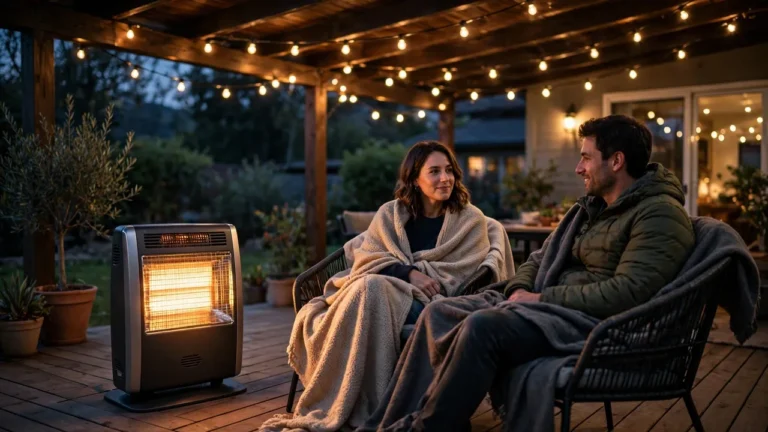
Tabletop Patio Heaters: Are They Worth It?
Tabletop patio heaters promise warm hands and warm faces at one small table, with no tall tower to store and no gas line to run. But do they put out enough heat to matter, or do they burn through fuel canisters while you still feel cold? This guide gives you the numbers, the costs, and the limits, so you can decide before you spend money on one.
We look only at tabletop models here. A full-size standing heater is a different tool for a different space, and it warms a whole seating area rather than one table. If you want the big picture first, our general patio heater guide puts standing towers, fire pits, and tabletop models side by side.
Heads Up: Read This Before You Light One
Propane tabletop heaters burn fuel and make carbon monoxide (CO), a gas you cannot see or smell. Never use one indoors, in a garage, in a tent, or in any closed or unvented space. Use it only outdoors in open air.
Keep a working CO alarm in your home, and know the early signs of CO poisoning: headache, dizziness, nausea, and confusion. If anyone feels ill near a heater, move to fresh air at once and call emergency services.
Keep the heater away from cushions, paper, and dry leaves. Never leave a lit heater alone on a table, and never let children or pets play near it. Check your local rules and HOA rules before you buy, and call a licensed gas professional if anything about the fuel hookup feels unclear.
Time to decide
15 minutes
Setup time
10 to 20 minutes
Skill level
Beginner
Best for
2 to 4 people
What You Need
- A tape measure, to check your table and the heater base
- A flat, stable outdoor table that can hold the heater weight plus a safety margin
- Fuel: 1-pound propane canisters, or an adapter hose plus a 20-pound tank
- A lighter or matches, if your model has no push-button igniter
- A heat-safe mat or tile under the heater, if your table top needs it
- A wind screen made for patio heaters (optional, and never blocking vents)
- A cover for storage, and a dry place to keep the heater out of season
At a Glance: Tabletop Patio Heaters
Heat output
9,500 to 11,000 BTU
Warm area
About 30 sq ft
Run time
About 2 hours per 1-lb canister
Typical price
$90 to $150 (2026)
Use
Outdoors only for propane
Bottom line
Great for one table, poor for a whole patio
What Is a Tabletop Patio Heater?
A tabletop patio heater is a small heater that sits in the middle of an outdoor table. Most models burn propane from a 1-pound canister tucked into the base. A smaller group plugs into a standard wall outlet and heats with an electric element instead.
These heaters stand about 25 to 39 inches tall and weigh about 8 to 14 pounds. That size makes them light enough to carry with one hand and small enough to store on a shelf. It also sets a hard limit on how much heat they can make.
Heat rises from a burner near the top and spreads out in a small circle. Maker listings for the most common models claim about 30 square feet of warm space. Picture a circle about 3 feet out from the heater in each direction. That covers the people sitting at the table and not much more.
How Much Heat Do You Really Get?
Heat output for patio heaters is rated in BTU per hour. BTU stands for British Thermal Unit, and a higher number means more heat. Most tabletop propane models list 10,000 or 11,000 BTU per hour, with a few flame-tube models at 9,500 BTU per hour. Those are maker ratings, so check the label on the exact model you buy.
For a sense of scale, a full-size standing propane patio heater lists 40,000 to 50,000 BTU per hour, or about four times as much. That is why a standing heater can warm a seating area while a tabletop heater warms one table.
The gap matters most on cool nights. At 50 degrees Fahrenheit with no wind, a tabletop heater can keep hands and faces warm at a bistro table. At 40 degrees with a breeze, the same heater may feel weak, and people at the far side of a six-foot table may feel little heat at all.
Heat Reach: Tabletop vs Standing Heater
Tabletop heater, 11,000 BTU: warm circle about 6 feet across (30 sq ft)
Standing heater, 40,000 to 48,000 BTU: warm circle about 15 to 20 feet across (150 to 200 sq ft)
Area figures come from maker listings and patio heater guides. Wind, cold air, and open sides shrink the warm circle for both types.
Radiant heat is the key idea here. A tabletop heater warms people and objects in its line of sight, much like a campfire warms the side of you that faces it. It does not heat the air around the patio. Turn your back to it and you will feel the cold side at once.
That is not a flaw. It is the trade that comes with the small size. If your goal is warm conversation for two to four people at one table, the trade works. If your goal is a warm patio for eight guests, it does not.
Propane or Electric: Which Tabletop Heater Fits Your Space?
Propane models give you more heat and no cord. Electric models give you clean heat with no fuel to buy and no flame to watch. The right pick depends on your table, your outlet, and how often you plan to use it.
Propane Tabletop Heaters
Propane is the most common choice. A 1-pound canister screws into the base, and a push-button igniter lights the burner. Most models list 10,000 to 11,000 BTU per hour and run about 2 hours on one canister at high heat, or about 2.5 hours on low, based on maker specs.
Propane heaters work anywhere outdoors, with no outlet in reach. The cost is fuel: canisters run out fast, and you need spares on hand. They also make carbon monoxide, so they belong outdoors only, in open air.
Electric Tabletop Heaters
Electric tabletop heaters plug into a standard 120-volt outlet. Most top out at 1,500 watts, which equals about 5,100 BTU per hour. That is roughly half the heat of a propane tabletop model, so the warm circle is smaller.
The payoff is ease of use. There is no flame, no fuel to buy, and no carbon monoxide. You can use one in a covered spot if the maker allows it, and you never run out of heat mid-meal. The cord is the weak point: it can trip guests, and you need an outdoor-rated outlet with ground-fault protection (GFCI) close to the table.
| Feature | Propane tabletop | Electric tabletop |
|---|---|---|
| Heat output | 9,500 to 11,000 BTU per hour | About 5,100 BTU per hour (1,500 watts) |
| Fuel | 1-lb canister, or 20-lb tank with adapter hose | Wall outlet, 120 volts |
| Run time | About 2 hours per canister on high | As long as it stays plugged in |
| Carbon monoxide | Yes, outdoors only | None |
| Running cost | About $1.60 per hour on canisters (2026 estimate) | About $0.20 to $0.25 per hour at typical US power rates (2026 estimate) |
| Best for | Tables far from an outlet, camping, tailgates | Covered patios near an outlet, nightly use |
If you use a heater most nights, electric often wins on running cost and ease. If your table sits far from the house with no outlet nearby, propane is the practical pick. Either way, read the manual first and follow its clearance and use limits.
What One Evening Really Costs
The heater price is only the start. A tabletop propane heater can cost more to run in one month than the heater itself cost to buy, if you feed it 1-pound canisters. The math below shows why, with each step shown so you can check it.
One pound of propane holds about 21,600 BTU of energy. A heater rated at 11,000 BTU per hour burns through that in about 2 hours: 21,600 divided by 11,000 equals about 1.96 hours. Maker specs agree, listing about 2 hours on high and about 2.5 hours on low for a 1-pound canister.
For a 4-hour evening at high heat, you need 2 canisters. At $3.25 per canister, a 2026 estimate, that evening costs $6.50. Prices vary by store, and some stores charge more, so treat this as a worked example, not a quote. For full running-cost detail, see our guide to how much it costs to run a patio heater.
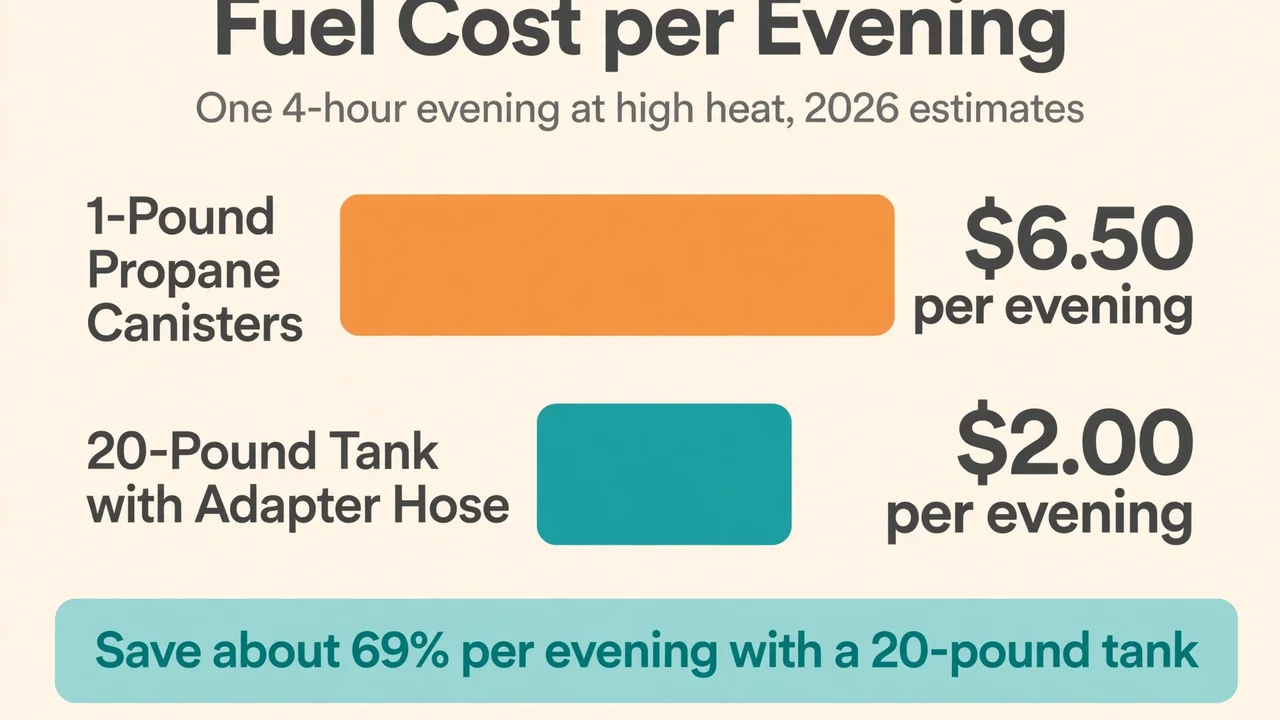
A 20-pound tank changes the math a lot. It holds about 432,000 BTU, which is 20 pounds times 21,600 BTU per pound. Divide that by 11,000 BTU per hour and you get about 39 hours of heat. A refill costs about $20 as a 2026 estimate, so one hour costs about $0.50, and a 4-hour evening costs about $2.00.
The saving is about 69 percent per evening: $6.50 minus $2.00 equals $4.50 saved, and $4.50 divided by $6.50 equals about 0.69. Over 12 evenings in a month, canisters cost about $78 while a 20-pound tank costs about $24. The adapter hose pays for itself fast if you use the heater often.
| Cost item | 1-lb canisters | 20-lb tank + adapter |
|---|---|---|
| Fuel per evening (4 hours, high heat) | 2 canisters | About 0.1 of a tank |
| Cost per evening | About $6.50 | About $2.00 |
| Cost per hour | About $1.60 | About $0.50 |
| Cost for 12 evenings | About $78 | About $24 |
| Refills or swaps | 24 canisters to buy and store | Less than one tank refill |
Worked example with stated inputs: 11,000 BTU per hour, 1 pound of propane equals 21,600 BTU, canister at $3.25 each, 20-pound refill at $20. All prices are 2026 estimates. Your store prices will differ.
Electric models cost far less to run. A 1,500-watt heater at a typical US power rate of about 13 to 17 cents per kilowatt-hour costs about $0.20 to $0.25 per hour. A 4-hour evening costs about $0.80 to $1.00. Check your own power bill for your exact rate.
Do not forget the heater price itself. Tabletop propane models often sell for $90 to $150 as a typical US retail range in 2026. Add an adapter hose, a cover, and a first batch of canisters, and the first month can reach $150 to $200 before you feel much heat.
1-Pound Canisters vs a 20-Pound Tank With an Adapter
Canisters are neat and light. You screw one into the base, and the heater is ready. They suit rare use, camping trips, and tables where a hose would get in the way. The cost is the catch: canister fuel costs about three times as much per hour as tank fuel.
A 20-pound tank with an adapter hose suits regular use. The tank sits on the ground next to the table, and the hose feeds the heater. You get about 39 hours per refill instead of 2 hours per canister, and you stop mid-meal swaps.
Buy only a hose and regulator made for your heater model, and follow the maker steps for hookup. Check every joint with soapy water before you light the heater. Bubbles mean a leak, so turn the gas off and fix the joint before you try again. Never force a fitting that does not match, and never use a hose with cracks or worn ends.
Store spare canisters in a cool, dry place away from heat, and never store propane in a hot car or near a furnace. Keep the tank upright, outdoors or in a ventilated spot the manual allows, and keep it away from sparks and open flame when it is not in use.
Wind Is the Weak Spot
Wind hits tabletop heaters twice. It blows radiant heat away from the people at the table, and it can push a light heater across a smooth table top. A gust that a standing heater would shrug off can tip a tabletop model.
Most tabletop models carry an anti-tilt switch that cuts the gas if the heater falls over. Test it when the heater is new: with the gas off, tilt the heater gently and listen for the click. If you hear no click, check the manual or ask the maker before you use it. Our guide on how to keep a patio heater from tipping over in wind covers anchors and wind screens in more detail.
A wind screen can help on a calm night, but it is not a fix for real wind. Place the screen on the windward side only, and never block the vents or the burner. If the flame leans hard or blows out more than once, turn the heater off and move the meal indoors. No heater is worth a fire risk.
Pick a sheltered spot when you can. A wall, a fence, or a hedge on the windward side cuts the breeze more than any screen. Avoid rooftops and open balconies on gusty days, where wind has nothing to slow it down.
Will It Sit Safe on Your Table?
Tabletop heaters need a table that is flat, level, and strong. A wobbly bistro table or a light plastic table can tip under the weight of a heater plus a bump from an elbow. Test the table first: press down on each corner and watch for rock. If it rocks, fix the table or pick another spot.
Check the heater base against your table size. A base about 13 inches across needs a table with room to spare on each side, so guests do not knock it while reaching for food. Many models also fit through a patio table umbrella hole, but measure the hole and the heater pole before you buy.
Heat under the base matters too. The base gets hot during use, and a thin plastic or glass top can warp or crack. A heat-safe mat, a ceramic tile, or a metal tray under the heater protects the table. On a wood deck, the same care applies: read our guide on putting a patio heater on a wood deck before you set one down.
Keep the heater away from the table edge, at least a hand span in from each side. Keep cords, napkins, and tablecloths clear of the burner, and seat children and pets where they cannot reach the hot glass or metal.
How to Choose and Set Up a Tabletop Patio Heater in 7 Steps
Follow these steps in order. They take about 20 minutes the first time, and about 5 minutes once you know the routine.
Step 1: Measure Your Table and Your Seating Circle
Measure the table top and the space around it. Note the table width, the umbrella hole size if you have one, and how far each chair sits from the center. A heater warms about 3 feet out in each direction, so seats beyond that range will stay cold. Seats more than 3 feet from the heater get little heat.
Step 2: Pick Propane or Electric for Your Space
Pick propane if your table sits far from an outlet or you want the most heat per dollar of heater. Pick electric if you have a GFCI outlet within reach and you plan to use the heater most nights. Electric tops out near 5,100 BTU per hour, about half of propane. Match the fuel to your patio, not to the prettiest model.
Step 3: Read the BTU Label Before You Pay
Read the label or the spec sheet for the exact model. Look for the BTU rating, the run time per canister, and the shutoff features: anti-tilt switch and thermocouple are the two to confirm. Most tabletop models list 10,000 to 11,000 BTU per hour. Skip any listing that hides the BTU number.
Step 4: Plan Your Fuel Before the First Evening
Count your evenings. One canister lasts about 2 hours on high, so a 4-hour evening needs 2 canisters. Buy spares before guests arrive, or buy an adapter hose and a 20-pound tank if you plan to use the heater each week. Two canisters per evening is the planning number for high heat.
Step 5: Set the Heater on a Flat, Heat-Safe Spot
Place the heater in the center of a flat, level table, on a heat-safe mat if your table top needs one. Keep at least 3 feet of clear space above and around the heater, or follow the larger clearance in your manual. Keep the base a hand span in from the table edge. Check that the table does not rock when you press on it.
Step 6: Light It, Test the Shutoff, and Watch the Flame
Connect the fuel, open the valve slowly, and light the burner per the manual. Watch the flame for a minute: it should burn steady and blue at the base with a warm glow above. Test the anti-tilt switch with the gas off before first use. If the flame sputters, blows out, or smells strongly of gas, turn it off and check the hookup.
Step 7: Cool It Down, Cover It, and Store It Dry
Turn the gas off and let the heater cool fully before you move it. Hot glass and metal can burn skin long after the flame goes out. Let it cool for at least 30 minutes before you cover it.
Store it dry under a cover, and check the hose, burner, and shutoff at the start of each season. For a sense of how long these heaters last with care, see how long patio heaters last.
Tabletop vs Standing Heater: Side by Side
The choice comes down to how many people you need to warm and how much space you have. This table puts the two types next to each other with real numbers.
| Feature | Tabletop heater | Standing heater |
|---|---|---|
| Heat output | 9,500 to 11,000 BTU per hour | 40,000 to 50,000 BTU per hour |
| Warm area | About 30 sq ft | About 150 to 200 sq ft |
| People warmed | 2 to 4 at one table | 6 to 8 in a seating area |
| Fuel | 1-lb canister, or 20-lb tank with hose | 20-lb tank in the base |
| Run time | About 2 hours per canister | About 8 to 10 hours per tank on high |
| Typical price | $90 to $150 (2026) | Often $150 to $400 (2026 estimate) |
| Storage | Fits on a shelf | Needs floor space and a cover |
| Wind risk | High, light and tall on a table | Lower, heavy base on the ground |
Standing heater figures come from maker listings and patio heater guides. Check the label on the exact model you buy.
A tabletop heater wins on price, size, and ease of storage. A standing heater wins on heat, range, and wind resistance. If you have a small balcony or a bistro set, the tabletop model is the right tool. If you host six people on a wide patio, buy the standing heater and skip the tabletop model.
Who Should Not Buy a Tabletop Patio Heater
These heaters are not for every patio. Be honest about your space before you buy, and you will avoid a heater that sits in a corner unused.
Skip one if you host large groups. Six or more people spread around a patio need a standing heater or a fire pit, not a small flame on one table. The people at the far chairs will stay cold, and the heater will run at full heat all night for little gain.
Skip one if your patio is wide open to wind. Rooftops, hilltops, and open balconies strip radiant heat away fast. A tabletop heater cannot fight a steady breeze, and gusts raise the tip risk.
Skip one if your table is light, wobbly, or glass-topped with no heat-safe mat. A heater needs a firm base, and a fall from table height can crack glass, spill hot parts, and start a fire.
Skip one if you have no safe place to store fuel. Propane canisters and tanks need cool, dry, ventilated storage away from heat. If you live in a small flat with no outdoor store, an electric model or a different heat source fits better.
Skip one if you want heat for a whole evening, every evening, on canisters alone. At about $6.50 per 4-hour evening, the fuel bill adds up fast. Either buy the adapter hose and a 20-pound tank, pick an electric model, or pick a standing heater with a tank in its base.
Common Mistakes That Waste Money and Heat
| Mistake | What goes wrong | Do this instead |
|---|---|---|
| Buying for a big patio | Guests beyond 3 feet feel no heat | Buy a standing heater for groups of 6 or more |
| One canister for the night | Heat dies mid-meal after about 2 hours | Bring 2 canisters per 4-hour evening, or a 20-lb tank |
| Skipping the leak test | A loose joint can leak gas unseen | Brush soapy water on each joint and watch for bubbles |
| Placing it on a wobbly table | A bump can tip a hot heater | Use a flat, level, heavy table and test for rock first |
| Using it under a low roof | Heat can scorch or catch coverings | Keep 3 feet clear above it, or follow your manual |
| Leaving it lit and walking away | Wind or a bump can turn a small flame into a fire | Stay with a lit heater and turn it off when you go in |
Frequently Asked Questions
How long does a tabletop patio heater run on one canister?
About 2 hours on high heat, or about 2.5 hours on low, based on maker specs for common 11,000 BTU models. One pound of propane holds about 21,600 BTU, so the math lines up: 21,600 divided by 11,000 equals about 2 hours. A 4-hour evening needs 2 canisters.
Can I use a tabletop patio heater on a wood deck?
Yes, if the table is stable and the heater sits on a heat-safe mat. Keep 3 feet of clear space around it and above it, or follow the larger clearance in your manual. Never place the heater straight on a wood deck, and never leave it lit alone. Our guide to patio heaters on wood decks has the full checklist.
Can I use one under a covered patio or umbrella?
Only if your manual allows it and you keep the full clearance above the heater. Most manuals ask for about 3 feet of clear space above the burner. Never use a propane tabletop heater indoors, in a garage, or in a tent, even with the door open. Carbon monoxide builds up fast in closed spaces.
Are electric tabletop patio heaters better than propane?
It depends on your patio. Electric models cost less to run, make no carbon monoxide, and never run out of fuel mid-meal. Propane models give about twice the heat and work anywhere, with no cord. Pick electric for nightly use near an outlet, and propane for tables far from the house.
Can I hook a tabletop heater to a 20-pound tank?
Yes, with an adapter hose and regulator made for your model. The tank sits on the ground, and the hose feeds the heater. One refill gives about 39 hours of heat at 11,000 BTU per hour, and a 4-hour evening costs about $2.00 instead of about $6.50 on canisters, based on 2026 estimates. Test each joint with soapy water before you light it, and read our guide on converting a propane patio heater to natural gas before you think about changing fuel types.
Do tabletop patio heaters work in wind?
Poorly. Wind blows radiant heat away from the table and can tip a light heater. A wind screen on the windward side helps a little on calm nights, but it cannot fix a gusty evening, so turn the heater off and move indoors if the flame leans hard or blows out.
Quick Reference Card
- Heat: 9,500 to 11,000 BTU per hour, about 30 sq ft of warm space
- Seats: 2 to 4 people at one table, within 3 feet of the heater
- Fuel: 1-lb canister lasts about 2 hours on high, and a 20-lb tank lasts about 39 hours
- Cost per 4-hour evening: about $6.50 on canisters, about $2.00 on a 20-lb tank, about $1.00 on electric (2026 estimates)
- Price to buy: $90 to $150 for the heater (2026 typical retail)
- Clearance: about 3 feet on all sides and above, or your manual number if larger
- Safety: outdoors only for propane, never leave lit alone, test the anti-tilt switch first
- Wind: shelter the table or skip the heater on gusty nights
- Storage: cool fully, cover, store dry, check hose and burner each season
Tabletop patio heaters are worth it for one clear case: two to four people, one small table, calm nights, and a heater you will use often enough to feed with a 20-pound tank or a wall outlet. They are small, light, and kind on storage space.
They are not worth it as a whole-patio heater, a windy-night heater, or a canister-only heater used every night. The heat bubble is small, the fuel runs out fast, and the cost per evening adds up.
Measure your table, pick your fuel, and run the numbers for your own evenings. If the math fits your patio, a tabletop heater can stretch your outdoor season by weeks. If it does not fit, a standing heater will serve you better, and your money will stay where the heat is.
Sources we checked: Outside Modern, Best Tabletop Patio Heaters (updated November 2026). Cuisinart tabletop patio heater maker listing, 11,000 BTU and 2-hour burn time. Dwellify, Patio Heater Propane guide (November 2026). Hanover mini umbrella tabletop heater spec sheet.
Prices in this guide are 2026 estimates, and BTU and run time figures are maker ratings, so check the label on the exact model you buy.