Can You Put a Patio Heater on a Wood Deck? What Is Safe and What Is Not
A wood deck and a patio heater can work together, but only when you set the heater up the right way. Can you put a patio heater on a wood deck? Yes, in most cases you can, as long as the heater stands on a stable base, keeps its distance from rails and furniture, and never runs without someone watching it. The deck itself is the part that needs care. Wood can scorch, dry out, and catch fire when heat builds up under a heater or beside an open flame.
This guide walks you through the whole setup in order. You will learn which heater types are safest on wood, how much clear space to leave, what a heat shield or mat does, and what to do if the boards under your heater feel hot or look scorched. You will also see the mistakes that cause most deck heater problems, so you can skip them. Plan on about 45 minutes for the full setup and first heat check, and keep this page open while you work through it.
Safety First: Read This Before You Light Anything
A patio heater is an open heat source sitting on a flammable surface. Never leave a lit heater alone on a wood deck. Keep children and pets away from the hot parts. Never use a fuel-burning patio heater indoors, in a garage, or under a low roof with poor airflow, because carbon monoxide can build up and cause serious harm.
Always follow the manual that came with your heater. Check your local fire code and any rules from your homeowner association before you set up. If you smell gas, turn the heater off, move away from the area, and call your gas company or emergency services from outside. This article gives general guidance only. It does not replace your heater manual or local rules.
Total Time
About 45 minutes
Active Time
About 30 minutes
Difficulty
Beginner friendly
What You Need
- Your patio heater and its manual
- A tape measure
- A heat-resistant mat or heat shield rated for patio heater use
- A level surface check, such as a small spirit level or a phone level app
- A fire extinguisher rated for outdoor use, kept within reach
- A bucket of sand or a garden hose nearby for emergencies
- Heat-proof gloves for handling hot parts
- A propane tank or a weatherproof outdoor power outlet, depending on your heater type
- Chalk or painter tape to mark the clear zone on the deck
At a Glance: The 7 Steps
- Read the manual and check local fire rules
- Pick the heater type that fits a wood deck
- Measure your deck and mark the clear zone
- Set a heat shield or mat under the heater
- Place the heater on flat, stable boards
- Connect fuel or power the safe way
- Run a first heat check and watch the deck
The Short Answer: Yes, With the Right Setup
Yes, you can put a patio heater on a wood deck. Most patio heaters are made for outdoor use, and a wood deck counts as an outdoor surface. The risk is not the deck itself. The risk is heat trapped under the base, flames too close to rails or furniture, and a heater that tips over onto dry boards.
Electric heaters are the lowest-risk choice on wood because they have no open flame and no fuel tank. Propane tower heaters are the most common choice, and they work well on decks when you give them space and a heat shield. Natural gas heaters need a fixed gas line, so they suit decks only when a licensed plumber has run the line. The rest of this guide shows you how to pick, place, and test your heater so the deck stays safe.
Read the Manual and Check Local Fire Rules
Your heater manual is the first thing to read, before you move the heater onto the deck. The manual lists the clearance distances for your exact model, and those numbers beat any general advice in this article. Look for the section on clearances, surface types, and wind limits. Some manuals state that the heater must not sit on a combustible surface at all. If yours says that, do not place it on wood. Use a stone paver patio or a concrete slab instead.
Local rules come next. Some towns and cities limit open-flame heaters on decks, and some apartment buildings and homeowner associations ban them outright. A quick call to your local fire department or a check of your association rules takes five minutes and can save you a fine or a forced removal. Note the rules you find, so you can check them again if you move or buy a new heater.
While you have the manual open, check the wind rating too. Most tall patio heaters should not run in strong wind, and a gust can push heat sideways onto a rail or a chair. If your deck is high up and catches wind, plan to use the heater only on calm evenings.
Heads Up: Never Skip the Manual Clearances
Clearance numbers differ from one model to the next. A distance that is safe for one heater can be too close for another. If you cannot find the clearance page in your manual, search the maker website for your model number before you light the heater. Guessing at clearances is how decks get scorched.
Pick the Heater Type That Fits a Wood Deck
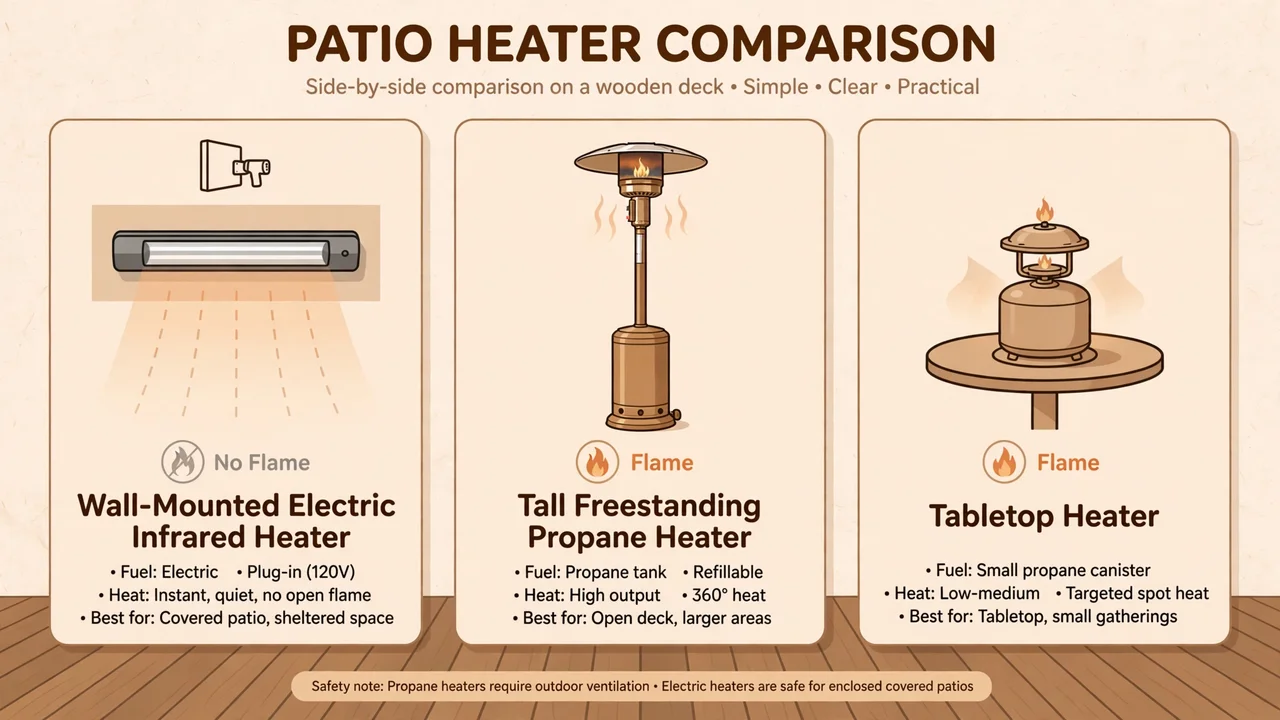
Three heater types show up on decks most often, and they carry different risks on wood. Electric infrared heaters warm people and objects with radiant heat and have no flame. Propane tower heaters burn gas under a reflector hood and give off strong heat in all directions. Natural gas heaters work like propane models but connect to a fixed gas line instead of a tank.
For a wood deck, electric heaters are the safest pick. They run cooler at the base, they cannot leak fuel, and many models have tip-over shutoff switches. Propane heaters are a close second when they have a wide, stable base and a heat shield. Tabletop propane heaters deserve extra care, because their small base can tip, and their burner sits closer to the deck surface.
The table below compares the three types on the points that matter most for a wood deck. Use it to match a heater to your deck, not to chase the highest heat output. A heater that is too strong for a small deck creates more risk than comfort. For a closer look at fuel trade-offs, see our guide to electric vs propane patio heaters.
| Heater type | Open flame | Deck fire risk | Needs on a wood deck |
|---|---|---|---|
| Electric infrared | No | Lowest | Weatherproof outdoor outlet, dry cord path |
| Propane tower | Yes | Medium | Heat shield or mat, 3 feet of clear space, stable base |
| Propane tabletop | Yes | Higher | Sturdy table, heat shield, never near rail edges |
| Natural gas | Yes | Medium | Licensed gas line install, heat shield, fixed position |
Risk ratings are general guidance for a typical wood deck. Your manual may set stricter rules for your model.
Measure Your Deck and Mark the Clear Zone
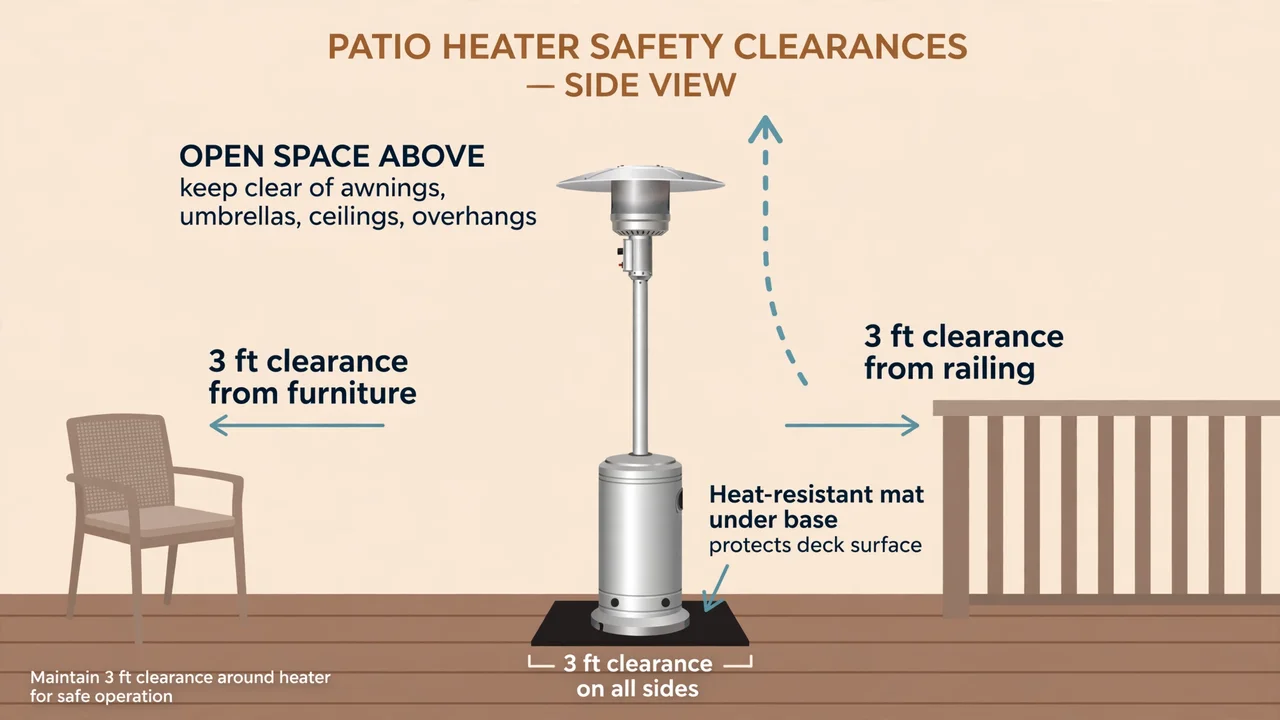
Clear space is the single best protection for a wood deck. Most patio heater manuals call for at least 3 feet of clear space on all sides of the heater, and 3 feet above it to any roof, pergola beam, or umbrella. Measure from the outer edge of the heater base, not from the center pole. Chairs, planters, cushions, and railings all count as things that must stay outside the zone.
Mark the zone with chalk or painter tape so everyone can see it. A 3-foot radius around the base covers about 28 square feet of deck floor. That is a circle a little wider than a dining table. If your deck cannot fit that circle plus seating, the heater belongs on a larger surface, or you need a smaller electric model with lower clearance needs.
Check the space above the heater as well. A tall tower heater under a low pergola can send heat straight into wood beams. Measure from the top of the reflector hood to the nearest beam or roof panel. If the gap is under 3 feet, move the heater to open sky. Our patio heater clearance guide walks through these measurements in more detail.
Set a Heat Shield or Mat Under the Heater
A heat shield or mat sits between the heater base and the deck boards. It spreads out the heat that drops from the burner and stops one hot spot from forming under the base. Look for a mat rated for patio heater use, made from fire-resistant material such as fiberglass or silicone-coated fabric. A thin yoga mat or a rug will not do the job, and some rugs can melt or catch fire.
Place the mat first, then set the heater base in the center of it. The mat should stick out at least 6 inches past the base on all sides. If the mat slides on smooth boards, tape the corners down with painter tape or place a heavy paver tile under the base as well. Check the mat after the first use. If it shows scorch marks, the heater is running too hot for that spot, and you need more clearance or a thicker shield.
Pro Tip: A Paver Tile Adds a Second Layer of Protection
A single large concrete or stone paver under the heater base, on top of the heat mat, spreads heat even further and gives the base a flat, solid seat. Choose a paver at least 18 inches square so the base sits fully on stone, not half on stone and half on wood.
Place the Heater on Flat, Stable Boards
Pick the flattest part of the deck for the heater. Warped boards, gaps, and slopes make a tall heater lean, and a leaning heater can tip in a gust of wind. Set the base down and press on the pole from each side. If the heater rocks, move it to another spot or shim the base with a flat paver tile until it stands still.
Keep the heater away from deck edges, stairs, and walkways. People brush past heaters in the dark, and a bump near a stair edge is worse than a bump in the middle of the deck. Leave a clear path behind chairs so no one has to squeeze past the hot reflector hood to reach the door. If your deck has a raised section, place the heater on the lower level where a fall would do less harm.
Connect Fuel or Power the Safe Way
For a propane heater, check the tank and hose before every use. Look for cracks in the hose, rust on the tank valve, and any smell of gas. Connect the tank with the heater off, then open the valve slowly and brush soapy water over the joints. Bubbles mean a leak. Turn the gas off at once and do not light the heater until the leak is fixed. Store spare tanks upright, outside, away from the deck and any heat source.
For an electric heater, plug it straight into a weatherproof outdoor outlet with a ground fault circuit interrupter. Never run the cord across a walkway, and never use an indoor extension cord outside. If the outlet is far from the heater spot, move the heater closer to the outlet instead of stretching a cord across the deck. A cord underfoot is a trip hazard, and a damaged cord near a hot heater is a fire hazard.
For a natural gas heater, only a licensed plumber should connect the gas line. Never adapt a propane heater to natural gas on your own. The parts and pressures differ, and a wrong conversion can leak gas. If you are weighing a switch, read our guide on converting a propane patio heater to natural gas before you decide.
Run a First Heat Check and Watch the Deck
Light the heater and let it run for 15 minutes on a low setting while you stay nearby. After 15 minutes, turn it off and feel the deck boards under and around the base with the back of your hand. The boards should feel warm at most. If they feel hot enough that you pull your hand away, the heater is too close to the wood, and you need more clearance or a thicker heat shield.
Look for scorch marks, dark patches, or a smell of hot wood. A faint warm wood smell on a first run can be normal for new boards, but a sharp smell or visible darkening means the heat is too strong. Move the heater, raise the shield, or switch to a lower setting. Repeat the 15-minute check each time you move the heater to a new spot on the deck.
Stay with the heater while it runs. Turn it off when you go inside, even for a short time. A heater left alone on a wood deck is the most common setup for a deck fire, and most deck fires start when no one is watching. For party nights, our guide to portable heater safety for parties covers how to keep guests warm without crowding the heater.
Deck Material: What Changes With the Boards You Have
Not all wood decks behave the same under heat. Pressure-treated pine is the most common deck wood, and it chars slowly, which gives you time to spot a problem. Cedar and redwood are softer and dry out faster, so they scorch more easily. Old, grey, weathered boards are the riskiest of all, because years of sun and rain dry the wood right through.
Composite decking looks like wood but is made from plastic and wood fiber. It can melt and warp under sustained heat, even when it never catches fire. Check the decking maker guide for heat limits before you place a fuel heater on composite boards. Painted or stained decks need care too. Some stains and sealers soften under heat, and a softened finish can stick to a heat mat or peel in a dark patch.
If you are unsure what your deck is made of, lift a board end or check the paperwork from the deck build. When in doubt, treat the deck as the most heat-sensitive type and use the full clearance, a heat mat, and a paver tile together.
What Not to Do on a Wood Deck
A few habits turn a safe setup into a risky one. Avoid all of these, even on a calm evening.
- Do not place a patio heater on a rug, a towel, or a thin mat that is not rated for heat.
- Do not run a fuel heater under a low roof, inside a screened porch, or in a garage.
- Do not hang laundry, towels, or decorations from the heater pole or reflector hood.
- Do not leave a lit heater running while you sleep or leave the house.
- Do not let children play near the heater or climb on the deck rail beside it.
- Do not store a propane tank on the deck, under the deck, or beside the house wall.
- Do not use a damaged hose, a rusted tank, or a heater with a cracked reflector.
- Do not cover a hot heater with a cover until it has cooled down fully.
If you ever find scorch marks on the deck, stop using the heater in that spot until you find the cause. A scorched board is a warning, not a cosmetic mark. Sanding the mark away without fixing the heat problem leaves the risk in place.
Common Mistakes on a Wood Deck
- Skipping the heat mat. The base of a tall heater gets hot enough to mark boards over a long evening. A mat costs little and stops the damage.
- Measuring clearance from the pole, not the base. The base is wider than the pole. Measure from the base edge, or your clear zone ends up too small.
- Forgetting the space above. Heat rises. A pergola beam or umbrella above the heater needs the same 3 feet of space as the sides.
- Running the heater on high all night. High heat for hours dries out the boards under the heater. Low or medium heat is often warm enough once guests gather.
- Leaving the heater out in wind. Wind pushes heat sideways and can tip a tall heater. Bring the heater inside or lay it down safely when the wind picks up.
Frequently Asked Questions
Can I put a propane patio heater on a wood deck?
Yes, you can, if the heater has a stable base, at least 3 feet of clear space on all sides, and a heat shield or mat under the base. Stay with the heater while it runs and turn it off when you go inside.
Is an electric patio heater safer than propane on a wood deck?
Yes. Electric heaters have no open flame and no fuel tank, so they carry less fire risk on wood. They still need clear space around the heating element and a dry, safe power connection.
Do I need a heat mat under a patio heater on a wood deck?
A heat mat is strongly advised for any fuel-burning heater on wood. It spreads heat from the base and stops scorch marks. Add a paver tile under the base for a second layer of protection.
How far should a patio heater be from a deck railing?
Most manuals call for at least 3 feet of clear space between the heater and any railing, wall, or furniture. Check your manual first, because some models need more.
What should I do if my deck gets scorched under the heater?
Turn the heater off and let it cool. Move the heater to a new spot with more clearance and a thicker heat shield. If the scorch is deep or the board feels soft, have a deck professional check the board before you use the heater there again.
Quick Reference Card: Patio Heater on a Wood Deck
What you need: Heater and manual, tape measure, heat mat, paver tile, fire extinguisher, heat-proof gloves.
Clear space: At least 3 feet on all sides and above the heater. Mark the zone with chalk or tape.
Steps: 1. Read the manual and check local fire rules. 2. Pick the heater type that fits a wood deck. 3. Measure and mark the clear zone. 4. Set a heat shield or mat. 5. Place the heater on flat, stable boards. 6. Connect fuel or power safely. 7. Run a 15-minute heat check.
Remember: Never leave a lit heater alone on a wood deck. Turn it off when you go inside.
Warm Decks, Safe Evenings
You now have a full plan for using a patio heater on a wood deck. Check the manual, pick the right heater type, mark your clear zone, set a heat mat, and run a short heat check before guests arrive. Those five habits keep the deck safe and the evening warm.
Keep the heater manual and a fire extinguisher near the deck all season, and re-check the boards under the heater every few weeks. A deck that stays cool under the base is a deck you can enjoy for years. If you want help picking the right model first, read our guide on how to use a patio heater, and keep up with routine care in our guide on how to clean a patio heater.